Week of 14 to 18 Sept 2026
Regulation as a design material: when the rules become part of the product
1 / 9 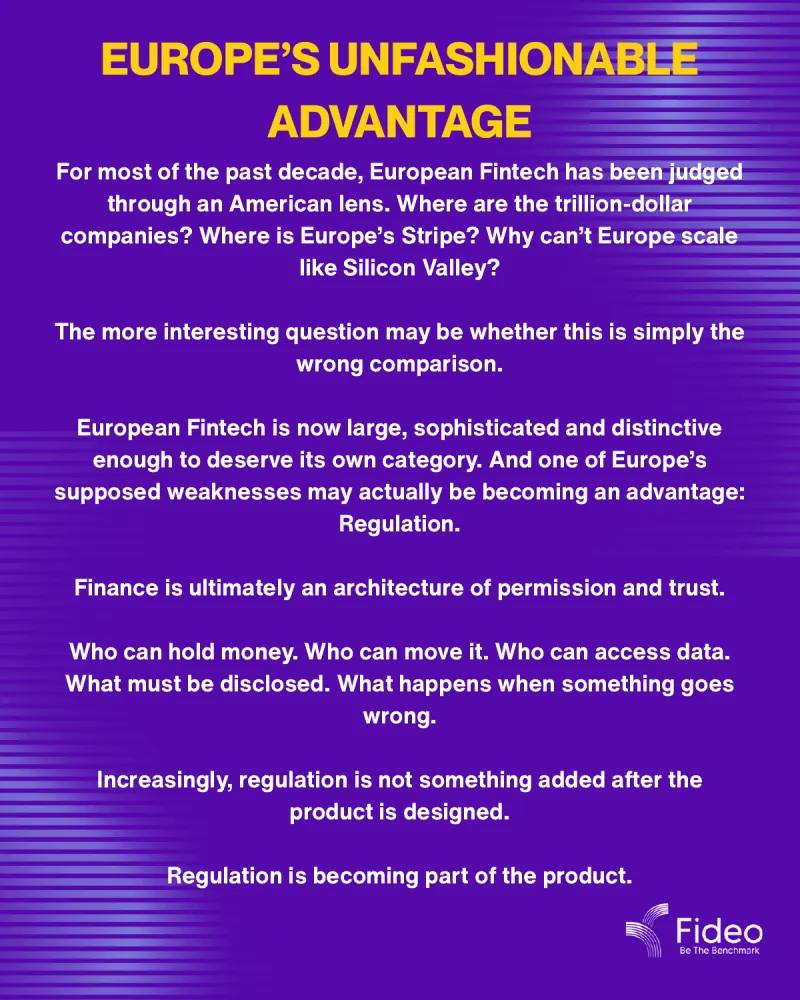
2 / 9 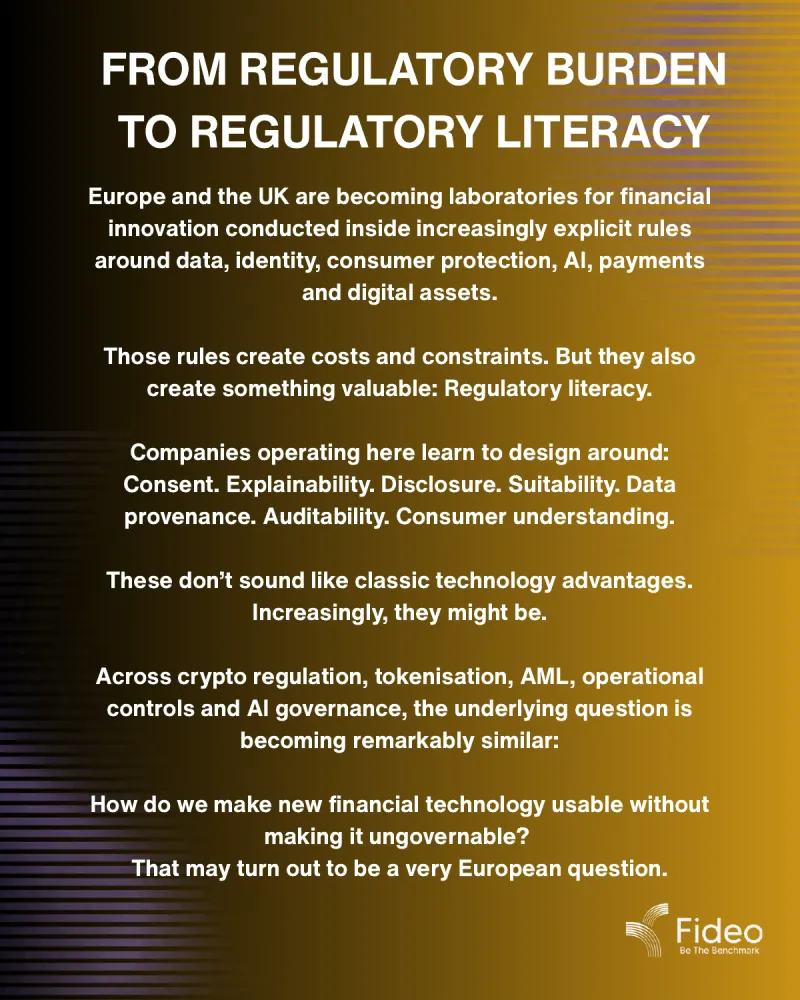
3 / 9 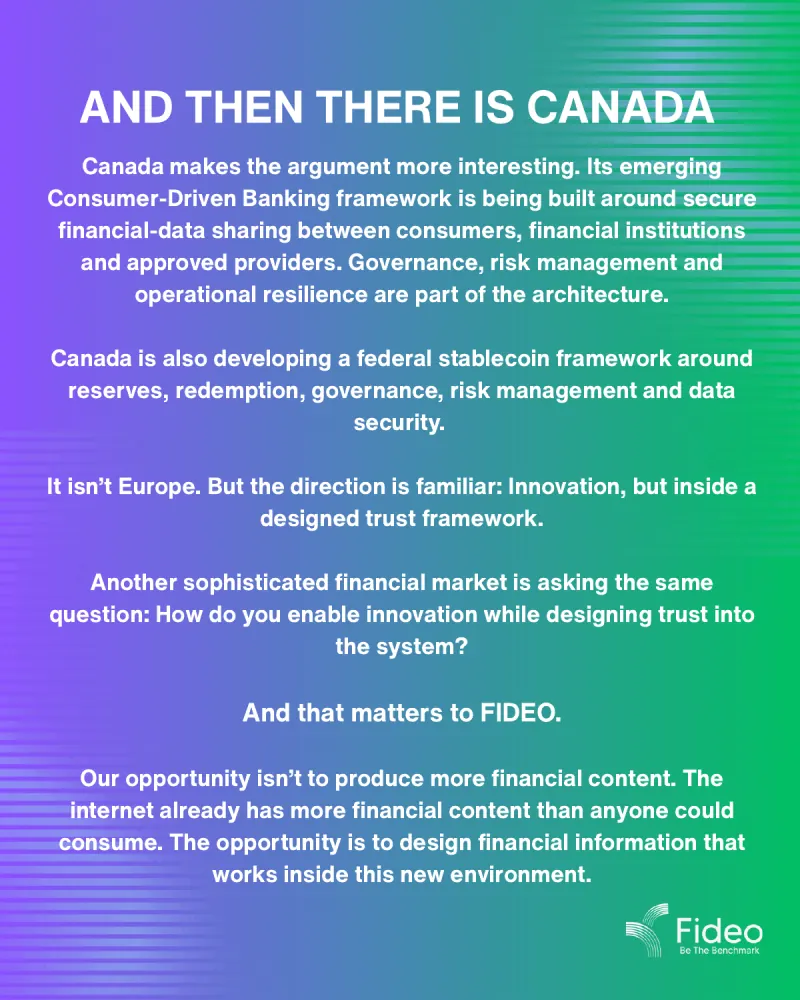
4 / 9 
5 / 9 
6 / 9 
7 / 9 
8 / 9 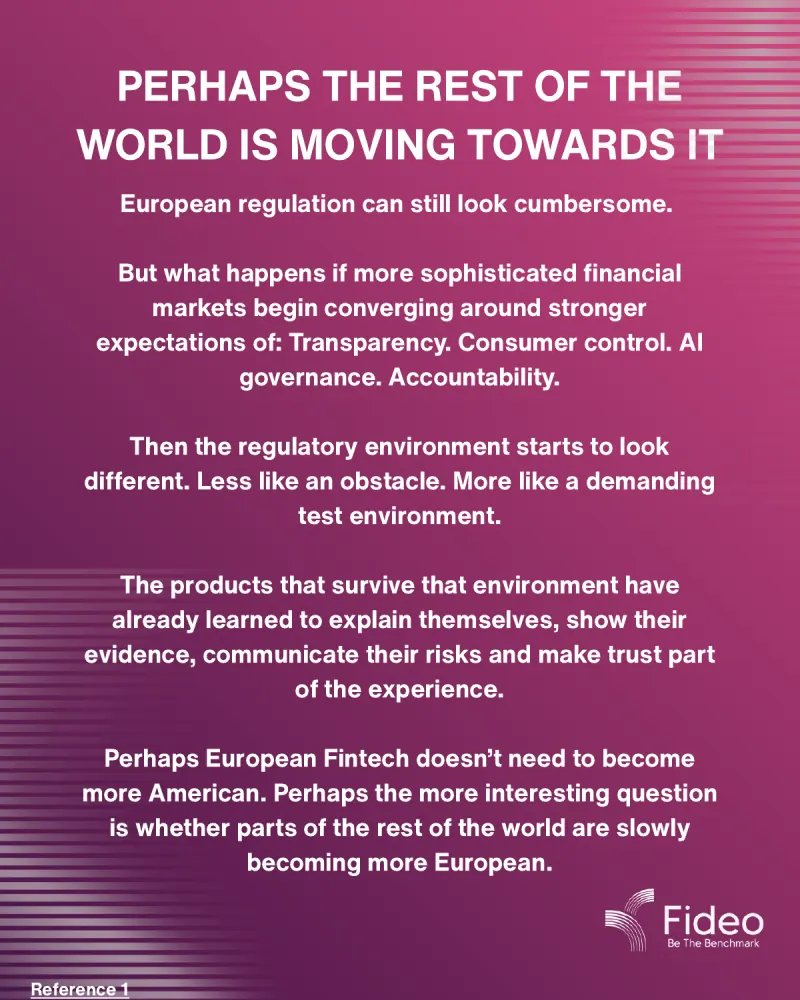
9 / 9
This week in 60 seconds
Why Europe's regulatory literacy may be an export advantage for fintech and financial content
- Judging European fintech through an American lens, asking where Europe's Stripe is, may simply be the wrong comparison.
- Europe's rules on data, identity, AI, payments and digital assets build regulatory literacy: designing around consent, explainability, disclosure and auditability.
- Canada's Consumer-Driven Banking framework and planned federal stablecoin framework point the same way: innovation inside a designed trust framework.
- Financial content in regulated markets needs comprehension without distortion, clear provenance and, with AI, a way to reconstruct how information was produced.
- Standards scale internationally as platforms do, so Europe's rulebook on privacy, financial data and AI governance may become its export product.
Try this with your team
Take one financial product page and redesign it with regulation as a design material: build provenance, explanation, permissions, risk communication and an audit trail in from the start, put risk information before the decision point, and test it against the question of what the customer could reasonably have understood, not just what they clicked.
Read this edition as text (5 min)
EUROPE’S UNFASHIONABLE ADVANTAGE
For most of the past decade, European Fintech has been judged through an American lens. Where are the trillion-dollar companies? Where is Europe’s Stripe? Why can’t Europe scale like Silicon Valley?
The more interesting question may be whether this is simply the wrong comparison.
European Fintech is now large, sophisticated and distinctive enough to deserve its own category. And one of Europe’s supposed weaknesses may actually be becoming an advantage: Regulation.
Finance is ultimately an architecture of permission and trust.
Who can hold money. Who can move it. Who can access data. What must be disclosed. What happens when something goes wrong.
Increasingly, regulation is not something added after the product is designed.
Regulation is becoming part of the product.
FROM REGULATORY BURDEN TO REGULATORY LITERACY
Europe and the UK are becoming laboratories for financial innovation conducted inside increasingly explicit rules around data, identity, consumer protection, AI, payments and digital assets.
Those rules create costs and constraints. But they also create something valuable: Regulatory literacy.
Companies operating here learn to design around: Consent. Explainability. Disclosure. Suitability. Data provenance. Auditability. Consumer understanding.
These don’t sound like classic technology advantages. Increasingly, they might be.
Across crypto regulation, tokenisation, AML, operational controls and AI governance, the underlying question is becoming remarkably similar:
How do we make new financial technology usable without making it ungovernable? That may turn out to be a very European question.
AND THEN THERE IS CANADA
Canada makes the argument more interesting. Its emerging Consumer-Driven Banking framework is being built around secure financial-data sharing between consumers, financial institutions and approved providers. Governance, risk management and operational resilience are part of the architecture.
Canada is also developing a federal stablecoin framework around reserves, redemption, governance, risk management and data security.
It isn’t Europe. But the direction is familiar: Innovation, but inside a designed trust framework.
Another sophisticated financial market is asking the same question: How do you enable innovation while designing trust into the system?
And that matters to FIDEO.
Our opportunity isn’t to produce more financial content. The internet already has more financial content than anyone could consume. The opportunity is to design financial information that works inside this new environment.
CONTENT AS REGULATED INFRASTRUCTURE
The traditional content model optimises for attention. Find the hook. Reduce friction. Increase engagement. Drive conversion.
Those instincts aren’t wrong. But regulated financial environments introduce another design objective: Comprehension without distortion.
Open banking, tokenisation, embedded finance and AI are making financial experiences more sophisticated.
Somebody still has to explain what is happening. Clearly. Accurately. Without hiding the risk. Without confusing information with recommendation.
And increasingly: Where did this claim, number or conclusion come from?
With AI, that may also mean being able to reconstruct how information was produced. That isn’t simply copywriting. It is information architecture for trust.
THE FIDEO DESIGN OPPORTUNITY
We shouldn’t think of regulation as a compliance layer applied after the creative work is finished. We should treat the regulatory environment as a design material.
The same way a product designer thinks about accessibility or latency, financial-content designers increasingly need to think about: Evidence. Permissions. Disclosures. Jurisdiction. Suitability. Auditability.
That can produce better experiences, not merely safer ones.
A disclosure doesn’t have to be six paragraphs of legal language. Risk information doesn’t have to arrive after someone has made the decision. Compliance doesn’t have to mean a disclaimer at the bottom of a page.
Good design can make the rules intelligible. And good content can make regulated financial products feel simpler because their complexity has been properly designed.
EUROPE’S EXPORT PRODUCT MAY BE THE RULEBOOK
Europe spends a lot of time worrying that it hasn’t produced enough global technology platforms. But platforms aren’t the only things that scale internationally. Standards scale too.
Privacy regulation demonstrated that. Financial-data frameworks may do the same. AI governance could follow.
And Canada’s direction of travel suggests the addressable world for products designed around stronger expectations of transparency, consumer control and accountability may be getting larger.
That creates an interesting possibility for European Fintech — and for FIDEO.
Instead of building financial experiences somewhere else and adapting them to European regulation afterwards:
Start here.
DESIGN TRUST IN FROM THE START
Design the provenance in. Design the explanation in. Design the permissions in. Design the risk communication in. Design the audit trail in.
And design for the moment when the question isn’t simply: What did the customer click?
But: What could the customer reasonably have understood?
That is a different standard for financial experience design. The American internet taught us to design for engagement. Europe has been forcing companies to learn how to design for trust.
The next generation of financial experiences will need both.
And products designed around that combination may travel well beyond Europe.
PERHAPS THE REST OF THE WORLD IS MOVING TOWARDS IT
European regulation can still look cumbersome.
But what happens if more sophisticated financial markets begin converging around stronger expectations of: Transparency. Consumer control. AI governance. Accountability.
Then the regulatory environment starts to look different. Less like an obstacle. More like a demanding test environment.
The products that survive that environment have already learned to explain themselves, show their evidence, communicate their risks and make trust part of the experience.
Perhaps European Fintech doesn’t need to become more American. Perhaps the more interesting question is whether parts of the rest of the world are slowly becoming more European.
Sources
- middlegamevc.commiddlegamevc.com/articles/european-fintech-deserves-its-own-line-item/
More questions about this edition
Does treating regulation as a design material only make products safer?
No. The edition argues it can produce better experiences, not merely safer ones. Disclosures need not be six paragraphs of legal language, and good design can make the rules intelligible and complex products feel simpler.
What does this mean for Fideo itself?
Fideo sees its opportunity not in producing more financial content but in designing financial information that works inside this regulated environment, treating content as information architecture for trust.
Why might the rest of the world become more European?
If sophisticated markets converge on transparency, consumer control, AI governance and accountability, European regulation looks less like an obstacle and more like a demanding test environment whose surviving products already explain themselves.
Get the Zeitgeist every Friday
One email a week with the new edition. Unsubscribe in one click.
Check your inbox to confirm your subscription.
Please enter a valid email address and try again.