Week of 7 to 11 Sept 2026
The apprenticeship paradox: when AI automates the work that builds experts
1 / 9 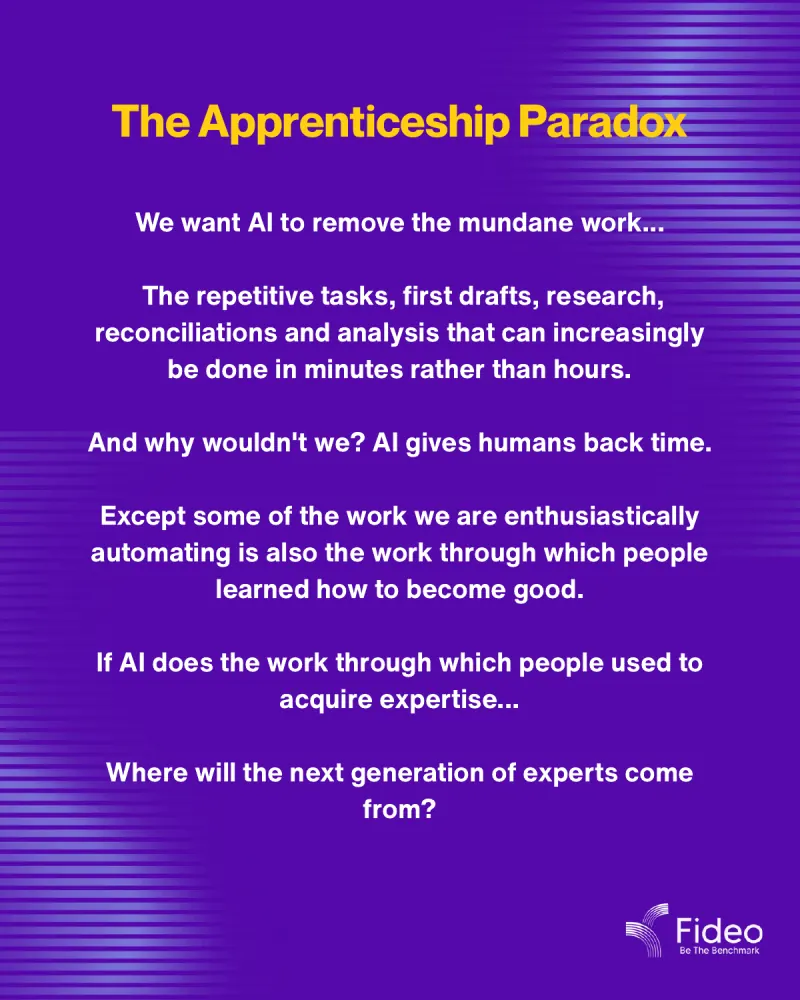
2 / 9 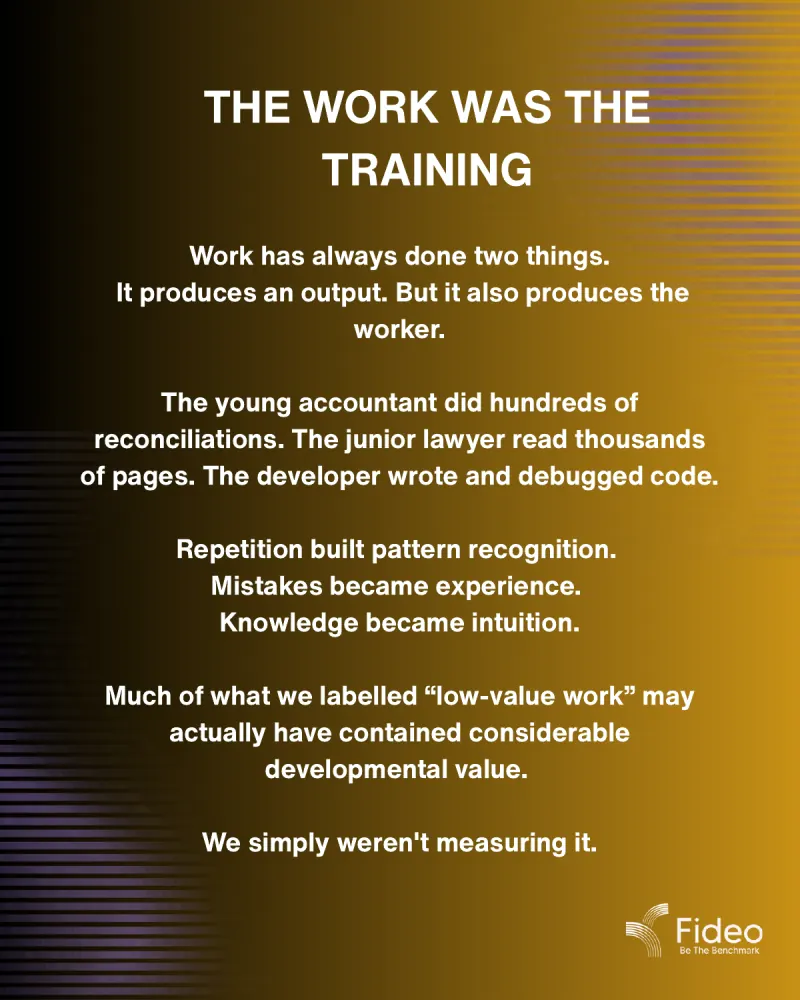
3 / 9 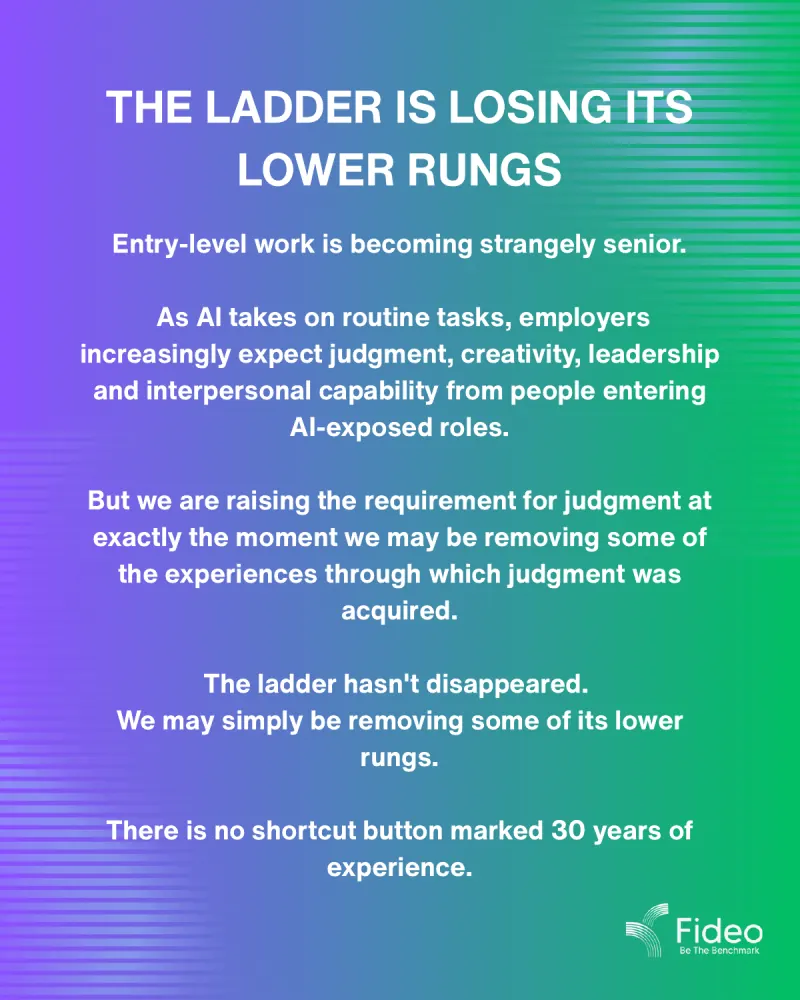
4 / 9 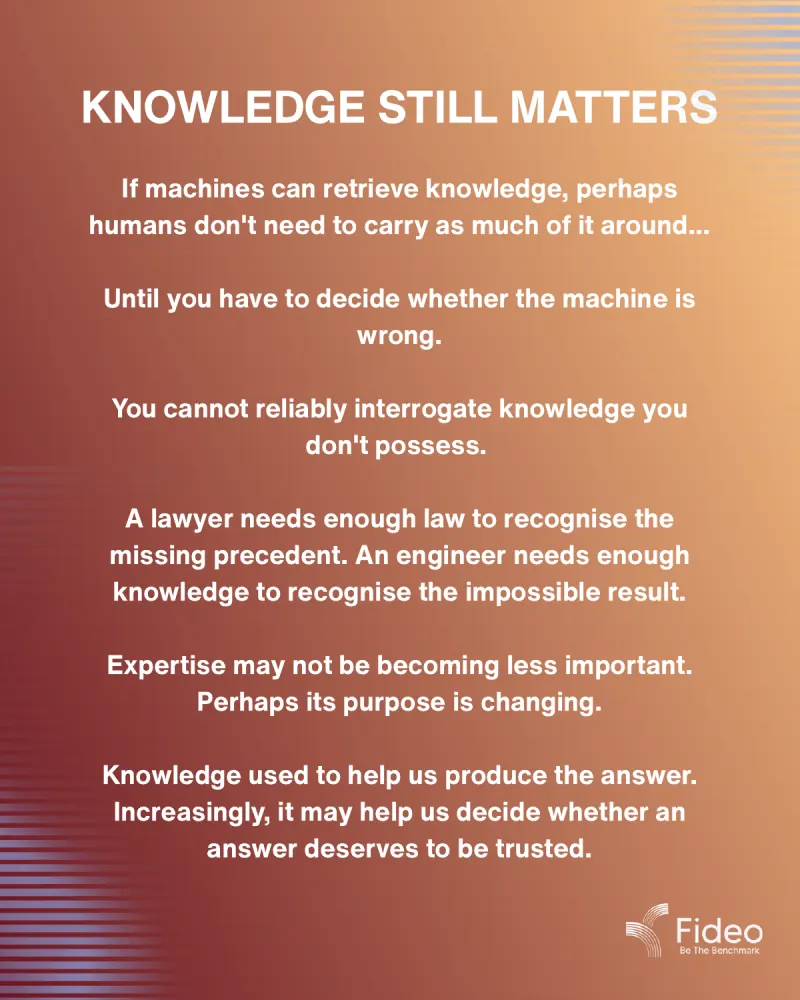
5 / 9 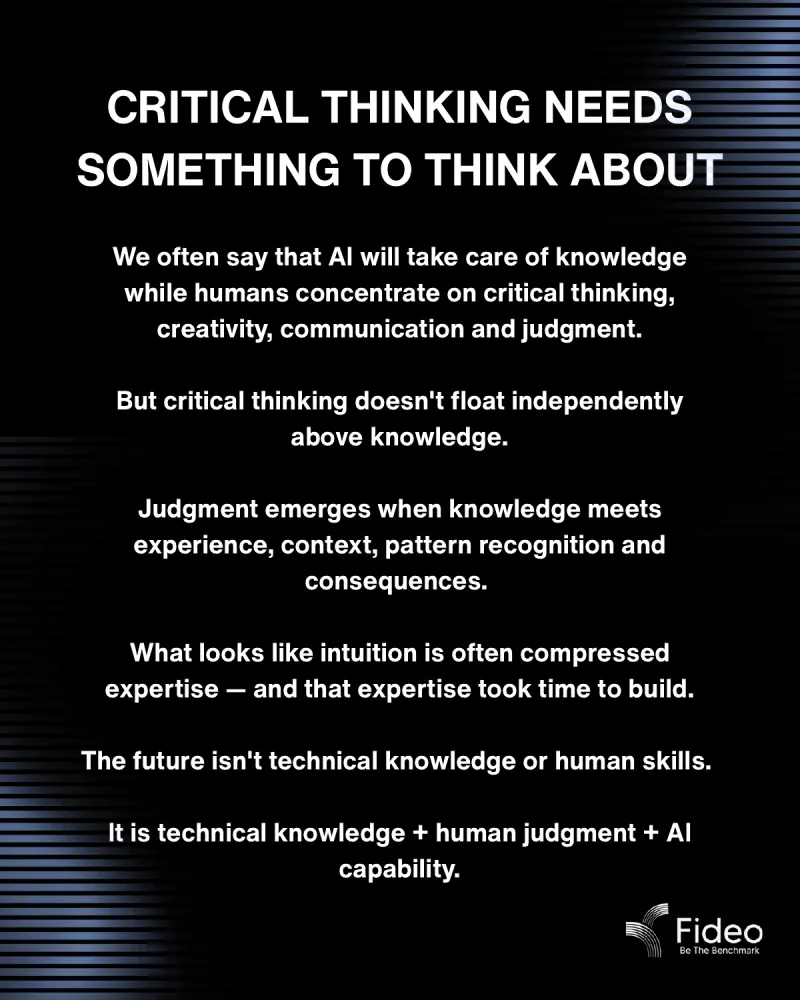
6 / 9 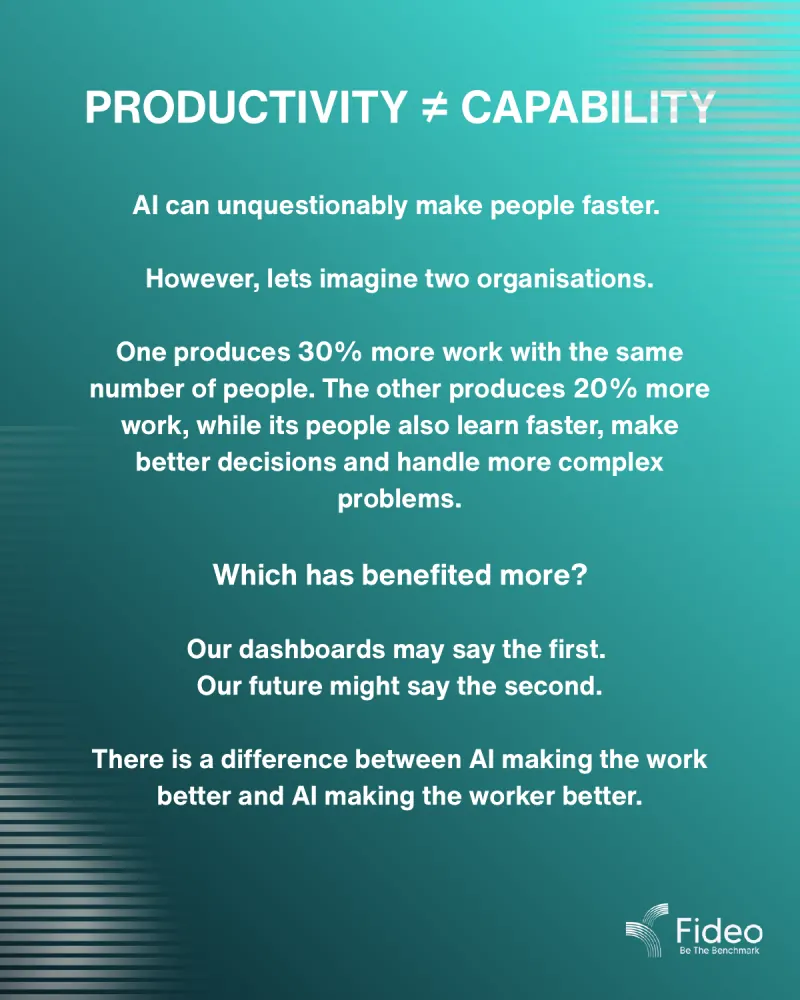
7 / 9 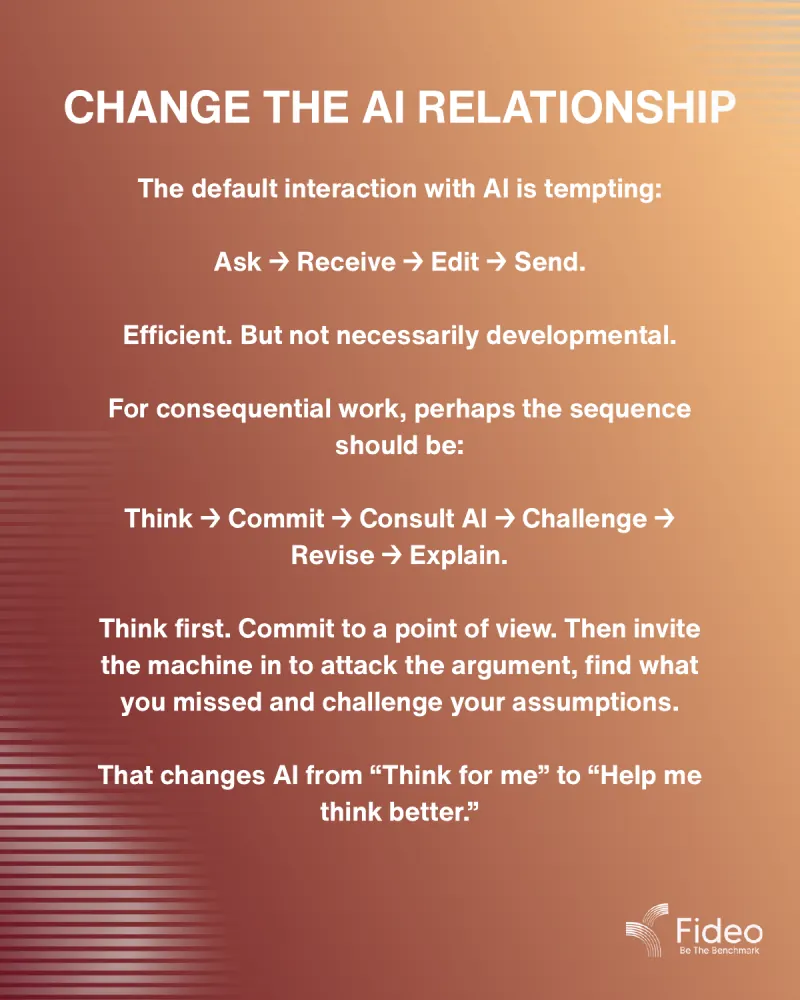
8 / 9 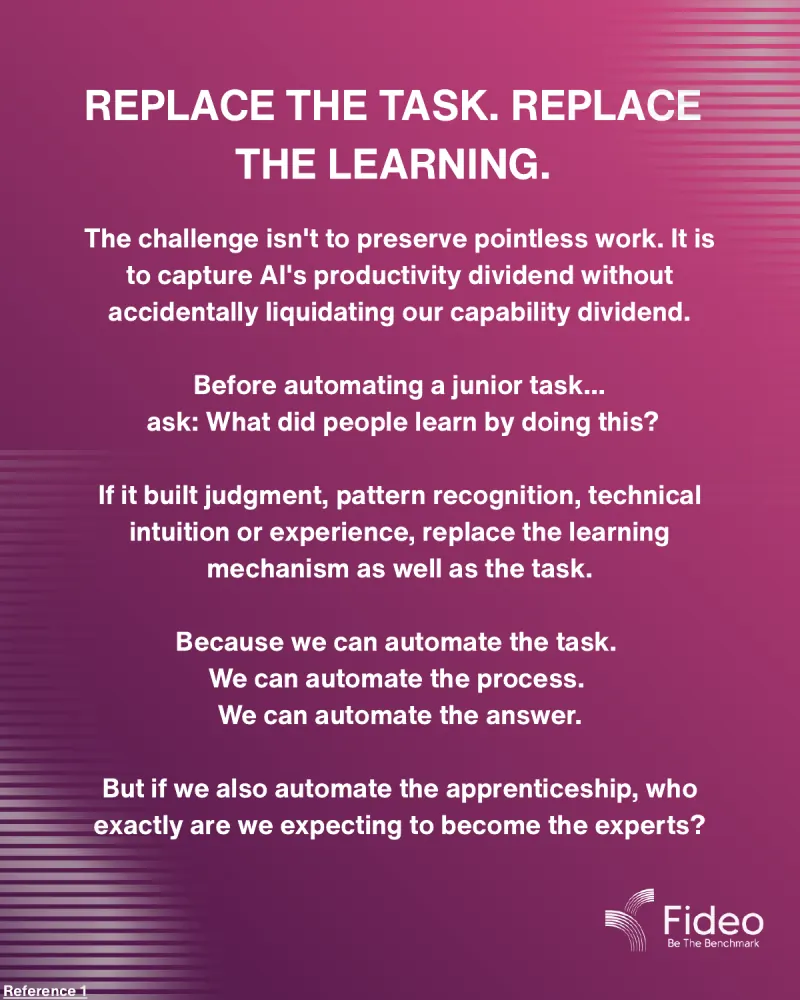
9 / 9
This week in 60 seconds
If AI does the junior work through which people learned, where will the next generation of experts come from?
- Work produces an output and also produces the worker; repetition built pattern recognition and mistakes became experience.
- Entry-level roles now demand judgment just as AI removes some of the experiences through which judgment was acquired.
- Knowledge still matters: you cannot reliably interrogate an AI answer without the knowledge to spot when it is wrong.
- Productivity is not capability; dashboards may favour raw output while the future rewards people who learn faster and decide better.
- For consequential work, shift AI from 'think for me' to 'help me think better' by thinking and committing before consulting it.
Try this with your team
Before automating any junior task, ask what people learned by doing it. If it built judgment, pattern recognition, technical intuition or experience, design a replacement learning mechanism alongside the automation.
Read this edition as text (4 min)
The Apprenticeship Paradox
We want AI to remove the mundane work...
The repetitive tasks, first drafts, research, reconciliations and analysis that can increasingly be done in minutes rather than hours.
And why wouldn't we? AI gives humans back time.
Except some of the work we are enthusiastically automating is also the work through which people learned how to become good.
If AI does the work through which people used to acquire expertise...
Where will the next generation of experts come from?
THE WORK WAS THE TRAINING
Work has always done two things. It produces an output. But it also produces the worker.
The young accountant did hundreds of reconciliations. The junior lawyer read thousands of pages. The developer wrote and debugged code.
Repetition built pattern recognition. Mistakes became experience. Knowledge became intuition.
Much of what we labelled “low-value work” may actually have contained considerable developmental value.
We simply weren't measuring it.
THE LADDER IS LOSING ITS LOWER RUNGS
Entry-level work is becoming strangely senior.
As AI takes on routine tasks, employers increasingly expect judgment, creativity, leadership and interpersonal capability from people entering AI-exposed roles.
But we are raising the requirement for judgment at exactly the moment we may be removing some of the experiences through which judgment was acquired.
The ladder hasn't disappeared. We may simply be removing some of its lower rungs.
There is no shortcut button marked 30 years of experience.
KNOWLEDGE STILL MATTERS
If machines can retrieve knowledge, perhaps humans don't need to carry as much of it around...
Until you have to decide whether the machine is wrong.
You cannot reliably interrogate knowledge you don't possess.
A lawyer needs enough law to recognise the missing precedent. An engineer needs enough knowledge to recognise the impossible result.
Expertise may not be becoming less important. Perhaps its purpose is changing.
Knowledge used to help us produce the answer. Increasingly, it may help us decide whether an answer deserves to be trusted.
CRITICAL THINKING NEEDS SOMETHING TO THINK ABOUT
We often say that AI will take care of knowledge while humans concentrate on critical thinking, creativity, communication and judgment.
But critical thinking doesn't float independently above knowledge.
Judgment emerges when knowledge meets experience, context, pattern recognition and consequences.
What looks like intuition is often compressed expertise — and that expertise took time to build.
The future isn't technical knowledge or human skills.
It is technical knowledge + human judgment + AI capability.
PRODUCTIVITY ≠ CAPABILITY
AI can unquestionably make people faster.
However, lets imagine two organisations.
One produces 30% more work with the same number of people. The other produces 20% more work, while its people also learn faster, make better decisions and handle more complex problems.
Which has benefited more?
Our dashboards may say the first. Our future might say the second.
There is a difference between AI making the work better and AI making the worker better.
CHANGE THE AI RELATIONSHIP
The default interaction with AI is tempting:
Ask → Receive → Edit → Send.
Efficient. But not necessarily developmental.
For consequential work, perhaps the sequence should be:
Think → Commit → Consult AI → Challenge → Revise → Explain.
Think first. Commit to a point of view. Then invite the machine in to attack the argument, find what you missed and challenge your assumptions.
That changes AI from “Think for me” to “Help me think better.”
REPLACE THE TASK. REPLACE THE LEARNING.
The challenge isn't to preserve pointless work. It is to capture AI's productivity dividend without accidentally liquidating our capability dividend.
Before automating a junior task... ask: What did people learn by doing this?
If it built judgment, pattern recognition, technical intuition or experience, replace the learning mechanism as well as the task.
Because we can automate the task. We can automate the process. We can automate the answer.
But if we also automate the apprenticeship, who exactly are we expecting to become the experts?
Sources
- LinkedInlinkedin.com/pulse/letter-from-accounting-teacher-2045-stephen-coetzee-4clof/
More questions about this edition
What sequence does the edition suggest for using AI on consequential work?
Think, commit, consult AI, challenge, revise, explain. Form and commit to a point of view first, then invite AI to attack the argument, find what you missed and challenge your assumptions.
Does the edition argue for preserving routine work?
No. It says the challenge is not to preserve pointless work but to capture AI's productivity dividend without accidentally liquidating the capability dividend.
How does the edition illustrate productivity versus capability?
It imagines one organisation producing 30% more work with the same people, and another producing 20% more while its people learn faster, decide better and handle more complex problems.
Get the Zeitgeist every Friday
One email a week with the new edition. Unsubscribe in one click.
Check your inbox to confirm your subscription.
Please enter a valid email address and try again.