Week of 13 to 17 Apr 2026
When AI adoption outpaces understanding: the literacy gap
1 / 7 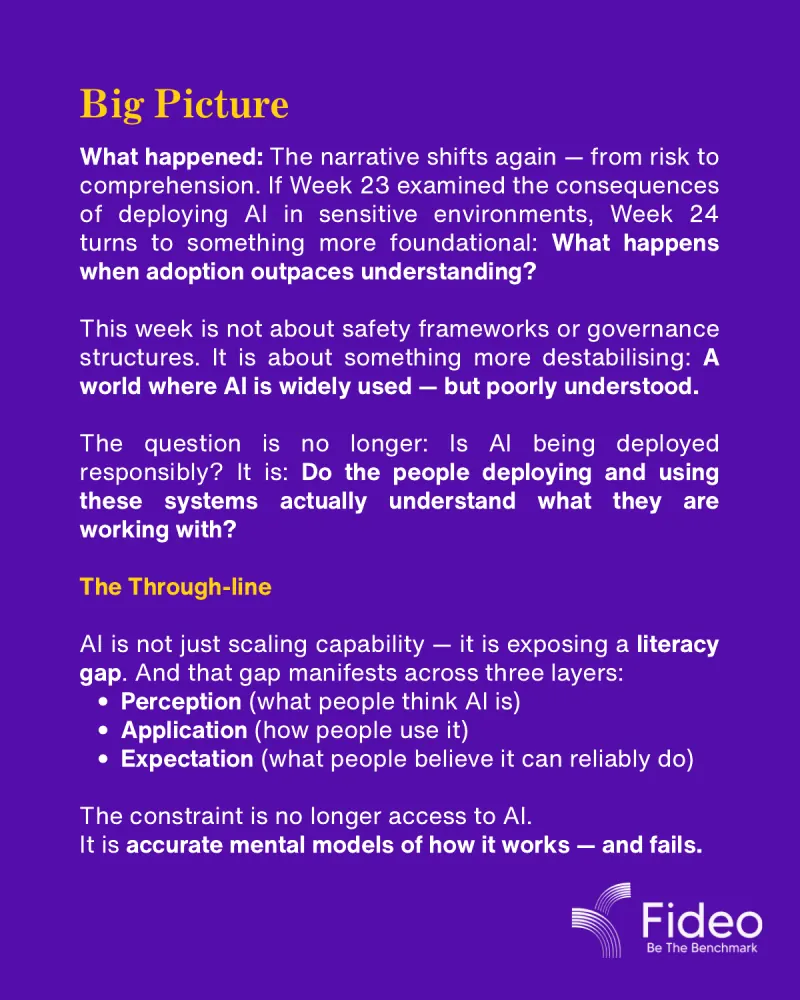
2 / 7 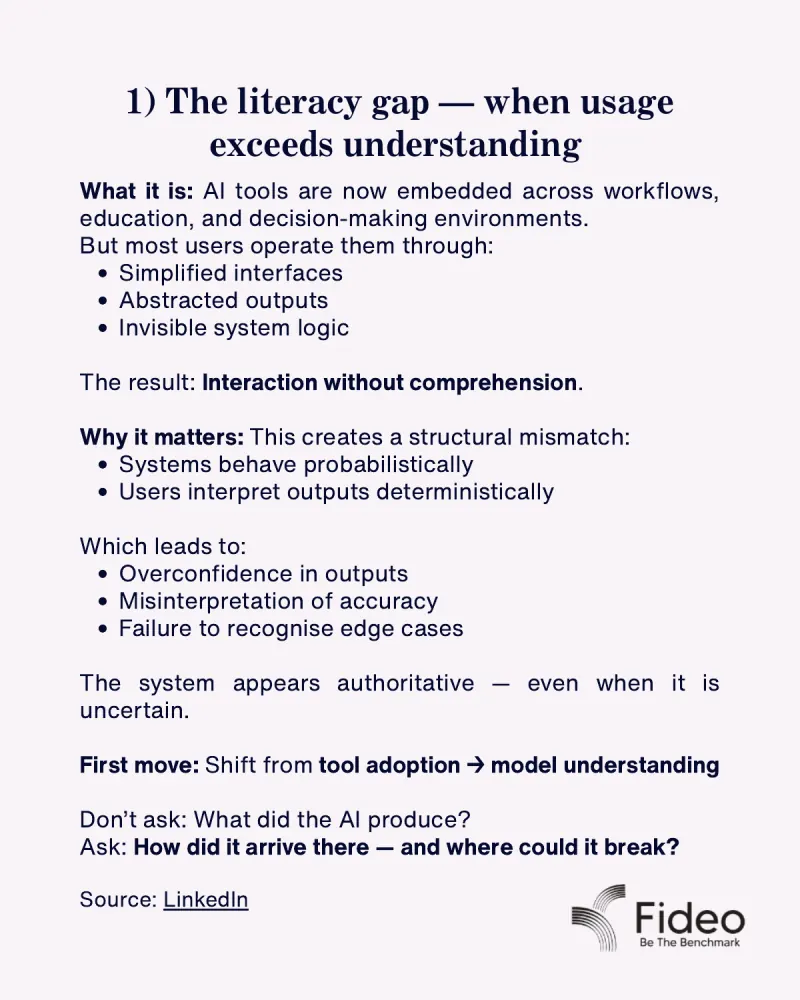
3 / 7 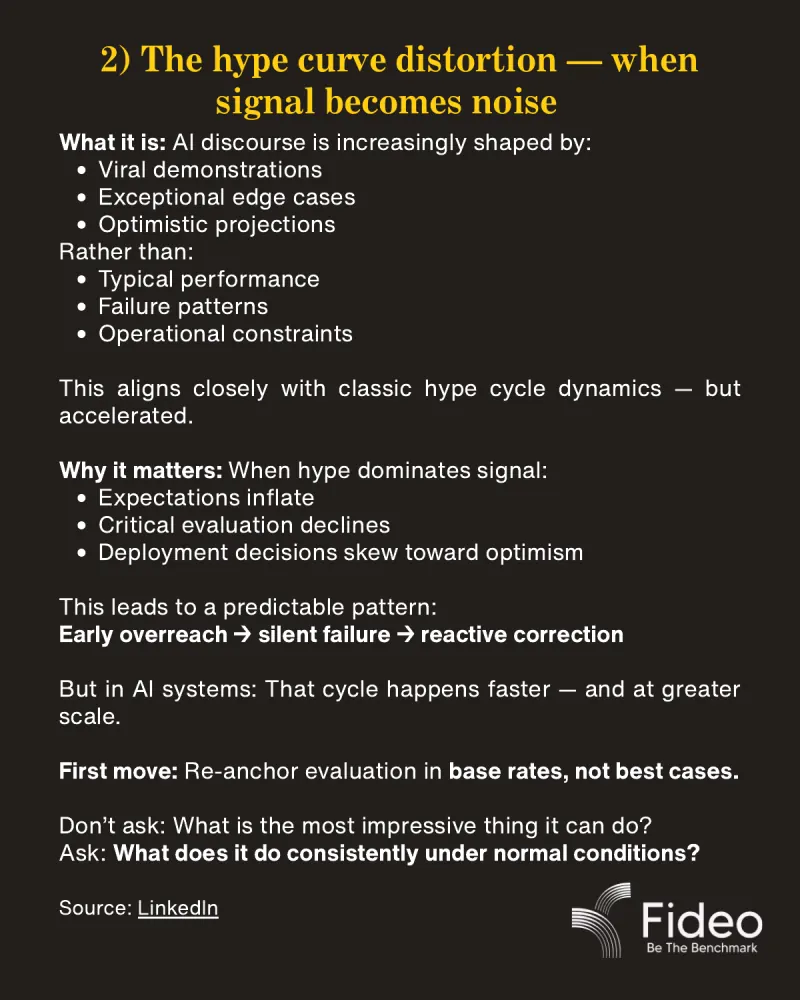
4 / 7 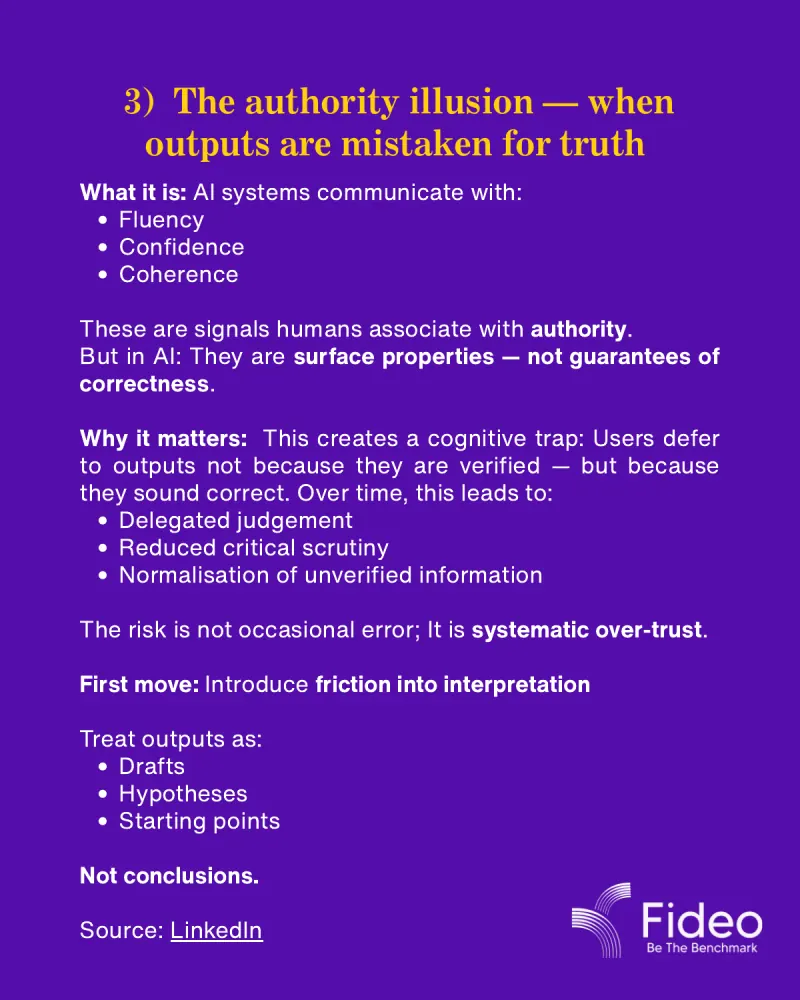
5 / 7 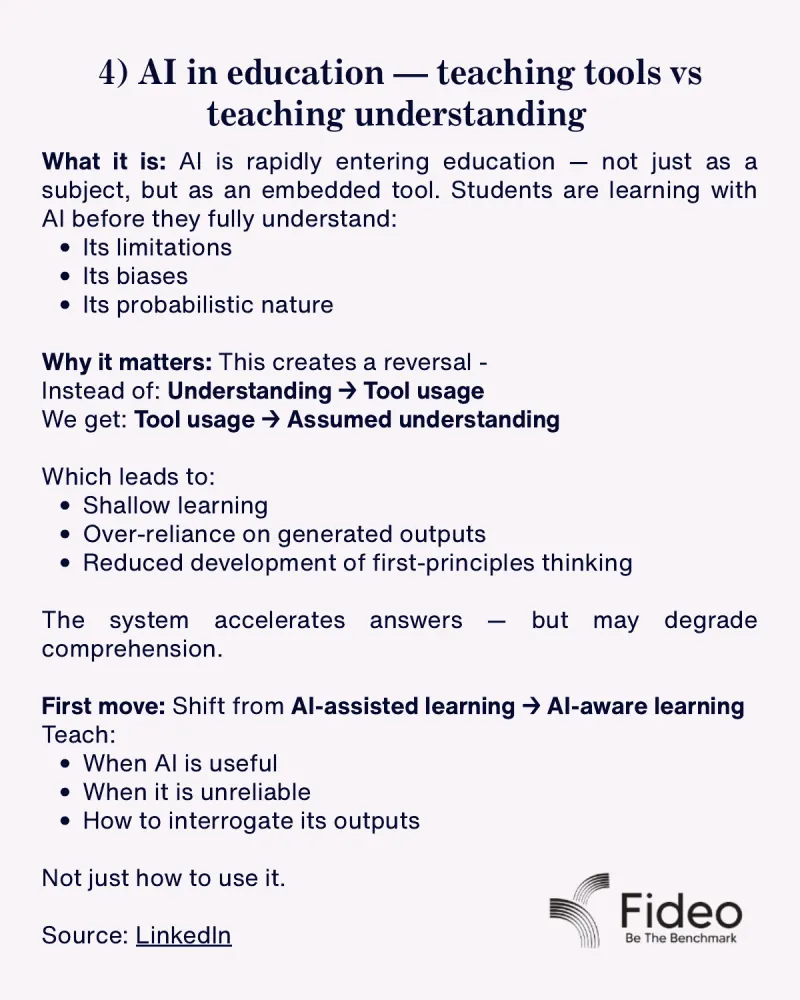
6 / 7 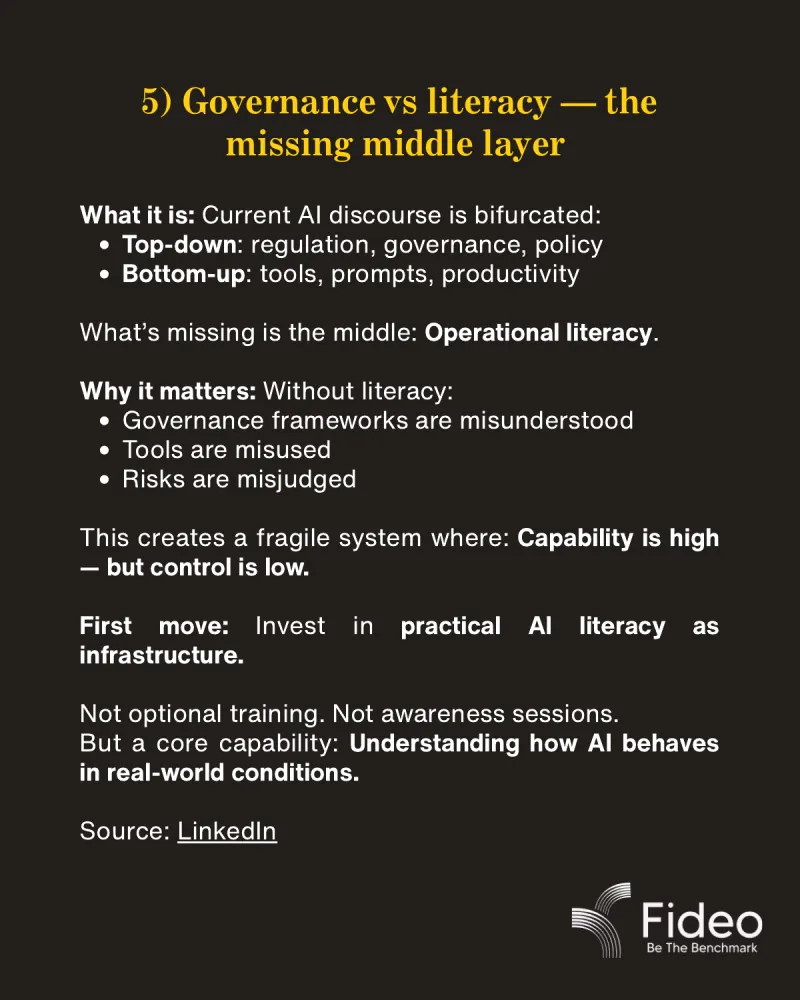
7 / 7
This week in 60 seconds
Week 24 shifts from risk to comprehension across perception, application and expectation
- The constraint is no longer access to AI but accurate mental models of how it works and fails.
- Systems behave probabilistically while users read outputs deterministically, leading to overconfidence and missed edge cases.
- Fluency, confidence and coherence are surface properties, not guarantees of correctness; the risk is systematic over-trust.
- In education, tool usage is coming before understanding, which risks shallow learning and weaker first-principles thinking.
- Between top-down governance and bottom-up tools sits a missing middle layer: operational literacy, to be treated as infrastructure.
Try this with your team
Review one AI tool your team relies on by asking what it does consistently under normal conditions, not its most impressive demo. Then treat its outputs as drafts or hypotheses and ask how each was reached and where it could break.
Read this edition as text (4 min)
Big Picture
What happened: The narrative shifts again — from risk to comprehension. If Week 23 examined the consequences of deploying AI in sensitive environments, Week 24 turns to something more foundational: What happens when adoption outpaces understanding?
This week is not about safety frameworks or governance structures. It is about something more destabilising: A world where AI is widely used — but poorly understood.
The question is no longer: Is AI being deployed responsibly? It is: Do the people deploying and using these systems actually understand what they are working with?
The Through-line
AI is not just scaling capability — it is exposing a literacy gap . And that gap manifests across three layers: Perception (what people think AI is) Application (how people use it) Expectation (what people believe it can reliably do)
The constraint is no longer access to AI. It is accurate mental models of how it works — and fails.
1) The literacy gap — when usage exceeds understanding What it is: AI tools are now embedded across workflows, education, and decision-making environments. But most users operate them through: Simplified interfaces Abstracted outputs Invisible system logic
The result: Interaction without comprehension .
Why it matters: This creates a structural mismatch: Systems behave probabilistically Users interpret outputs deterministically
Which leads to: Overconfidence in outputs Misinterpretation of accuracy Failure to recognise edge cases
The system appears authoritative — even when it is uncertain.
First move: Shift from tool adoption → model understanding
Don’t ask: What did the AI produce? Ask: How did it arrive there — and where could it break?
Source: LinkedIn
2) The hype curve distortion — when signal becomes noise What it is: AI discourse is increasingly shaped by: Viral demonstrations Exceptional edge cases Optimistic projections Rather than: Typical performance Failure patterns Operational constraints
This aligns closely with classic hype cycle dynamics — but accelerated.
Why it matters: When hype dominates signal: Expectations inflate Critical evaluation declines Deployment decisions skew toward optimism
This leads to a predictable pattern: Early overreach → silent failure → reactive correction
But in AI systems: That cycle happens faster — and at greater scale.
First move: Re-anchor evaluation in base rates, not best cases.
Don’t ask: What is the most impressive thing it can do? Ask: What does it do consistently under normal conditions?
Source: LinkedIn
3) The authority illusion — when outputs are mistaken for truth What it is: AI systems communicate with: Fluency Confidence Coherence
These are signals humans associate with authority . But in AI: They are surface properties — not guarantees of correctness .
Why it matters: This creates a cognitive trap: Users defer to outputs not because they are verified — but because they sound correct. Over time, this leads to: Delegated judgement Reduced critical scrutiny Normalisation of unverified information
The risk is not occasional error; It is systematic over-trust .
First move: Introduce friction into interpretation
Treat outputs as: Drafts Hypotheses Starting points
Not conclusions.
Source: LinkedIn
4) AI in education — teaching tools vs teaching understanding What it is: AI is rapidly entering education — not just as a subject, but as an embedded tool. Students are learning with AI before they fully understand: Its limitations Its biases Its probabilistic nature
Why it matters: This creates a reversal - Instead of: Understanding → Tool usage We get: Tool usage → Assumed understanding
Which leads to: Shallow learning Over-reliance on generated outputs Reduced development of first-principles thinking
The system accelerates answers — but may degrade comprehension.
First move: Shift from AI-assisted learning → AI-aware learning Teach: When AI is useful When it is unreliable How to interrogate its outputs
Not just how to use it.
Source: LinkedIn
5) Governance vs literacy — the missing middle layer
What it is: Current AI discourse is bifurcated: Top-down : regulation, governance, policy Bottom-up : tools, prompts, productivity
What’s missing is the middle: Operational literacy .
Why it matters: Without literacy: Governance frameworks are misunderstood Tools are misused Risks are misjudged
This creates a fragile system where: Capability is high — but control is low.
First move: Invest in practical AI literacy as infrastructure.
Not optional training. Not awareness sessions. But a core capability: Understanding how AI behaves in real-world conditions.
Source: LinkedIn
Sources
- LinkedInlinkedin.com/posts/emollick_if-you-care-about-understanding-how-your-ugcPost-7449176173311
- LinkedInlinkedin.com/posts/avoiding-snake-oil-using-the-hype-curve-share-7449706259454431232-b4Ot/
- LinkedInlinkedin.com/posts/james-adonopoulos-307901_making-ai-work-for-education-webinar-series-sh
- LinkedInlinkedin.com/posts/purdyhouse_how-much-ai-governance-attention-does-your-ugcPost-744987561
- LinkedInlinkedin.com/posts/allan-koltin-24a8181_ai-accounting-audit-share-7449830994523762689-hj0O
More questions about this edition
What are the three layers of the AI literacy gap?
Perception (what people think AI is), application (how people use it) and expectation (what people believe it can reliably do).
What pattern does hype create in AI deployment?
Early overreach, then silent failure, then reactive correction, and in AI systems this cycle happens faster and at greater scale.
How does this edition differ from the previous week?
Week 23 examined the consequences of deploying AI in sensitive environments; Week 24 turns from risk to comprehension and asks what happens when adoption outpaces understanding.
Get the Zeitgeist every Friday
One email a week with the new edition. Unsubscribe in one click.
Check your inbox to confirm your subscription.
Please enter a valid email address and try again.