Week of 4 to 8 May 2026
Stablecoins and the shift from financial systems to financial networks

1 / 9 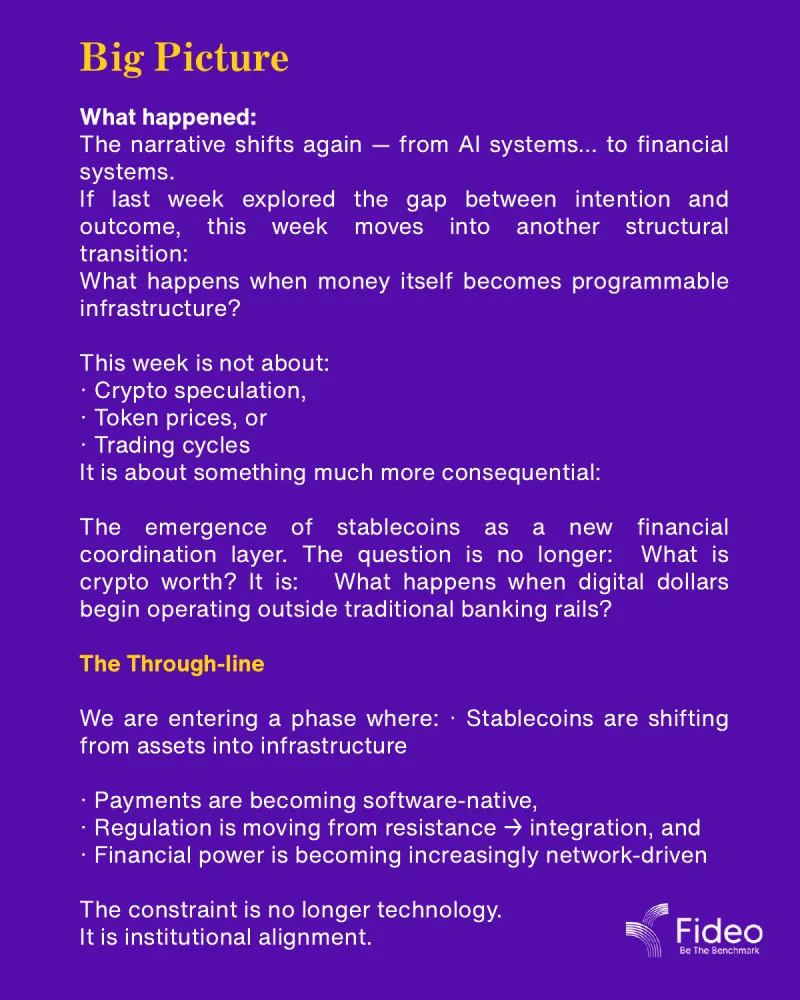
2 / 9 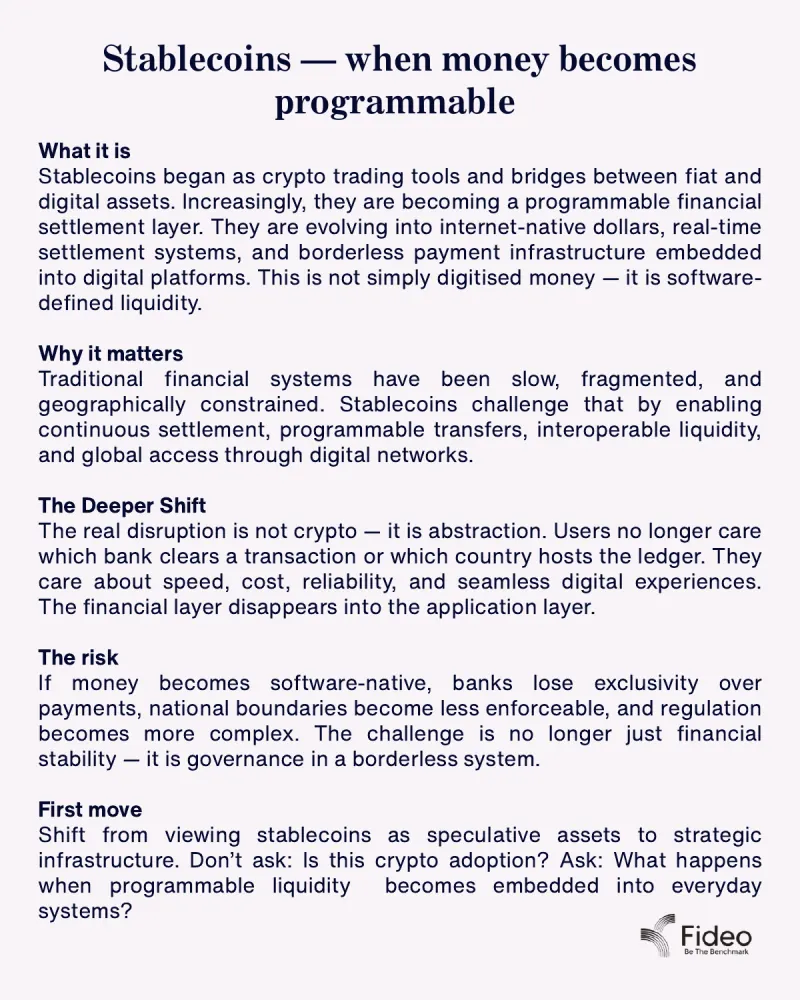
3 / 9 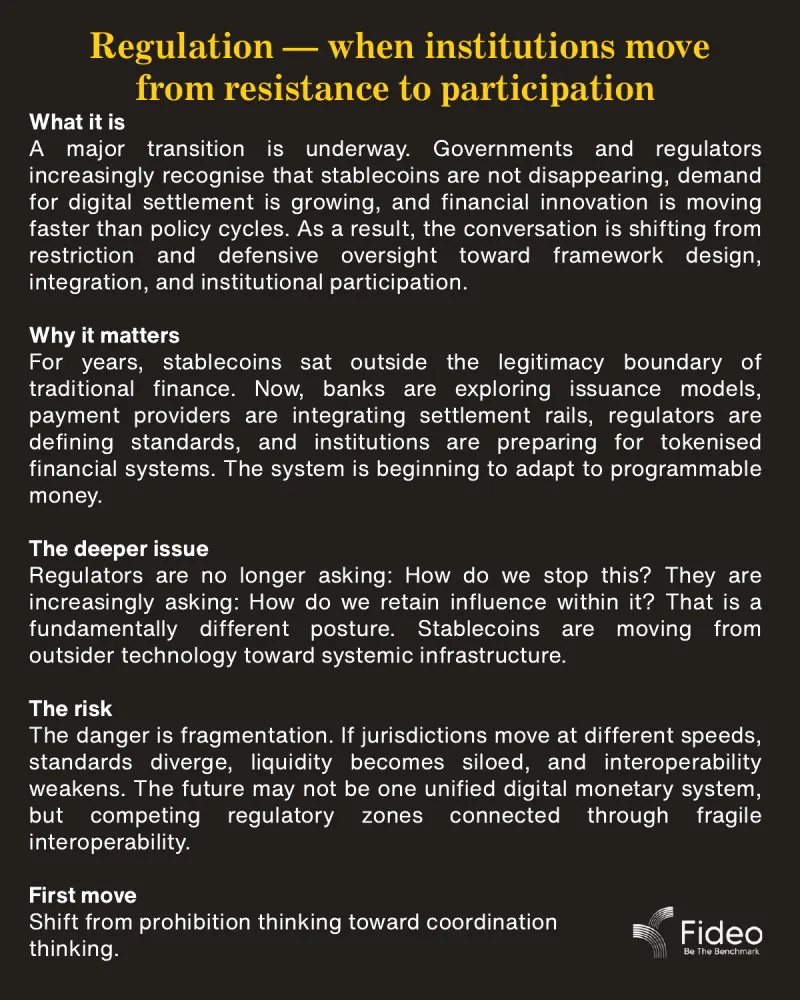
4 / 9 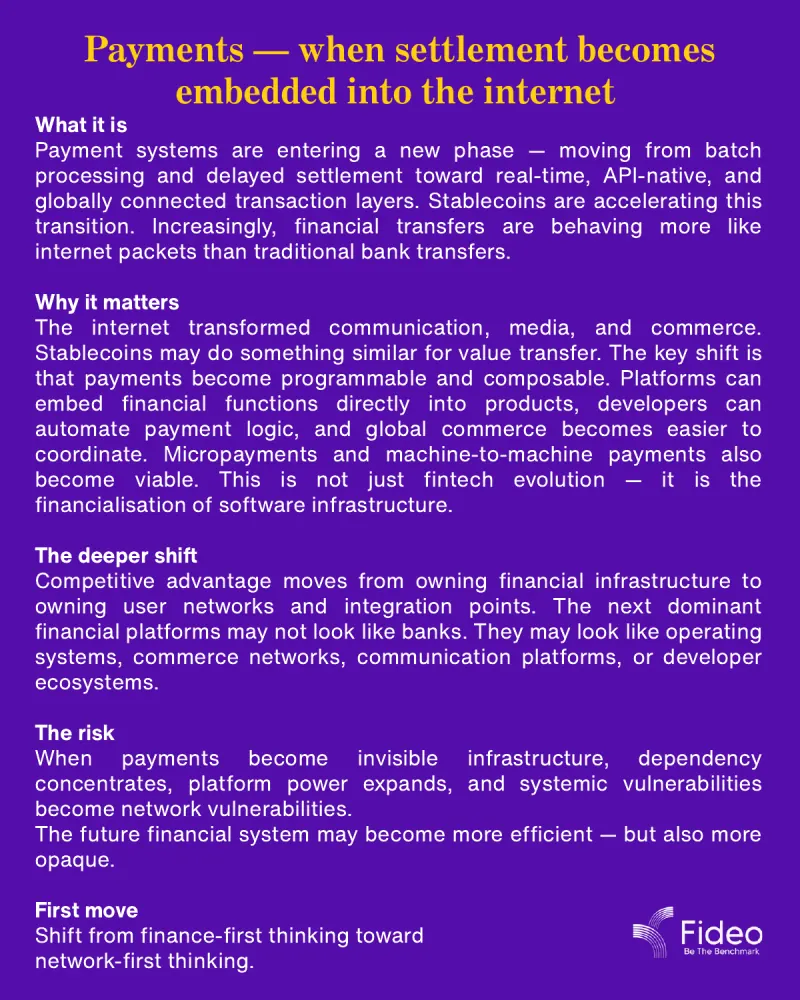
5 / 9 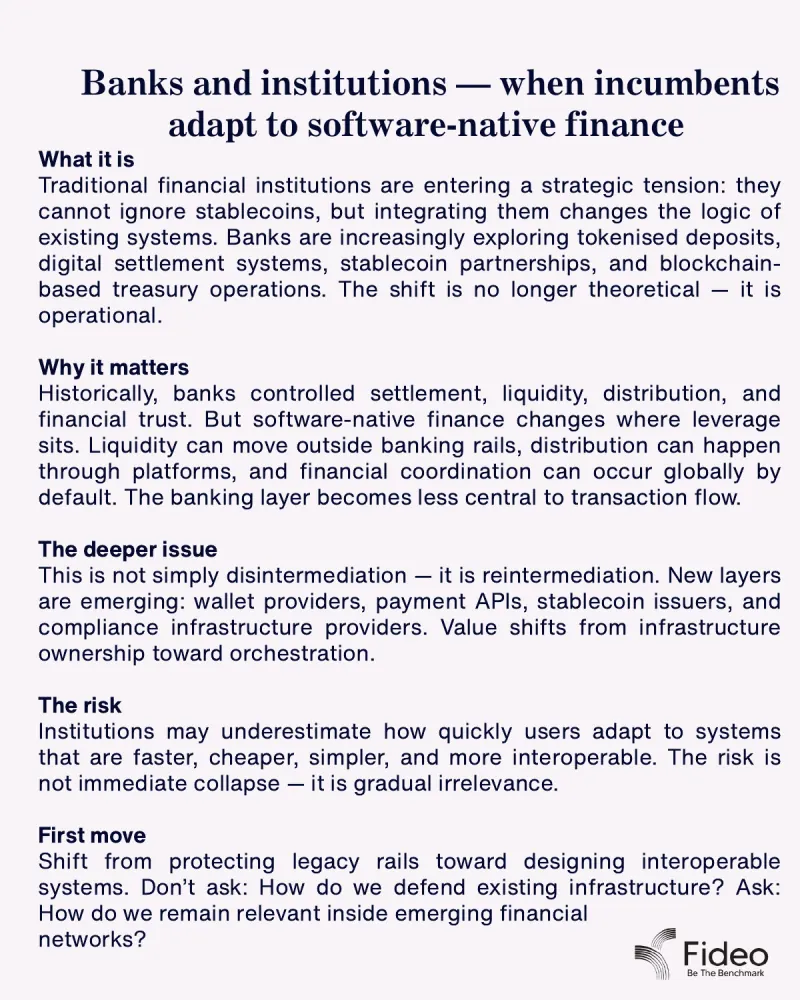
6 / 9 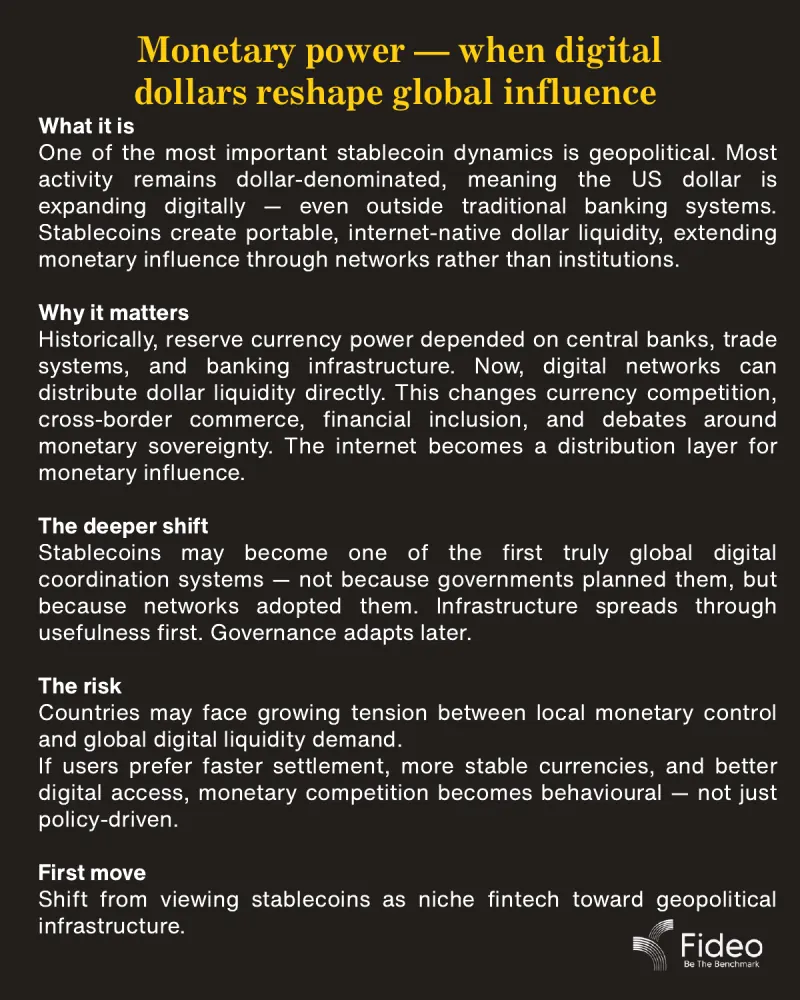
7 / 9 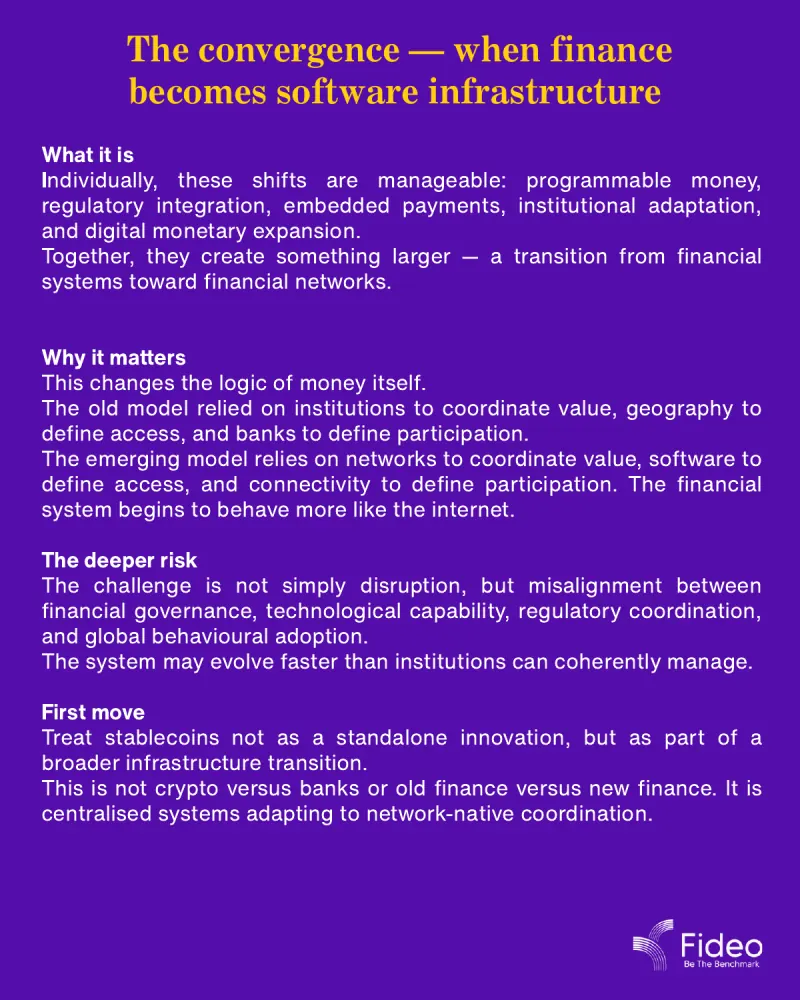
8 / 9 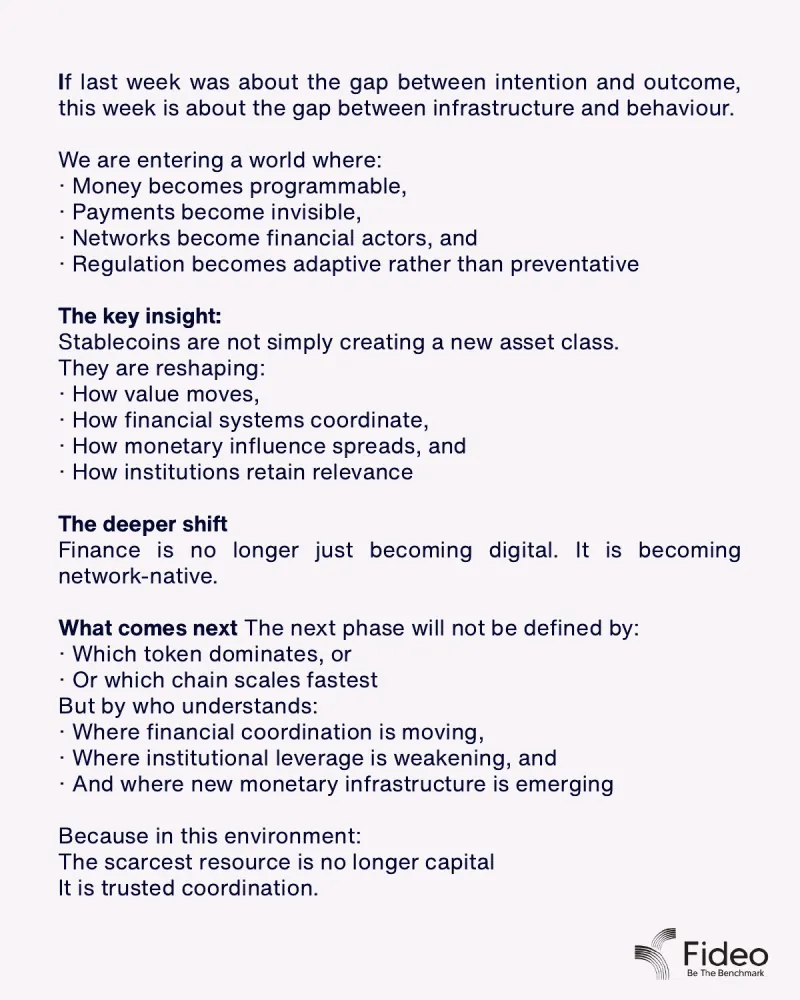
9 / 9
This week in 60 seconds
When money becomes programmable infrastructure, the constraint is no longer technology but institutional alignment.
- Stablecoins are shifting from speculative assets into a programmable settlement layer: internet-native dollars and borderless payment infrastructure.
- Regulators are moving from asking how to stop stablecoins to asking how to retain influence within them, with fragmentation across jurisdictions the key risk.
- Payments are becoming programmable and composable, so advantage moves from owning financial infrastructure to owning user networks and integration points.
- For banks the threat is not immediate collapse but gradual irrelevance, as value shifts from infrastructure ownership towards orchestration.
- Most stablecoin activity is dollar-denominated, extending US monetary influence through networks rather than institutions.
Try this with your team
Reframe your stablecoin discussion: instead of asking whether this is crypto adoption or how to defend existing infrastructure, ask what happens when programmable liquidity is embedded into everyday systems and how your organisation remains relevant inside emerging financial networks.
Read this edition as text (7 min)
Big Picture
What happened: The narrative shifts again — from AI systems… to financial systems. If last week explored the gap between intention and outcome, this week moves into another structural transition: What happens when money itself becomes programmable infrastructure?
This week is not about: · Crypto speculation, · Token prices, or · Trading cycles It is about something much more consequential:
The emergence of stablecoins as a new financial coordination layer. The question is no longer: What is crypto worth? It is: What happens when digital dollars begin operating outside traditional banking rails?
The Through-line
We are entering a phase where: · Stablecoins are shifting from assets into infrastructure
· Payments are becoming software-native, · Regulation is moving from resistance → integration, and · Financial power is becoming increasingly network-driven
The constraint is no longer technology. It is institutional alignment.
Stablecoins — when money becomes programmable
What it is Stablecoins began as crypto trading tools and bridges between fiat and digital assets. Increasingly, they are becoming a programmable financial settlement layer. They are evolving into internet-native dollars, real-time settlement systems, and borderless payment infrastructure embedded into digital platforms. This is not simply digitised money — it is software- defined liquidity.
Why it matters Traditional financial systems have been slow, fragmented, and geographically constrained. Stablecoins challenge that by enabling continuous settlement, programmable transfers, interoperable liquidity, and global access through digital networks.
The Deeper Shift The real disruption is not crypto — it is abstraction. Users no longer care which bank clears a transaction or which country hosts the ledger. They care about speed, cost, reliability, and seamless digital experiences. The financial layer disappears into the application layer.
The risk If money becomes software-native, banks lose exclusivity over payments, national boundaries become less enforceable, and regulation becomes more complex. The challenge is no longer just financial stability — it is governance in a borderless system.
First move Shift from viewing stablecoins as speculative assets to strategic infrastructure. Don’t ask: Is this crypto adoption? Ask: What happens when programmable liquidity becomes embedded into everyday systems?
Regulation — when institutions move from resistance to participation
What it is A major transition is underway. Governments and regulators increasingly recognise that stablecoins are not disappearing, demand for digital settlement is growing, and financial innovation is moving faster than policy cycles. As a result, the conversation is shifting from restriction and defensive oversight toward framework design, integration, and institutional participation.
Why it matters For years, stablecoins sat outside the legitimacy boundary of traditional finance. Now, banks are exploring issuance models, payment providers are integrating settlement rails, regulators are defining standards, and institutions are preparing for tokenised financial systems. The system is beginning to adapt to programmable money.
The deeper issue Regulators are no longer asking: How do we stop this? They are increasingly asking: How do we retain influence within it? That is a fundamentally different posture. Stablecoins are moving from outsider technology toward systemic infrastructure.
The risk The danger is fragmentation. If jurisdictions move at different speeds, standards diverge, liquidity becomes siloed, and interoperability weakens. The future may not be one unified digital monetary system, but competing regulatory zones connected through fragile interoperability.
First move Shift from prohibition thinking toward coordination thinking.
Payments — when settlement becomes embedded into the internet
What it is Payment systems are entering a new phase — moving from batch processing and delayed settlement toward real-time, API-native, and globally connected transaction layers. Stablecoins are accelerating this transition. Increasingly, financial transfers are behaving more like internet packets than traditional bank transfers.
Why it matters The internet transformed communication, media, and commerce. Stablecoins may do something similar for value transfer. The key shift is that payments become programmable and composable. Platforms can embed financial functions directly into products, developers can automate payment logic, and global commerce becomes easier to coordinate. Micropayments and machine-to-machine payments also become viable. This is not just fintech evolution — it is the financialisation of software infrastructure.
The deeper shift Competitive advantage moves from owning financial infrastructure to owning user networks and integration points. The next dominant financial platforms may not look like banks. They may look like operating systems, commerce networks, communication platforms, or developer ecosystems.
The risk When payments become invisible infrastructure, dependency concentrates, platform power expands, and systemic vulnerabilities become network vulnerabilities. The future financial system may become more efficient — but also more opaque.
First move Shift from finance-first thinking toward network-first thinking.
Banks and institutions — when incumbents adapt to software-native finance
What it is Traditional financial institutions are entering a strategic tension: they cannot ignore stablecoins, but integrating them changes the logic of existing systems. Banks are increasingly exploring tokenised deposits, digital settlement systems, stablecoin partnerships, and blockchain- based treasury operations. The shift is no longer theoretical — it is operational.
Why it matters Historically, banks controlled settlement, liquidity, distribution, and financial trust. But software-native finance changes where leverage sits. Liquidity can move outside banking rails, distribution can happen through platforms, and financial coordination can occur globally by default. The banking layer becomes less central to transaction flow.
The deeper issue This is not simply disintermediation — it is reintermediation. New layers are emerging: wallet providers, payment APIs, stablecoin issuers, and compliance infrastructure providers. Value shifts from infrastructure ownership toward orchestration.
The risk Institutions may underestimate how quickly users adapt to systems that are faster, cheaper, simpler, and more interoperable. The risk is not immediate collapse — it is gradual irrelevance.
First move Shift from protecting legacy rails toward designing interoperable systems. Don’t ask: How do we defend existing infrastructure? Ask: How do we remain relevant inside emerging financial networks?
Monetary power — when digital dollars reshape global influence
What it is One of the most important stablecoin dynamics is geopolitical. Most activity remains dollar-denominated, meaning the US dollar is expanding digitally — even outside traditional banking systems. Stablecoins create portable, internet-native dollar liquidity, extending monetary influence through networks rather than institutions.
Why it matters Historically, reserve currency power depended on central banks, trade systems, and banking infrastructure. Now, digital networks can distribute dollar liquidity directly. This changes currency competition, cross-border commerce, financial inclusion, and debates around monetary sovereignty. The internet becomes a distribution layer for monetary influence.
The deeper shift Stablecoins may become one of the first truly global digital coordination systems — not because governments planned them, but because networks adopted them. Infrastructure spreads through usefulness first. Governance adapts later.
The risk Countries may face growing tension between local monetary control and global digital liquidity demand. If users prefer faster settlement, more stable currencies, and better digital access, monetary competition becomes behavioural — not just policy-driven.
First move Shift from viewing stablecoins as niche fintech toward geopolitical infrastructure.
The convergence — when finance becomes software infrastructure
What it is I ndividually, these shifts are manageable: programmable money, regulatory integration, embedded payments, institutional adaptation, and digital monetary expansion. Together, they create something larger — a transition from financial systems toward financial networks.
Why it matters This changes the logic of money itself. The old model relied on institutions to coordinate value, geography to define access, and banks to define participation. The emerging model relies on networks to coordinate value, software to define access, and connectivity to define participation. The financial system begins to behave more like the internet.
The deeper risk The challenge is not simply disruption, but misalignment between financial governance, technological capability, regulatory coordination, and global behavioural adoption. The system may evolve faster than institutions can coherently manage.
First move Treat stablecoins not as a standalone innovation, but as part of a broader infrastructure transition. This is not crypto versus banks or old finance versus new finance. It is centralised systems adapting to network-native coordination.
I f last week was about the gap between intention and outcome, this week is about the gap between infrastructure and behaviour.
We are entering a world where: · Money becomes programmable, · Payments become invisible, · Networks become financial actors, and · Regulation becomes adaptive rather than preventative
The key insight: Stablecoins are not simply creating a new asset class. They are reshaping: · How value moves, · How financial systems coordinate, · How monetary influence spreads, and · How institutions retain relevance
The deeper shift Finance is no longer just becoming digital. It is becoming network-native.
What comes next The next phase will not be defined by: · Which token dominates, or · Or which chain scales fastest But by who understands: · Where financial coordination is moving, · Where institutional leverage is weakening, and · And where new monetary infrastructure is emerging
Because in this environment: The scarcest resource is no longer capital It is trusted coordination.
More questions about this edition
Is this edition about crypto prices or trading?
No. The edition says it is not about crypto speculation, token prices or trading cycles, but about stablecoins emerging as a new financial coordination layer.
What new intermediaries does the edition expect to emerge?
It describes reintermediation rather than simple disintermediation, with new layers such as wallet providers, payment APIs, stablecoin issuers and compliance infrastructure providers.
What does the edition call the scarcest resource in this environment?
It argues the scarcest resource is no longer capital but trusted coordination.
Get the Zeitgeist every Friday
One email a week with the new edition. Unsubscribe in one click.
Check your inbox to confirm your subscription.
Please enter a valid email address and try again.