Week of 21 to 25 Sept 2026
The proof problem: when knowledge becomes cheap, what becomes valuable?
1 / 9 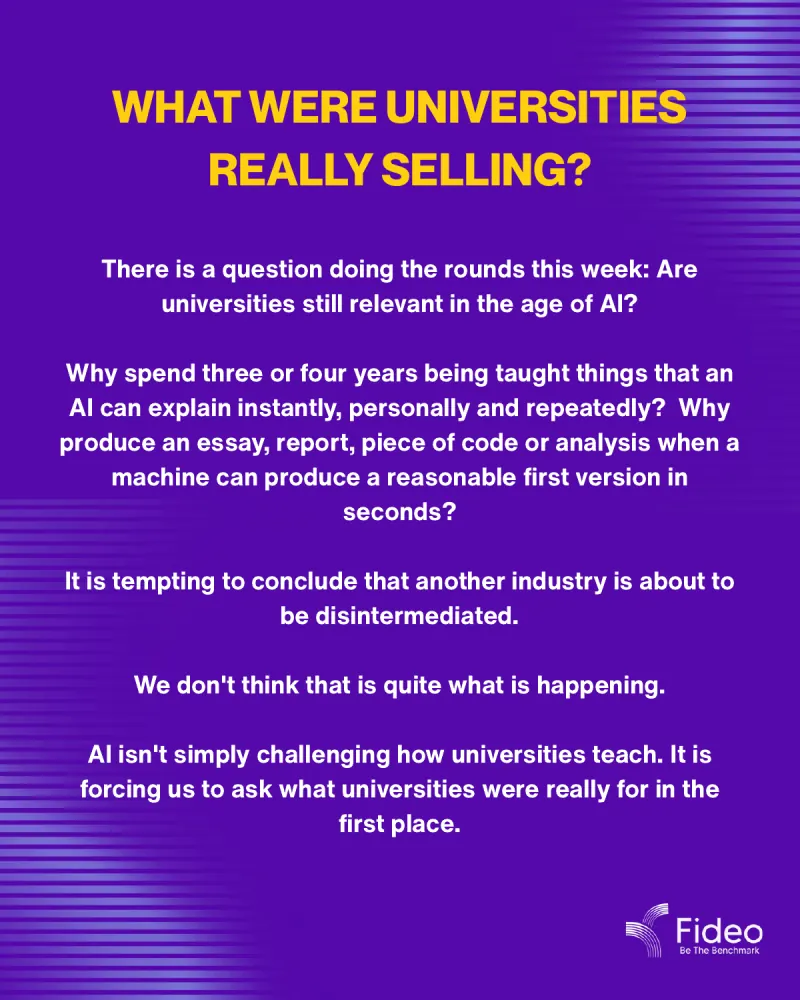
2 / 9 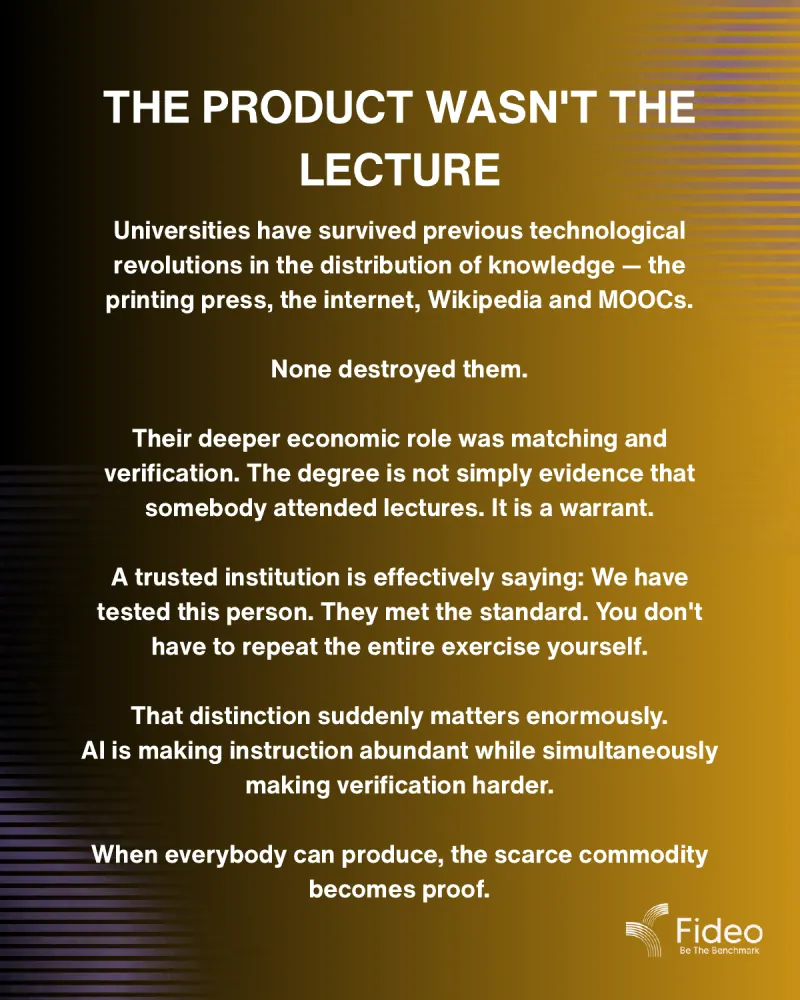
3 / 9 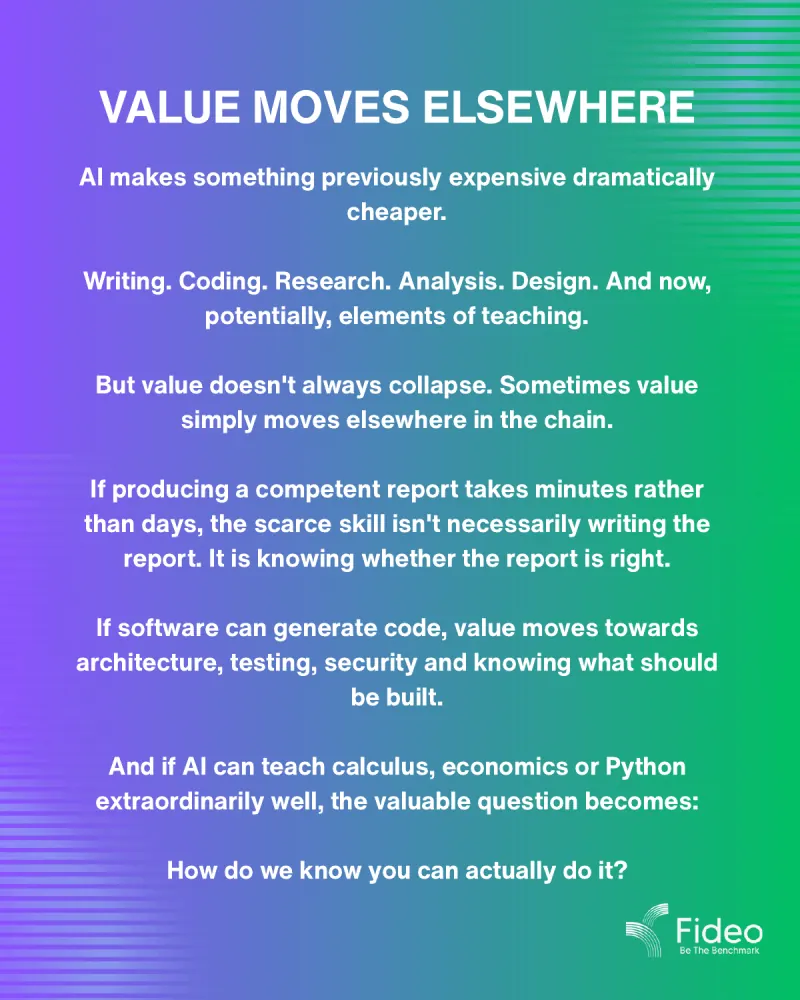
4 / 9 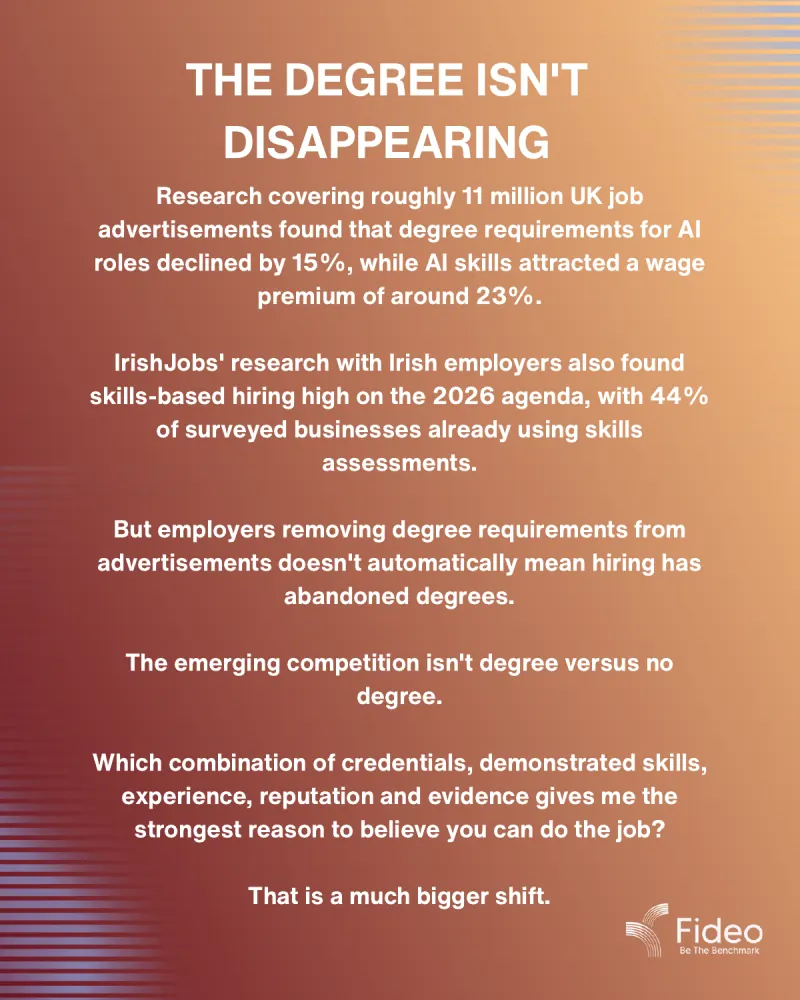
5 / 9 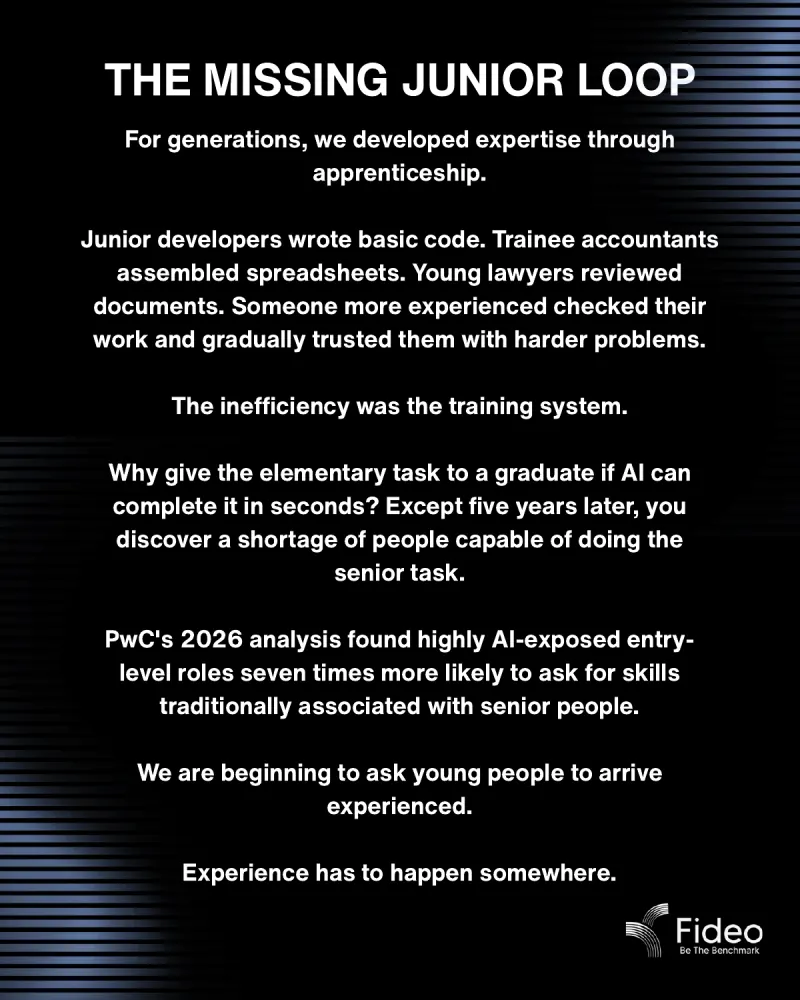
6 / 9 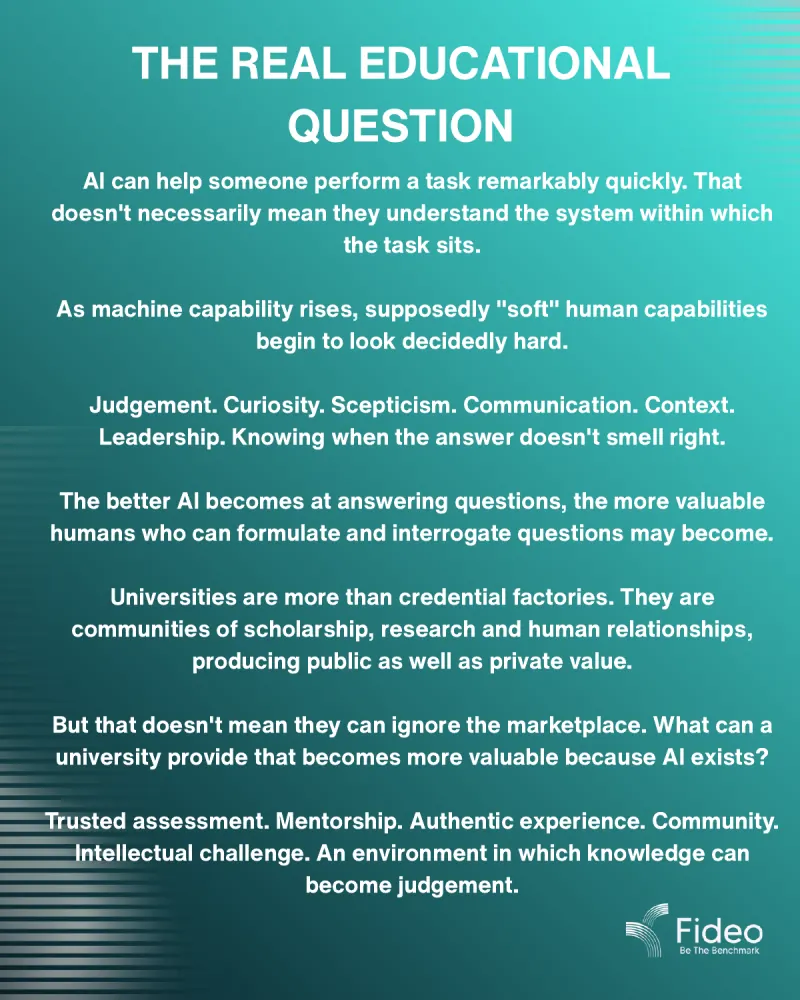
7 / 9 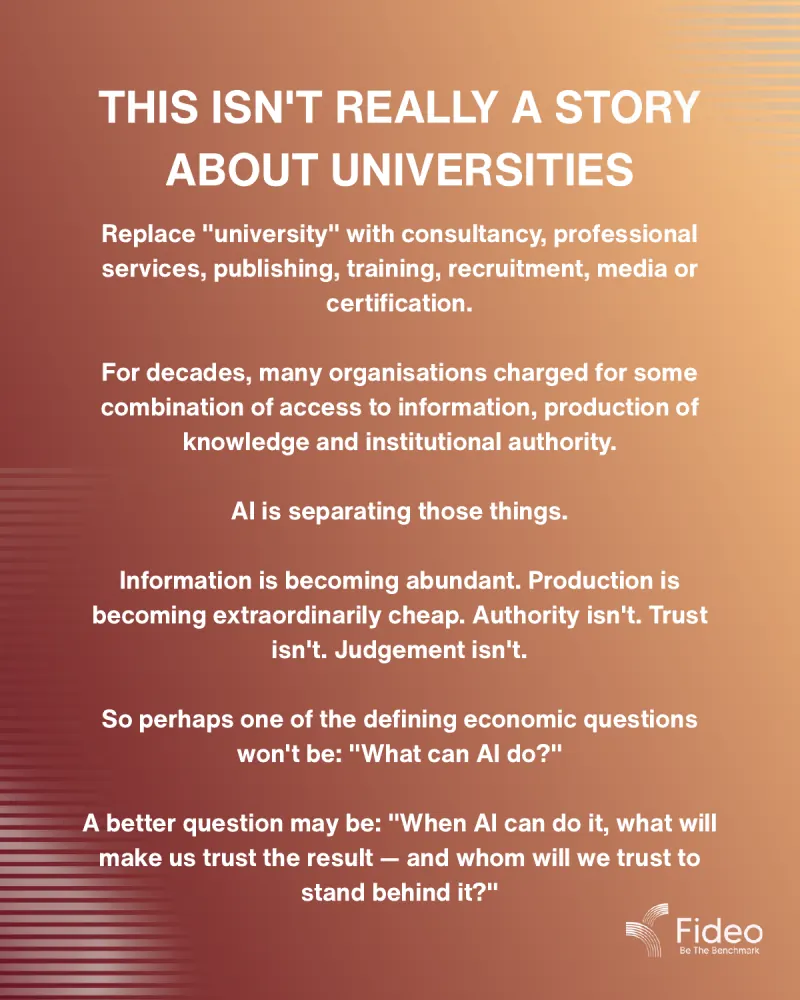
8 / 9 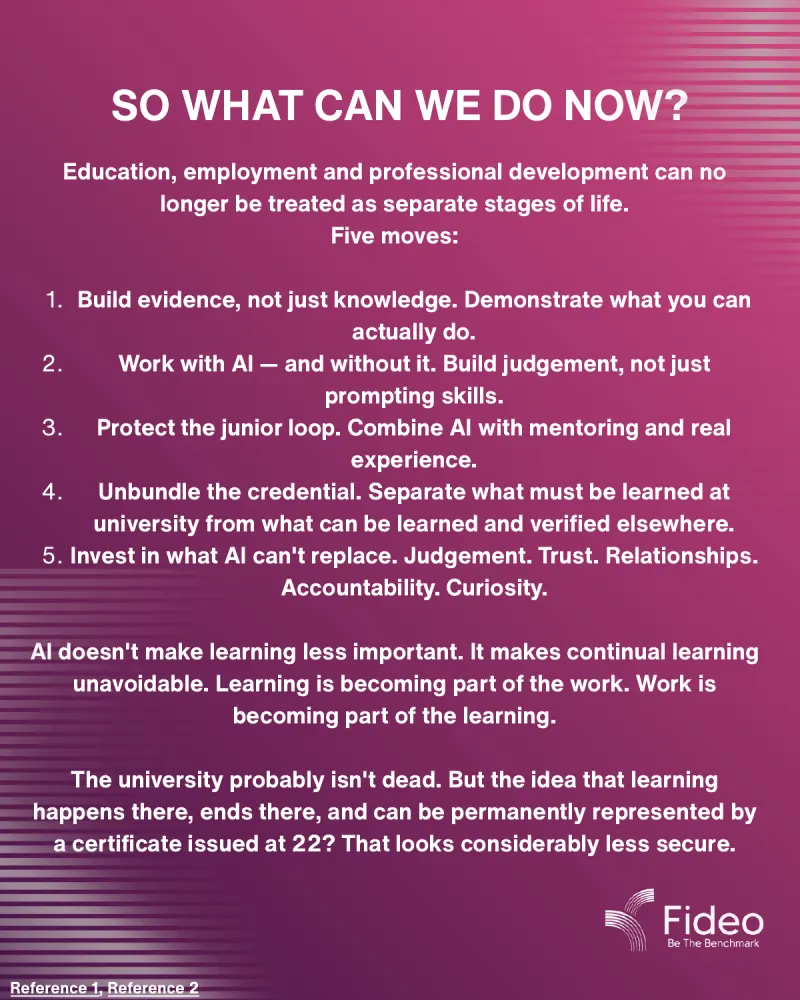
9 / 9
This week in 60 seconds
AI makes instruction abundant and verification harder, so trusted proof of ability becomes the scarce commodity
- A degree works as a warrant: a trusted institution has tested someone so employers need not repeat the exercise. AI makes that verification harder just as instruction becomes abundant.
- When AI can write the report or the code, value shifts to knowing whether the report is right and to architecture, testing, security and deciding what should be built.
- Research on roughly 11 million UK job adverts found degree requirements for AI roles fell 15%, while AI skills drew a wage premium of around 23%.
- PwC's 2026 analysis found highly AI-exposed entry-level roles seven times more likely to ask for senior skills, threatening the junior loop that builds expertise.
- Across consultancy, publishing, recruitment and certification, AI is separating information and production from authority, trust and judgement.
Try this with your team
Pick one entry-level task your team now hands to AI and redesign it as a junior loop: have a trainee do it with AI and then without it, with an experienced colleague checking the work, so judgement is built alongside speed.
Read this edition as text (5 min)
WHAT WERE UNIVERSITIES REALLY SELLING?
There is a question doing the rounds this week: Are universities still relevant in the age of AI?
Why spend three or four years being taught things that an AI can explain instantly, personally and repeatedly? Why produce an essay, report, piece of code or analysis when a machine can produce a reasonable first version in seconds?
It is tempting to conclude that another industry is about to be disintermediated.
We don't think that is quite what is happening.
AI isn't simply challenging how universities teach. It is forcing us to ask what universities were really for in the first place.
THE PRODUCT WASN'T THE LECTURE
Universities have survived previous technological revolutions in the distribution of knowledge — the printing press, the internet, Wikipedia and MOOCs.
None destroyed them.
Their deeper economic role was matching and verification. The degree is not simply evidence that somebody attended lectures. It is a warrant.
A trusted institution is effectively saying: We have tested this person. They met the standard. You don't have to repeat the entire exercise yourself.
That distinction suddenly matters enormously. AI is making instruction abundant while simultaneously making verification harder.
When everybody can produce, the scarce commodity becomes proof.
VALUE MOVES ELSEWHERE
AI makes something previously expensive dramatically cheaper.
Writing. Coding. Research. Analysis. Design. And now, potentially, elements of teaching.
But value doesn't always collapse. Sometimes value simply moves elsewhere in the chain.
If producing a competent report takes minutes rather than days, the scarce skill isn't necessarily writing the report. It is knowing whether the report is right.
If software can generate code, value moves towards architecture, testing, security and knowing what should be built.
And if AI can teach calculus, economics or Python extraordinarily well, the valuable question becomes:
How do we know you can actually do it?
THE DEGREE ISN'T DISAPPEARING
Research covering roughly 11 million UK job advertisements found that degree requirements for AI roles declined by 15%, while AI skills attracted a wage premium of around 23%.
IrishJobs' research with Irish employers also found skills-based hiring high on the 2026 agenda, with 44% of surveyed businesses already using skills assessments.
But employers removing degree requirements from advertisements doesn't automatically mean hiring has abandoned degrees.
The emerging competition isn't degree versus no degree.
Which combination of credentials, demonstrated skills, experience, reputation and evidence gives me the strongest reason to believe you can do the job?
That is a much bigger shift.
THE MISSING JUNIOR LOOP
For generations, we developed expertise through apprenticeship.
Junior developers wrote basic code. Trainee accountants assembled spreadsheets. Young lawyers reviewed documents. Someone more experienced checked their work and gradually trusted them with harder problems.
The inefficiency was the training system.
Why give the elementary task to a graduate if AI can complete it in seconds? Except five years later, you discover a shortage of people capable of doing the senior task.
PwC's 2026 analysis found highly AI-exposed entry- level roles seven times more likely to ask for skills traditionally associated with senior people.
We are beginning to ask young people to arrive experienced.
Experience has to happen somewhere.
THE REAL EDUCATIONAL QUESTION
AI can help someone perform a task remarkably quickly. That doesn't necessarily mean they understand the system within which the task sits.
As machine capability rises, supposedly "soft" human capabilities begin to look decidedly hard.
Judgement. Curiosity. Scepticism. Communication. Context. Leadership. Knowing when the answer doesn't smell right.
The better AI becomes at answering questions, the more valuable humans who can formulate and interrogate questions may become.
Universities are more than credential factories. They are communities of scholarship, research and human relationships, producing public as well as private value.
But that doesn't mean they can ignore the marketplace. What can a university provide that becomes more valuable because AI exists?
Trusted assessment. Mentorship. Authentic experience. Community. Intellectual challenge. An environment in which knowledge can become judgement.
THIS ISN'T REALLY A STORY ABOUT UNIVERSITIES
Replace "university" with consultancy, professional services, publishing, training, recruitment, media or certification.
For decades, many organisations charged for some combination of access to information, production of knowledge and institutional authority.
AI is separating those things.
Information is becoming abundant. Production is becoming extraordinarily cheap. Authority isn't. Trust isn't. Judgement isn't.
So perhaps one of the defining economic questions won't be: "What can AI do?"
A better question may be: "When AI can do it, what will make us trust the result — and whom will we trust to stand behind it?"
SO WHAT CAN WE DO NOW?
Education, employment and professional development can no longer be treated as separate stages of life. Five moves:
1. Build evidence, not just knowledge. Demonstrate what you can actually do. 2. Work with AI — and without it. Build judgement, not just prompting skills. 3. Protect the junior loop. Combine AI with mentoring and real experience. 4. Unbundle the credential. Separate what must be learned at university from what can be learned and verified elsewhere. 5. Invest in what AI can't replace. Judgement. Trust. Relationships. Accountability. Curiosity.
AI doesn't make learning less important. It makes continual learning unavoidable. Learning is becoming part of the work. Work is becoming part of the learning.
The university probably isn't dead. But the idea that learning happens there, ends there, and can be permanently represented by a certificate issued at 22? That looks considerably less secure.
Sources
- LinkedInlinkedin.com/posts/david-dor-83a59b24_a-new-mit-report-finds-ai-is-causing-mass-share-7507
- LinkedInlinkedin.com/posts/amitrawal-ai_are-universities-still-relevant-in-the-share-7507032539228
More questions about this edition
Does dropping degree requirements from job adverts mean employers have abandoned degrees?
Not automatically. The edition argues the competition is not degree versus no degree but which mix of credentials, demonstrated skills, experience, reputation and evidence best shows someone can do the job.
What can a university offer that becomes more valuable because AI exists?
Trusted assessment, mentorship, authentic experience, community, intellectual challenge and an environment in which knowledge can become judgement.
Have universities faced disruption like this before?
Yes. They survived the printing press, the internet, Wikipedia and MOOCs, none of which destroyed them, because their deeper economic role was matching and verification.
Get the Zeitgeist every Friday
One email a week with the new edition. Unsubscribe in one click.
Check your inbox to confirm your subscription.
Please enter a valid email address and try again.