Week of 22 to 26 Jun 2026
The experience paradox: AI makes expertise more valuable and harder to create
1 / 9 
2 / 9 
3 / 9 
4 / 9 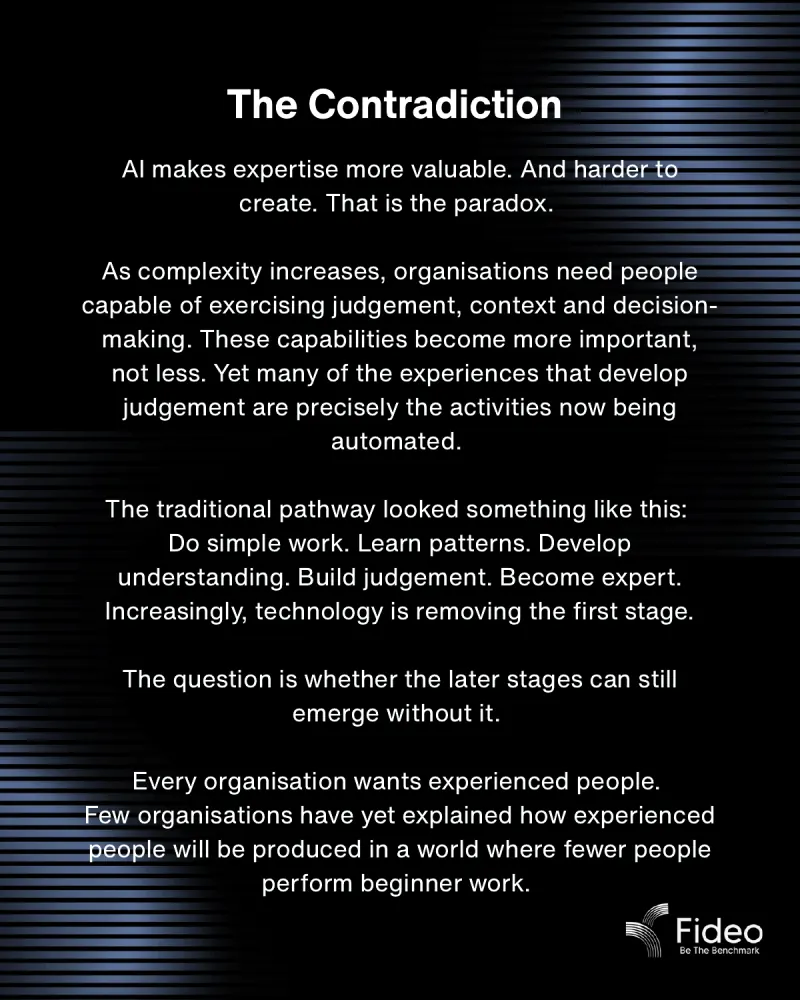
5 / 9 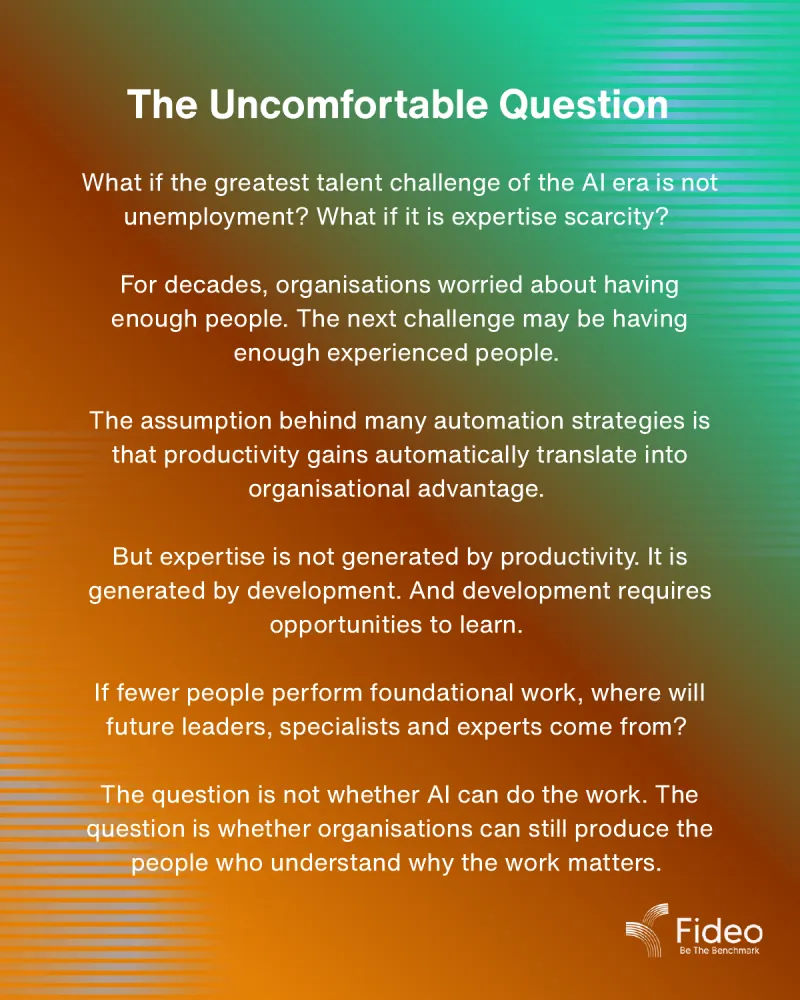
6 / 9 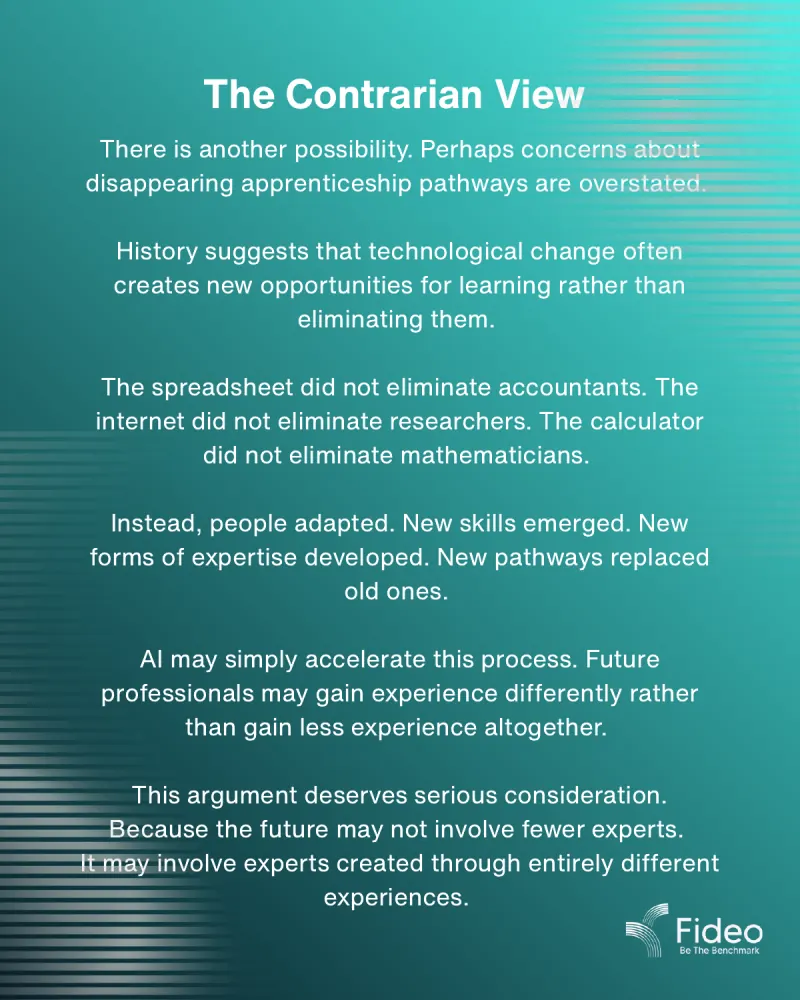
7 / 9 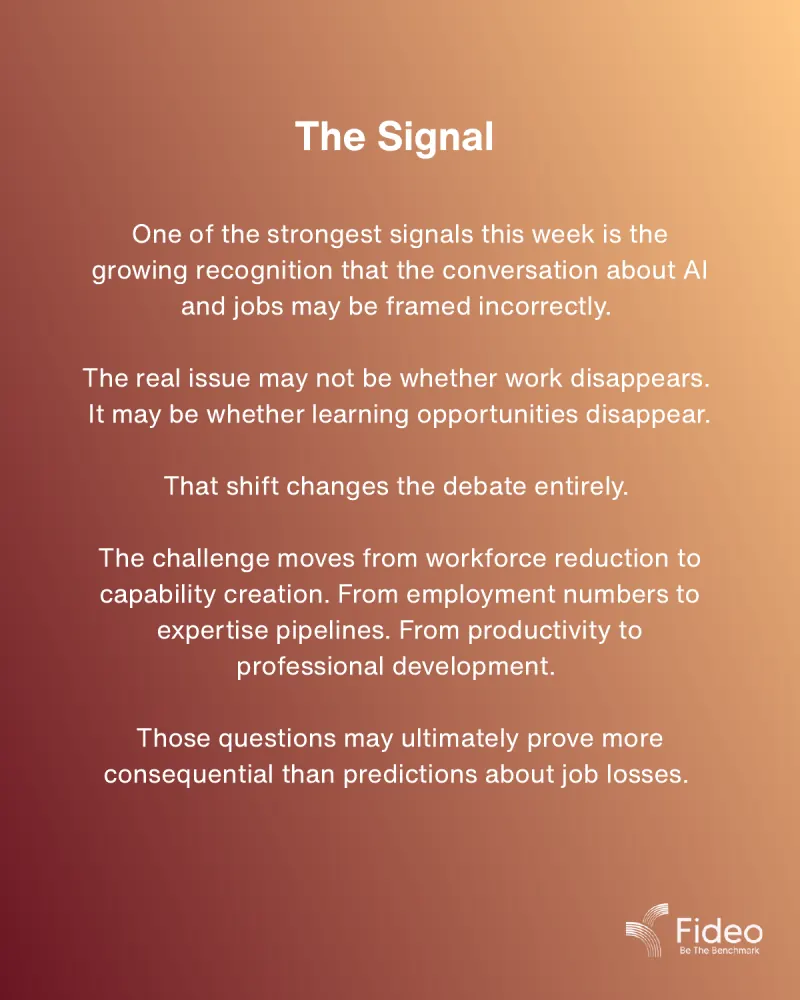
8 / 9 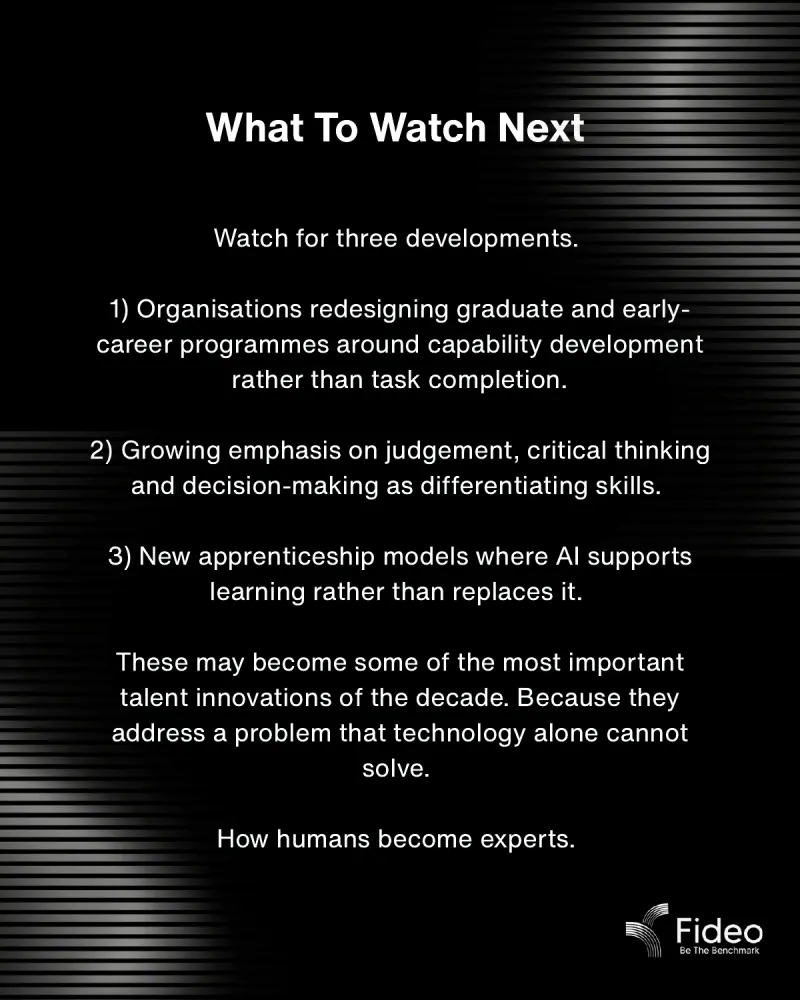
9 / 9
This week in 60 seconds
The more work we automate, the harder it becomes to create expertise.
- The challenge may not be that AI replaces jobs but that it replaces the experiences through which expertise has always been built.
- Entry-level tasks such as research, drafting, analysis and routine problem-solving were valuable because they developed capability, not for their output.
- The traditional pathway ran from simple work to patterns, understanding, judgement and expertise, and technology is increasingly removing the first stage.
- Organisations may find themselves accelerating output while slowing development, leading to expertise scarcity rather than unemployment.
- A contrarian view holds that, as with spreadsheets and calculators, AI may change how professionals gain experience rather than reduce it.
Try this with your team
Review your graduate and early-career programmes and identify where they are built around task completion rather than capability development, then consider how AI could support learning rather than replace it.
Read this edition as text (4 min)
The Experience Paradox
For decades, organisations have pursued the same objective. Increase efficiency. Reduce friction. Accelerate productivity.
Every generation of technology has promised some version of this outcome. AI may be the most powerful productivity tool yet. Tasks that once took hours now take minutes. Processes that required teams can increasingly be completed by individuals supported by intelligent systems.
From an operational perspective, this appears to be progress. Yet beneath the productivity gains sits a question that few organisations have fully answered. If technology increasingly performs the work people once learned from, where will future expertise come from?
The challenge may not be that AI replaces jobs. The challenge may be that it replaces experiences. And experience has always been how expertise is built.
The Human Story
Meet Daniel.
He joins a consulting firm in 2028. Previous generations spent years conducting research, building presentations, analysing data and learning through repetition. Much of that work is now completed with AI assistance.
Daniel is more productive than graduates who entered the profession a decade earlier. He can produce higher- quality outputs in less time. On paper, this looks like progress. Yet after three years, an unexpected question emerges.
What experiences has Daniel actually accumulated? He has generated excellent work. But has he developed the judgement that traditionally came from doing the work himself?
His challenge is not access to knowledge. It is access to experience. For the first time, organisations may find themselves accelerating output while slowing development.
What We're Actually Seeing
Much of the public conversation around AI focuses on job displacement. Will roles disappear? Will occupations change? Will employment decline? These questions matter.
But they may not be the most important questions. A different signal is beginning to emerge. Across industries, organisations are increasingly automating entry-level tasks. The very activities that historically served as apprenticeship pathways are becoming candidates for augmentation or elimination.
Research. Drafting. Analysis. Administrative coordination. Routine problem-solving.
These tasks were rarely valued because of the output they produced. They were valuable because they developed capability.
For generations, organisations transformed beginners into experts through participation in work. AI challenges that model. Not because expertise becomes unnecessary. But because the route to acquiring expertise becomes less obvious.
The Contradiction
AI makes expertise more valuable. And harder to create. That is the paradox.
As complexity increases, organisations need people capable of exercising judgement, context and decision- making. These capabilities become more important, not less. Yet many of the experiences that develop judgement are precisely the activities now being automated.
The traditional pathway looked something like this: Do simple work. Learn patterns. Develop understanding. Build judgement. Become expert. Increasingly, technology is removing the first stage.
The question is whether the later stages can still emerge without it.
Every organisation wants experienced people. Few organisations have yet explained how experienced people will be produced in a world where fewer people perform beginner work.
The Uncomfortable Question
What if the greatest talent challenge of the AI era is not unemployment? What if it is expertise scarcity?
For decades, organisations worried about having enough people. The next challenge may be having enough experienced people.
The assumption behind many automation strategies is that productivity gains automatically translate into organisational advantage.
But expertise is not generated by productivity. It is generated by development. And development requires opportunities to learn.
If fewer people perform foundational work, where will future leaders, specialists and experts come from?
The question is not whether AI can do the work. The question is whether organisations can still produce the people who understand why the work matters.
The Contrarian View
There is another possibility. Perhaps concerns about disappearing apprenticeship pathways are overstated.
History suggests that technological change often creates new opportunities for learning rather than eliminating them.
The spreadsheet did not eliminate accountants. The internet did not eliminate researchers. The calculator did not eliminate mathematicians.
Instead, people adapted. New skills emerged. New forms of expertise developed. New pathways replaced old ones.
AI may simply accelerate this process. Future professionals may gain experience differently rather than gain less experience altogether.
This argument deserves serious consideration. Because the future may not involve fewer experts. It may involve experts created through entirely different experiences.
The Signal
One of the strongest signals this week is the growing recognition that the conversation about AI and jobs may be framed incorrectly.
The real issue may not be whether work disappears. It may be whether learning opportunities disappear.
That shift changes the debate entirely.
The challenge moves from workforce reduction to capability creation. From employment numbers to expertise pipelines. From productivity to professional development.
Those questions may ultimately prove more consequential than predictions about job losses.
What To Watch Next
Watch for three developments.
1) Organisations redesigning graduate and early- career programmes around capability development rather than task completion.
2) Growing emphasis on judgement, critical thinking and decision-making as differentiating skills.
3) New apprenticeship models where AI supports learning rather than replaces it.
These may become some of the most important talent innovations of the decade. Because they address a problem that technology alone cannot solve.
How humans become experts.
More questions about this edition
What does the hypothetical example in the edition illustrate?
It describes a graduate joining a consulting firm in 2028 who is more productive than predecessors thanks to AI, yet after three years may lack the judgement that came from doing the work himself. His challenge is access to experience, not knowledge.
What developments does the edition suggest watching?
Redesigned graduate and early-career programmes focused on capability development, growing emphasis on judgement, critical thinking and decision-making, and new apprenticeship models where AI supports learning rather than replaces it.
How does the edition say the AI and jobs debate should shift?
From workforce reduction to capability creation, from employment numbers to expertise pipelines, and from productivity to professional development.
Get the Zeitgeist every Friday
One email a week with the new edition. Unsubscribe in one click.
Check your inbox to confirm your subscription.
Please enter a valid email address and try again.