Week of 3 to 7 Aug 2026
What if universities have to become more commercial to remain universities?
1 / 9 
2 / 9 
3 / 9 
4 / 9 
5 / 9 
6 / 9 
7 / 9 
8 / 9 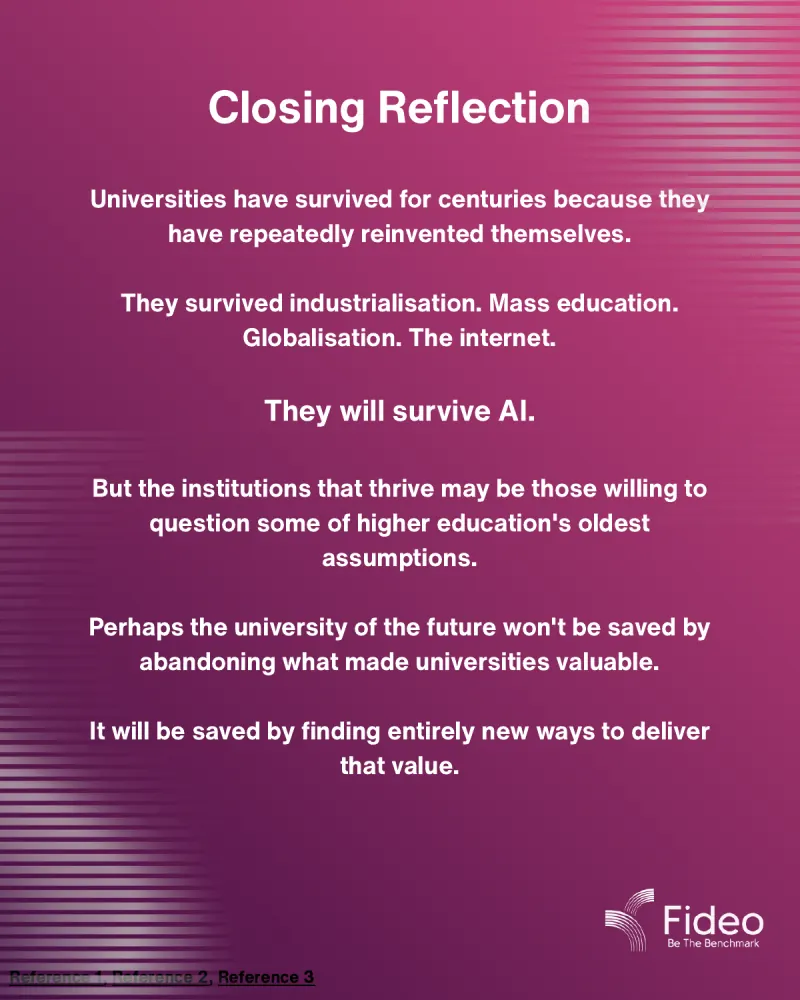
9 / 9
This week in 60 seconds
Why financial sustainability may be a precondition of academic purpose, not its enemy
- Rising costs, global competition and less predictable international recruitment mean the pressure for change in higher education is no longer theoretical.
- Growth may shift from how many students can come to campus to how many learners a university can reach online, through employers and through partnerships.
- Financial weakness does not protect academic independence. Over time it restricts freedom, research, experimentation and choice.
- Many current challenges, such as AI, digital transformation and new business models, come from outside higher education, so outside experience may complement academic leadership.
- Universities have reinvented themselves before, and those that thrive may question old assumptions while keeping what makes them valuable.
Read this edition as text (3 min)
The Reinvention Paradox
Imagine becoming Vice-Chancellor of a university tomorrow.
Your institution has existed for more than a century. Respected academics. Important research. Thousands of students. A proud place in its community.
But there's a problem.
The economics are under increasing strain. Costs continue to rise. International recruitment is less predictable. Competition is increasingly global. And the university you've inherited was designed for a world where students travelled to education.
The question sounds simple: How do we grow?
Then someone asks something different. What if growth no longer means putting more students on the campus?
The Human Story
Consider Maya.
She works in financial services in Singapore and wants to develop expertise in AI governance.
Years ago, that meant leaving work and moving overseas.
Today she wants something different. A flexible programme. Delivered online. Recognised internationally. Built around her career. Perhaps stackable into a larger qualification.
Maya still values British higher education. She simply doesn't need to become an international student in the traditional sense.
The next opportunity may not be bringing learners to universities.
It may be taking universities to learners.
What We're Actually Seeing
The pressure for change is no longer theoretical.
Universities face rising costs, greater competition and growing dependence on international recruitment.
At the same time, a different model is emerging.
Online programmes. Professional education. Microcredentials. Corporate learning. International partnerships. Lifelong learning.
The future university may no longer be defined by its campus.
It may be defined by the reach of its expertise.
The Real Trade-Off
Here's this week's paradox.
Universities may need to become more commercial to protect what should never become purely commercial.
Universities are not ordinary businesses. Their purpose extends far beyond profit.
But financial sustainability isn't the enemy of academic purpose.
It may be one of its preconditions.
The question isn't whether universities should become businesses.
It's whether refusing to think commercially eventually limits their ability to fulfil their academic mission.
The Leadership Question
If the operating model has to change...
Who knows how to change it?
Universities possess extraordinary expertise. But many of today's challenges arrived from outside higher education. AI. Digital transformation. Global markets. New business models.
Perhaps one of the most valuable things universities could recruit isn't another thousand students.
Perhaps it's different experience. Not to replace academic leadership.
But to challenge it, complement it and help imagine new possibilities.
Beyond the Campus
For decades, growth meant bigger campuses. More students. More buildings.
Today, growth may look very different.
Universities can reach learners online. Through employers. Through partnerships. Across entire careers.
The question quietly changes from: "How many students can come to us?"
to
"How many learners can we reach?"
That isn't simply a new delivery model.
It may be a new definition of what a university is.
The Uncomfortable Question
Higher education rightly worries about becoming too commercial.
But what if the greater danger is becoming commercially unsustainable?
Financial weakness doesn't protect academic independence.
Eventually, it restricts it. Less freedom. Less research. Less experimentation. Less choice.
So perhaps the real question isn't: Academic values or commercial thinking?
It's this:
How much commercial imagination is required to protect academic values?
Closing Reflection
Universities have survived for centuries because they have repeatedly reinvented themselves.
They survived industrialisation. Mass education. Globalisation. The internet.
They will survive AI.
But the institutions that thrive may be those willing to question some of higher education's oldest assumptions.
Perhaps the university of the future won't be saved by abandoning what made universities valuable.
It will be saved by finding entirely new ways to deliver that value.
Sources
- LinkedInlinkedin.com/posts/tim-moon-24447925_aiineducation-cognitiveoffloading-futureoflearning-sh
- LinkedInlinkedin.com/posts/markrhwallace_highereducation-internationaleducation-internationalstude
- LinkedInlinkedin.com/posts/markrhwallace_highereducation-universityleadership-higheredleadership-s
More questions about this edition
What kind of learner does the edition use to illustrate the shift?
A financial services professional in Singapore who wants AI governance expertise through a flexible, online, internationally recognised and possibly stackable programme, without moving overseas.
Which alternative models does the edition say are emerging?
Online programmes, professional education, microcredentials, corporate learning, international partnerships and lifelong learning.
Is the edition arguing that universities should become businesses?
No. It says universities are not ordinary businesses. The question is whether refusing to think commercially eventually limits their ability to fulfil their academic mission.
Get the Zeitgeist every Friday
One email a week with the new edition. Unsubscribe in one click.
Check your inbox to confirm your subscription.
Please enter a valid email address and try again.