Week of 31 Aug to 4 Sept 2026
The compass problem: what should education prepare you for when nobody knows what comes next?
1 / 9 
2 / 9 
3 / 9 
4 / 9 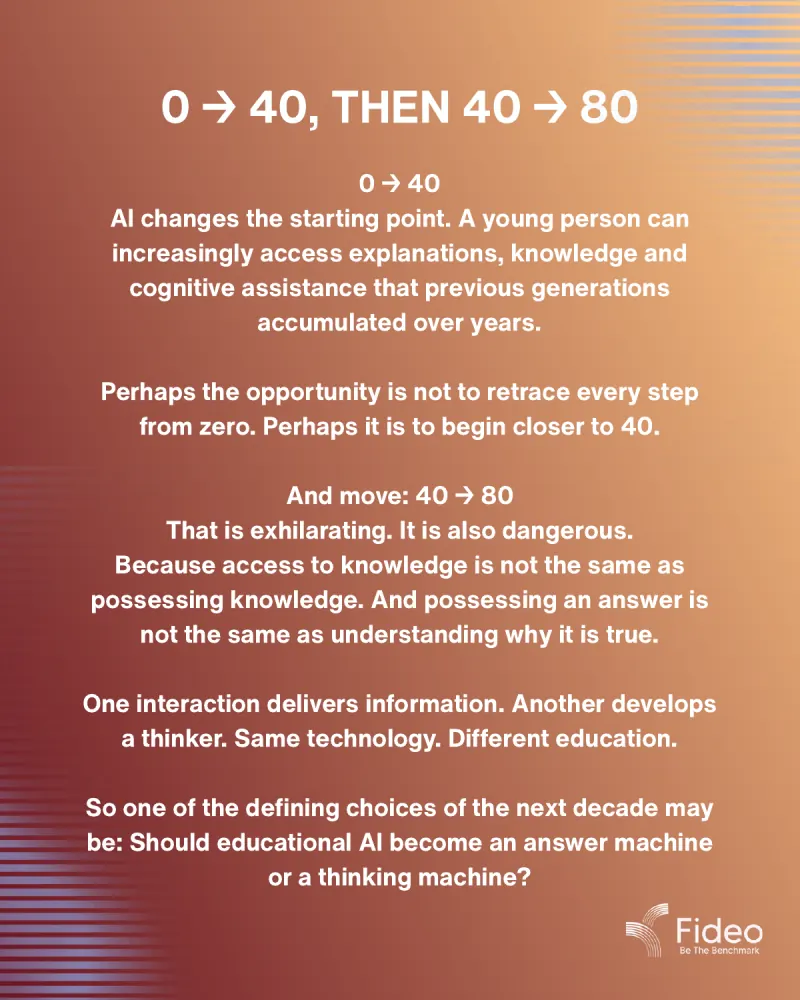
5 / 9 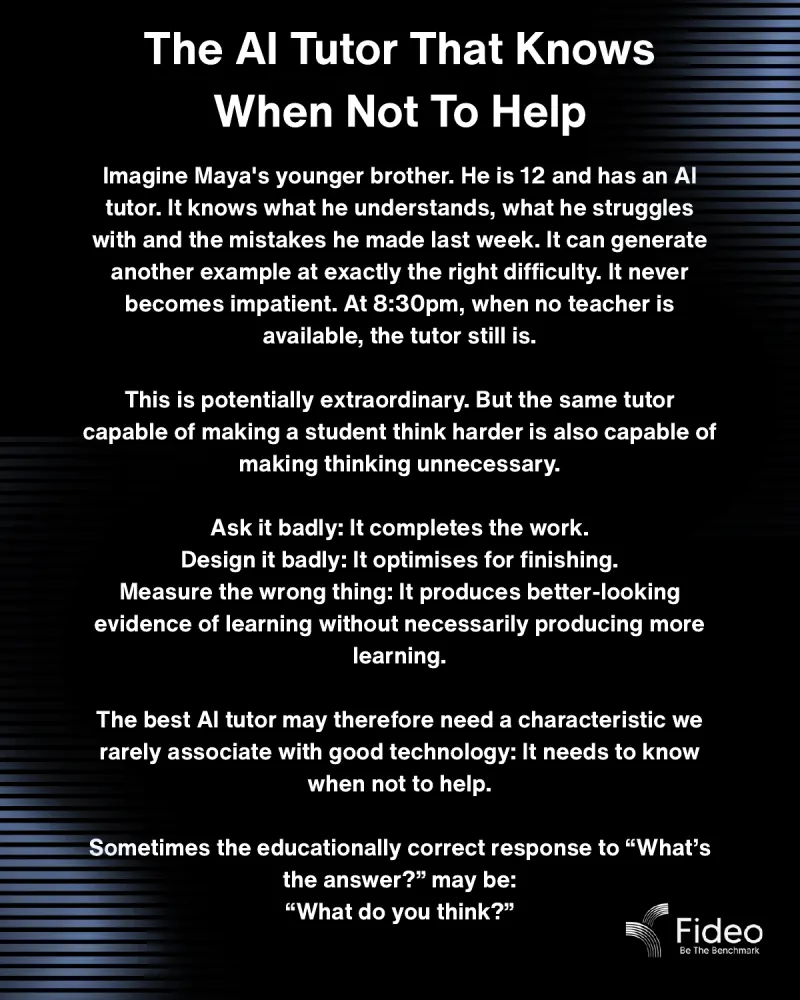
6 / 9 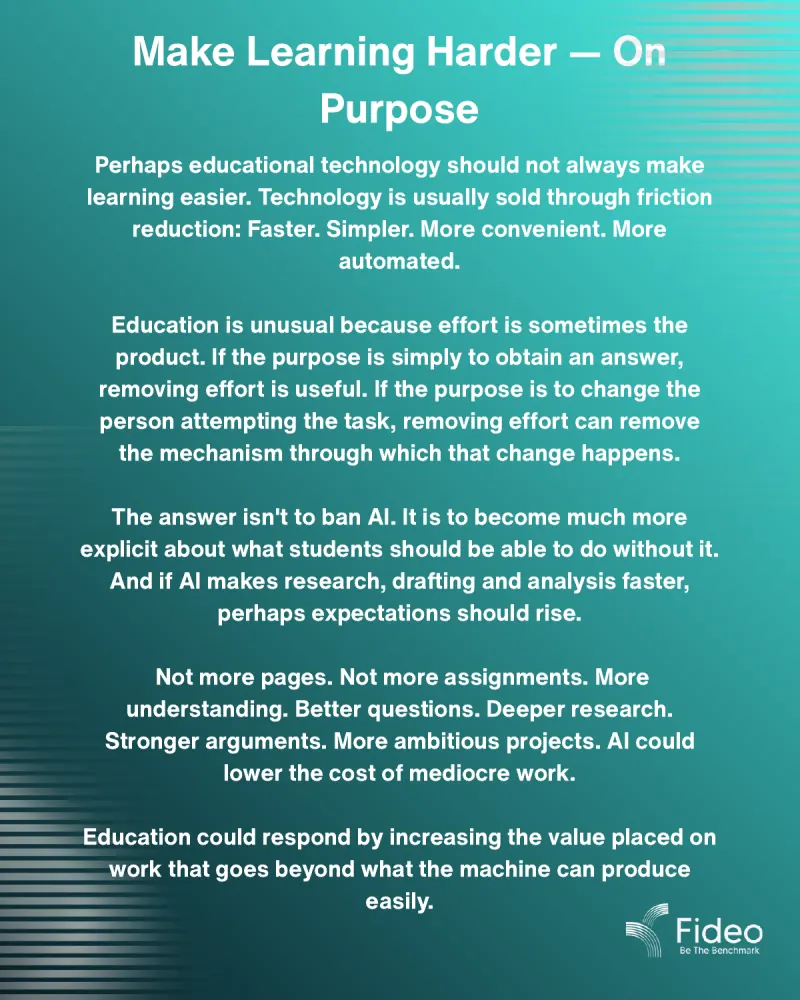
7 / 9 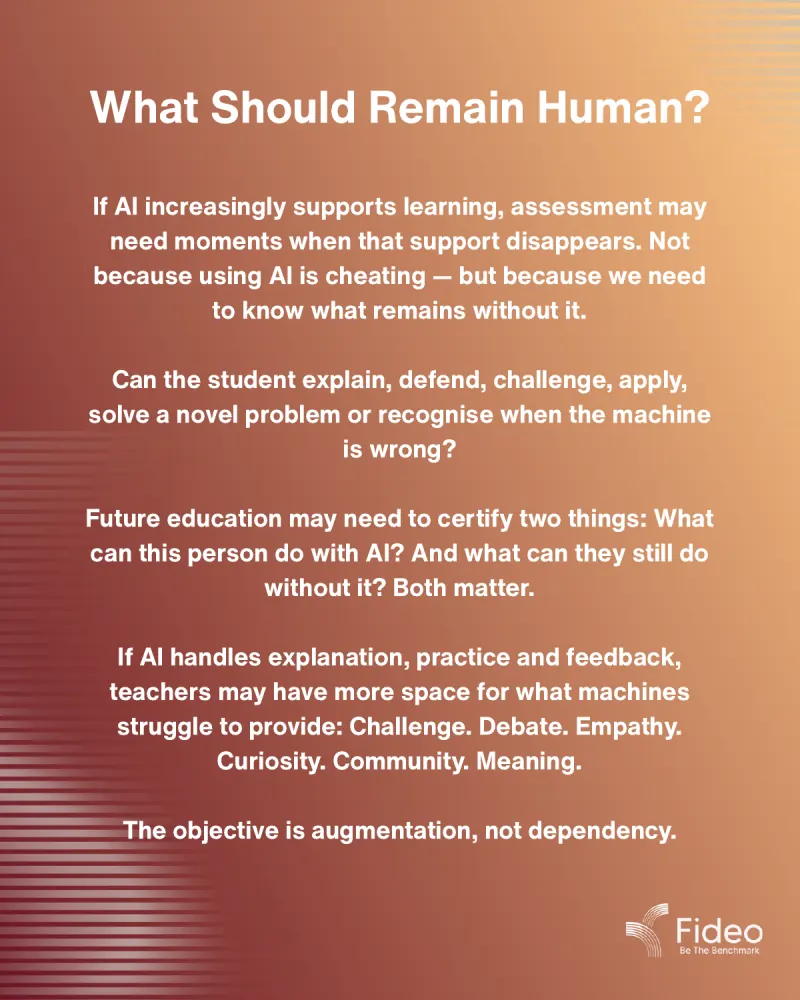
8 / 9 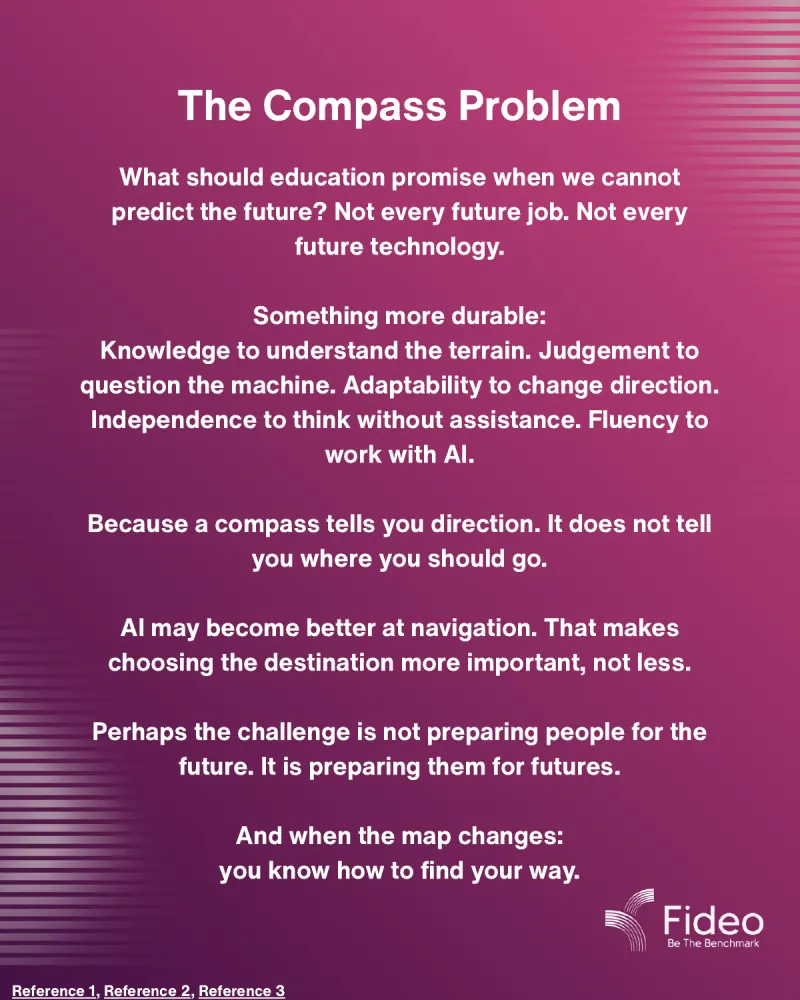
9 / 9
This week in 60 seconds
Why education in the AI era may need to build a compass rather than hand out a map
- A map assumes stable terrain. A compass assumes you may need to find your own route, and the terrain of work may now be moving faster than curricula can adapt.
- Tools such as today's AI interfaces will not last. Slower-changing capabilities like communication, creativity, judgement, problem-solving, adaptability and learning will.
- AI lets learners start closer to 40 rather than zero, but access to knowledge is not possessing it, and having an answer is not understanding why it is true.
- The best AI tutor may need to know when not to help, sometimes replying to "What's the answer?" with "What do you think?"
- Future education may need to certify both what a person can do with AI and what they can still do without it.
Try this with your team
Review one assignment or training task and state explicitly what learners should be able to do without AI. Then add a moment where AI support is removed and check whether they can explain, defend, apply their work or spot when the machine is wrong.
Read this edition as text (5 min)
The Future We Can’t Map
Imagine we were designing education today. Not reforming it. Not adding AI literacy to the curriculum. Starting again. A blank page.
We know students will have access to machines capable of explaining, writing, translating, coding, analysing, researching, tutoring and generating ideas.
We have almost no idea what the labour market they eventually enter will look like. Some jobs do not exist yet. Some existing roles will change beyond recognition. Skills may expire faster. Careers may become less linear.
So we ask a surprisingly difficult question: What exactly should we teach them?
Not for the next exam. Not for their first job. For a world we cannot describe yet.
That may be the real educational problem of the AI era.
MAYA: Preparing For A Moving Target
Imagine Maya. She is 18 and begins university. Her parents want what parents have always wanted: a good education, a useful degree, a promising career and some security.
But even that vocabulary is becoming unstable. What counts as a useful degree? Which career is promising?
Maya uses AI throughout university. It explains difficult concepts, challenges her drafts, creates practice questions, helps her code and models alternative arguments. By her final year, the AI she uses is dramatically more capable than the one she started with. Then she graduates.
Some entry-level tasks have already been automated. Other roles have appeared. Employers want capabilities nobody mentioned at her university induction.
Maya has spent four years preparing for the future. The future has spent those same four years changing.
What should her education have given her? A map? Or the ability to navigate when the map is wrong?
From Map To Compass
We cannot give young people a perfect map. We can help them build a compass. A map assumes the terrain is stable enough to represent. A compass assumes you may have to find your own route.
For much of modern education, we have behaved as though the map was reasonably dependable: Study this. Qualify as that. Enter this profession. Progress through these stages.
Now the terrain itself may be moving. New professions can emerge faster than curricula can adapt. The tools inside those professions may change again almost immediately.
TikTok is not a lifelong capability. Instagram is not a curriculum. Today's AI interface certainly will not be.
Underneath them sit slower-changing capabilities: Communication. Creativity. Judgement. Problem-solving. Adaptability. Learning.
As technology changes faster, education may need to focus more intensely on the things that change slowly.
0 → 40, THEN 40 → 80
0 → 40 AI changes the starting point. A young person can increasingly access explanations, knowledge and cognitive assistance that previous generations accumulated over years.
Perhaps the opportunity is not to retrace every step from zero. Perhaps it is to begin closer to 40.
And move: 40 → 80 That is exhilarating. It is also dangerous. Because access to knowledge is not the same as possessing knowledge. And possessing an answer is not the same as understanding why it is true.
One interaction delivers information. Another develops a thinker. Same technology. Different education.
So one of the defining choices of the next decade may be: Should educational AI become an answer machine or a thinking machine?
The AI Tutor That Knows When Not To Help
Imagine Maya's younger brother. He is 12 and has an AI tutor. It knows what he understands, what he struggles with and the mistakes he made last week. It can generate another example at exactly the right difficulty. It never becomes impatient. At 8:30pm, when no teacher is available, the tutor still is.
This is potentially extraordinary. But the same tutor capable of making a student think harder is also capable of making thinking unnecessary.
Ask it badly: It completes the work. Design it badly: It optimises for finishing. Measure the wrong thing: It produces better-looking evidence of learning without necessarily producing more learning.
The best AI tutor may therefore need a characteristic we rarely associate with good technology: It needs to know when not to help.
Sometimes the educationally correct response to “What’s the answer?” may be: “What do you think?”
Make Learning Harder — On Purpose
Perhaps educational technology should not always make learning easier. Technology is usually sold through friction reduction: Faster. Simpler. More convenient. More automated.
Education is unusual because effort is sometimes the product. If the purpose is simply to obtain an answer, removing effort is useful. If the purpose is to change the person attempting the task, removing effort can remove the mechanism through which that change happens.
The answer isn't to ban AI. It is to become much more explicit about what students should be able to do without it. And if AI makes research, drafting and analysis faster, perhaps expectations should rise.
Not more pages. Not more assignments. More understanding. Better questions. Deeper research. Stronger arguments. More ambitious projects. AI could lower the cost of mediocre work.
Education could respond by increasing the value placed on work that goes beyond what the machine can produce easily.
What Should Remain Human?
If AI increasingly supports learning, assessment may need moments when that support disappears. Not because using AI is cheating — but because we need to know what remains without it.
Can the student explain, defend, challenge, apply, solve a novel problem or recognise when the machine is wrong?
Future education may need to certify two things: What can this person do with AI? And what can they still do without it? Both matter.
If AI handles explanation, practice and feedback, teachers may have more space for what machines struggle to provide: Challenge. Debate. Empathy. Curiosity. Community. Meaning.
The objective is augmentation, not dependency.
The Compass Problem
What should education promise when we cannot predict the future? Not every future job. Not every future technology.
Something more durable: Knowledge to understand the terrain. Judgement to question the machine. Adaptability to change direction. Independence to think without assistance. Fluency to work with AI.
Because a compass tells you direction. It does not tell you where you should go.
AI may become better at navigation. That makes choosing the destination more important, not less.
Perhaps the challenge is not preparing people for the future. It is preparing them for futures.
And when the map changes: you know how to find your way.
Sources
- kevinbryanecon.comkevinbryanecon.com/teachwithai.html
- LinkedInlinkedin.com/posts/chrismayer01_highereducation-futureofemployability-studentsuccess-share
- LinkedInlinkedin.com/pulse/what-we-designed-education-ai-era-from-scratch-tjeerd-hunnekens-uquve/
More questions about this edition
Does the edition argue for banning AI in education?
No. It says the answer is not to ban AI but to be much more explicit about what students should be able to do without it, and perhaps to raise expectations because AI makes research, drafting and analysis faster.
How might AI tutors go wrong?
Asked badly, a tutor completes the work. Designed badly, it optimises for finishing. Measured on the wrong thing, it produces better-looking evidence of learning without necessarily producing more learning.
What role does the edition see for teachers?
If AI handles explanation, practice and feedback, teachers may have more space for what machines struggle to provide: challenge, debate, empathy, curiosity, community and meaning. The aim is augmentation, not dependency.
Get the Zeitgeist every Friday
One email a week with the new edition. Unsubscribe in one click.
Check your inbox to confirm your subscription.
Please enter a valid email address and try again.