Week of 10 to 14 Aug 2026
The expiry date of education: when the world changes faster than the curriculum
1 / 9 
2 / 9 
3 / 9 
4 / 9 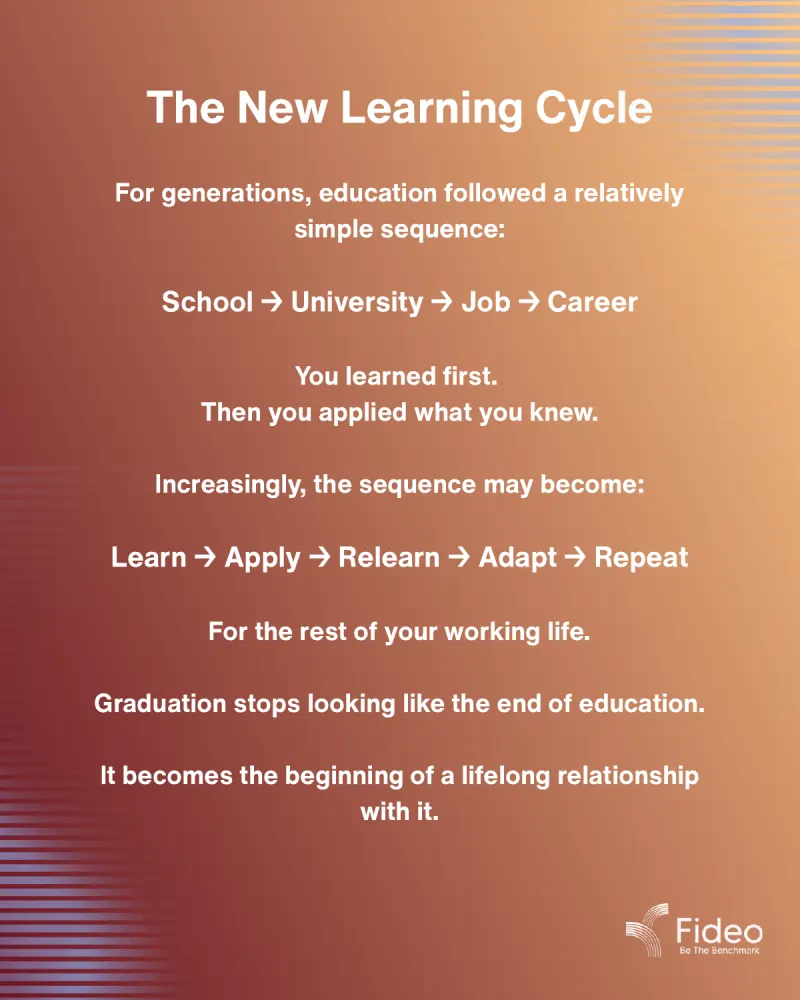
5 / 9 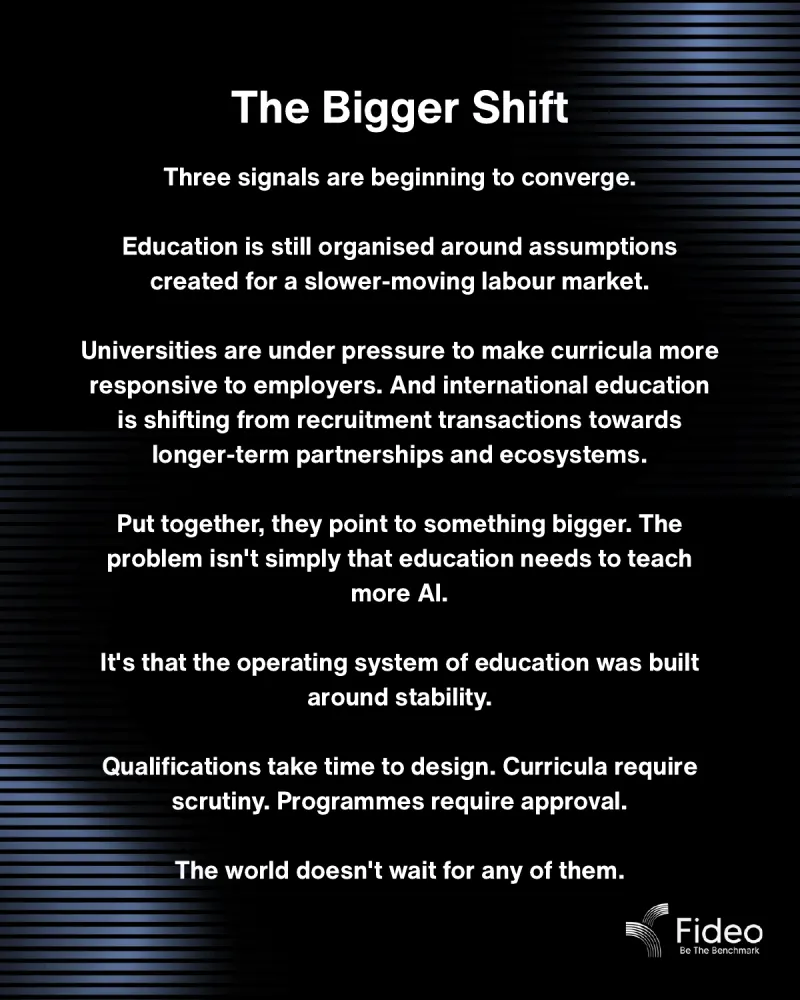
6 / 9 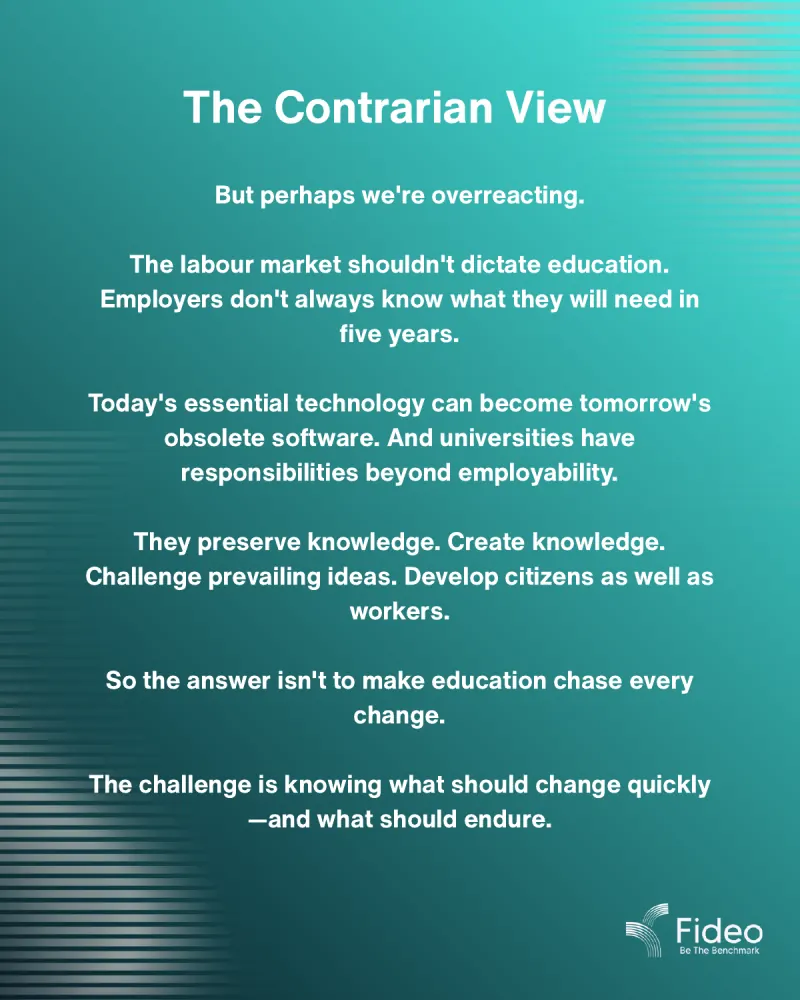
7 / 9 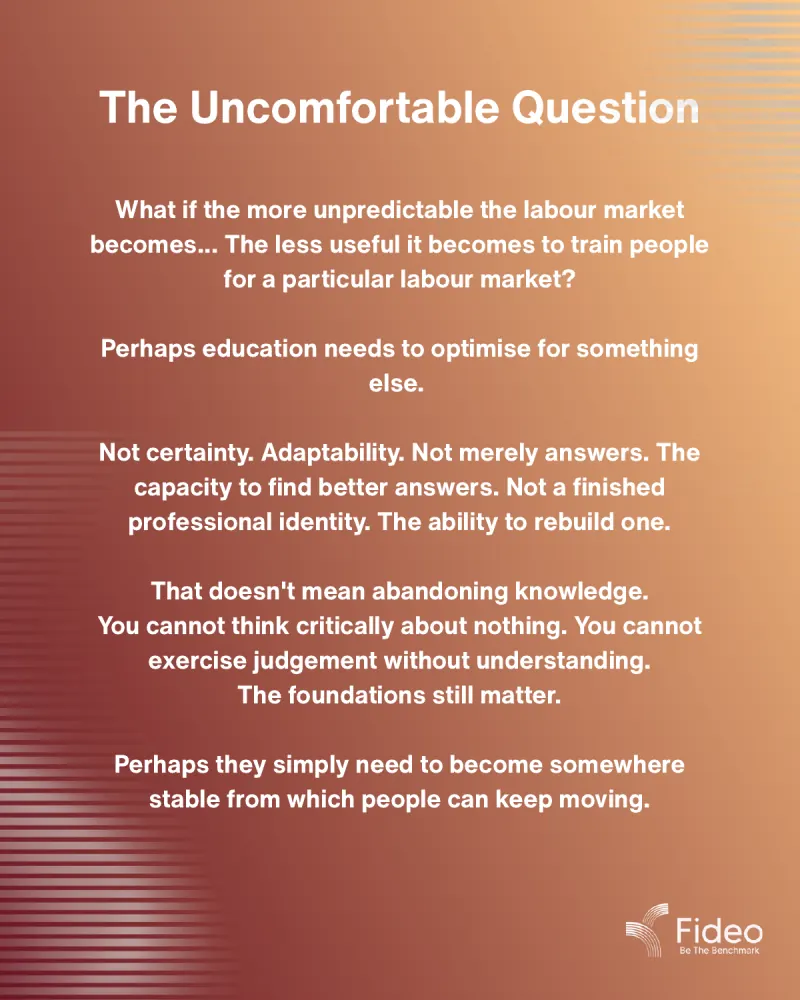
8 / 9 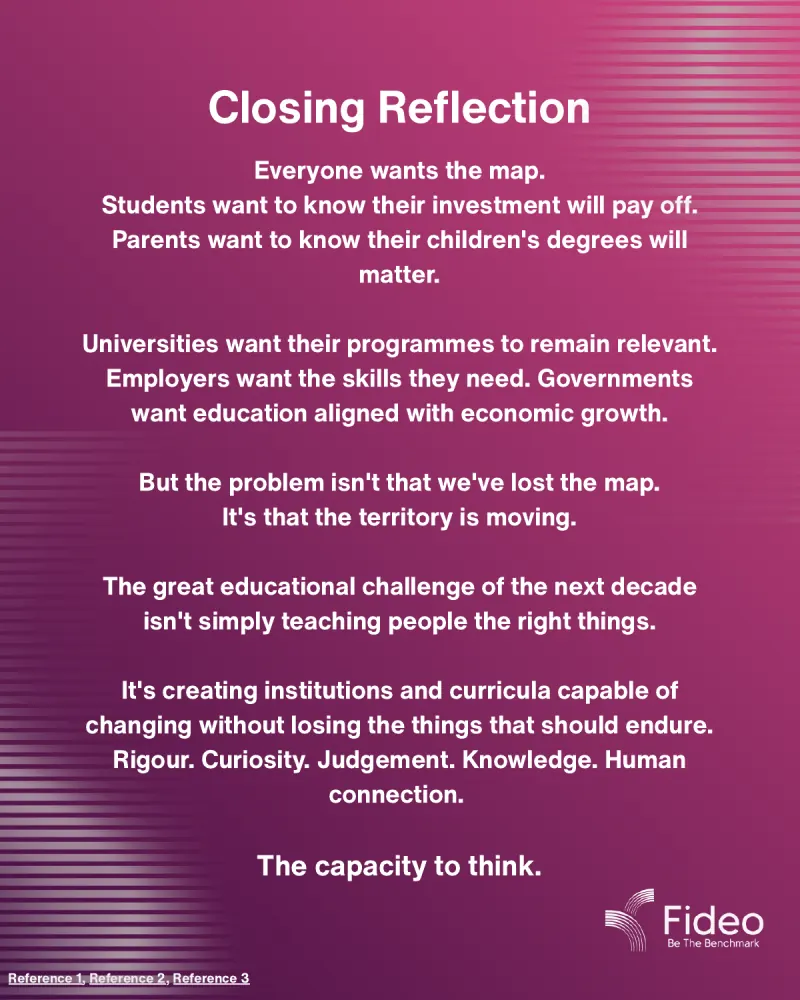
9 / 9
This week in 60 seconds
Why degrees may need two speeds, and what education should optimise for as AI reshapes entry-level work
- Between a student's first lecture and graduation, AI can absorb entry-level tasks and employers can rewrite job descriptions, while curricula change more slowly.
- A degree may need two speeds: a slower layer of knowledge, foundations and critical reasoning, and a faster layer of technology, employer projects and emerging skills.
- Redesigning a curriculum around this month's job adverts prepares students for Tuesday, not the future.
- The linear path of school, university, job and career is giving way to a cycle of learn, apply, relearn, adapt and repeat.
- Education's operating system was built around stability, so the task is building institutions that can change without losing rigour, curiosity, judgement and knowledge.
Try this with your team
Map one programme or training course against the two-speed model: list which elements belong in the slower layer (knowledge, foundations, critical reasoning) and which in the faster layer (technology, employer projects, professional practice, emerging skills), then flag anything in the wrong layer.
Read this edition as text (4 min)
The Moving Target
Imagine starting university this September.
You choose carefully. You look at employment prospects, talk to your parents, read the rankings and ask what employers want.
Then you make one of the largest investments of your young life: three or four years of time and thousands of pounds.
And somewhere between your first lecture and graduation, the job you were preparing for changes.
AI absorbs some entry-level tasks. Employers rewrite job descriptions. New capabilities become valuable. Old ones become easier to automate.
The curriculum changes too. Just more slowly.
Knowledge Has an Expiry Date
Consider Daniel.
He begins university learning research, communication, analytics and campaign planning.
By his second year, AI can already produce research summaries, analyse data, generate campaign concepts, create imagery, draft copy and build presentations.
By graduation, employers may still want marketers— but they may want very different marketers.
Daniel's degree hasn't become useless. It's more complicated than that.
Some of what he learns may remain valuable for decades. Other parts could age before he graduates.
The Two-Speed Degree
This creates a difficult challenge. Education needs to become faster at responding to change.But it becomes less valuable if it simply chases change.
A university that redesigns its curriculum around this month's job advertisements isn't preparing students for the future.
It's preparing them for Tuesday.
Perhaps the degree needs two speeds. A slower layer: knowledge, intellectual foundations, disciplinary expertise and critical reasoning.
A faster layer: technology, employer projects, professional practice and emerging skills.
The first stops education becoming a training manual. The second stops it becoming a museum.
The New Learning Cycle
For generations, education followed a relatively simple sequence:
School → University → Job → Career
You learned first. Then you applied what you knew.
Increasingly, the sequence may become:
Learn → Apply → Relearn → Adapt → Repeat
For the rest of your working life.
Graduation stops looking like the end of education.
It becomes the beginning of a lifelong relationship with it.
The Bigger Shift
Three signals are beginning to converge.
Education is still organised around assumptions created for a slower-moving labour market.
Universities are under pressure to make curricula more responsive to employers. And international education is shifting from recruitment transactions towards longer-term partnerships and ecosystems.
Put together, they point to something bigger. The problem isn't simply that education needs to teach more AI.
It's that the operating system of education was built around stability.
Qualifications take time to design. Curricula require scrutiny. Programmes require approval.
The world doesn't wait for any of them.
The Contrarian View
But perhaps we're overreacting.
The labour market shouldn't dictate education. Employers don't always know what they will need in five years.
Today's essential technology can become tomorrow's obsolete software. And universities have responsibilities beyond employability.
They preserve knowledge. Create knowledge. Challenge prevailing ideas. Develop citizens as well as workers.
So the answer isn't to make education chase every change.
The challenge is knowing what should change quickly —and what should endure.
The Uncomfortable Question
What if the more unpredictable the labour market becomes... The less useful it becomes to train people for a particular labour market?
Perhaps education needs to optimise for something else.
Not certainty. Adaptability. Not merely answers. The capacity to find better answers. Not a finished professional identity. The ability to rebuild one.
That doesn't mean abandoning knowledge. You cannot think critically about nothing. You cannot exercise judgement without understanding. The foundations still matter.
Perhaps they simply need to become somewhere stable from which people can keep moving.
Closing Reflection
Everyone wants the map. Students want to know their investment will pay off. Parents want to know their children's degrees will matter.
Universities want their programmes to remain relevant. Employers want the skills they need. Governments want education aligned with economic growth.
But the problem isn't that we've lost the map. It's that the territory is moving.
The great educational challenge of the next decade isn't simply teaching people the right things.
It's creating institutions and curricula capable of changing without losing the things that should endure. Rigour. Curiosity. Judgement. Knowledge. Human connection.
The capacity to think.
Sources
- LinkedInlinkedin.com/pulse/education-77-trillion-industry-still-planning-labour-market-penfold-epi
- LinkedInlinkedin.com/posts/markrhwallace_highereducation-graduateemployability-curriculum-share-74
- LinkedInlinkedin.com/pulse/future-international-education-why-partnerships-define-kalpesh-mishra-t
More questions about this edition
Does this mean degrees are becoming useless?
No. The edition says a degree has not become useless. Some of what students learn may stay valuable for decades, while other parts could age before they graduate.
Should universities simply follow what employers ask for?
Not entirely. The contrarian view notes employers do not always know what they will need in five years, and universities also preserve and create knowledge, challenge prevailing ideas and develop citizens as well as workers.
What three signals does the edition say are converging?
Education is still organised for a slower-moving labour market, universities face pressure to make curricula more responsive to employers, and international education is shifting from recruitment transactions towards longer-term partnerships and ecosystems.
Get the Zeitgeist every Friday
One email a week with the new edition. Unsubscribe in one click.
Check your inbox to confirm your subscription.
Please enter a valid email address and try again.