Week of 24 to 28 Aug 2026
The competence paradox: when AI makes it easier to perform and harder to become good
1 / 9 
2 / 9 
3 / 9 
4 / 9 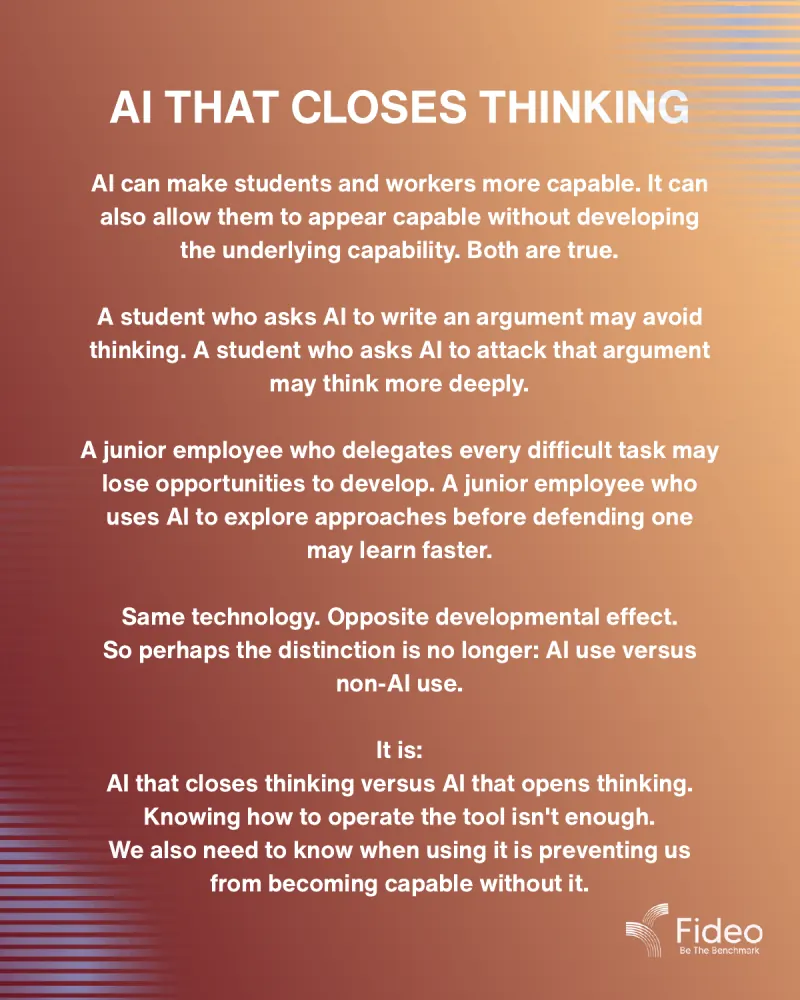
5 / 9 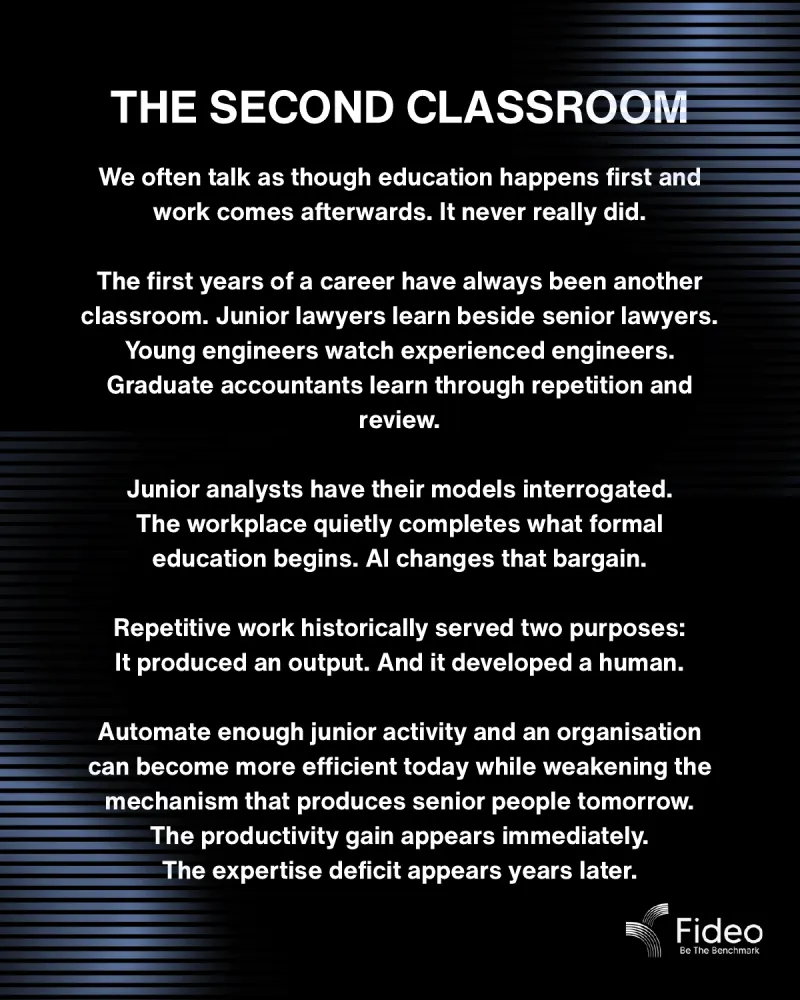
6 / 9 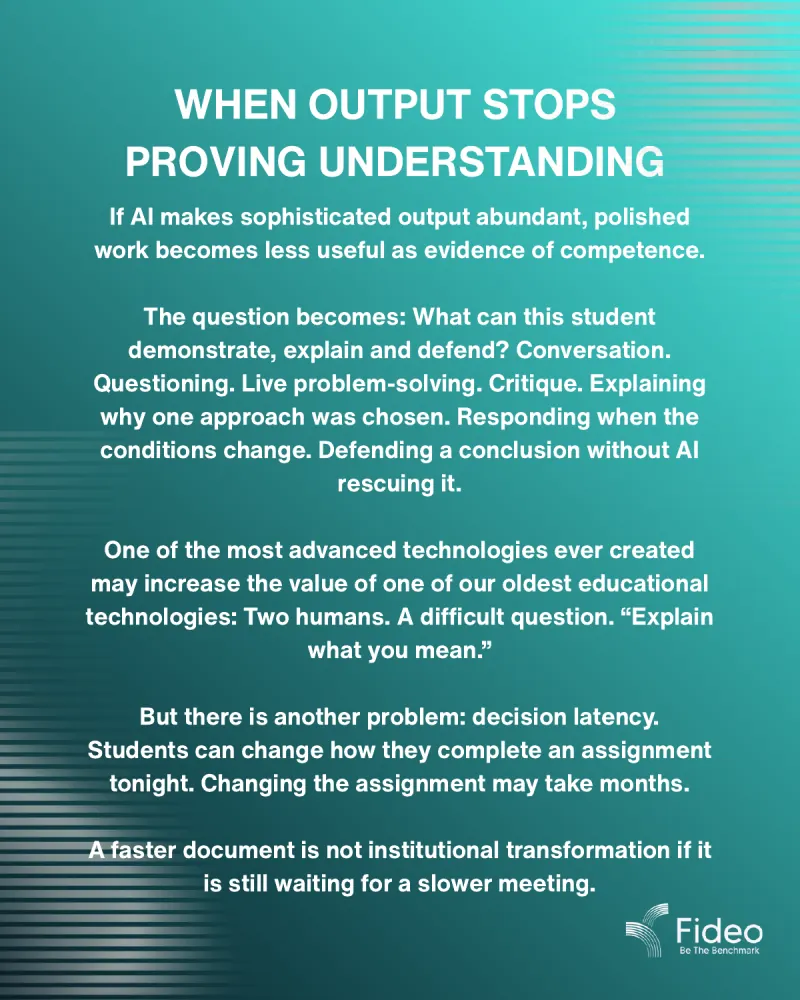
7 / 9 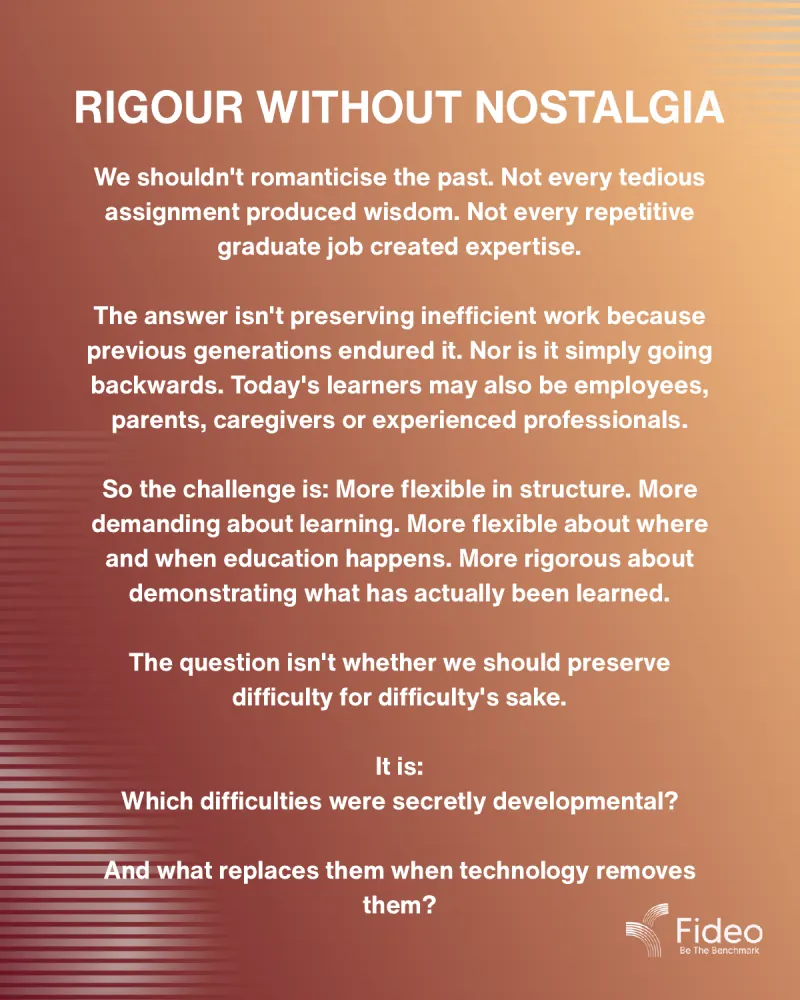
8 / 9 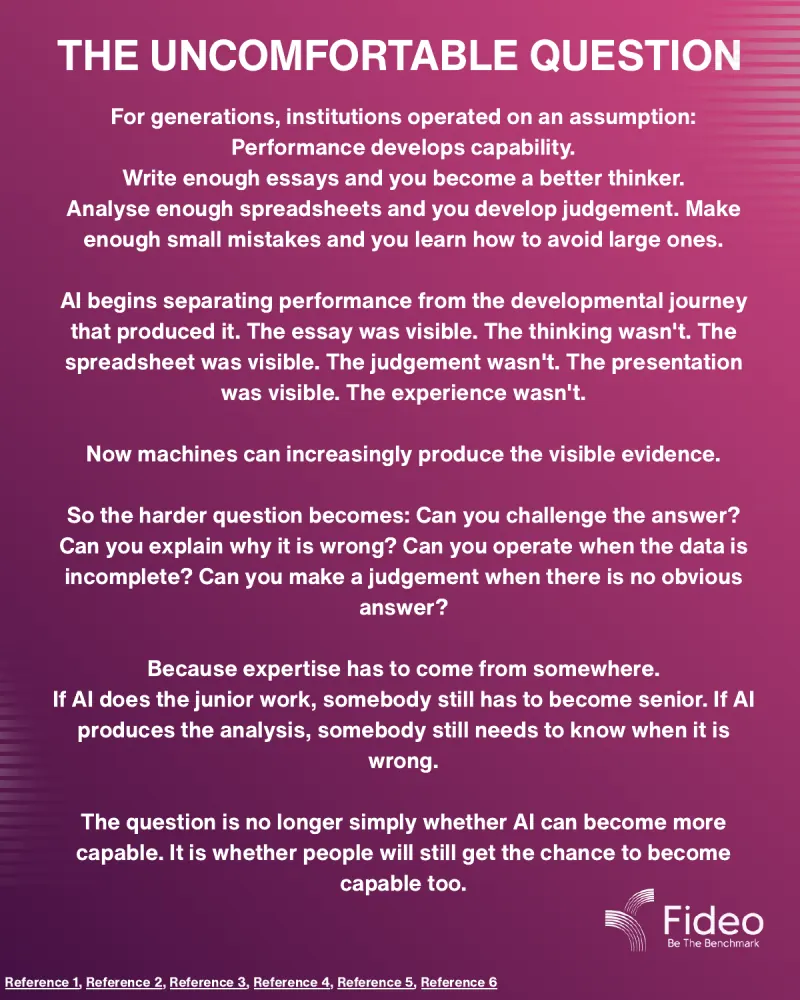
9 / 9
This week in 60 seconds
If AI does the junior work, how does anyone become senior?
- Two graduates with identical degrees may differ sharply in capability, and neither employers, universities nor the students themselves may be able to tell.
- Entry-level work was never merely cheap labour. It was a training system disguised as employment, building judgement through repetition, correction and failure.
- The useful distinction is not AI use versus non-AI use, but AI that closes thinking versus AI that opens thinking.
- Automating junior activity can deliver an immediate productivity gain while creating an expertise deficit that only appears years later.
- As polished output becomes abundant, it proves less about competence, raising the value of conversation, questioning and defending conclusions without AI.
Try this with your team
Instead of asking AI to write an argument or complete a task, ask it to attack your argument or suggest alternative approaches, then explain and defend your chosen approach to a colleague without AI support.
Read this edition as text (5 min)
The Competence Paradox
Imagine two graduates. Same university. Same degree. Same classification. Same polished CV.
Both can research, analyse, write, present and use AI. One spent three years using AI to challenge their thinking — testing arguments, finding weaknesses and exploring alternatives. The other became exceptionally good at producing the outputs university asked for, with AI doing more of the thinking underneath.
Their degrees look the same. Their work may look the same. But are they equally capable?
And here is the problem:
The employer may not know. The university may not know. Perhaps even the students themselves may not know.
What happens when human performance becomes easier to display than human capability is to develop?
THE MISSING APPRENTICESHIP
Consider Emma. She graduates with strong marks and gets her first job.
But the company already uses AI for much of the junior research. First drafts. Routine analysis. Meeting summaries. Basic presentations. She avoids much of the repetitive work older colleagues complained about.
That sounds like progress.
But those colleagues learned something while doing it. Which numbers looked wrong. Which assumptions needed challenging. Which client wasn't saying what they really meant.
They accumulated that knowledge through repetition, correction, observation, failure and experience. Entry-level work was never merely cheap labour. It was also a training system disguised as employment.
If AI completes the beginner work, what work does a beginner do to become senior?
THE SAME PROBLEM, TWO DIRECTIONS
Education and employment are now encountering the same problem.
Graduate pathways are changing. Routine junior roles are under pressure. The shape of entry is changing.
Universities face their own version. AI can research, write, analyse, explain and construct arguments.
But if education were simply about producing correct answers, that wouldn't be a crisis. The essay was supposed to change the person writing it. The problem was supposed to develop the person solving it.
AI increasingly separates two things we once treated as proxies for one another:
Producing the work and Becoming the person capable of producing it.
AI THAT CLOSES THINKING
AI can make students and workers more capable. It can also allow them to appear capable without developing the underlying capability. Both are true.
A student who asks AI to write an argument may avoid thinking. A student who asks AI to attack that argument may think more deeply.
A junior employee who delegates every difficult task may lose opportunities to develop. A junior employee who uses AI to explore approaches before defending one may learn faster.
Same technology. Opposite developmental effect. So perhaps the distinction is no longer: AI use versus non-AI use.
It is: AI that closes thinking versus AI that opens thinking. Knowing how to operate the tool isn't enough. We also need to know when using it is preventing us from becoming capable without it.
THE SECOND CLASSROOM
We often talk as though education happens first and work comes afterwards. It never really did.
The first years of a career have always been another classroom. Junior lawyers learn beside senior lawyers. Young engineers watch experienced engineers. Graduate accountants learn through repetition and review.
Junior analysts have their models interrogated. The workplace quietly completes what formal education begins. AI changes that bargain.
Repetitive work historically served two purposes: It produced an output. And it developed a human.
Automate enough junior activity and an organisation can become more efficient today while weakening the mechanism that produces senior people tomorrow. The productivity gain appears immediately. The expertise deficit appears years later.
WHEN OUTPUT STOPS PROVING UNDERSTANDING
If AI makes sophisticated output abundant, polished work becomes less useful as evidence of competence.
The question becomes: What can this student demonstrate, explain and defend? Conversation. Questioning. Live problem-solving. Critique. Explaining why one approach was chosen. Responding when the conditions change. Defending a conclusion without AI rescuing it.
One of the most advanced technologies ever created may increase the value of one of our oldest educational technologies: Two humans. A difficult question. “Explain what you mean.”
But there is another problem: decision latency. Students can change how they complete an assignment tonight. Changing the assignment may take months.
A faster document is not institutional transformation if it is still waiting for a slower meeting.
RIGOUR WITHOUT NOSTALGIA
We shouldn't romanticise the past. Not every tedious assignment produced wisdom. Not every repetitive graduate job created expertise.
The answer isn't preserving inefficient work because previous generations endured it. Nor is it simply going backwards. Today's learners may also be employees, parents, caregivers or experienced professionals.
So the challenge is: More flexible in structure. More demanding about learning. More flexible about where and when education happens. More rigorous about demonstrating what has actually been learned.
The question isn't whether we should preserve difficulty for difficulty's sake.
It is: Which difficulties were secretly developmental?
And what replaces them when technology removes them?
THE UNCOMFORTABLE QUESTION
For generations, institutions operated on an assumption: Performance develops capability. Write enough essays and you become a better thinker. Analyse enough spreadsheets and you develop judgement. Make enough small mistakes and you learn how to avoid large ones.
AI begins separating performance from the developmental journey that produced it. The essay was visible. The thinking wasn't. The spreadsheet was visible. The judgement wasn't. The presentation was visible. The experience wasn't.
Now machines can increasingly produce the visible evidence.
So the harder question becomes: Can you challenge the answer? Can you explain why it is wrong? Can you operate when the data is incomplete? Can you make a judgement when there is no obvious answer?
Because expertise has to come from somewhere. If AI does the junior work, somebody still has to become senior. If AI produces the analysis, somebody still needs to know when it is wrong.
The question is no longer simply whether AI can become more capable. It is whether people will still get the chance to become capable too.
Sources
- LinkedInlinkedin.com/posts/charles-duignan-29764866_youthemployment-graduatejobs-futureofwork-shar
- futurism.comfuturism.com/future-society/college-critical-thinking-ai
- LinkedInlinkedin.com/posts/assaaddib_highereducation-ukhe-artificialintelligence-activity-74969612
- rupertwegerif.substack.comrupertwegerif.substack.com/p/what-makes-education-educational
- LinkedInlinkedin.com/posts/chrismayer01_highereducation-studentsuccess-institutionaldesign-share-7
- LinkedInlinkedin.com/posts/kevindeasy_yesterday-inspired-by-jose-santiago-i-wrote-share-7498691457
More questions about this edition
Does the edition argue for preserving tedious work as it was?
No. It says not every tedious assignment produced wisdom and the answer is not preserving inefficient work. The task is to identify which difficulties were secretly developmental and decide what replaces them.
What is decision latency in this context?
Students can change how they complete an assignment overnight, but institutions may take months to change the assignment itself. A faster document is not transformation if it still waits for a slower meeting.
What should education look like in response?
The edition calls for education that is more flexible in structure and in where and when it happens, while being more demanding about learning and more rigorous about demonstrating what has actually been learned.
Get the Zeitgeist every Friday
One email a week with the new edition. Unsubscribe in one click.
Check your inbox to confirm your subscription.
Please enter a valid email address and try again.