Week of 28 Sept to 2 Oct 2026
The proof problem: when the answer is no longer the evidence
1 / 9 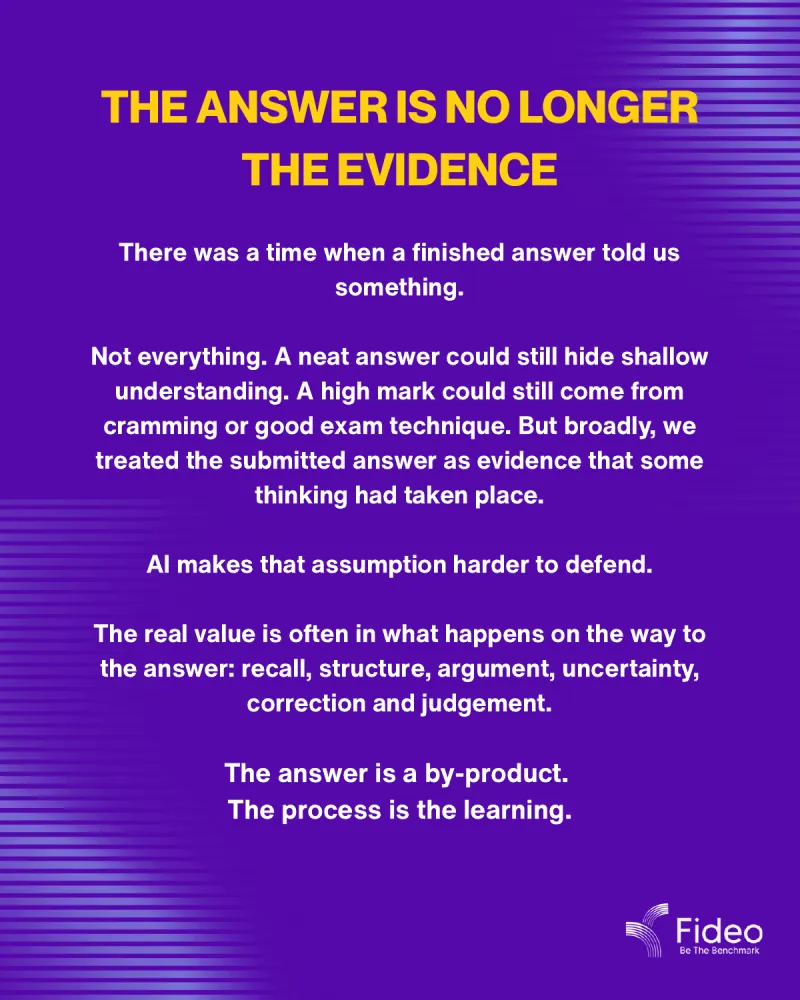
2 / 9 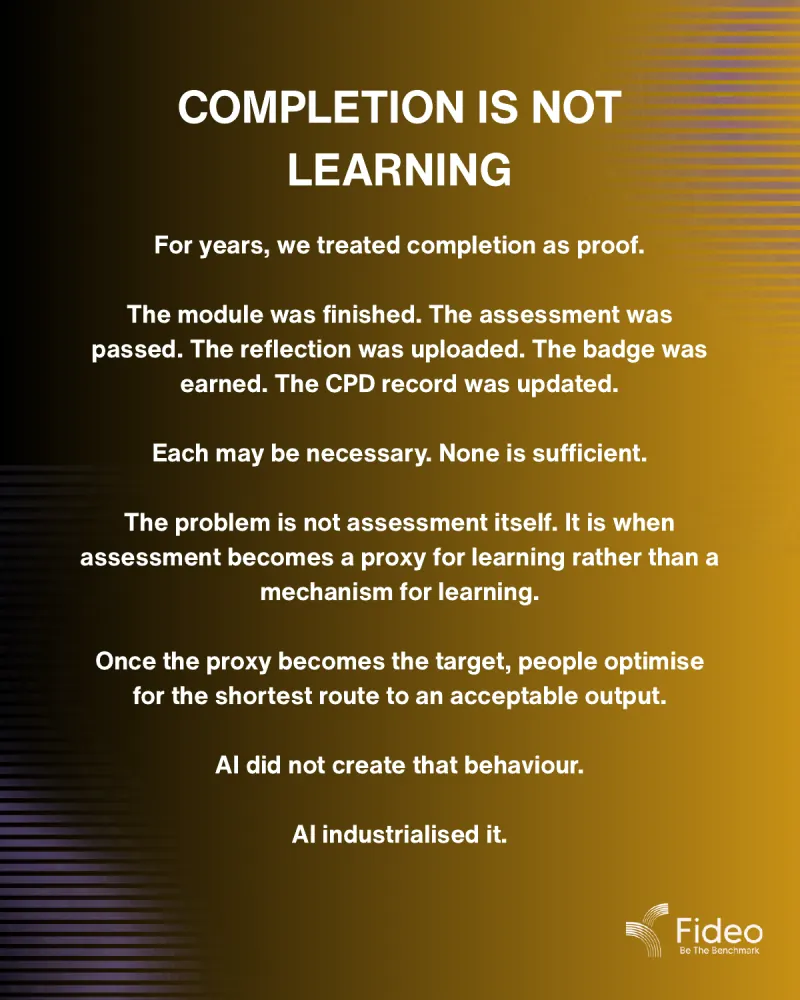
3 / 9 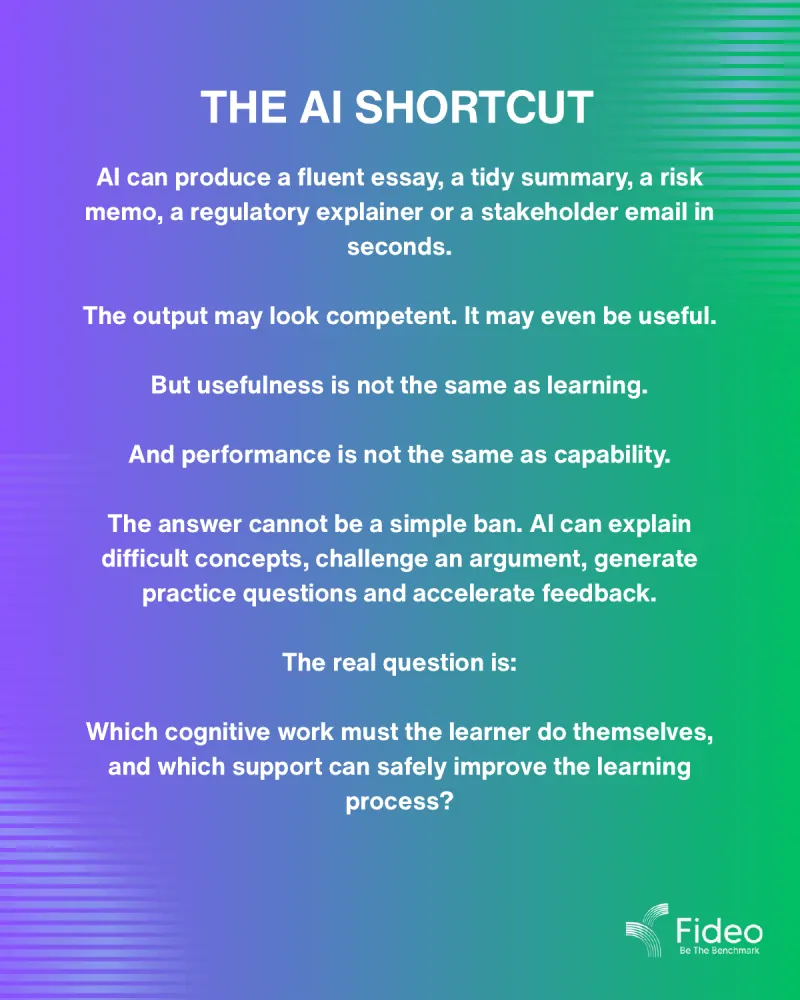
4 / 9 
5 / 9 
6 / 9 
7 / 9 
8 / 9 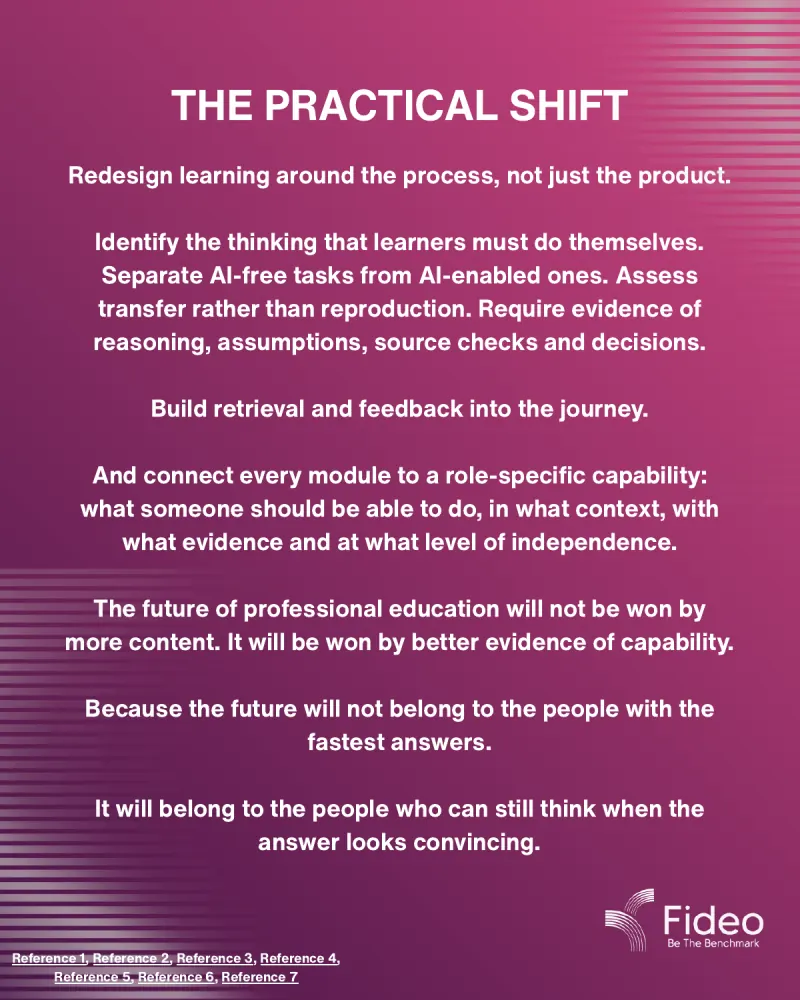
9 / 9
This week in 60 seconds
AI makes finished answers a weak signal of learning, so professional education must evidence capability, not completion
- The answer is a by-product and the process is the learning: recall, structure, argument, uncertainty, correction and judgement.
- AI did not create the habit of optimising for completion as a proxy for learning. It industrialised it.
- Usefulness is not learning and performance is not capability. A simple ban on AI is not the answer.
- In regulated fields, capability means spotting weak controls, identifying money laundering typologies and explaining why an AI output is attractive but wrong.
- AI literacy for regulated firms means using AI without weakening judgement, and it must be taught, practised and evidenced.
Try this with your team
Take one existing training module and map it to a role-specific capability: what someone should be able to do, in what context, with what evidence and at what level of independence. Then separate its AI-free tasks from AI-enabled ones and require evidence of reasoning, assumptions, source checks and decisions.
Read this edition as text (4 min)
THE ANSWER IS NO LONGER THE EVIDENCE
There was a time when a finished answer told us something.
Not everything. A neat answer could still hide shallow understanding. A high mark could still come from cramming or good exam technique. But broadly, we treated the submitted answer as evidence that some thinking had taken place.
AI makes that assumption harder to defend.
The real value is often in what happens on the way to the answer: recall, structure, argument, uncertainty, correction and judgement.
The answer is a by-product. The process is the learning.
COMPLETION IS NOT LEARNING
For years, we treated completion as proof.
The module was finished. The assessment was passed. The reflection was uploaded. The badge was earned. The CPD record was updated.
Each may be necessary. None is sufficient.
The problem is not assessment itself. It is when assessment becomes a proxy for learning rather than a mechanism for learning.
Once the proxy becomes the target, people optimise for the shortest route to an acceptable output.
AI did not create that behaviour.
AI industrialised it.
THE AI SHORTCUT
AI can produce a fluent essay, a tidy summary, a risk memo, a regulatory explainer or a stakeholder email in seconds.
The output may look competent. It may even be useful.
But usefulness is not the same as learning.
And performance is not the same as capability.
The answer cannot be a simple ban. AI can explain difficult concepts, challenge an argument, generate practice questions and accelerate feedback.
The real question is:
Which cognitive work must the learner do themselves, and which support can safely improve the learning process?
WHERE CAPABILITY ACTUALLY MATTERS
In financial services, compliance, fintech, risk, payments, digital assets and AI governance, the issue is not whether someone can produce a plausible paragraph.
Can they recognise a weak control? Distinguish a policy statement from an operational control? Identify a money laundering typology in a messy fact pattern?
Can they explain why an AI output is attractive but wrong? Turn a regulatory requirement into a workflow, a control, a responsibility and evidence for audit?
These are not answer-production skills.
They are capability skills.
They require practice, feedback, retrieval, scenario exposure, reflection and the ability to work through uncertainty.
AI LITERACY IS NOT JUST KNOWING AI
AI literacy is becoming a professional requirement.
But for a regulated firm, it cannot mean simply knowing that AI has risks.
It means knowing when not to rely on it.
Knowing what evidence to preserve. Knowing how to validate an output. Knowing which decisions cannot be delegated. Knowing when an AI-generated explanation is plausible but incomplete.
AI literacy is not just knowledge about AI.
It is the ability to use AI without weakening judgement.
And that is a capability that has to be taught, practised and evidenced.
THE QUESTION FOR PROFESSIONAL EDUCATION
If learning is a process, professional education cannot be built around isolated content, passive consumption or easy-to-complete assessments.
It needs repeated cycles of practice, evidence and transfer.
The uncomfortable question for education providers, employers, universities, professional bodies and regulated firms is:
Are we designing learning experiences that create capability — or evidence trails that merely suggest it?
Because AI makes the second option dangerously easy.
A learner can produce a strong reflection without reflecting. A candidate can sound fluent without being ready. A course can look modern because it uses AI while quietly removing the friction through which expertise is formed.
That is the paradox.
WHAT SHOULD WE WATCH?
The serious shift will be in how learning is evidenced.
Assessment will move beyond “can this be submitted?” towards what cognitive process the learner can demonstrate: live scenarios, simulations, reflective logs, supervised application and unfamiliar situations.
Credentials will increasingly need to evidence capability, not just completion.
AI literacy will move from generic awareness to role- specific judgement.
And as AI changes entry-level work, organisations will need to protect the learning mechanisms hidden inside that work — not simply automate them away.
The question is no longer just what someone knows.
It is what they can do with it.
THE PRACTICAL SHIFT
Redesign learning around the process, not just the product.
Identify the thinking that learners must do themselves. Separate AI-free tasks from AI-enabled ones. Assess transfer rather than reproduction. Require evidence of reasoning, assumptions, source checks and decisions.
Build retrieval and feedback into the journey.
And connect every module to a role-specific capability: what someone should be able to do, in what context, with what evidence and at what level of independence.
The future of professional education will not be won by more content. It will be won by better evidence of capability.
Because the future will not belong to the people with the fastest answers.
It will belong to the people who can still think when the answer looks convincing.
Sources
- pedley-smith.ukpedley-smith.uk/2026/09/30/learning-is-a-process-not-a-destination/
- bjorklab.psych.ucla.edubjorklab.psych.ucla.edu/wp-content/uploads/sites/13/2016/07/Soderstrom_Bjork_Learning_vers
- hepi.ac.ukhepi.ac.uk/reports/student-generative-ai-survey-2025/
- assets.nationbuilder.comassets.nationbuilder.com/stonehaven/pages/6430/attachments/original/1790070901/Britain%27s
- digital-strategy.ec.europa.eudigital-strategy.ec.europa.eu/en/faqs/ai-literacy-questions-answers
- weforum.orgweforum.org/publications/the-future-of-jobs-report-2025/digest/
- oecd.orgoecd.org/en/publications/ai-and-skills_f843b352-en/full-report.html
More questions about this edition
How is assessment expected to change?
The edition expects assessment to move beyond whether something can be submitted towards the cognitive process a learner can demonstrate, using live scenarios, simulations, reflective logs, supervised application and unfamiliar situations.
What is the paradox the edition describes?
AI makes it dangerously easy to design evidence trails that merely suggest capability. A learner can write a strong reflection without reflecting, and a course can look modern by using AI while removing the friction through which expertise is formed.
Why does entry-level work matter here?
As AI changes entry-level work, organisations will need to protect the learning mechanisms hidden inside that work rather than simply automate them away.
Get the Zeitgeist every Friday
One email a week with the new edition. Unsubscribe in one click.
Check your inbox to confirm your subscription.
Please enter a valid email address and try again.