Week of 20 to 24 Jul 2026
The end of prediction as a competitive advantage
1 / 9 
2 / 9 
3 / 9 
4 / 9 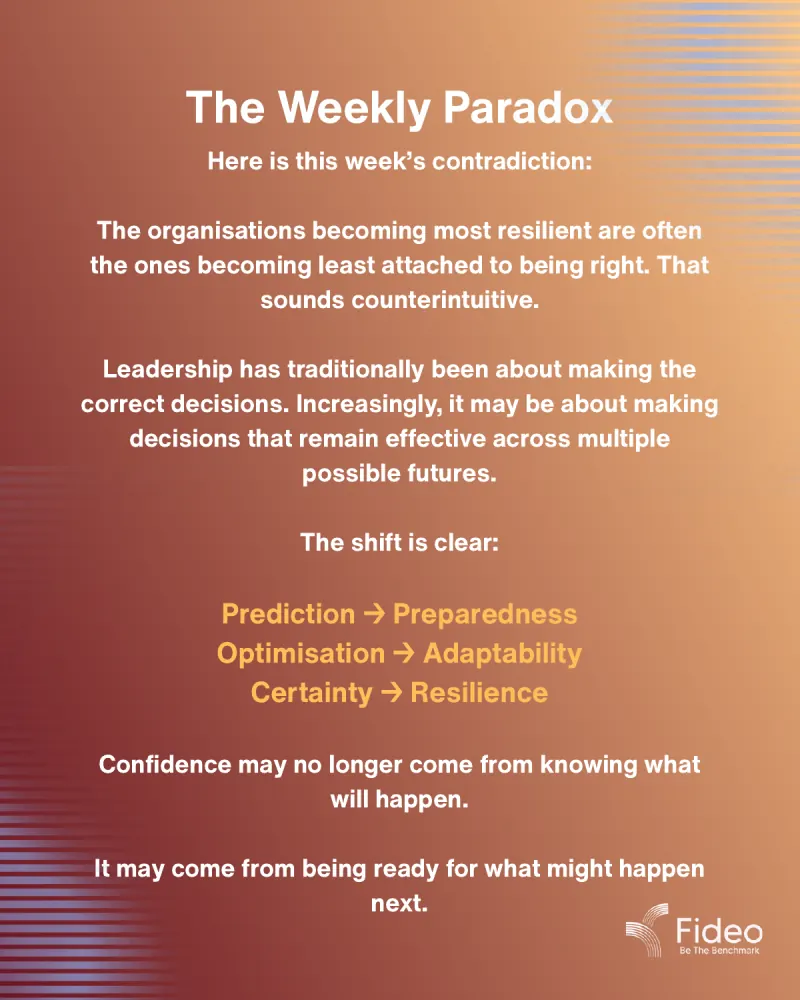
5 / 9 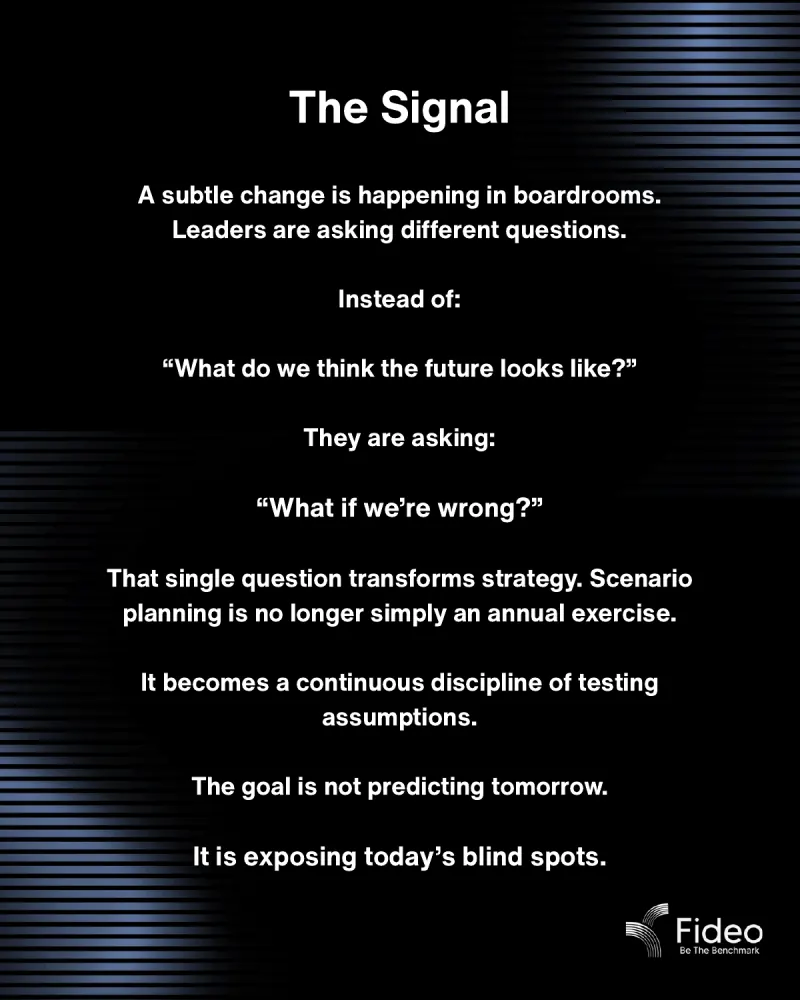
6 / 9 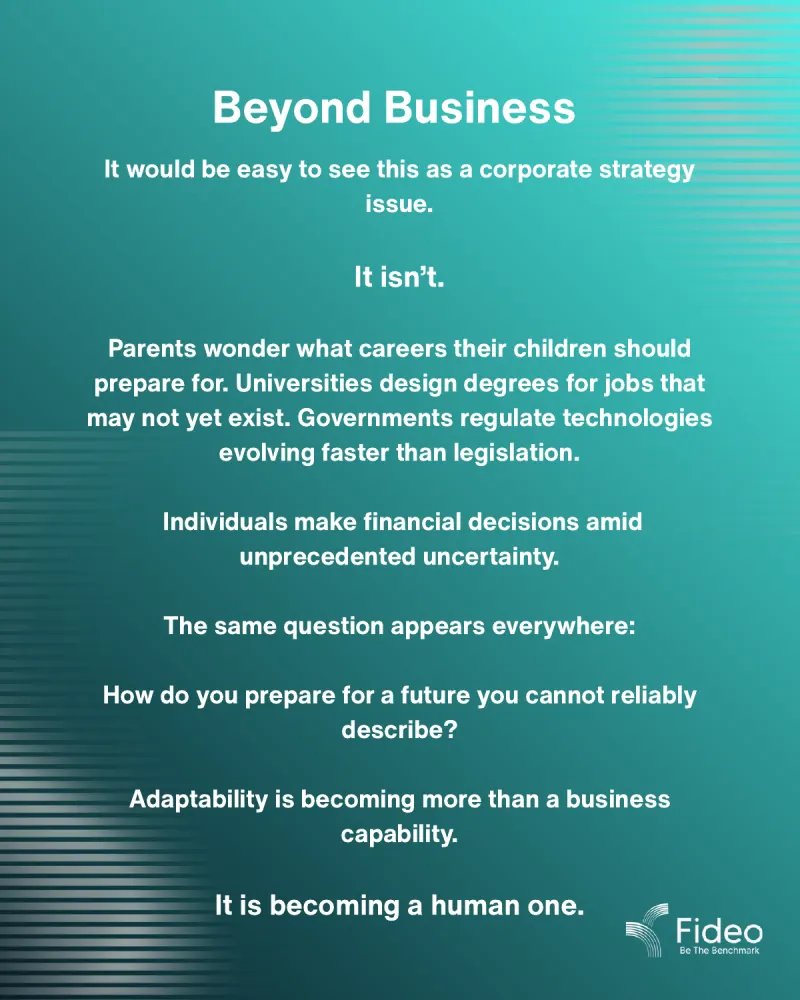
7 / 9 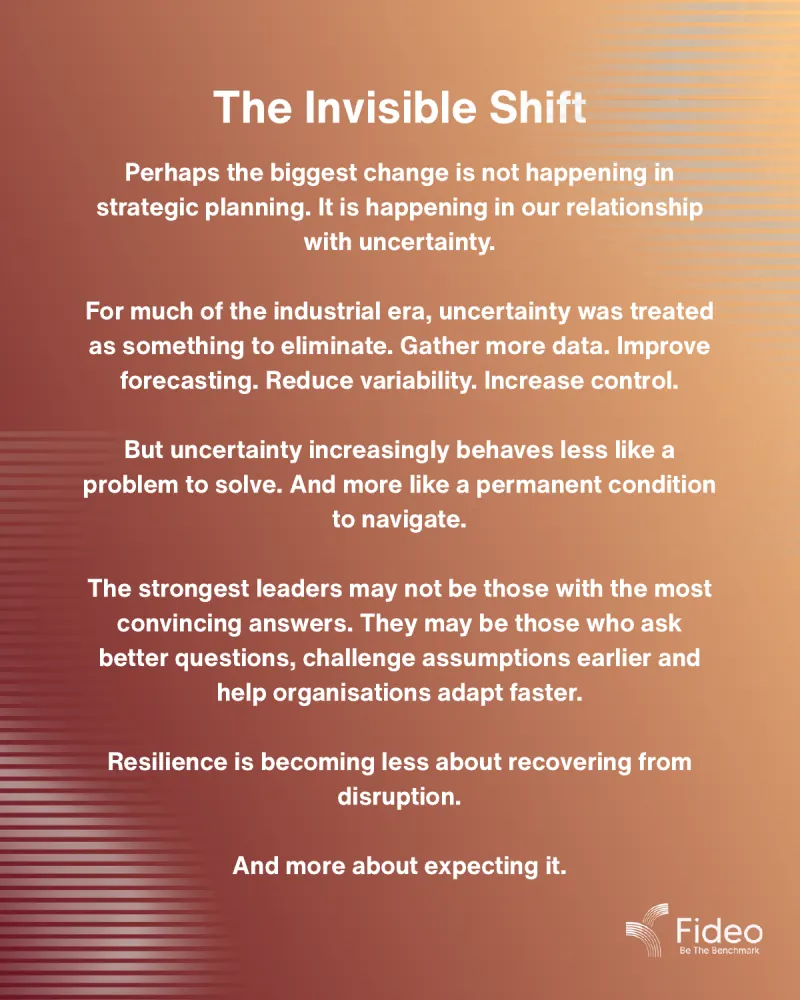
8 / 9 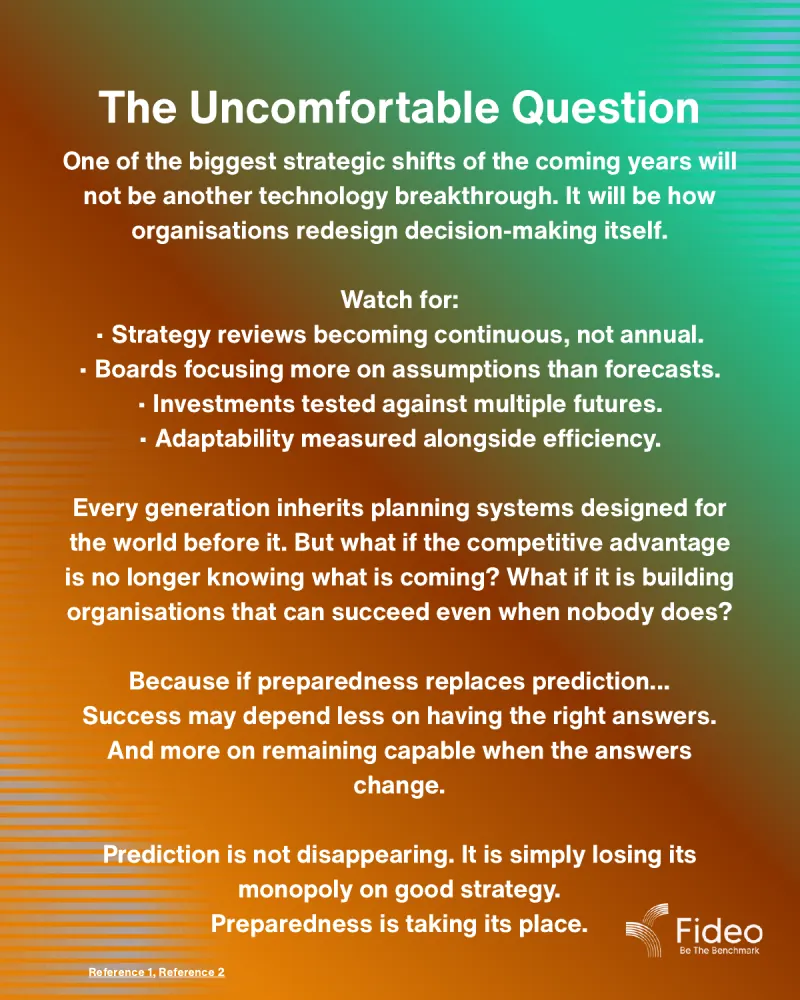
9 / 9
This week in 60 seconds
Why preparedness is becoming the new strategy
- The environment has become harder to forecast, not because leaders got worse, but because AI, geopolitics, climate and demographics now interact.
- The key question is shifting from which future is most likely to which futures we cannot afford to ignore.
- Scenario planning is returning as a continuous discipline of testing assumptions, not an annual exercise.
- The shift runs from prediction to preparedness, optimisation to adaptability, and certainty to resilience.
- Watch for continuous strategy reviews, boards focused on assumptions, investments tested against multiple futures and adaptability measured alongside efficiency.
Try this with your team
Take your current strategic plan and ask the boardroom question the edition poses: what happens if none of these assumptions hold? List the core assumptions, then test key investments against several possible futures to expose today's blind spots.
Read this edition as text (4 min)
The Fragility of Forecasting
Imagine you're sitting in the boardroom in September 2026.
The executive team has spent six months refining the organisation's five-year strategic plan. Market forecasts have been modelled. Economic assumptions debated. Customer trends analysed. Investment priorities agreed. The document is polished. The numbers are robust. Everyone feels reassured.
Then someone asks: “What happens if none of these assumptions hold?” The room goes quiet. Because everyone realises the strategy only works if the future behaves itself.
For decades, prediction has been treated as a competitive advantage. But the future is becoming increasingly resistant to being forecast.
The defining capability of the next decade may not be predicting what happens next.
It may be remaining effective regardless of what happens next.
The Shift From Prediction
For much of modern business, the organisation with the clearest vision, strongest forecasts and best intelligence was expected to make the best decisions.
Today, that assumption is beginning to fracture.
Not because leaders have become worse at forecasting. Because the environment has become harder to forecast.
AI is reshaping industries. Geopolitical tensions create disruption. Climate events affect supply chains. Consumer expectations shift faster than planning cycles.
The challenge is no longer: “Which future is most likely?”
It is:
“Which futures can we not afford to ignore?”
What We're Actually Seeing
Across business, government and education, a quiet shift is taking place.
Traditional forecasting was built for environments where change was relatively linear.
Today’s environment is defined by interaction. Technology affects geopolitics. Climate risk affects supply chains. Demographics reshape labour markets.
AI accelerates everything simultaneously.
The result is not simply greater uncertainty. It is greater interdependence. Small events increasingly create disproportionate consequences.
This is why scenario planning is returning.
Not because organisations believe they can predict every future. Because they recognise they cannot rely on predicting just one.
The Weekly Paradox
Here is this week’s contradiction:
The organisations becoming most resilient are often the ones becoming least attached to being right. That sounds counterintuitive.
Leadership has traditionally been about making the correct decisions. Increasingly, it may be about making decisions that remain effective across multiple possible futures.
The shift is clear:
Prediction → Preparedness Optimisation → Adaptability Certainty → Resilience
Confidence may no longer come from knowing what will happen.
It may come from being ready for what might happen next.
The Signal
A subtle change is happening in boardrooms. Leaders are asking different questions.
Instead of:
“What do we think the future looks like?”
They are asking:
“What if we’re wrong?”
That single question transforms strategy. Scenario planning is no longer simply an annual exercise.
It becomes a continuous discipline of testing assumptions.
The goal is not predicting tomorrow.
It is exposing today’s blind spots.
Beyond Business
It would be easy to see this as a corporate strategy issue.
It isn’t.
Parents wonder what careers their children should prepare for. Universities design degrees for jobs that may not yet exist. Governments regulate technologies evolving faster than legislation.
Individuals make financial decisions amid unprecedented uncertainty.
The same question appears everywhere:
How do you prepare for a future you cannot reliably describe?
Adaptability is becoming more than a business capability.
It is becoming a human one.
The Invisible Shift
Perhaps the biggest change is not happening in strategic planning. It is happening in our relationship with uncertainty.
For much of the industrial era, uncertainty was treated as something to eliminate. Gather more data. Improve forecasting. Reduce variability. Increase control.
But uncertainty increasingly behaves less like a problem to solve. And more like a permanent condition to navigate.
The strongest leaders may not be those with the most convincing answers. They may be those who ask better questions, challenge assumptions earlier and help organisations adapt faster.
Resilience is becoming less about recovering from disruption.
And more about expecting it.
The Uncomfortable Question
One of the biggest strategic shifts of the coming years will not be another technology breakthrough. It will be how organisations redesign decision-making itself.
Watch for: • Strategy reviews becoming continuous, not annual. • Boards focusing more on assumptions than forecasts. • Investments tested against multiple futures. • Adaptability measured alongside efficiency.
Every generation inherits planning systems designed for the world before it. But what if the competitive advantage is no longer knowing what is coming? What if it is building organisations that can succeed even when nobody does?
Because if preparedness replaces prediction... Success may depend less on having the right answers. And more on remaining capable when the answers change.
Prediction is not disappearing. It is simply losing its monopoly on good strategy. Preparedness is taking its place.
Sources
- LinkedInlinkedin.com/posts/chrismayer01_highereducation-strategicforesight-scenarioplanning-share-
- forbes.comforbes.com/sites/deloitte/2026/06/30/strengthening-organizational-resilience-what-does-eff
More questions about this edition
Is prediction becoming useless?
No. The edition says prediction is not disappearing. It is losing its monopoly on good strategy, with preparedness taking its place.
Does this only matter for businesses?
No. Parents, universities, governments and individuals all face the same question of how to prepare for a future they cannot reliably describe, so adaptability is becoming a human capability.
What kind of leader does this shift favour?
Leaders who ask better questions, challenge assumptions earlier and help organisations adapt faster, rather than those with the most convincing answers.
Get the Zeitgeist every Friday
One email a week with the new edition. Unsubscribe in one click.
Check your inbox to confirm your subscription.
Please enter a valid email address and try again.