Week of 13 to 17 Jul 2026
When intelligence becomes infinite, what is education for?
1 / 9 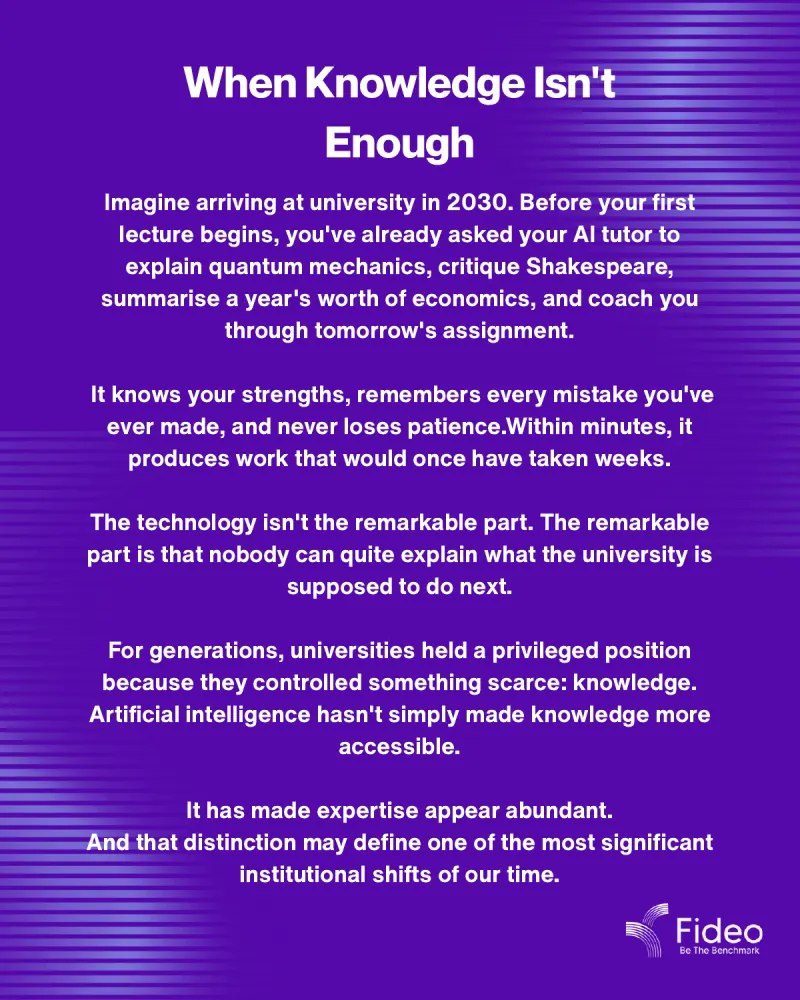
2 / 9 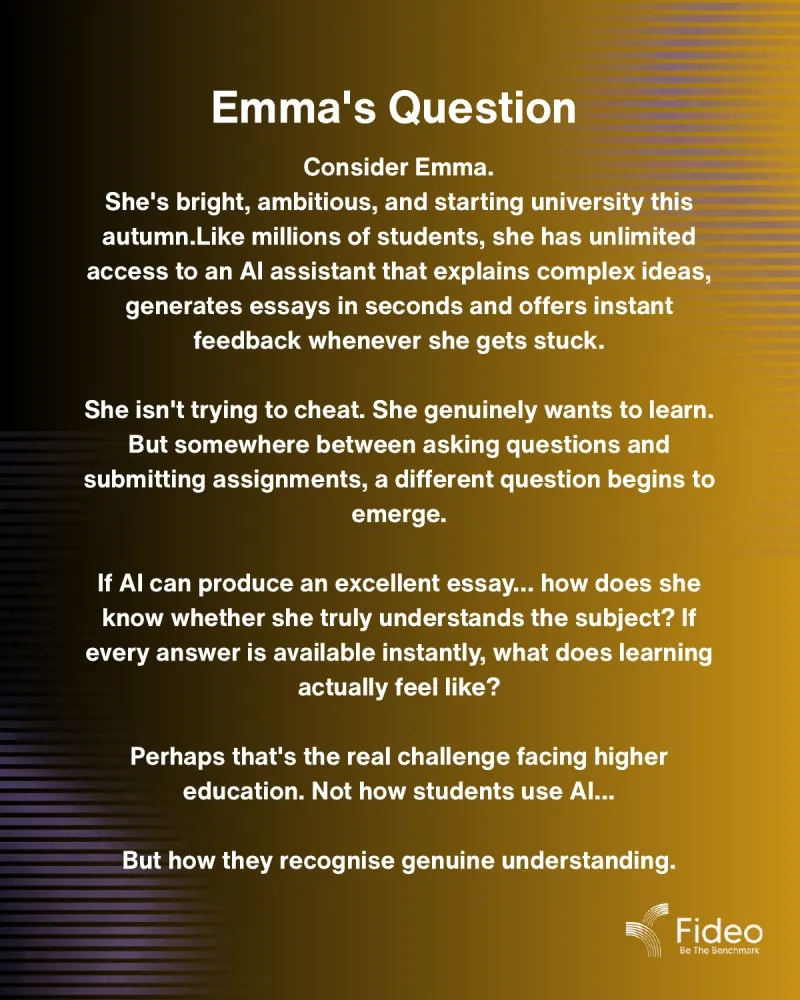
3 / 9 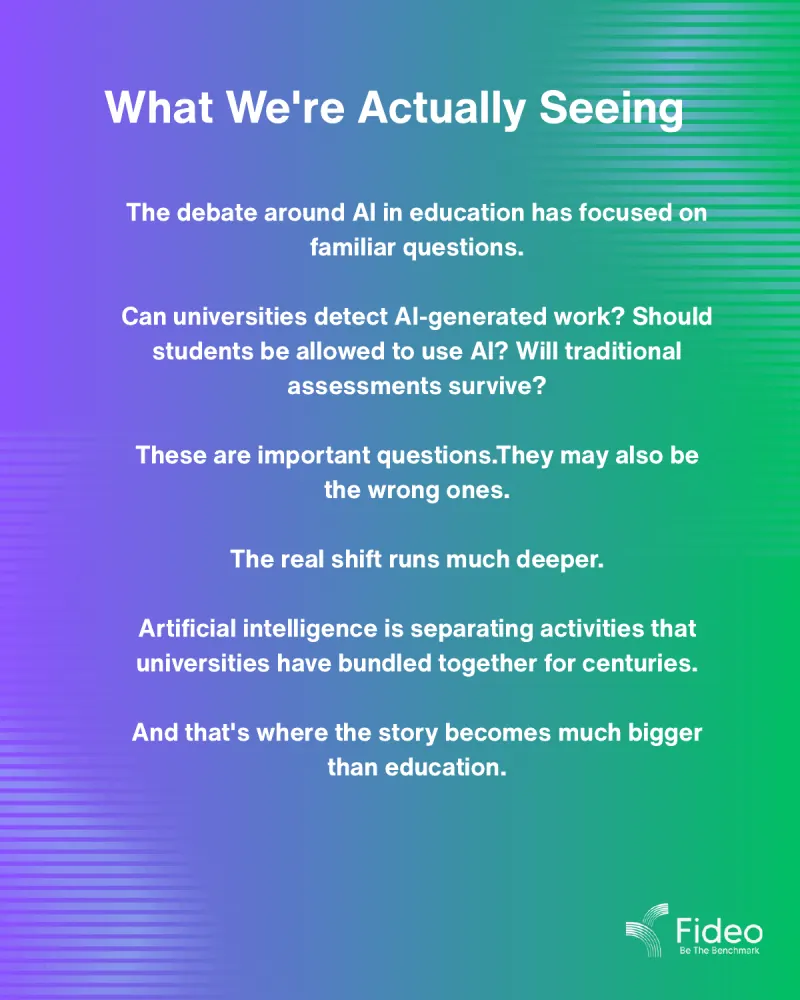
4 / 9 
5 / 9 
6 / 9 
7 / 9 
8 / 9 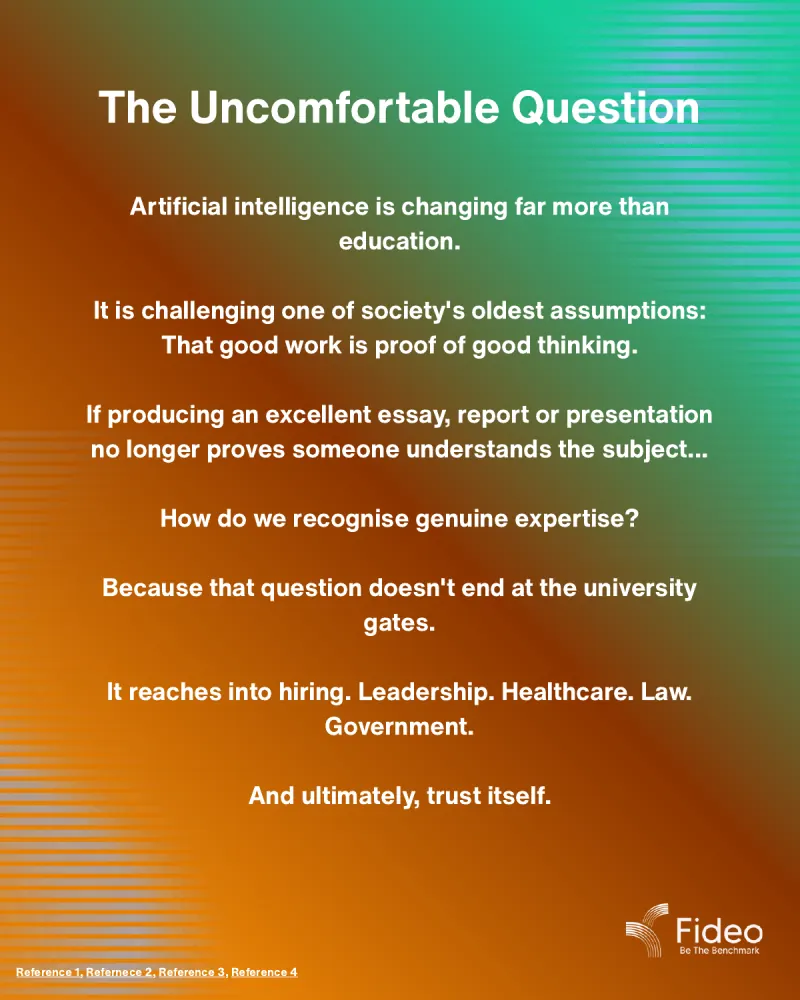
9 / 9
This week in 60 seconds
AI makes knowledge abundant but evidence of genuine thinking increasingly rare
- Universities once held a privileged position because they controlled scarce knowledge; AI has made expertise appear abundant.
- The usual debate on detection, permitted use and assessment survival may be asking the wrong questions.
- AI is unbundling research, teaching, credentials and learning, which universities have combined for centuries.
- The easier polished work becomes to produce, the harder it is to prove genuine understanding.
- Employers and professional bodies face the same problem: qualifications and outputs no longer guarantee capability.
Try this with your team
Replace one written deliverable this week with a live demonstration of thinking, such as an oral walkthrough or real-time reasoning session, to test how people think rather than what they produce.
Read this edition as text (4 min)
When Knowledge Isn't Enough
Imagine arriving at university in 2030. Before your first lecture begins, you've already asked your AI tutor to explain quantum mechanics, critique Shakespeare, summarise a year's worth of economics, and coach you through tomorrow's assignment.
It knows your strengths, remembers every mistake you've ever made, and never loses patience.Within minutes, it produces work that would once have taken weeks.
The technology isn't the remarkable part. The remarkable part is that nobody can quite explain what the university is supposed to do next.
For generations, universities held a privileged position because they controlled something scarce: knowledge. Artificial intelligence hasn't simply made knowledge more accessible.
It has made expertise appear abundant. And that distinction may define one of the most significant institutional shifts of our time.
Emma's Question
Consider Emma. She's bright, ambitious, and starting university this autumn.Like millions of students, she has unlimited access to an AI assistant that explains complex ideas, generates essays in seconds and offers instant feedback whenever she gets stuck.
She isn't trying to cheat. She genuinely wants to learn. But somewhere between asking questions and submitting assignments, a different question begins to emerge.
If AI can produce an excellent essay... how does she know whether she truly understands the subject? If every answer is available instantly, what does learning actually feel like?
Perhaps that's the real challenge facing higher education. Not how students use AI...
But how they recognise genuine understanding.
What We're Actually Seeing
The debate around AI in education has focused on familiar questions.
Can universities detect AI-generated work? Should students be allowed to use AI? Will traditional assessments survive?
These are important questions.They may also be the wrong ones.
The real shift runs much deeper.
Artificial intelligence is separating activities that universities have bundled together for centuries.
And that's where the story becomes much bigger than education.
The Great Unbundling
For centuries, universities combined research, teaching, credentials and learning into one institution.
That model is beginning to fragment.
Knowledge no longer lives primarily inside lecture halls.Teaching now competes with AI tutors available at any time.
Credentials still matter. But employers are beginning to ask whether qualifications alone demonstrate capability.
The university is no longer the only place where expertise develops.
It may no longer even be the primary one.
The Real Shift
Here's the defining tension of this week's Zeitgeist.
Artificial intelligence is making education more accessible than at any point in history.
At the same time, it is making evidence of genuine expertise harder to recognise. Both can be true.
The easier it becomes to produce polished work... ...the harder it becomes to prove genuine understanding.
Scarcity is shifting.
Knowledge is becoming abundant.
Evidence of thinking is becoming rare.
The Signal
The first signs are already appearing.
Across universities, traditional essays are becoming less reliable as evidence of learning.
Instead, educators are exploring oral examinations, live reasoning, collaborative problem-solving and real- time demonstrations of thinking.
At first glance, these look like small changes. They aren't. They signal a much bigger shift.
Education is moving away from evaluating what students produce... towards understanding how they think.
Beyond Universities
Universities are simply the first institutions confronting this change.
Employers are recruiting graduates whose qualifications no longer guarantee the capabilities they once implied.
Professional bodies are rethinking what competence looks like when expert advice can be generated in seconds.
Organisations face the same challenge. If AI automates more of the work that once developed expertise...
Where will tomorrow's experts come from?
The short-term efficiency gains are obvious.
The long-term consequences are only beginning to emerge.
The Uncomfortable Question
Artificial intelligence is changing far more than education.
It is challenging one of society's oldest assumptions: That good work is proof of good thinking.
If producing an excellent essay, report or presentation no longer proves someone understands the subject...
How do we recognise genuine expertise?
Because that question doesn't end at the university gates.
It reaches into hiring. Leadership. Healthcare. Law. Government.
And ultimately, trust itself.
Reference 1, Refernece 2, Reference 3, Reference 4
Sources
- LinkedInlinkedin.com/posts/chrismayer01_highereducation-generaleducation-liberalarts-share-7476742
- LinkedInlinkedin.com/posts/ingrid-vasiliu-feltes-mdmba_ai-risk-optimization-share-7481897498974949
- LinkedInlinkedin.com/posts/chrismayer01_highereducation-futureofemployability-studentsuccess-share
- LinkedInlinkedin.com/posts/sianleahbeilock_ai-has-made-the-transition-from-college-to-activity-748
More questions about this edition
How are educators changing assessment in response to AI?
The edition says educators are exploring oral examinations, live reasoning, collaborative problem-solving and real-time demonstrations of thinking, as traditional essays become less reliable evidence of learning.
Why does this matter for organisations outside education?
If AI automates more of the work that once developed expertise, organisations must ask where tomorrow's experts will come from. Short-term efficiency gains are obvious, but long-term consequences are only beginning to emerge.
What assumption does the edition say AI is challenging?
One of society's oldest assumptions: that good work is proof of good thinking. The edition says this reaches into hiring, leadership, healthcare, law, government and ultimately trust.
Get the Zeitgeist every Friday
One email a week with the new edition. Unsubscribe in one click.
Check your inbox to confirm your subscription.
Please enter a valid email address and try again.