Week of 6 to 10 Jul 2026
If AI can produce knowledge instantly, what is the university for?
1 / 9 
2 / 9 
3 / 9 
4 / 9 
5 / 9 
6 / 9 
7 / 9 
8 / 9 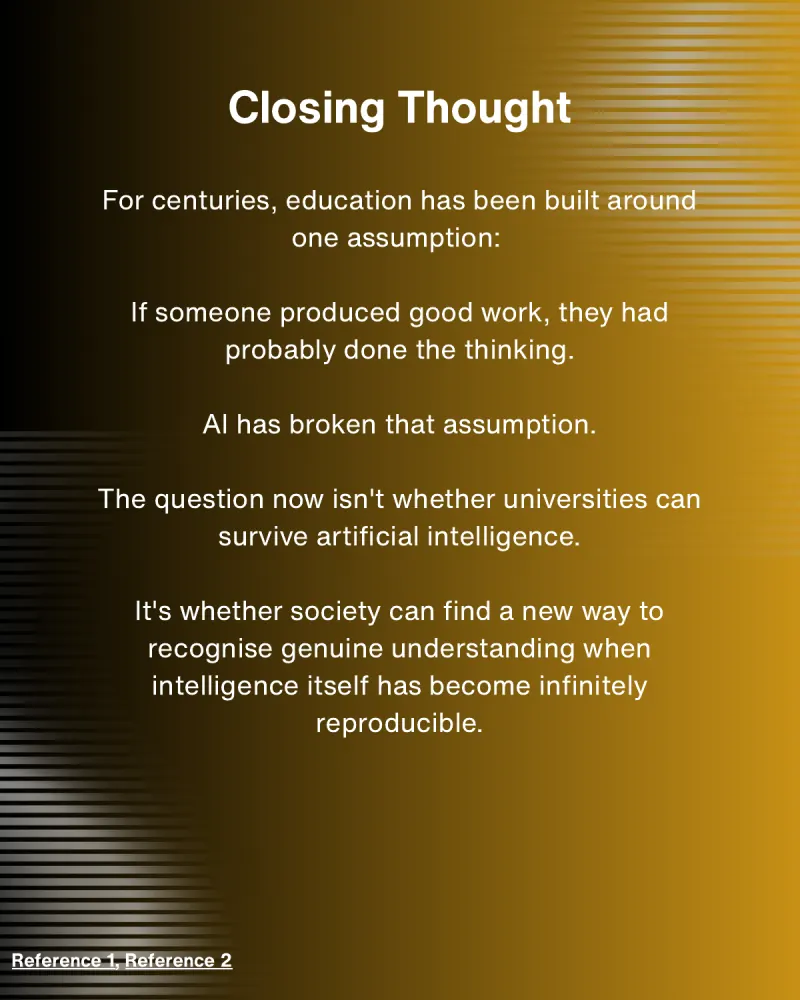
9 / 9
This week in 60 seconds
AI may not be destroying higher education so much as exposing what universities stopped being years ago.
- AI tutors, instant essay drafts and textbook summaries do not make learning easier. They leave nobody agreeing what learning actually is.
- One view says AI empties the classroom of meaningful intellectual work. Another says it is unbundling research, teaching, credentialing and social development.
- AI makes education more accessible than ever while possibly making traditional credentials less meaningful. Both can be true.
- Essays are losing value as assessment, and interest is growing in oral exams, live reasoning, Socratic dialogue and demonstrations of thinking.
- The contrarian view holds that AI may make education more human, rewarding judgement, discussion and creativity over information recall.
Read this edition as text (2 min)
The Central Paradox
Imagine arriving at university in 2030.
You already have access to an AI tutor that explains every concept more clearly than most lecturers.
Every essay can be drafted in minutes. Every textbook can be summarised instantly.
You haven't entered a world where learning is easier.
You've entered one where nobody agrees what learning actually is anymore.
The Human Story
Follow one student.
Not because the student matters.
They aren't trying to cheat.
They're trying to understand what genuine competence even looks like when intelligence has become abundant.
What We're Actually Seeing
One argues AI is emptying the classroom of meaningful intellectual work.
The other argues AI is dissolving the old "multiversity" model, in which research, teaching, credentialing, and social development all sat inside one institution.
The future may separate those functions rather than keeping them bundled together.
Different diagnoses. Shared observation.
The existing university model is under unprecedented pressure.
The Contradiction
AI makes education more accessible than ever.
AI may also make traditional educational credentials less meaningful.
Both can be true.
The Uncomfortable Question
The current debate asks: "Can students still write essays?"
The more interesting question is: what happens when producing the answer is no longer evidence that you've done the thinking?
That shifts the conversation from assessment to learning itself.
The Signal
Traditional assessments such as essays are losing their value because AI can generate polished outputs with ease.
In response, there is growing interest in oral examinations, live reasoning, Socratic dialogue, and demonstrations of thinking rather than polished written products.
The contrarian view
Every major communication technology — from writing itself to calculators and search engines — has prompted fears that human thinking would decline.
AI may ultimately force education to become more human rather than less, by placing greater value on judgment, discussion, and creativity instead of information recall.
Closing Thought
For centuries, education has been built around one assumption:
If someone produced good work, they had probably done the thinking.
AI has broken that assumption.
The question now isn't whether universities can survive artificial intelligence.
It's whether society can find a new way to recognise genuine understanding when intelligence itself has become infinitely reproducible.
Sources
- LinkedInlinkedin.com/posts/donperlgut_ai-universities-highereducation-share-7478035687171158017-ml
More questions about this edition
What is the "multiversity" model mentioned in the edition?
It is the model in which research, teaching, credentialing and social development all sit inside one institution. The edition suggests AI may lead these functions to separate rather than stay bundled together.
Has technology prompted similar fears about thinking before?
Yes. The edition notes that every major communication technology, from writing itself to calculators and search engines, prompted fears that human thinking would decline.
Why does the edition say the debate should move beyond essays?
Asking whether students can still write essays misses the bigger issue. When producing an answer no longer proves someone did the thinking, the conversation shifts from assessment to learning itself.
Get the Zeitgeist every Friday
One email a week with the new edition. Unsubscribe in one click.
Check your inbox to confirm your subscription.
Please enter a valid email address and try again.