Week of 18 to 22 May 2026
AI, universities and the restructuring of institutional legitimacy
1 / 8 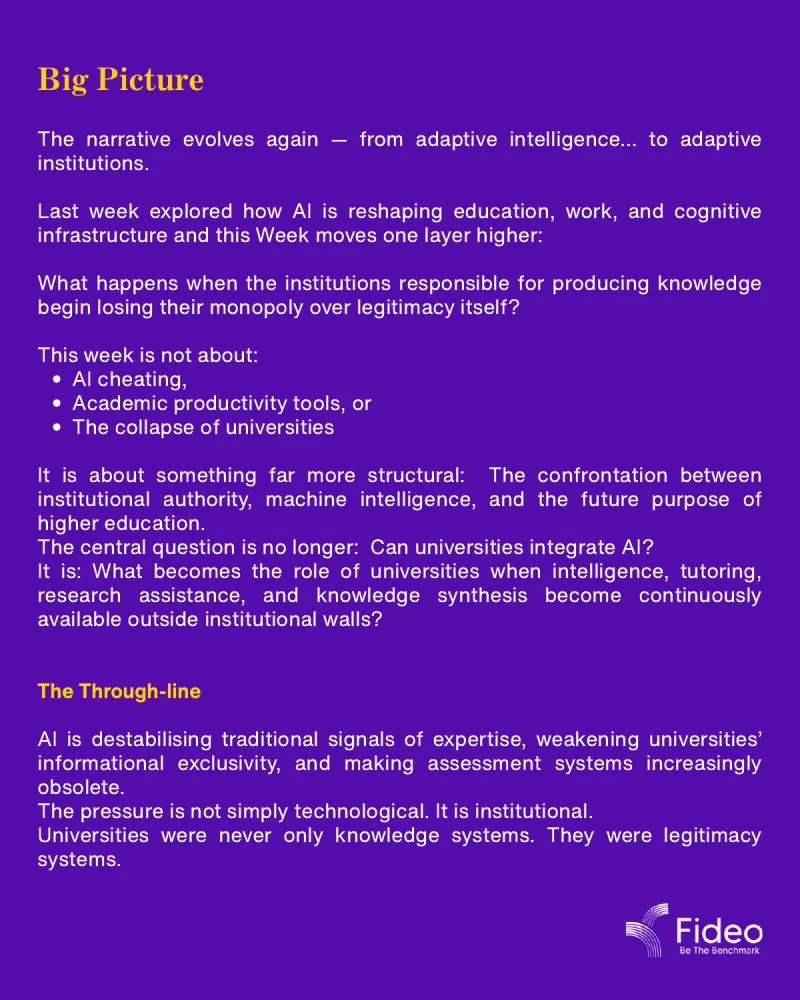
2 / 8 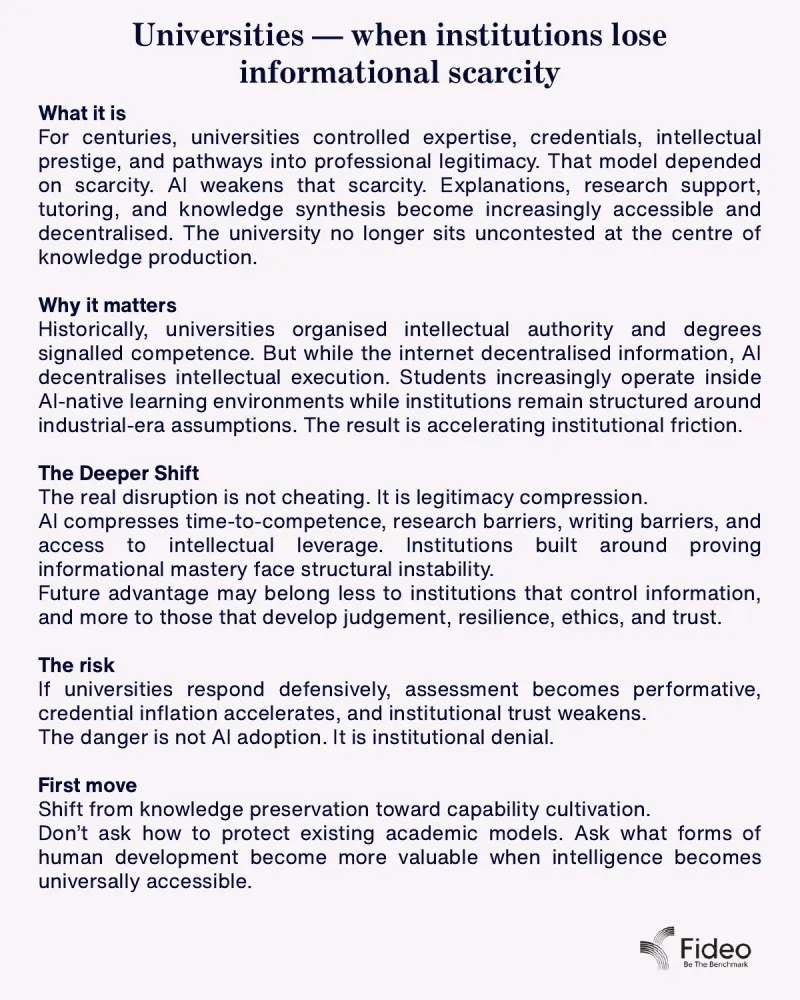
3 / 8 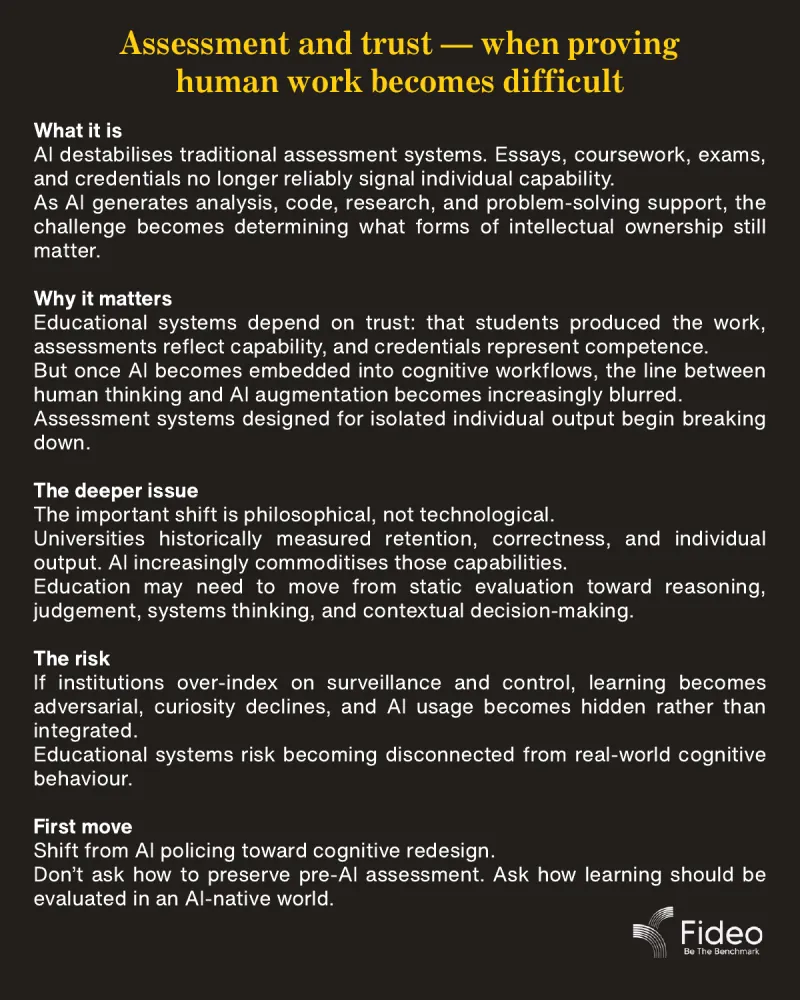
4 / 8 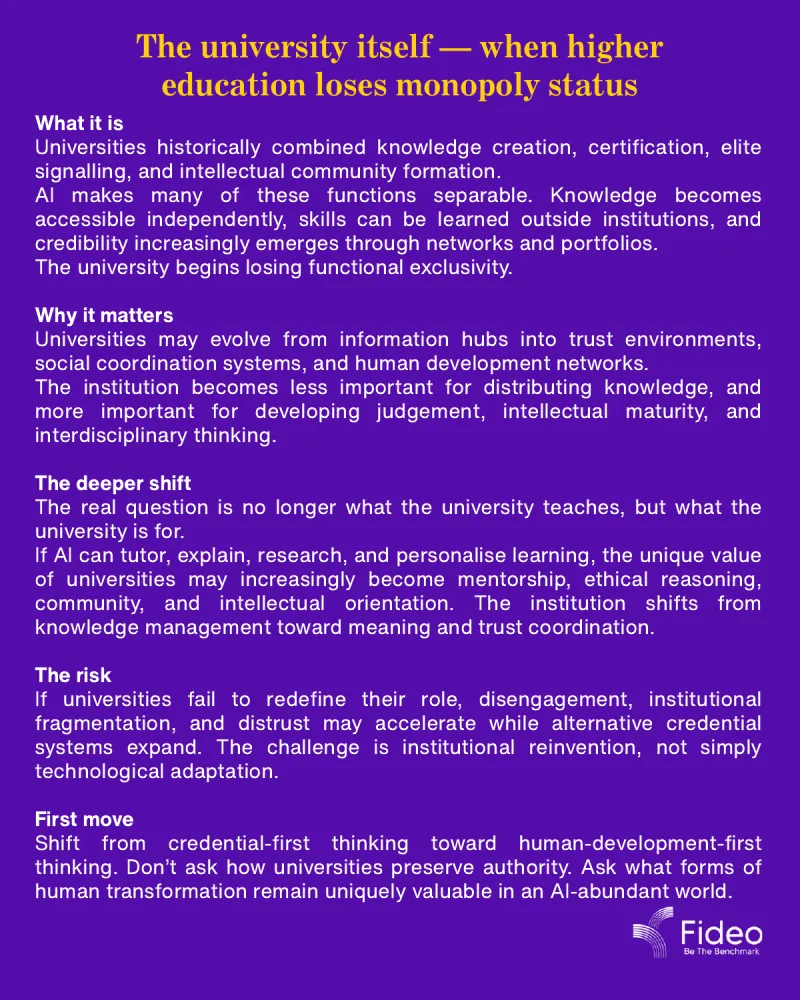
5 / 8 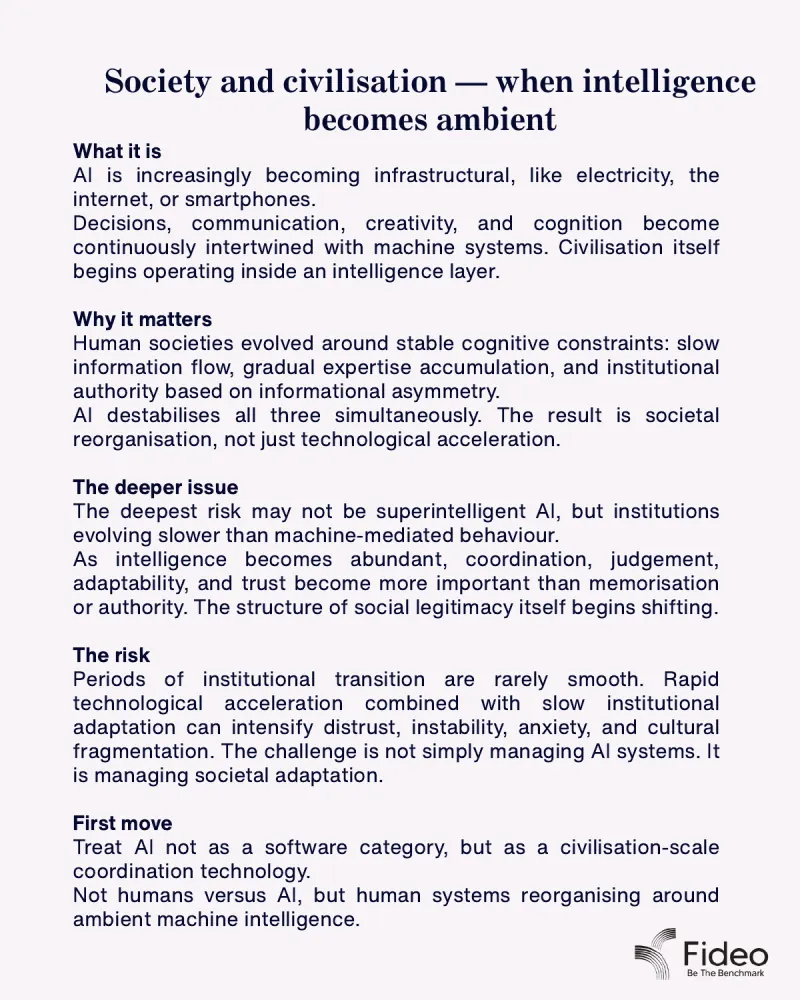
6 / 8 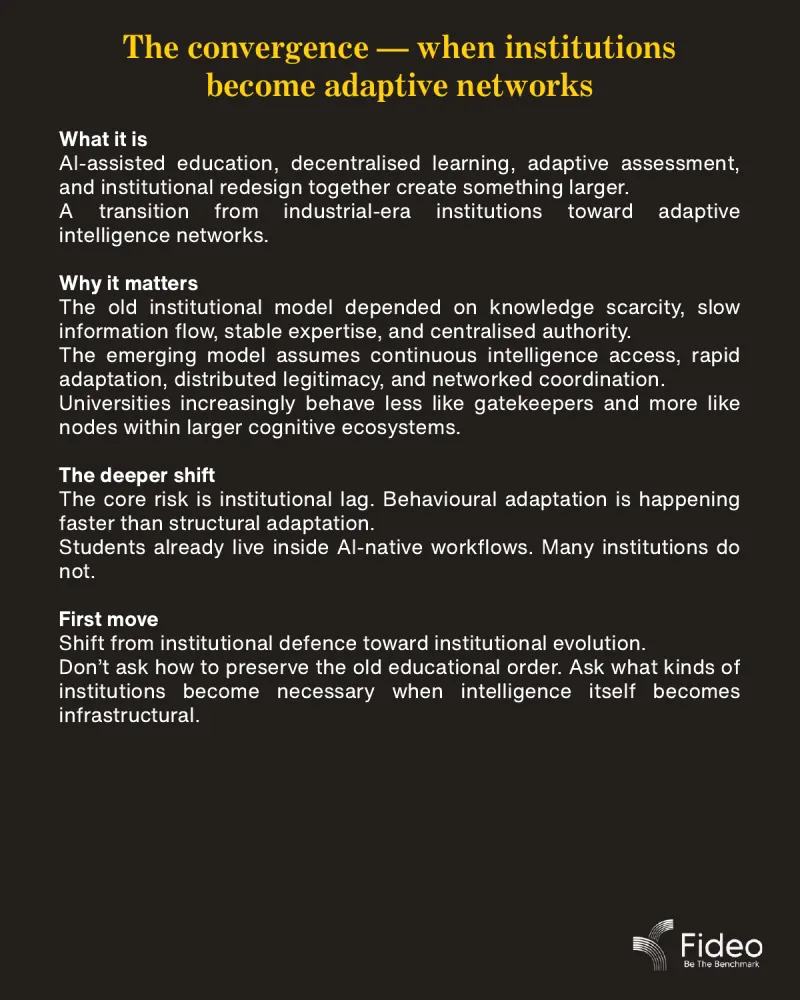
7 / 8 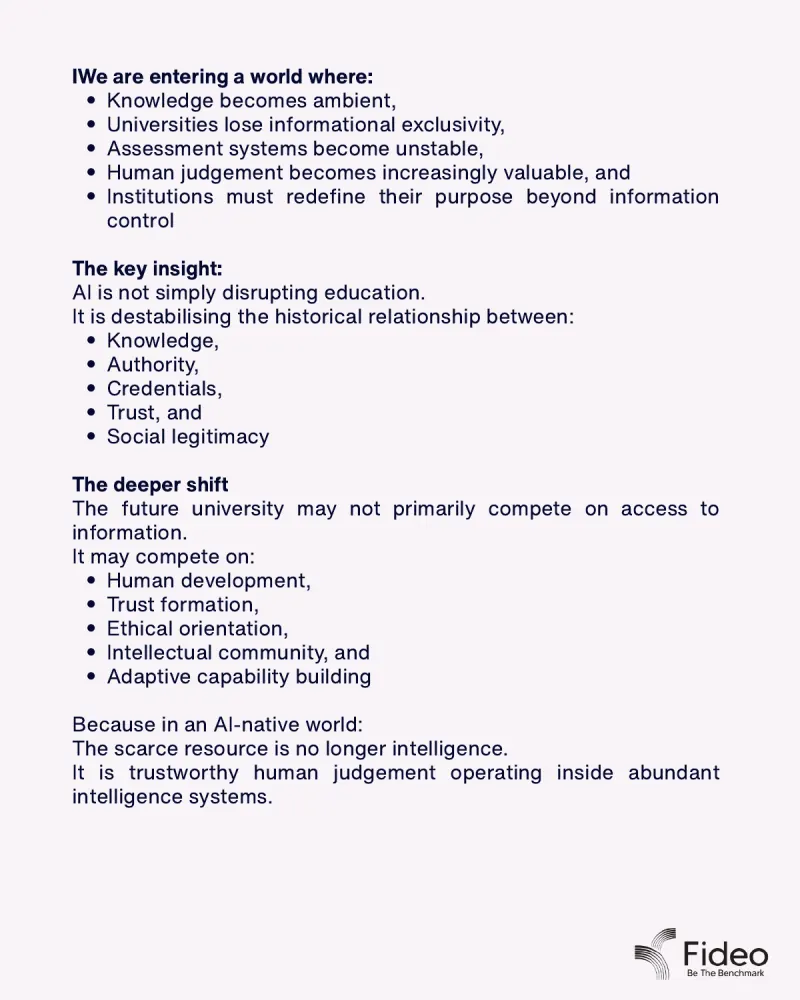
8 / 8
This week in 60 seconds
What becomes the role of universities when intelligence, tutoring and research support are available outside institutional walls?
- Universities were never only knowledge systems; they were legitimacy systems, and AI weakens the scarcity that model depended on.
- The real disruption is not cheating but legitimacy compression: AI shortens time-to-competence and lowers research and writing barriers.
- Essays, coursework and exams no longer reliably signal individual capability, so assessment may need to focus on reasoning, judgement and contextual decision-making.
- Over-reliance on surveillance risks making learning adversarial and pushing AI use into hiding rather than integrating it.
- The core risk is institutional lag: students already work in AI-native workflows while many institutions do not.
Try this with your team
Shift from AI policing toward cognitive redesign: rather than asking how to preserve pre-AI assessment, ask how learning should be evaluated in an AI-native world, and what forms of human development become more valuable when intelligence is universally accessible.
Read this edition as text (6 min)
Big Picture
The narrative evolves again — from adaptive intelligence… to adaptive institutions.
Last week explored how AI is reshaping education, work, and cognitive infrastructure and this Week moves one layer higher:
What happens when the institutions responsible for producing knowledge begin losing their monopoly over legitimacy itself?
This week is not about: AI cheating, Academic productivity tools, or The collapse of universities
It is about something far more structural: The confrontation between institutional authority, machine intelligence, and the future purpose of higher education. The central question is no longer: Can universities integrate AI? It is: What becomes the role of universities when intelligence, tutoring, research assistance, and knowledge synthesis become continuously available outside institutional walls?
The Through-line
AI is destabilising traditional signals of expertise, weakening universities’ informational exclusivity, and making assessment systems increasingly obsolete. The pressure is not simply technological. It is institutional. Universities were never only knowledge systems. They were legitimacy systems.
Universities — when institutions lose informational scarcity
What it is For centuries, universities controlled expertise, credentials, intellectual prestige, and pathways into professional legitimacy. That model depended on scarcity. AI weakens that scarcity. Explanations, research support, tutoring, and knowledge synthesis become increasingly accessible and decentralised. The university no longer sits uncontested at the centre of knowledge production.
Why it matters Historically, universities organised intellectual authority and degrees signalled competence. But while the internet decentralised information, AI decentralises intellectual execution. Students increasingly operate inside AI-native learning environments while institutions remain structured around industrial-era assumptions. The result is accelerating institutional friction.
The Deeper Shift The real disruption is not cheating. It is legitimacy compression. AI compresses time-to-competence, research barriers, writing barriers, and access to intellectual leverage. Institutions built around proving informational mastery face structural instability. Future advantage may belong less to institutions that control information, and more to those that develop judgement, resilience, ethics, and trust.
The risk If universities respond defensively, assessment becomes performative, credential inflation accelerates, and institutional trust weakens. The danger is not AI adoption. It is institutional denial.
First move Shift from knowledge preservation toward capability cultivation. Don’t ask how to protect existing academic models. Ask what forms of human development become more valuable when intelligence becomes universally accessible.
Assessment and trust — when proving human work becomes difficult
What it is AI destabilises traditional assessment systems. Essays, coursework, exams, and credentials no longer reliably signal individual capability. As AI generates analysis, code, research, and problem-solving support, the challenge becomes determining what forms of intellectual ownership still matter.
Why it matters Educational systems depend on trust: that students produced the work, assessments reflect capability, and credentials represent competence. But once AI becomes embedded into cognitive workflows, the line between human thinking and AI augmentation becomes increasingly blurred. Assessment systems designed for isolated individual output begin breaking down.
The deeper issue The important shift is philosophical, not technological. Universities historically measured retention, correctness, and individual output. AI increasingly commoditises those capabilities. Education may need to move from static evaluation toward reasoning, judgement, systems thinking, and contextual decision-making.
The risk If institutions over-index on surveillance and control, learning becomes adversarial, curiosity declines, and AI usage becomes hidden rather than integrated. Educational systems risk becoming disconnected from real-world cognitive behaviour.
First move Shift from AI policing toward cognitive redesign. Don’t ask how to preserve pre-AI assessment. Ask how learning should be evaluated in an AI-native world.
The university itself — when higher education loses monopoly status
What it is Universities historically combined knowledge creation, certification, elite signalling, and intellectual community formation. AI makes many of these functions separable. Knowledge becomes accessible independently, skills can be learned outside institutions, and credibility increasingly emerges through networks and portfolios. The university begins losing functional exclusivity.
Why it matters Universities may evolve from information hubs into trust environments, social coordination systems, and human development networks. The institution becomes less important for distributing knowledge, and more important for developing judgement, intellectual maturity, and interdisciplinary thinking.
The deeper shift The real question is no longer what the university teaches, but what the university is for. If AI can tutor, explain, research, and personalise learning, the unique value of universities may increasingly become mentorship, ethical reasoning, community, and intellectual orientation. The institution shifts from knowledge management toward meaning and trust coordination.
The risk If universities fail to redefine their role, disengagement, institutional fragmentation, and distrust may accelerate while alternative credential systems expand. The challenge is institutional reinvention, not simply technological adaptation.
First move Shift from credential-first thinking toward human-development-first thinking. Don’t ask how universities preserve authority. Ask what forms of human transformation remain uniquely valuable in an AI-abundant world.
Society and civilisation — when intelligence becomes ambient
What it is AI is increasingly becoming infrastructural, like electricity, the internet, or smartphones. Decisions, communication, creativity, and cognition become continuously intertwined with machine systems. Civilisation itself begins operating inside an intelligence layer.
Why it matters Human societies evolved around stable cognitive constraints: slow information flow, gradual expertise accumulation, and institutional authority based on informational asymmetry. AI destabilises all three simultaneously. The result is societal reorganisation, not just technological acceleration.
The deeper issue The deepest risk may not be superintelligent AI, but institutions evolving slower than machine-mediated behaviour. As intelligence becomes abundant, coordination, judgement, adaptability, and trust become more important than memorisation or authority. The structure of social legitimacy itself begins shifting.
The risk Periods of institutional transition are rarely smooth. Rapid technological acceleration combined with slow institutional adaptation can intensify distrust, instability, anxiety, and cultural fragmentation. The challenge is not simply managing AI systems. It is managing societal adaptation.
First move Treat AI not as a software category, but as a civilisation-scale coordination technology. Not humans versus AI, but human systems reorganising around ambient machine intelligence.
The convergence — when institutions become adaptive networks
What it is AI-assisted education, decentralised learning, adaptive assessment, and institutional redesign together create something larger. A transition from industrial-era institutions toward adaptive intelligence networks.
Why it matters The old institutional model depended on knowledge scarcity, slow information flow, stable expertise, and centralised authority. The emerging model assumes continuous intelligence access, rapid adaptation, distributed legitimacy, and networked coordination. Universities increasingly behave less like gatekeepers and more like nodes within larger cognitive ecosystems.
The deeper shift The core risk is institutional lag. Behavioural adaptation is happening faster than structural adaptation. Students already live inside AI-native workflows. Many institutions do not.
First move Shift from institutional defence toward institutional evolution. Don’t ask how to preserve the old educational order. Ask what kinds of institutions become necessary when intelligence itself becomes infrastructural.
IWe are entering a world where: Knowledge becomes ambient, Universities lose informational exclusivity, Assessment systems become unstable, Human judgement becomes increasingly valuable, and Institutions must redefine their purpose beyond information control
The key insight: AI is not simply disrupting education. It is destabilising the historical relationship between: Knowledge, Authority, Credentials, Trust, and Social legitimacy
The deeper shift The future university may not primarily compete on access to information. It may compete on: Human development, Trust formation, Ethical orientation, Intellectual community, and Adaptive capability building
Because in an AI-native world: The scarce resource is no longer intelligence. It is trustworthy human judgement operating inside abundant intelligence systems.
More questions about this edition
What does the edition say this week's analysis is not about?
It is explicitly not about AI cheating, academic productivity tools or the collapse of universities, but about the structural confrontation between institutional authority, machine intelligence and the purpose of higher education.
What might the future university compete on instead of access to information?
Human development, trust formation, ethical orientation, intellectual community and adaptive capability building.
Why does the edition describe AI as a civilisation-scale technology?
It argues AI is becoming infrastructural, like electricity or the internet, destabilising slow information flow, gradual expertise accumulation and authority based on informational asymmetry all at once.
Get the Zeitgeist every Friday
One email a week with the new edition. Unsubscribe in one click.
Check your inbox to confirm your subscription.
Please enter a valid email address and try again.