Week of 11 to 15 May 2026
When intelligence becomes abundant: AI, education and the future of work
1 / 9 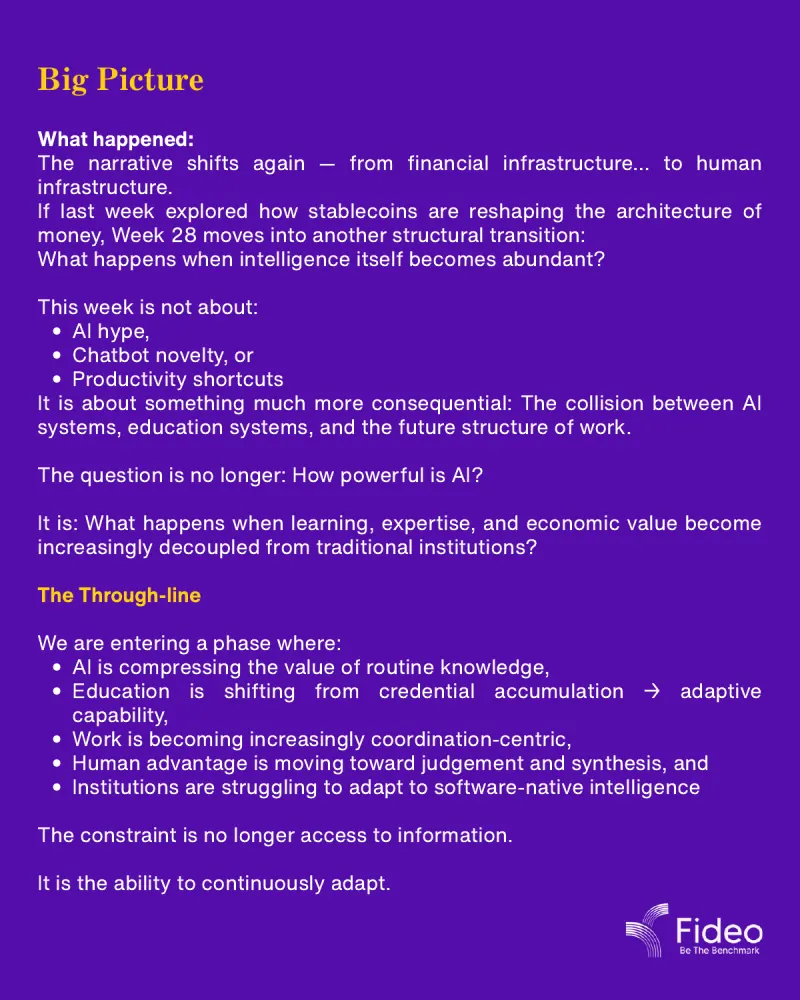
2 / 9 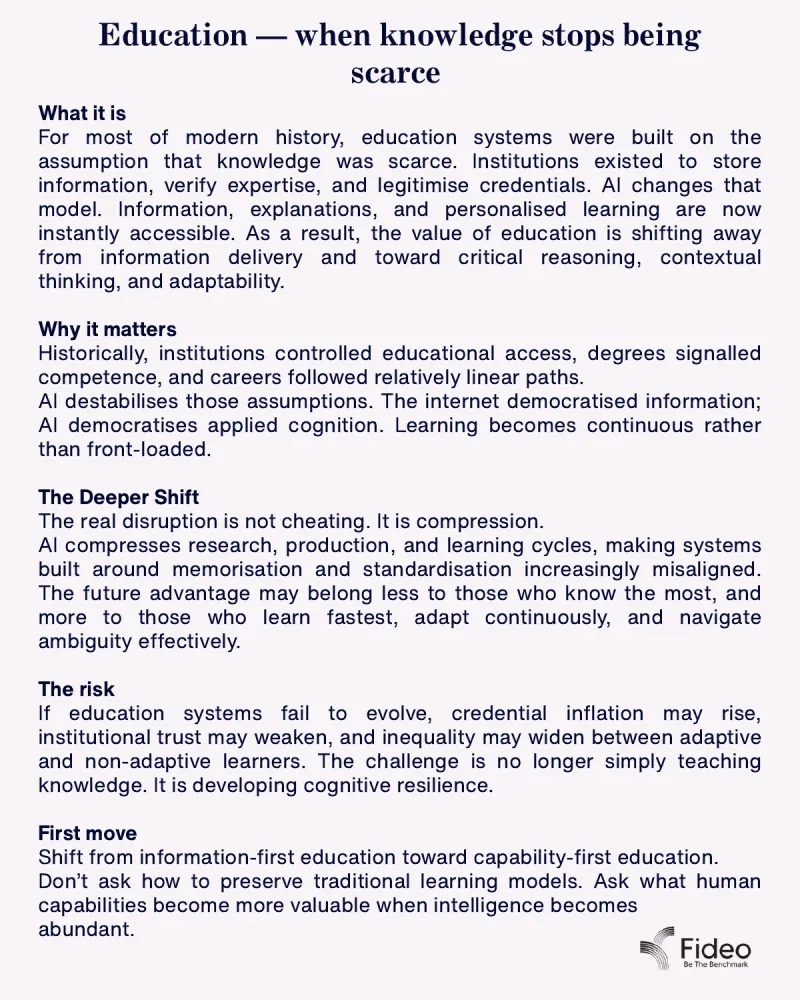
3 / 9 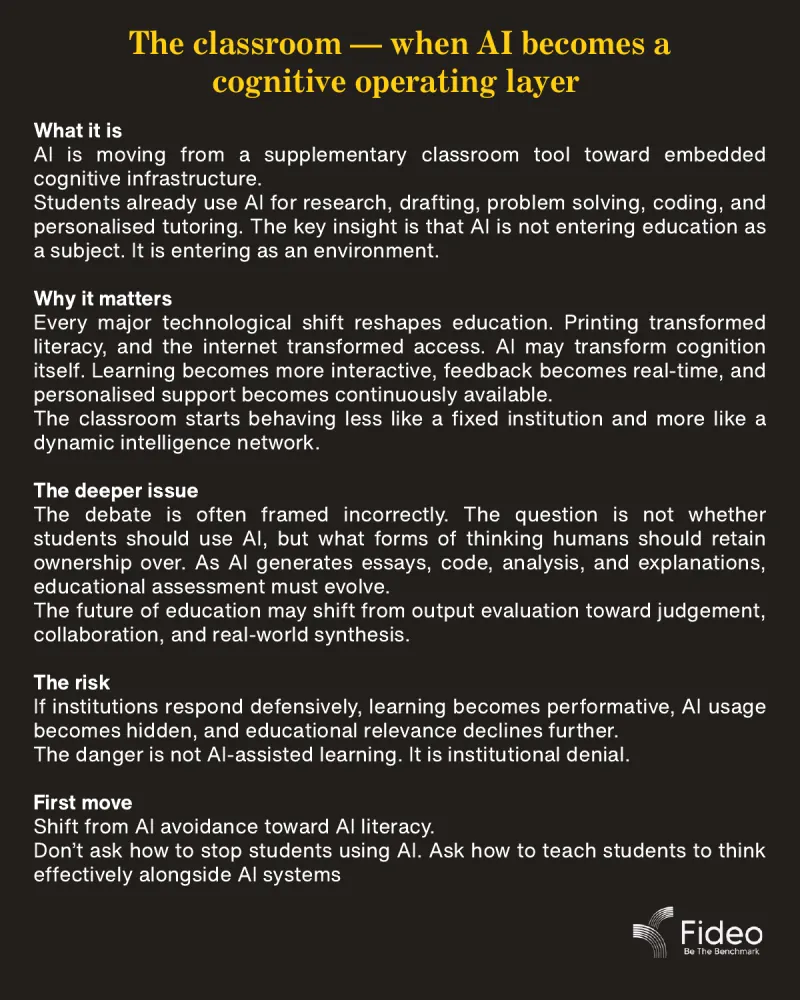
4 / 9 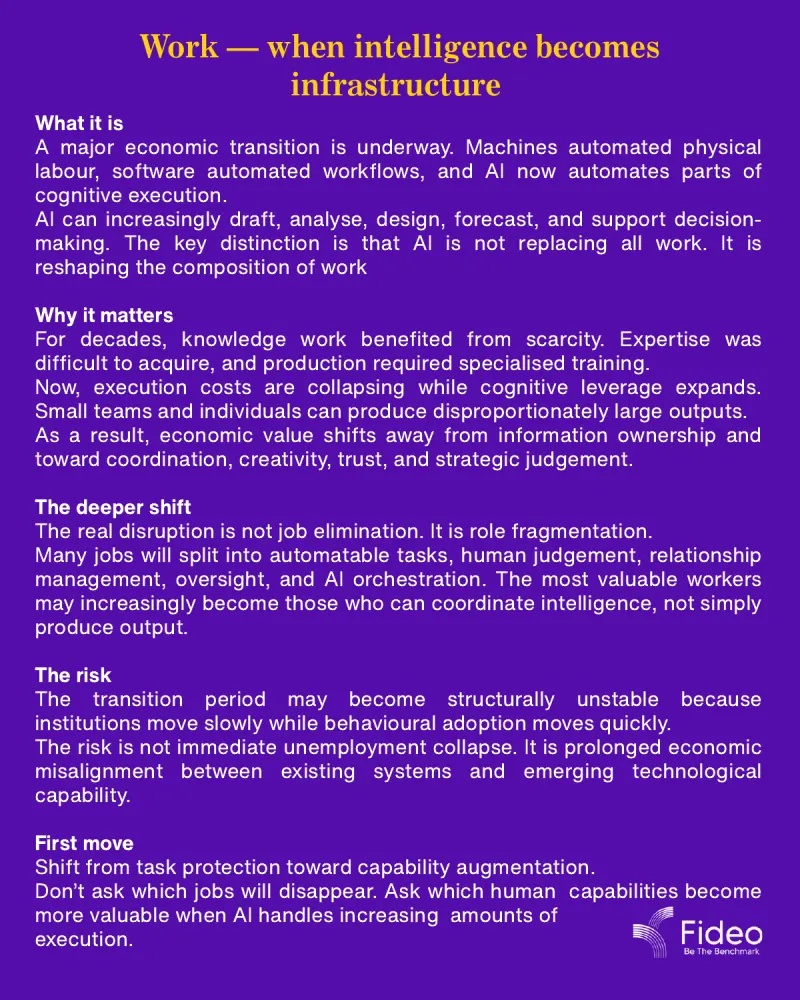
5 / 9 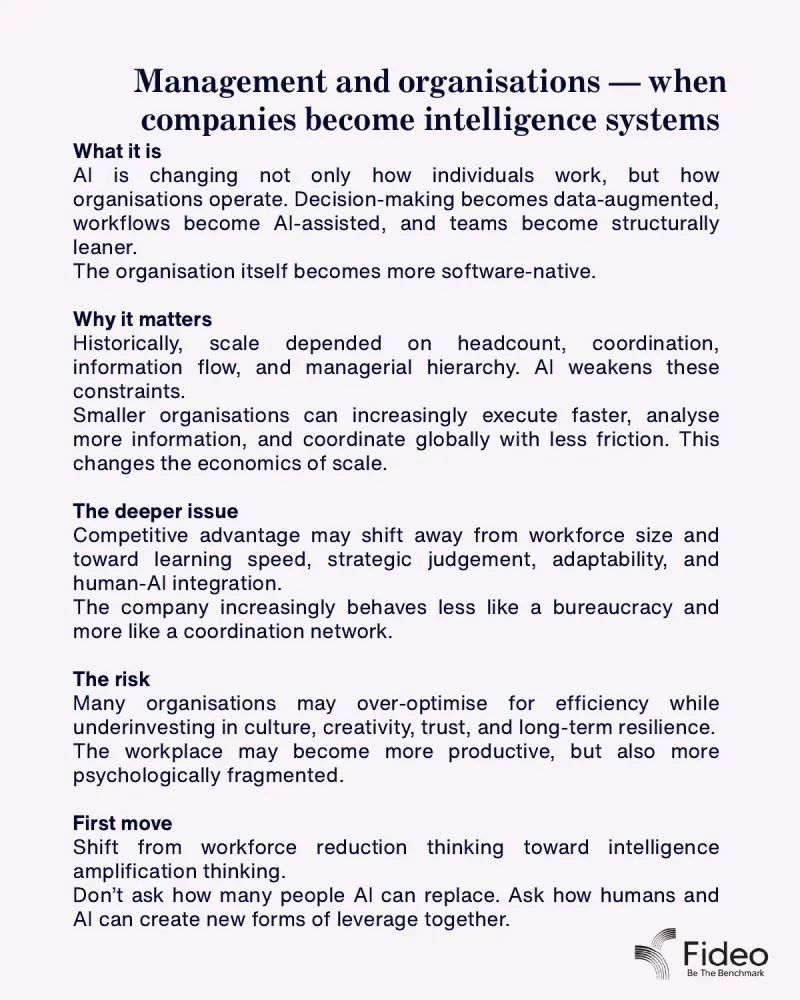
6 / 9 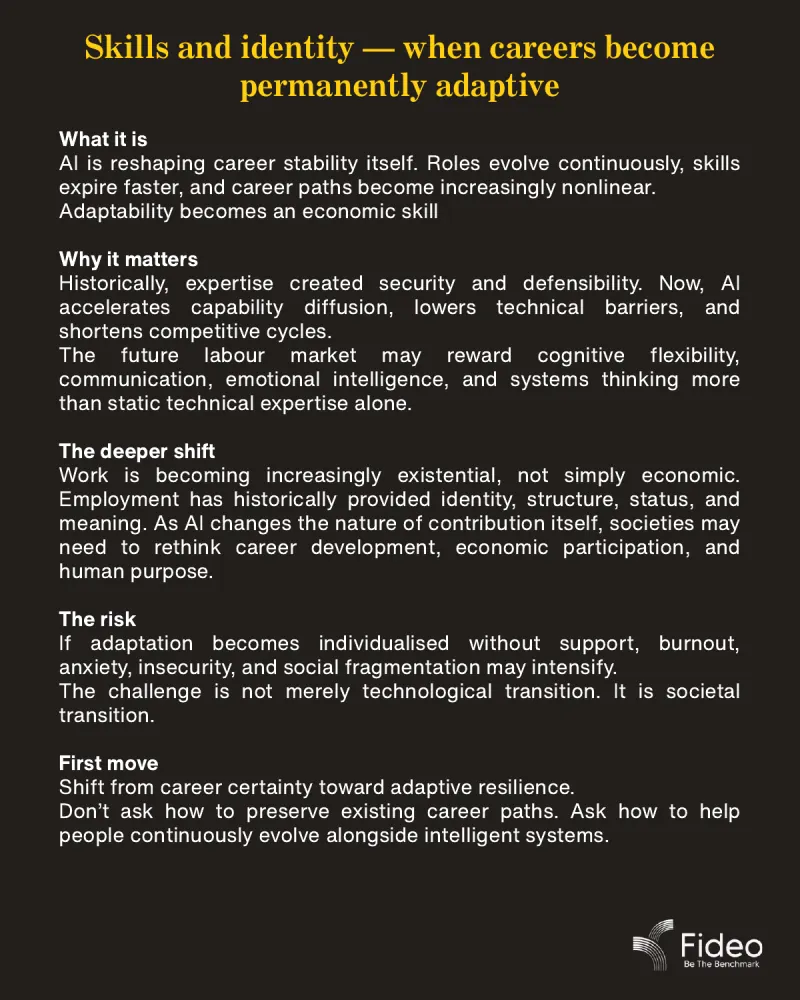
7 / 9 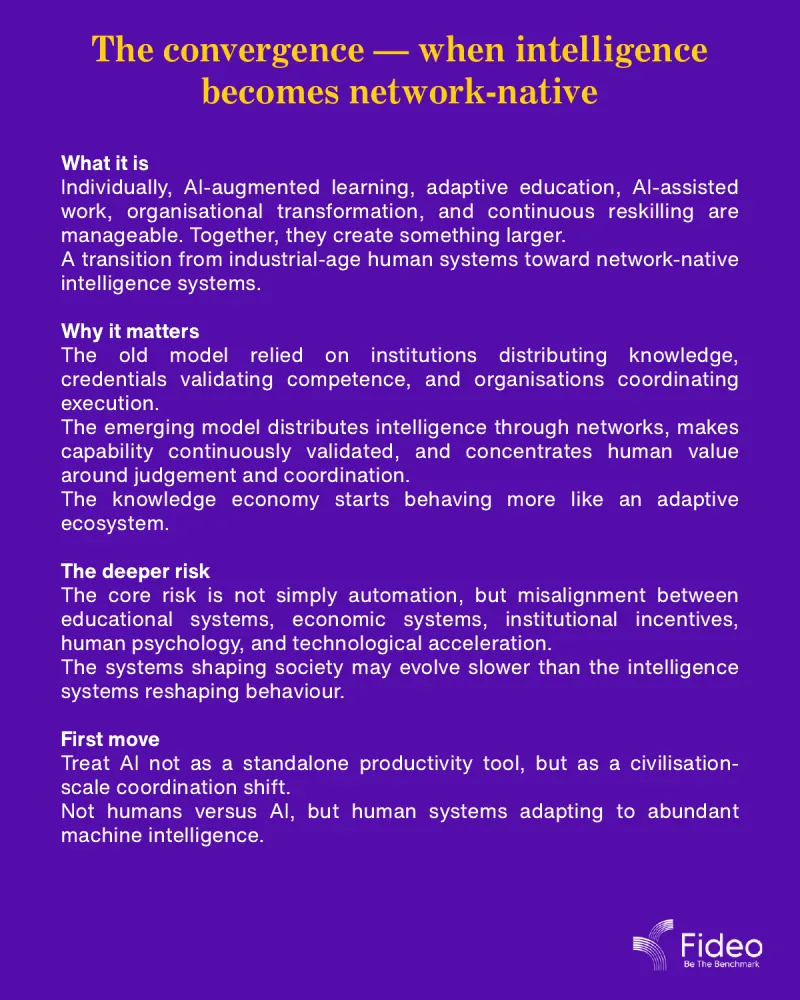
8 / 9 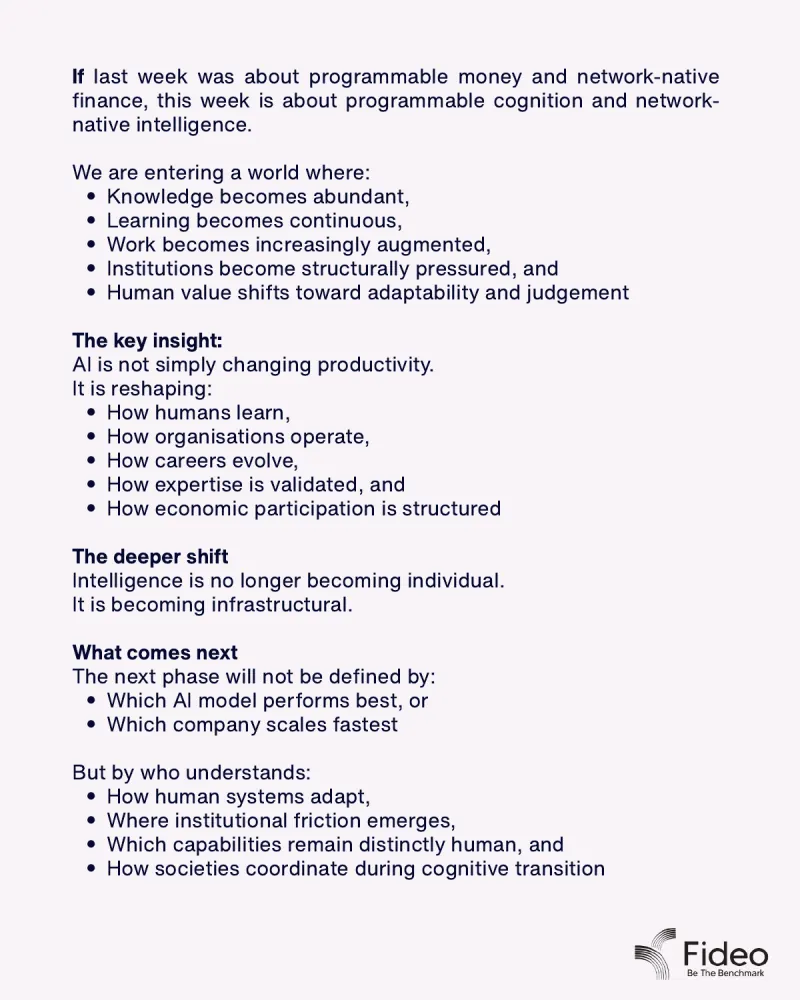
9 / 9
This week in 60 seconds
Week 28 moves from financial infrastructure to human infrastructure: learning, work, organisations and careers.
- The constraint is no longer access to information. It is the ability to continuously adapt.
- In education, the real disruption is not cheating but compression of research, production and learning cycles.
- AI is entering classrooms as an environment, not a subject, so assessment must shift toward judgement, collaboration and synthesis.
- At work, the disruption is role fragmentation rather than job elimination, with value moving to coordination, trust and strategic judgement.
- The core risk is misalignment: institutions and social systems may evolve slower than the AI systems reshaping behaviour.
Try this with your team
Swap the defensive question for the capability question. Instead of asking which jobs will disappear or how many people AI can replace, ask which human capabilities become more valuable when AI handles more execution, and how humans and AI can create new leverage together.
Read this edition as text (7 min)
Big Picture
What happened: The narrative shifts again — from financial infrastructure… to human infrastructure. If last week explored how stablecoins are reshaping the architecture of money, Week 28 moves into another structural transition: What happens when intelligence itself becomes abundant?
This week is not about: AI hype, Chatbot novelty, or Productivity shortcuts It is about something much more consequential: The collision between AI systems, education systems, and the future structure of work.
The question is no longer: How powerful is AI?
It is: What happens when learning, expertise, and economic value become increasingly decoupled from traditional institutions?
The Through-line
We are entering a phase where: AI is compressing the value of routine knowledge, Education is shifting from credential accumulation → adaptive capability, Work is becoming increasingly coordination-centric, Human advantage is moving toward judgement and synthesis, and Institutions are struggling to adapt to software-native intelligence
The constraint is no longer access to information.
It is the ability to continuously adapt.
Education — when knowledge stops being scarce
What it is For most of modern history, education systems were built on the assumption that knowledge was scarce. Institutions existed to store information, verify expertise, and legitimise credentials. AI changes that model. Information, explanations, and personalised learning are now instantly accessible. As a result, the value of education is shifting away from information delivery and toward critical reasoning, contextual thinking, and adaptability.
Why it matters Historically, institutions controlled educational access, degrees signalled competence, and careers followed relatively linear paths. AI destabilises those assumptions. The internet democratised information; AI democratises applied cognition. Learning becomes continuous rather than front-loaded.
The Deeper Shift The real disruption is not cheating. It is compression. AI compresses research, production, and learning cycles, making systems built around memorisation and standardisation increasingly misaligned. The future advantage may belong less to those who know the most, and more to those who learn fastest, adapt continuously, and navigate ambiguity effectively.
The risk If education systems fail to evolve, credential inflation may rise, institutional trust may weaken, and inequality may widen between adaptive and non-adaptive learners. The challenge is no longer simply teaching knowledge. It is developing cognitive resilience.
First move Shift from information-first education toward capability-first education. Don’t ask how to preserve traditional learning models. Ask what human capabilities become more valuable when intelligence becomes abundant.
The classroom — when AI becomes a cognitive operating layer
What it is AI is moving from a supplementary classroom tool toward embedded cognitive infrastructure. Students already use AI for research, drafting, problem solving, coding, and personalised tutoring. The key insight is that AI is not entering education as a subject. It is entering as an environment.
Why it matters Every major technological shift reshapes education. Printing transformed literacy, and the internet transformed access. AI may transform cognition itself. Learning becomes more interactive, feedback becomes real-time, and personalised support becomes continuously available. The classroom starts behaving less like a fixed institution and more like a dynamic intelligence network.
The deeper issue The debate is often framed incorrectly. The question is not whether students should use AI, but what forms of thinking humans should retain ownership over. As AI generates essays, code, analysis, and explanations, educational assessment must evolve. The future of education may shift from output evaluation toward judgement, collaboration, and real-world synthesis.
The risk If institutions respond defensively, learning becomes performative, AI usage becomes hidden, and educational relevance declines further. The danger is not AI-assisted learning. It is institutional denial.
First move Shift from AI avoidance toward AI literacy. Don’t ask how to stop students using AI. Ask how to teach students to think effectively alongside AI systems
Work — when intelligence becomes infrastructure
What it is A major economic transition is underway. Machines automated physical labour, software automated workflows, and AI now automates parts of cognitive execution. AI can increasingly draft, analyse, design, forecast, and support decision- making. The key distinction is that AI is not replacing all work. It is reshaping the composition of work
Why it matters For decades, knowledge work benefited from scarcity. Expertise was difficult to acquire, and production required specialised training. Now, execution costs are collapsing while cognitive leverage expands. Small teams and individuals can produce disproportionately large outputs. As a result, economic value shifts away from information ownership and toward coordination, creativity, trust, and strategic judgement.
The deeper shift The real disruption is not job elimination. It is role fragmentation. Many jobs will split into automatable tasks, human judgement, relationship management, oversight, and AI orchestration. The most valuable workers may increasingly become those who can coordinate intelligence, not simply produce output.
The risk The transition period may become structurally unstable because institutions move slowly while behavioural adoption moves quickly. The risk is not immediate unemployment collapse. It is prolonged economic misalignment between existing systems and emerging technological capability.
First move Shift from task protection toward capability augmentation. Don’t ask which jobs will disappear. Ask which human capabilities become more valuable when AI handles increasing amounts of execution.
Management and organisations — when companies become intelligence systems
What it is AI is changing not only how individuals work, but how organisations operate. Decision-making becomes data-augmented, workflows become AI-assisted, and teams become structurally leaner. The organisation itself becomes more software-native.
Why it matters Historically, scale depended on headcount, coordination, information flow, and managerial hierarchy. AI weakens these constraints. Smaller organisations can increasingly execute faster, analyse more information, and coordinate globally with less friction. This changes the economics of scale.
The deeper issue Competitive advantage may shift away from workforce size and toward learning speed, strategic judgement, adaptability, and human-AI integration. The company increasingly behaves less like a bureaucracy and more like a coordination network.
The risk Many organisations may over-optimise for efficiency while underinvesting in culture, creativity, trust, and long-term resilience. The workplace may become more productive, but also more psychologically fragmented.
First move Shift from workforce reduction thinking toward intelligence amplification thinking. Don’t ask how many people AI can replace. Ask how humans and AI can create new forms of leverage together.
Skills and identity — when careers become permanently adaptive
What it is AI is reshaping career stability itself. Roles evolve continuously, skills expire faster, and career paths become increasingly nonlinear. Adaptability becomes an economic skill
Why it matters Historically, expertise created security and defensibility. Now, AI accelerates capability diffusion, lowers technical barriers, and shortens competitive cycles. The future labour market may reward cognitive flexibility, communication, emotional intelligence, and systems thinking more than static technical expertise alone.
The deeper shift Work is becoming increasingly existential, not simply economic. Employment has historically provided identity, structure, status, and meaning. As AI changes the nature of contribution itself, societies may need to rethink career development, economic participation, and human purpose.
The risk If adaptation becomes individualised without support, burnout, anxiety, insecurity, and social fragmentation may intensify. The challenge is not merely technological transition. It is societal transition.
First move Shift from career certainty toward adaptive resilience. Don’t ask how to preserve existing career paths. Ask how to help people continuously evolve alongside intelligent systems.
The convergence — when intelligence becomes network-native
What it is Individually, AI-augmented learning, adaptive education, AI-assisted work, organisational transformation, and continuous reskilling are manageable. Together, they create something larger. A transition from industrial-age human systems toward network-native intelligence systems.
Why it matters The old model relied on institutions distributing knowledge, credentials validating competence, and organisations coordinating execution. The emerging model distributes intelligence through networks, makes capability continuously validated, and concentrates human value around judgement and coordination. The knowledge economy starts behaving more like an adaptive ecosystem.
The deeper risk The core risk is not simply automation, but misalignment between educational systems, economic systems, institutional incentives, human psychology, and technological acceleration. The systems shaping society may evolve slower than the intelligence systems reshaping behaviour.
First move Treat AI not as a standalone productivity tool, but as a civilisation- scale coordination shift. Not humans versus AI, but human systems adapting to abundant machine intelligence.
If last week was about programmable money and network-native finance, this week is about programmable cognition and network- native intelligence.
We are entering a world where: Knowledge becomes abundant, Learning becomes continuous, Work becomes increasingly augmented, Institutions become structurally pressured, and Human value shifts toward adaptability and judgement
The key insight: AI is not simply changing productivity. It is reshaping: How humans learn, How organisations operate, How careers evolve, How expertise is validated, and How economic participation is structured
The deeper shift Intelligence is no longer becoming individual. It is becoming infrastructural.
What comes next The next phase will not be defined by: Which AI model performs best, or Which company scales fastest
But by who understands: How human systems adapt, Where institutional friction emerges, Which capabilities remain distinctly human, and How societies coordinate during cognitive transition
More questions about this edition
How does this edition connect to the previous week?
Last week focused on stablecoins, programmable money and network-native finance. This week shifts to programmable cognition and network-native intelligence, from financial infrastructure to human infrastructure.
What is the risk for organisations adopting AI?
Many may over-optimise for efficiency while underinvesting in culture, creativity, trust and long-term resilience, leaving workplaces more productive but more psychologically fragmented.
What happens if people are left to adapt to AI alone?
If adaptation becomes individualised without support, burnout, anxiety, insecurity and social fragmentation may intensify, making this a societal transition and not only a technological one.
Get the Zeitgeist every Friday
One email a week with the new edition. Unsubscribe in one click.
Check your inbox to confirm your subscription.
Please enter a valid email address and try again.