Week of 1 to 5 Jun 2026
The education paradox: more investment, less certainty in the AI era
1 / 9 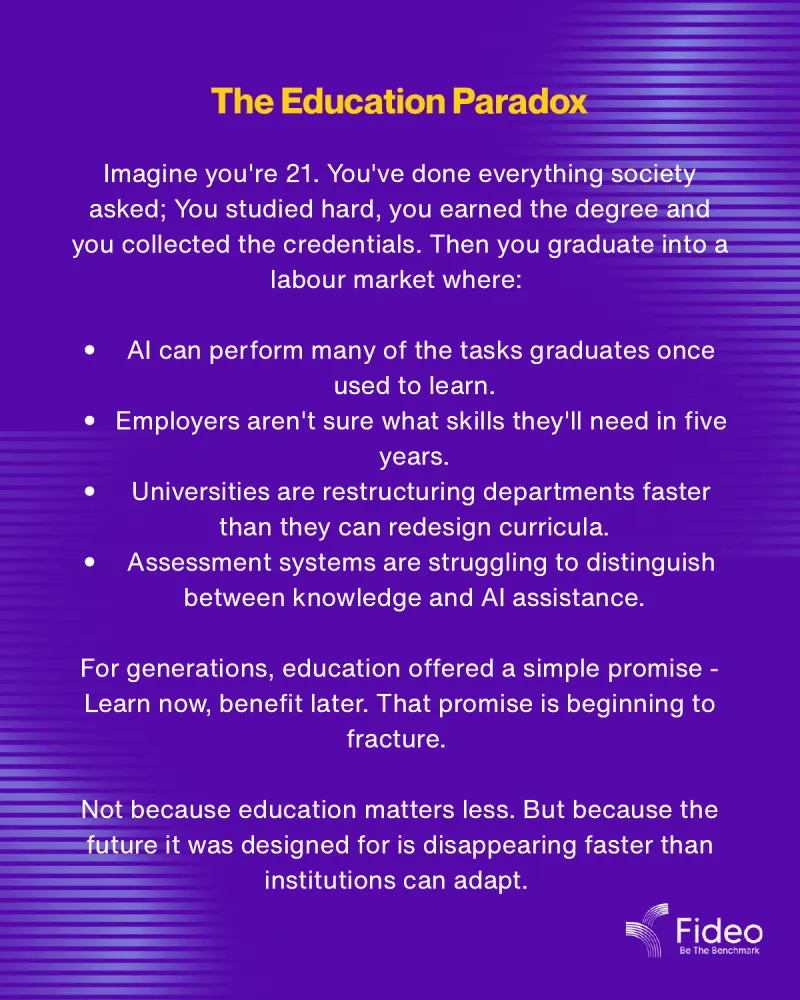
2 / 9 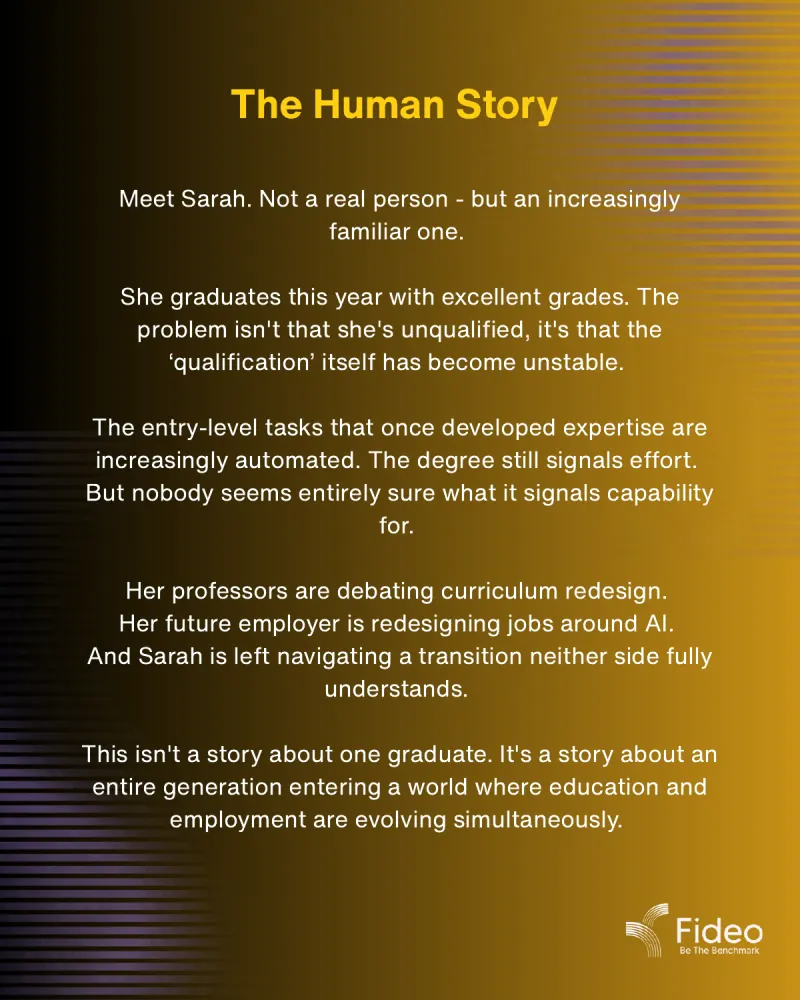
3 / 9 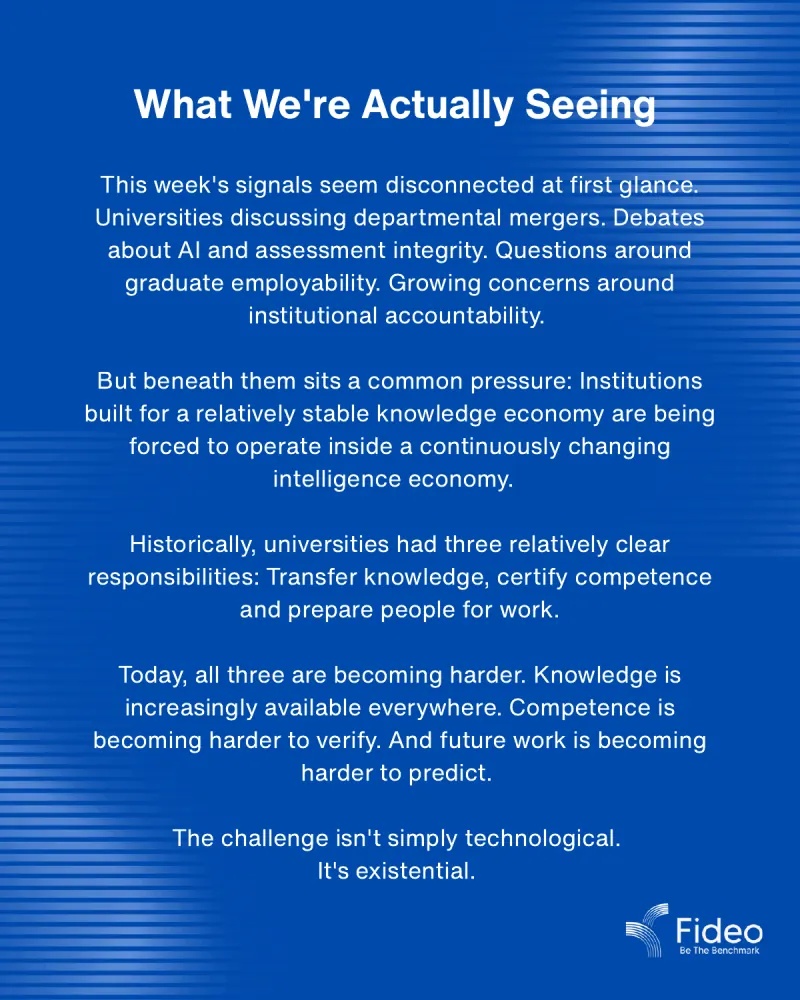
4 / 9 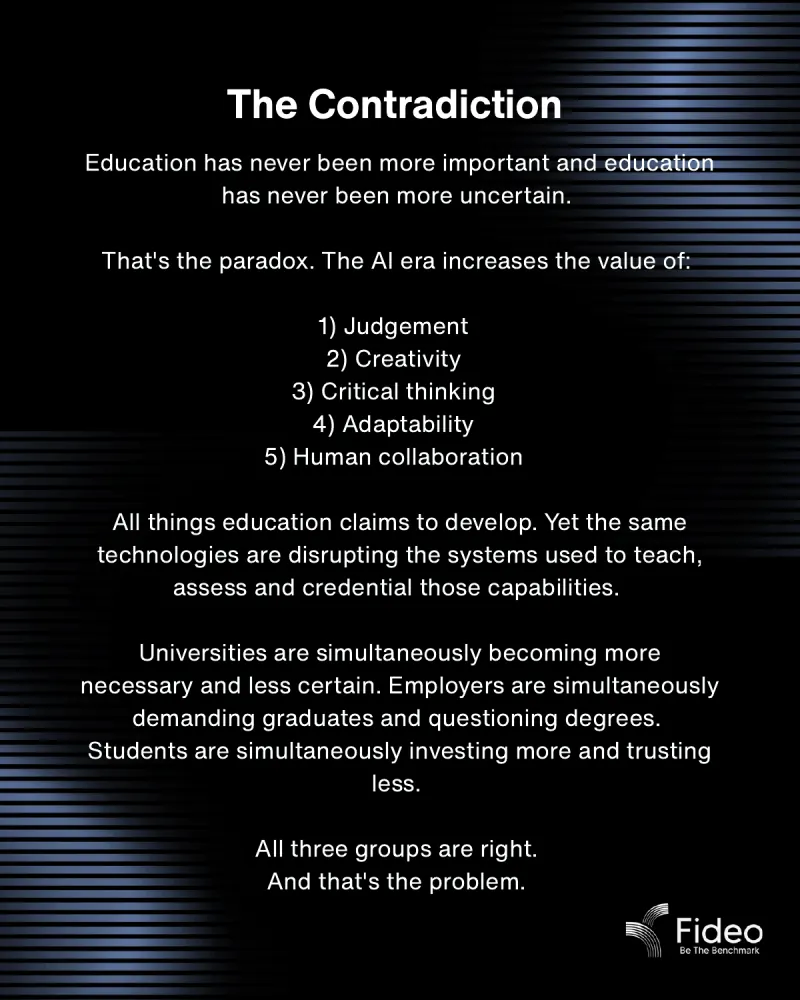
5 / 9 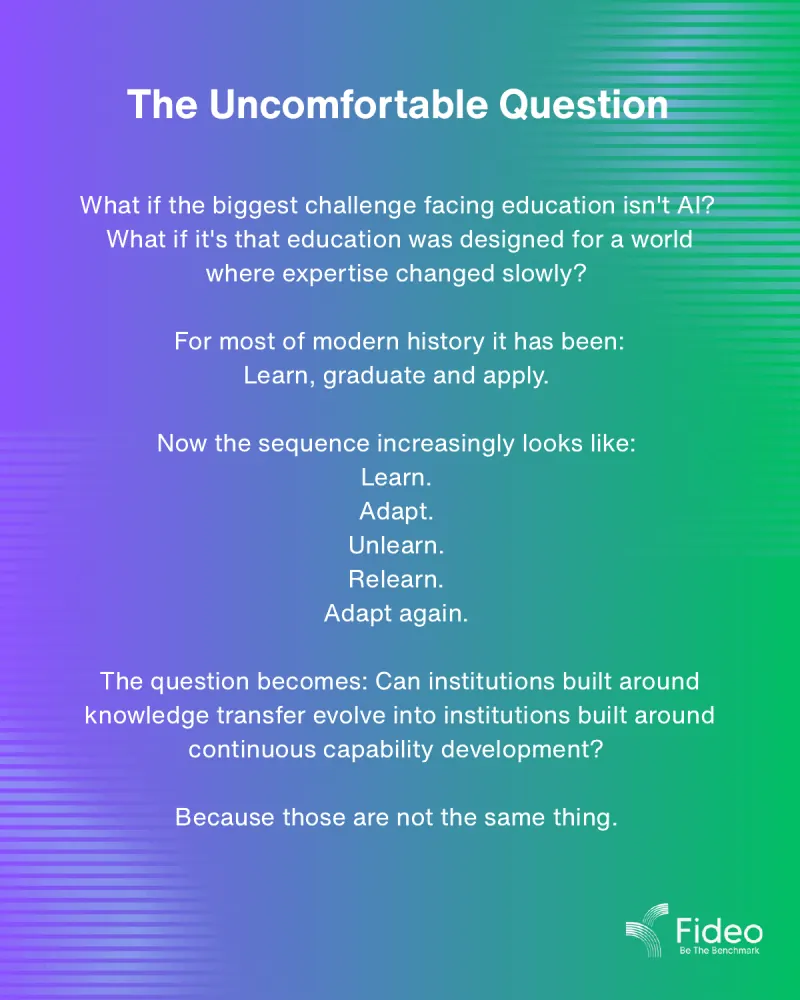
6 / 9 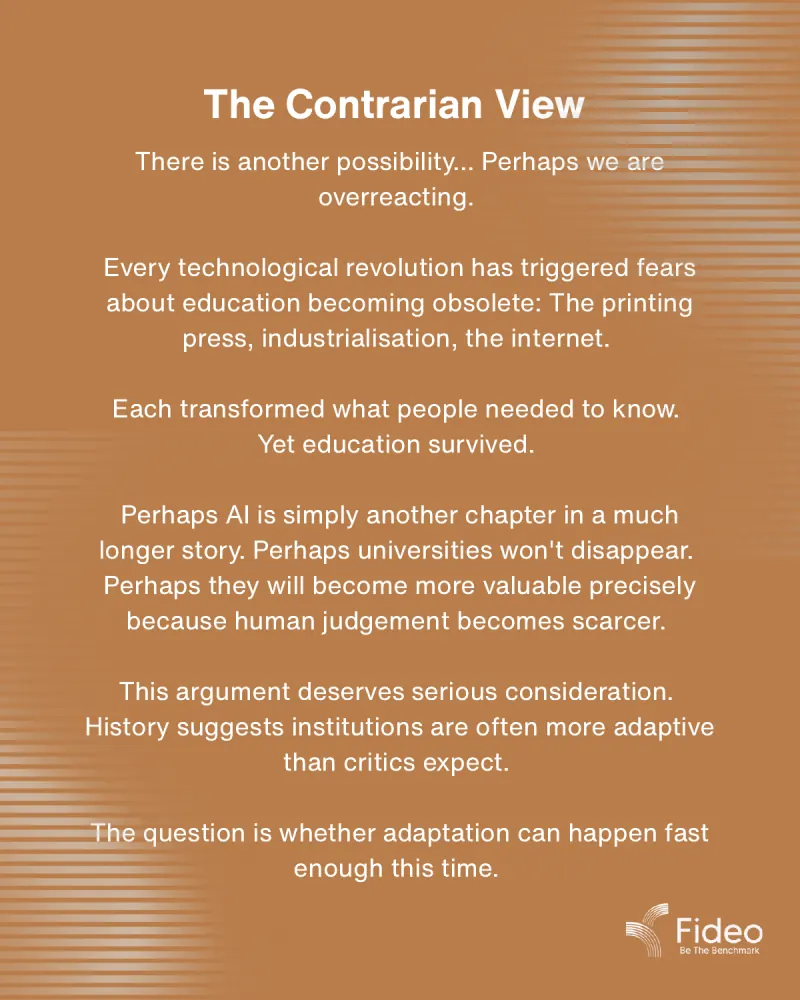
7 / 9 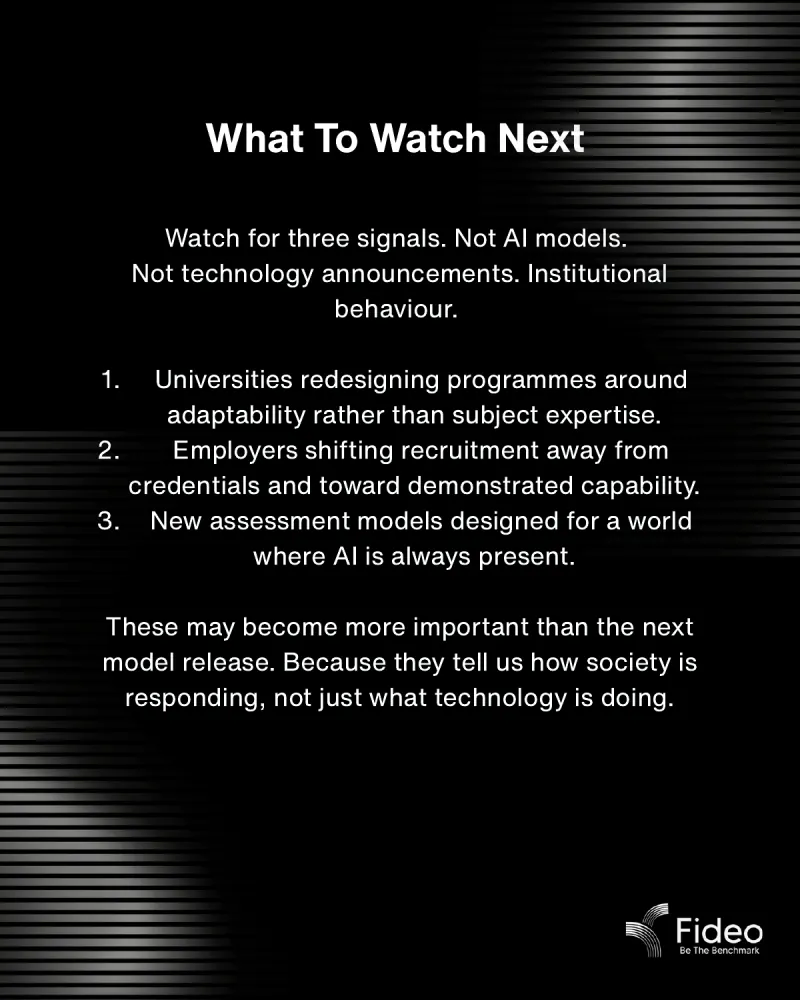
8 / 9 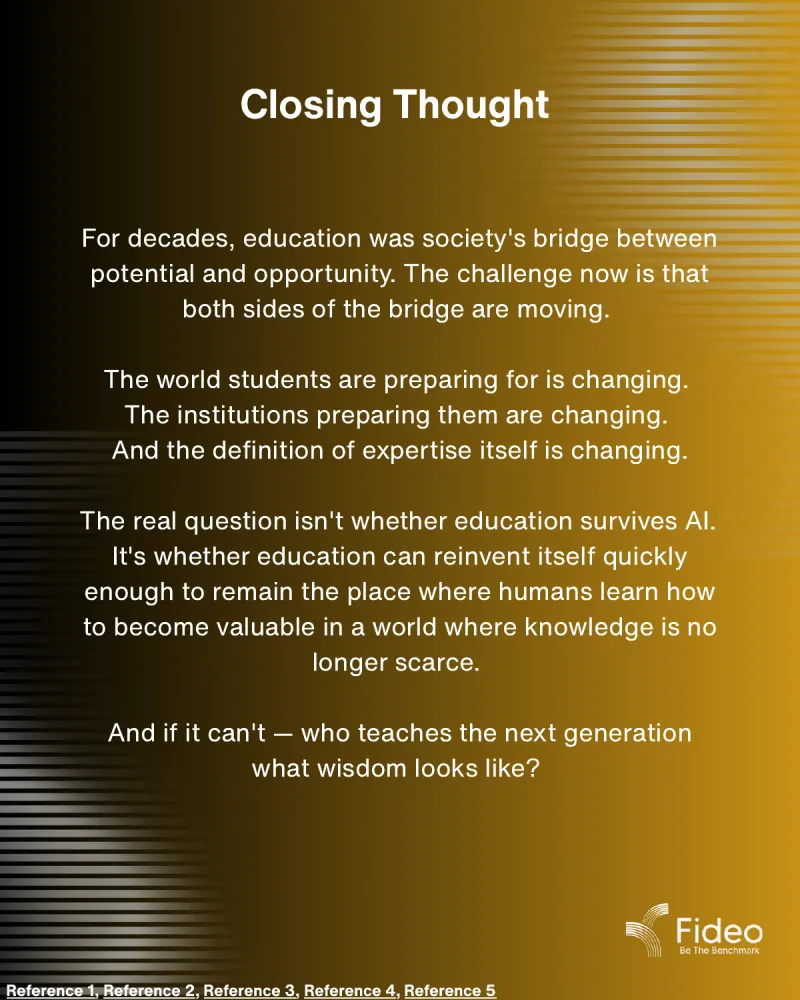
9 / 9
This week in 60 seconds
Why universities, employers and students are all right, and why that is the problem
- AI can now perform many entry-level tasks that once built graduate expertise, leaving degrees signalling effort but not clearly capability.
- Universities' three traditional jobs (transfer knowledge, certify competence, prepare people for work) are all getting harder at once.
- The AI era raises the value of judgement, creativity, critical thinking, adaptability and human collaboration, while disrupting how they are taught and credentialed.
- The old sequence of learn, graduate and apply is giving way to learn, adapt, unlearn, relearn and adapt again.
- A contrarian view holds that education survived the printing press, industrialisation and the internet; the open question is whether it can adapt fast enough now.
Try this with your team
Track the three institutional signals the edition highlights: universities redesigning programmes around adaptability rather than subject expertise, employers recruiting on demonstrated capability rather than credentials, and new assessment models built for a world where AI is always present.
Read this edition as text (4 min)
The Education Paradox
Imagine you're 21. You've done everything society asked; You studied hard, you earned the degree and you collected the credentials. Then you graduate into a labour market where:
AI can perform many of the tasks graduates once used to learn. Employers aren't sure what skills they'll need in five years. Universities are restructuring departments faster than they can redesign curricula. Assessment systems are struggling to distinguish between knowledge and AI assistance.
For generations, education offered a simple promise - Learn now, benefit later. That promise is beginning to fracture.
Not because education matters less. But because the future it was designed for is disappearing faster than institutions can adapt.
The Human Story
Meet Sarah. Not a real person - but an increasingly familiar one.
She graduates this year with excellent grades. The problem isn't that she's unqualified, it's that the ‘qualification’ itself has become unstable.
The entry-level tasks that once developed expertise are increasingly automated. The degree still signals effort. But nobody seems entirely sure what it signals capability for.
Her professors are debating curriculum redesign. Her future employer is redesigning jobs around AI. And Sarah is left navigating a transition neither side fully understands.
This isn't a story about one graduate. It's a story about an entire generation entering a world where education and employment are evolving simultaneously.
What We're Actually Seeing
This week's signals seem disconnected at first glance. Universities discussing departmental mergers. Debates about AI and assessment integrity. Questions around graduate employability. Growing concerns around institutional accountability.
But beneath them sits a common pressure: Institutions built for a relatively stable knowledge economy are being forced to operate inside a continuously changing intelligence economy.
Historically, universities had three relatively clear responsibilities: Transfer knowledge, certify competence and prepare people for work.
Today, all three are becoming harder. Knowledge is increasingly available everywhere. Competence is becoming harder to verify. And future work is becoming harder to predict.
The challenge isn't simply technological. It's existential.
The Contradiction
Education has never been more important and education has never been more uncertain.
That's the paradox. The AI era increases the value of:
1) Judgement 2) Creativity 3) Critical thinking 4) Adaptability 5) Human collaboration
All things education claims to develop. Yet the same technologies are disrupting the systems used to teach, assess and credential those capabilities.
Universities are simultaneously becoming more necessary and less certain. Employers are simultaneously demanding graduates and questioning degrees. Students are simultaneously investing more and trusting less.
All three groups are right. And that's the problem.
The Uncomfortable Question
What if the biggest challenge facing education isn't AI? What if it's that education was designed for a world where expertise changed slowly?
For most of modern history it has been: Learn, graduate and apply.
Now the sequence increasingly looks like: Learn. Adapt. Unlearn. Relearn. Adapt again.
The question becomes: Can institutions built around knowledge transfer evolve into institutions built around continuous capability development?
Because those are not the same thing.
The Contrarian View
There is another possibility... Perhaps we are overreacting.
Every technological revolution has triggered fears about education becoming obsolete: The printing press, industrialisation, the internet.
Each transformed what people needed to know. Yet education survived.
Perhaps AI is simply another chapter in a much longer story. Perhaps universities won't disappear. Perhaps they will become more valuable precisely because human judgement becomes scarcer.
This argument deserves serious consideration. History suggests institutions are often more adaptive than critics expect.
The question is whether adaptation can happen fast enough this time.
What To Watch Next
Watch for three signals. Not AI models. Not technology announcements. Institutional behaviour.
1. Universities redesigning programmes around adaptability rather than subject expertise. 2. Employers shifting recruitment away from credentials and toward demonstrated capability. 3. New assessment models designed for a world where AI is always present.
These may become more important than the next model release. Because they tell us how society is responding, not just what technology is doing.
Closing Thought
For decades, education was society's bridge between potential and opportunity. The challenge now is that both sides of the bridge are moving.
The world students are preparing for is changing. The institutions preparing them are changing. And the definition of expertise itself is changing.
The real question isn't whether education survives AI. It's whether education can reinvent itself quickly enough to remain the place where humans learn how to become valuable in a world where knowledge is no longer scarce.
And if it can't — who teaches the next generation what wisdom looks like?
Sources
- LinkedInlinkedin.com/pulse/what-graduates-need-know-ai-entry-level-jobs-bernard-marr-mj60e/
- LinkedInlinkedin.com/posts/leofranciscullen_institutional-accountability-in-the-age-of-ugcPost-746
- LinkedInlinkedin.com/posts/bette-a-ludwig-phd-89a74a139_should-universities-start-combining-depart
- LinkedInlinkedin.com/posts/stuart-pedley-smith-454b22_assessment-ai-criticalthinking-share-7467499
More questions about this edition
Who is Sarah in this edition?
Sarah is not a real person. She is an illustrative graduate with excellent grades whose qualification has become unstable as entry-level tasks are automated and jobs are redesigned around AI.
Why does the edition say all three groups are right?
Universities are becoming more necessary and less certain, employers are demanding graduates while questioning degrees, and students are investing more while trusting less. Each view is valid, which is what makes the problem hard.
What is the underlying pressure linking this week's signals?
Institutions built for a relatively stable knowledge economy are being forced to operate inside a continuously changing intelligence economy.
Get the Zeitgeist every Friday
One email a week with the new edition. Unsubscribe in one click.
Check your inbox to confirm your subscription.
Please enter a valid email address and try again.