Week of 19 to 23 Jan 2026
Six signals for internet-native finance: tokenisation, stablecoins and real-time risk
1 / 9 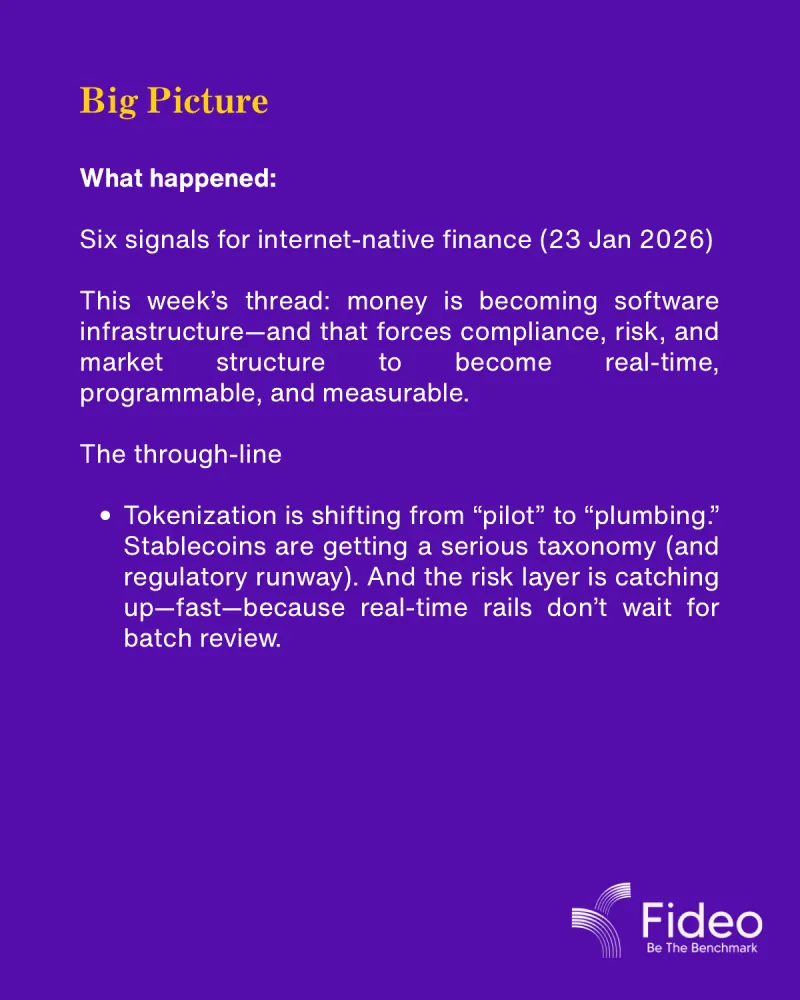
2 / 9 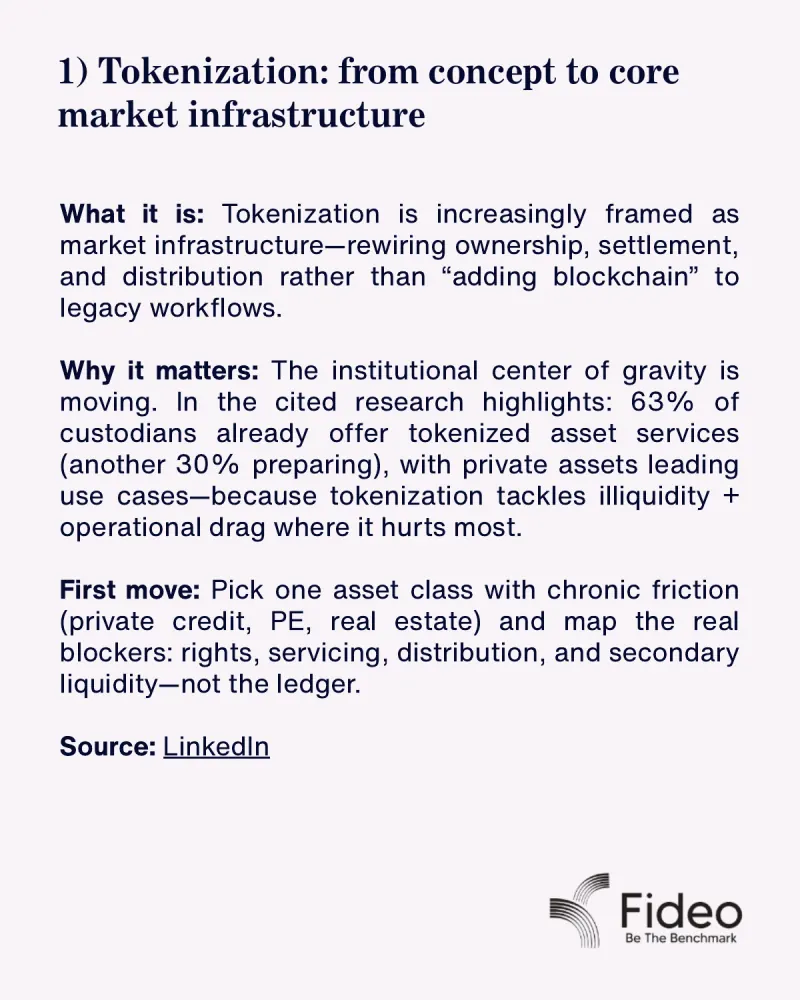
3 / 9 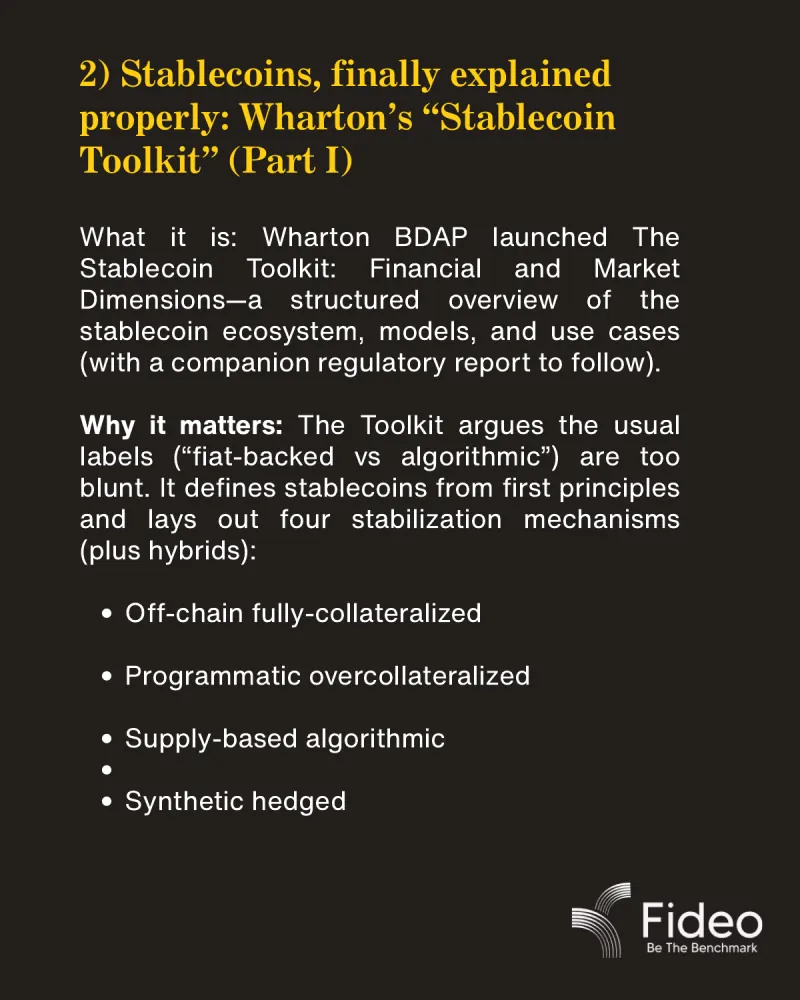
4 / 9 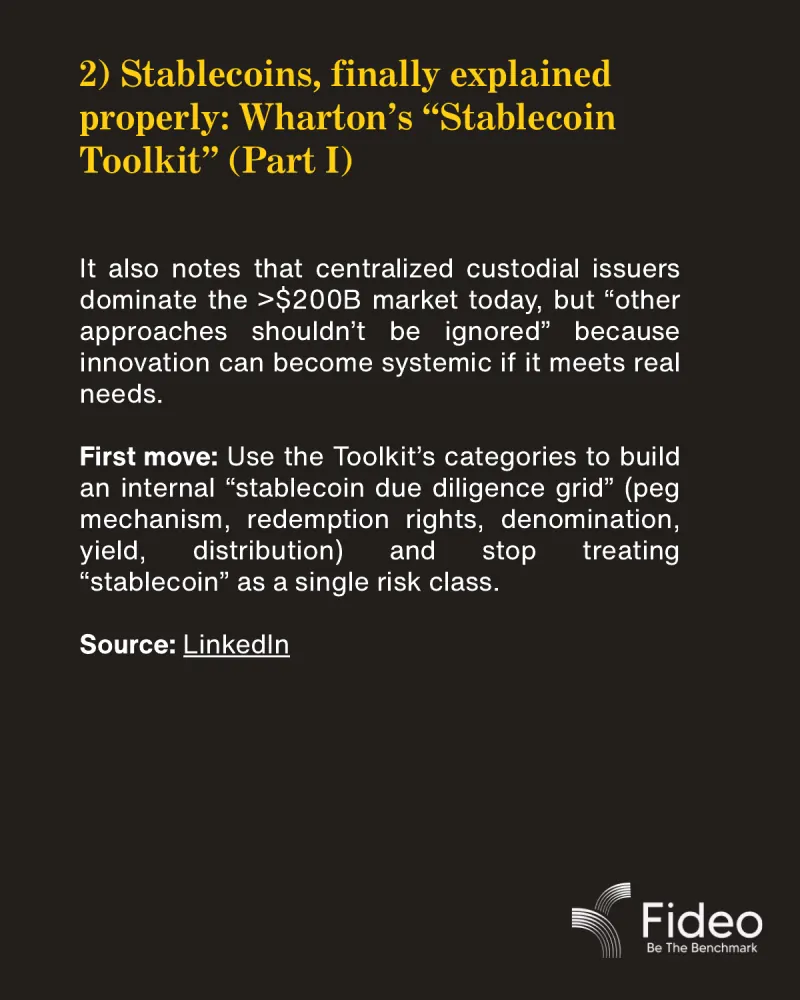
5 / 9 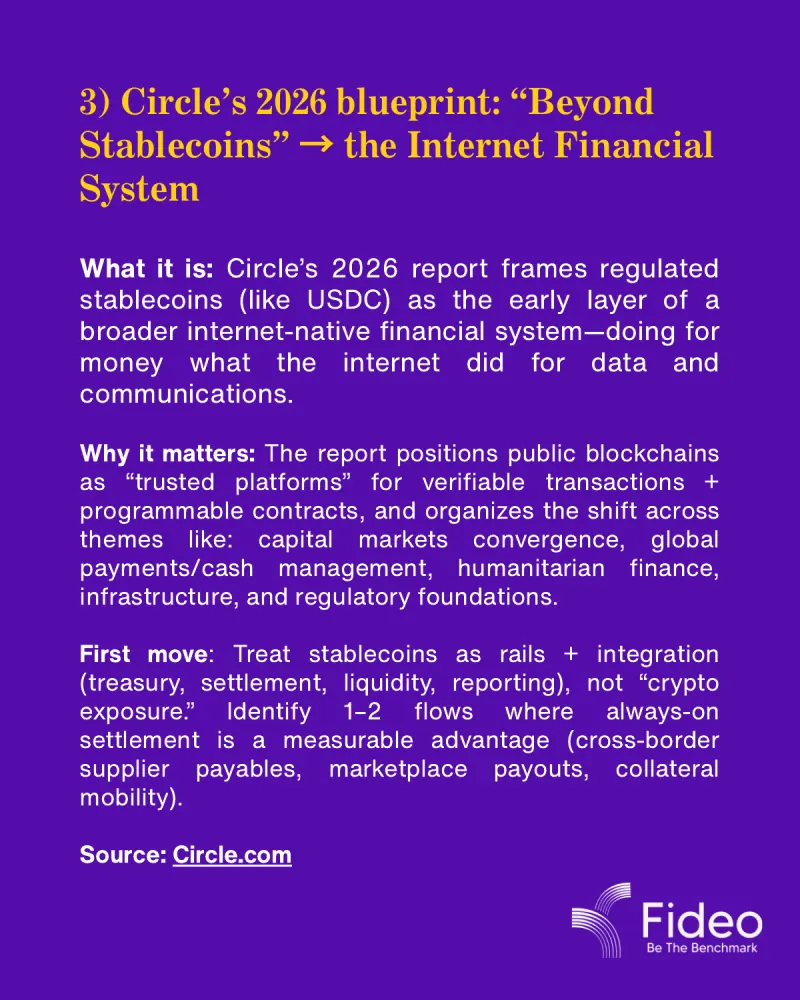
6 / 9 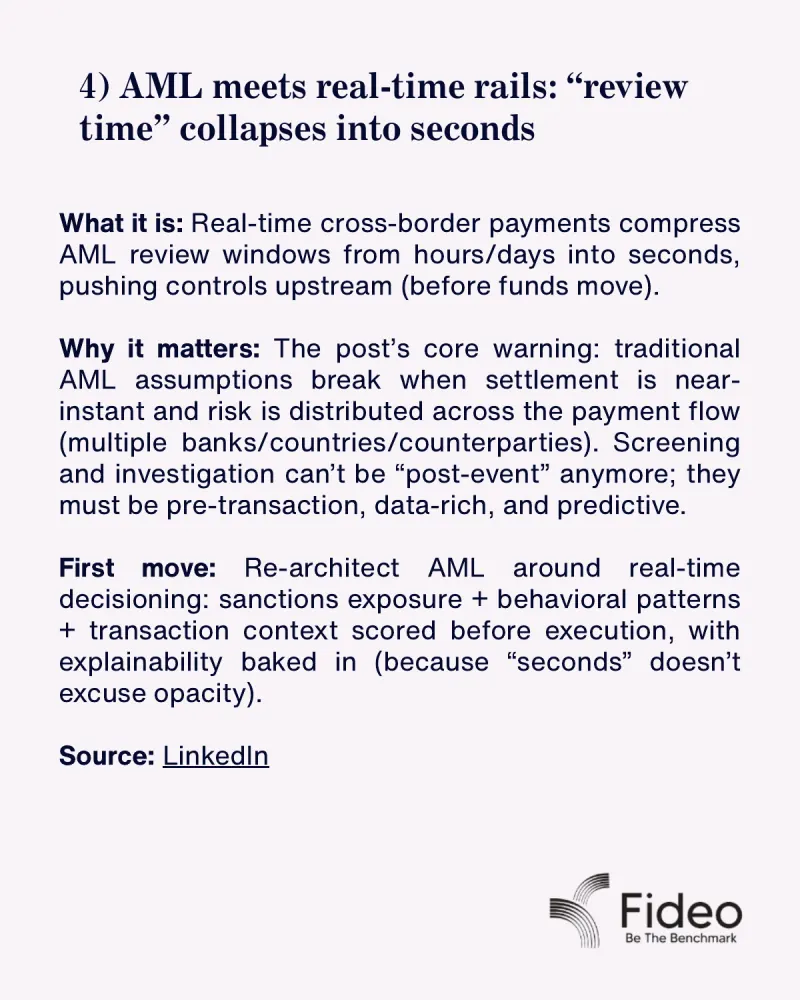
7 / 9 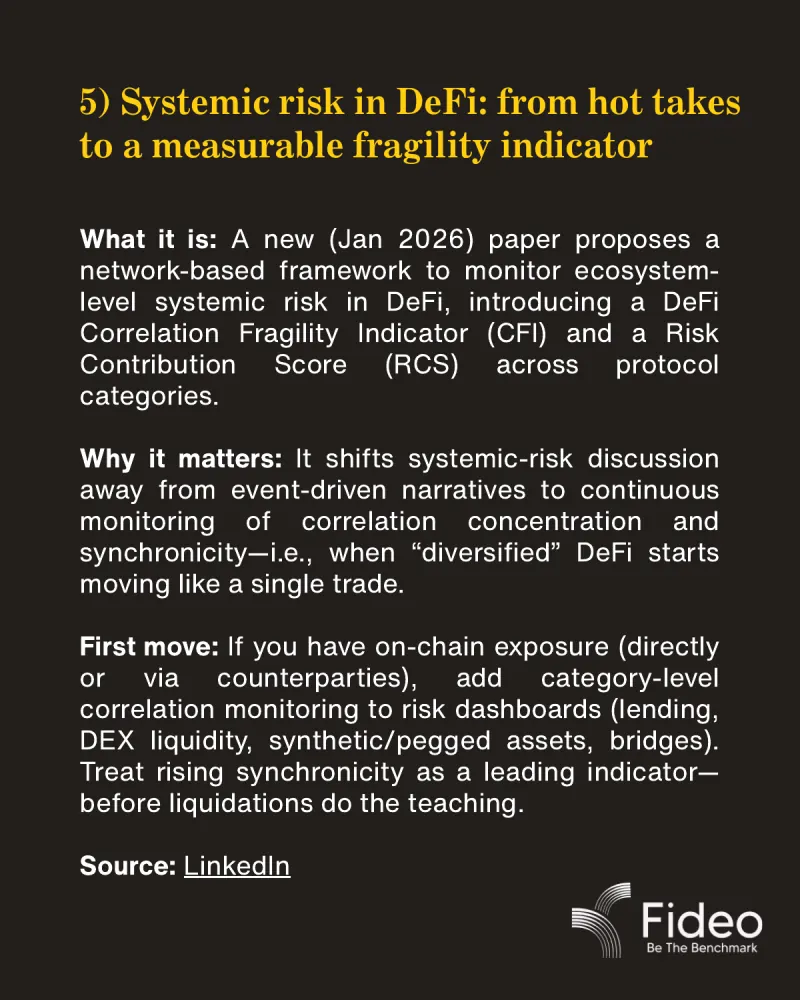
8 / 9 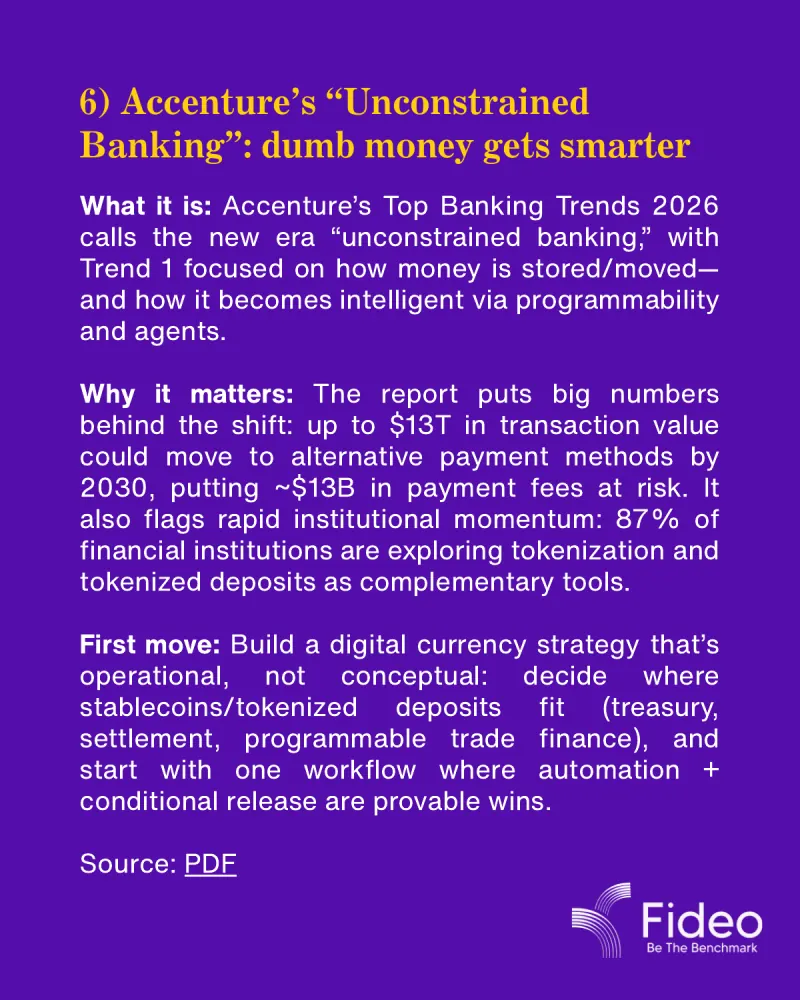
9 / 9
This week in 60 seconds
Money is becoming software infrastructure, forcing compliance, risk and market structure to become real-time, programmable and measurable.
- Cited research says 63% of custodians already offer tokenised asset services and another 30% are preparing, with private assets leading use cases.
- Wharton BDAP's Stablecoin Toolkit sets out four stabilisation mechanisms plus hybrids, arguing fiat-backed versus algorithmic labels are too blunt.
- Real-time cross-border payments compress AML review windows into seconds, so screening must move pre-transaction and be data-rich, predictive and explainable.
- A January 2026 paper proposes a DeFi Correlation Fragility Indicator and Risk Contribution Score to monitor systemic risk continuously.
- Accenture estimates up to $13T in transaction value could move to alternative payment methods by 2030, putting about $13B in payment fees at risk.
Try this with your team
Use the Wharton Toolkit's categories to build an internal stablecoin due diligence grid covering peg mechanism, redemption rights, denomination, yield and distribution, and stop treating stablecoins as a single risk class.
Read this edition as text (4 min)
Big Picture
What happened:
Six signals for internet-native finance (23 Jan 2026)
This week’s thread: money is becoming software infrastructure—and that forces compliance, risk, and market structure to become real-time, programmable, and measurable.
The through-line
Tokenization is shifting from “pilot” to “plumbing. ” Stablecoins are getting a serious taxonomy (and regulatory runway). And the risk layer is catching up—fast—because real-time rails don’t wait for batch review.
1) Tokenization: from concept to core market infrastructure
What it is: Tokenization is increasingly framed as market infrastructure—rewiring ownership, settlement, and distribution rather than “adding blockchain” to legacy workflows.
Why it matters: The institutional center of gravity is moving. In the cited research highlights: 63% of custodians already offer tokenized asset services (another 30% preparing), with private assets leading use cases—because tokenization tackles illiquidity + operational drag where it hurts most.
First move: Pick one asset class with chronic friction (private credit, PE, real estate) and map the real blockers: rights, servicing, distribution, and secondary liquidity—not the ledger.
Source: LinkedIn
2) Stablecoins, finally explained properly: Wharton’s “Stablecoin Toolkit” (Part I)
What it is: Wharton BDAP launched The Stablecoin Toolkit: Financial and Market Dimensions—a structured overview of the stablecoin ecosystem, models, and use cases (with a companion regulatory report to follow).
Why it matters: The Toolkit argues the usual labels (“fiat-backed vs algorithmic”) are too blunt. It defines stablecoins from first principles and lays out four stabilization mechanisms (plus hybrids):
Off-chain fully-collateralized
Programmatic overcollateralized
Supply-based algorithmic
Synthetic hedged
2) Stablecoins, finally explained properly: Wharton’s “Stablecoin Toolkit” (Part I)
It also notes that centralized custodial issuers dominate the >$200B market today, but “other approaches shouldn’t be ignored” because innovation can become systemic if it meets real needs.
First move: Use the Toolkit’s categories to build an internal “stablecoin due diligence grid” (peg mechanism, redemption rights, denomination, yield, distribution) and stop treating “stablecoin” as a single risk class.
Source: LinkedIn
3) Circle’s 2026 blueprint: “Beyond Stablecoins” the Internet Financial System
→
What it is: Circle’s 2026 report frames regulated stablecoins (like USDC) as the early layer of a broader internet-native financial system—doing for money what the internet did for data and communications.
Why it matters: The report positions public blockchains as “trusted platforms” for verifiable transactions + programmable contracts, and organizes the shift across themes like: capital markets convergence, global payments/cash management, humanitarian finance, infrastructure, and regulatory foundations.
First move : Treat stablecoins as rails + integration (treasury, settlement, liquidity, reporting), not “crypto exposure. ” Identify 1–2 flows where always-on settlement is a measurable advantage (cross-border supplier payables, marketplace payouts, collateral mobility).
Source: Circle.com
4) AML meets real-time rails: “review time” collapses into seconds
What it is: Real-time cross-border payments compress AML review windows from hours/days into seconds, pushing controls upstream (before funds move).
Why it matters: The post’s core warning: traditional AML assumptions break when settlement is near- instant and risk is distributed across the payment flow (multiple banks/countries/counterparties). Screening and investigation can’t be “post-event” anymore; they must be pre-transaction, data-rich, and predictive.
First move: Re-architect AML around real-time decisioning: sanctions exposure + behavioral patterns + transaction context scored before execution, with explainability baked in (because “seconds” doesn’t excuse opacity).
Source: LinkedIn
5) Systemic risk in DeFi: from hot takes to a measurable fragility indicator
What it is: A new (Jan 2026) paper proposes a network-based framework to monitor ecosystem- level systemic risk in DeFi, introducing a DeFi Correlation Fragility Indicator (CFI) and a Risk Contribution Score (RCS) across protocol categories.
Why it matters: It shifts systemic-risk discussion away from event-driven narratives to continuous monitoring of correlation concentration and synchronicity—i.e., when “diversified” DeFi starts moving like a single trade.
First move: If you have on-chain exposure (directly or via counterparties), add category-level correlation monitoring to risk dashboards (lending, DEX liquidity, synthetic/pegged assets, bridges). Treat rising synchronicity as a leading indicator— before liquidations do the teaching.
Source: LinkedIn
6) Accenture’s “Unconstrained Banking”: dumb money gets smarter
What it is: Accenture’s Top Banking Trends 2026 calls the new era “unconstrained banking,” with Trend 1 focused on how money is stored/moved— and how it becomes intelligent via programmability and agents.
Why it matters: The report puts big numbers behind the shift: up to $13T in transaction value could move to alternative payment methods by 2030, putting ~$13B in payment fees at risk. It also flags rapid institutional momentum: 87% of financial institutions are exploring tokenization and tokenized deposits as complementary tools.
First move: Build a digital currency strategy that’s operational, not conceptual: decide where stablecoins/tokenized deposits fit (treasury, settlement, programmable trade finance), and start with one workflow where automation + conditional release are provable wins.
Source: PDF
Sources
- LinkedInlinkedin.com/posts/sirahmad_tokenization-part-i-activity-7418668194917351424-S2ge/
- LinkedInlinkedin.com/posts/dimitrios-psarrakis-12819526_wharton-stablecoin-toolkit-part-i-activity
- circle.comcircle.com/reports/internet-financial-system
- LinkedInlinkedin.com/posts/larry-sobin-815402_cross-border-aml-ugcPost-7417922662624129024-c0Xh
- LinkedInlinkedin.com/posts/krzysztofgogol_systematic-risk-in-defi-activity-7419312563101786112-LL7
- media.licdn.commedia.licdn.com/dms/document/media/v2/D4D1FAQFaW6SNe_ThvQ/feedshare-document-pdf-analyzed/
More questions about this edition
What are the four stablecoin stabilisation mechanisms in the Wharton Toolkit?
Off-chain fully collateralised, programmatic overcollateralised, supply-based algorithmic and synthetic hedged, plus hybrids.
How does Circle's 2026 report frame stablecoins?
It frames regulated stablecoins such as USDC as the early layer of a broader internet-native financial system, with public blockchains as trusted platforms for verifiable transactions and programmable contracts.
Where should firms start with tokenisation?
Pick one asset class with chronic friction, such as private credit, private equity or real estate, and map the real blockers: rights, servicing, distribution and secondary liquidity, not the ledger.
Get the Zeitgeist every Friday
One email a week with the new edition. Unsubscribe in one click.
Check your inbox to confirm your subscription.
Please enter a valid email address and try again.