Week of 20 to 24 Apr 2026
When AI amplifies the literacy gaps we already have
1 / 6 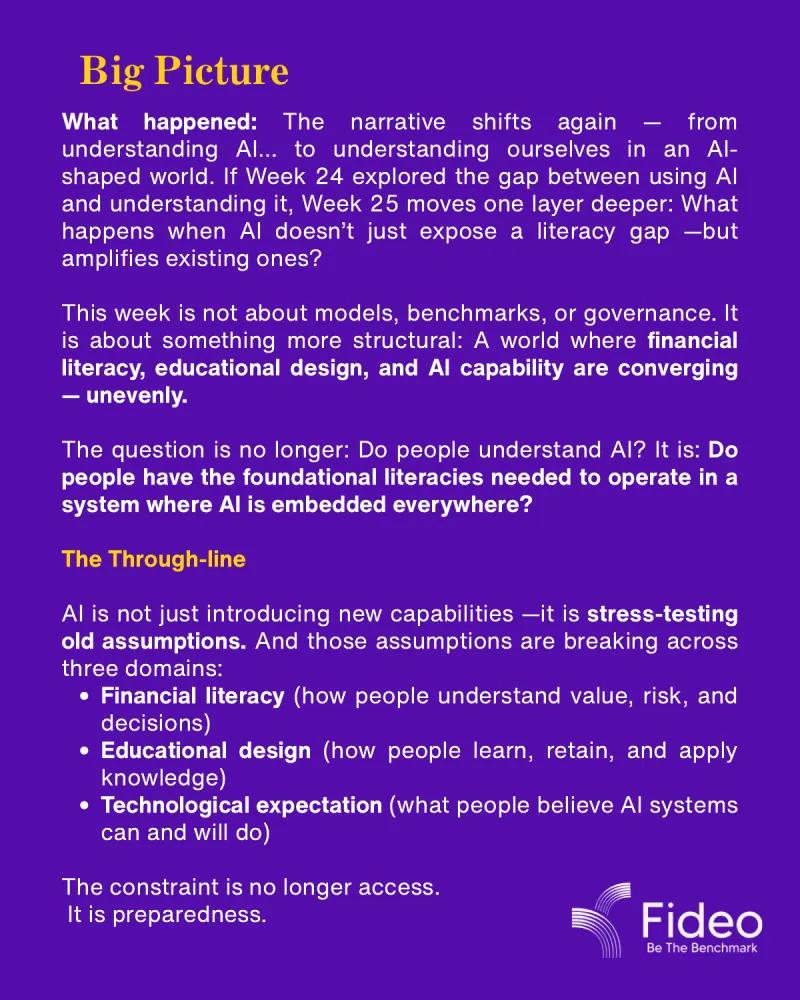
2 / 6 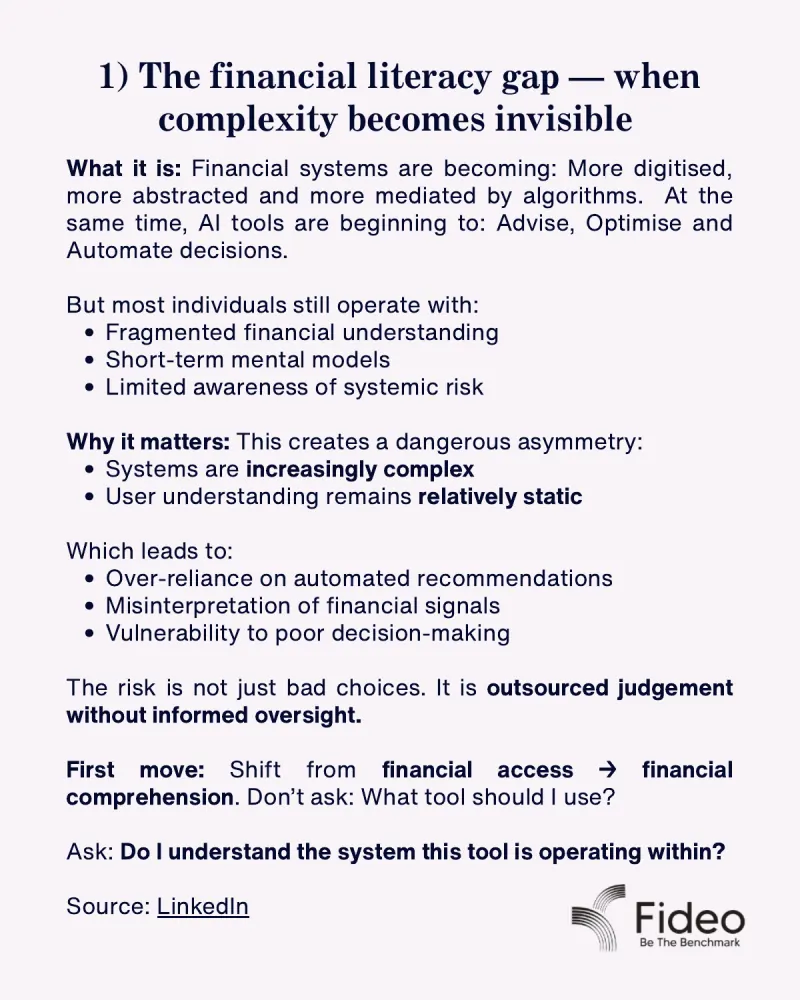
3 / 6 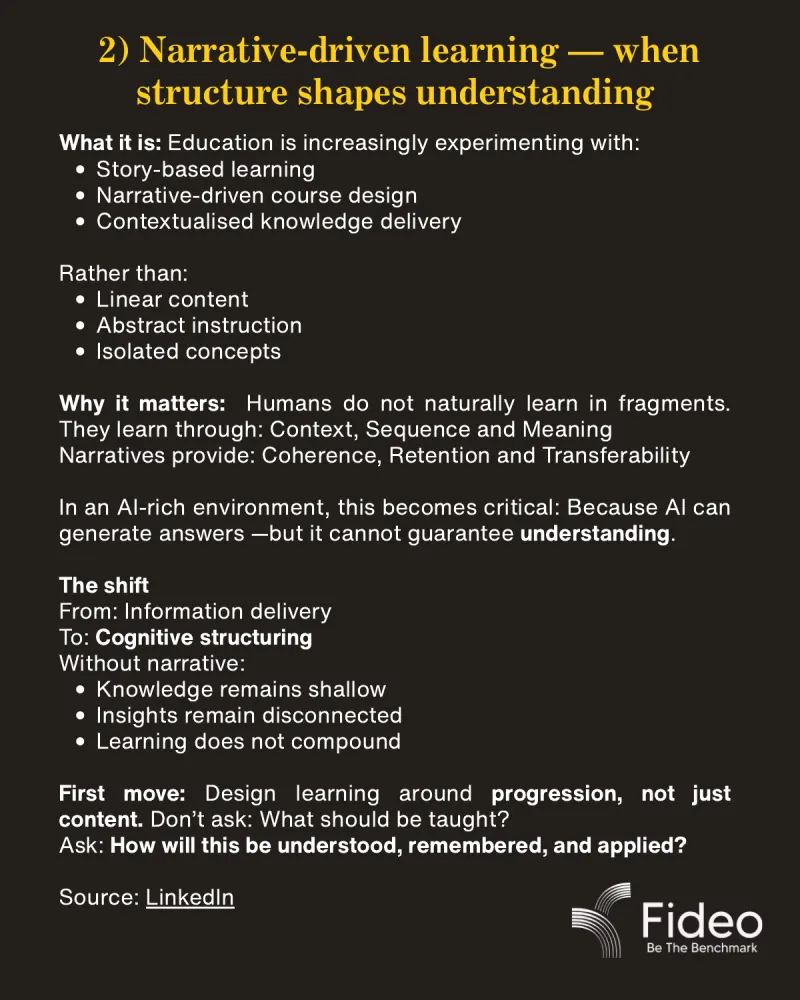
4 / 6 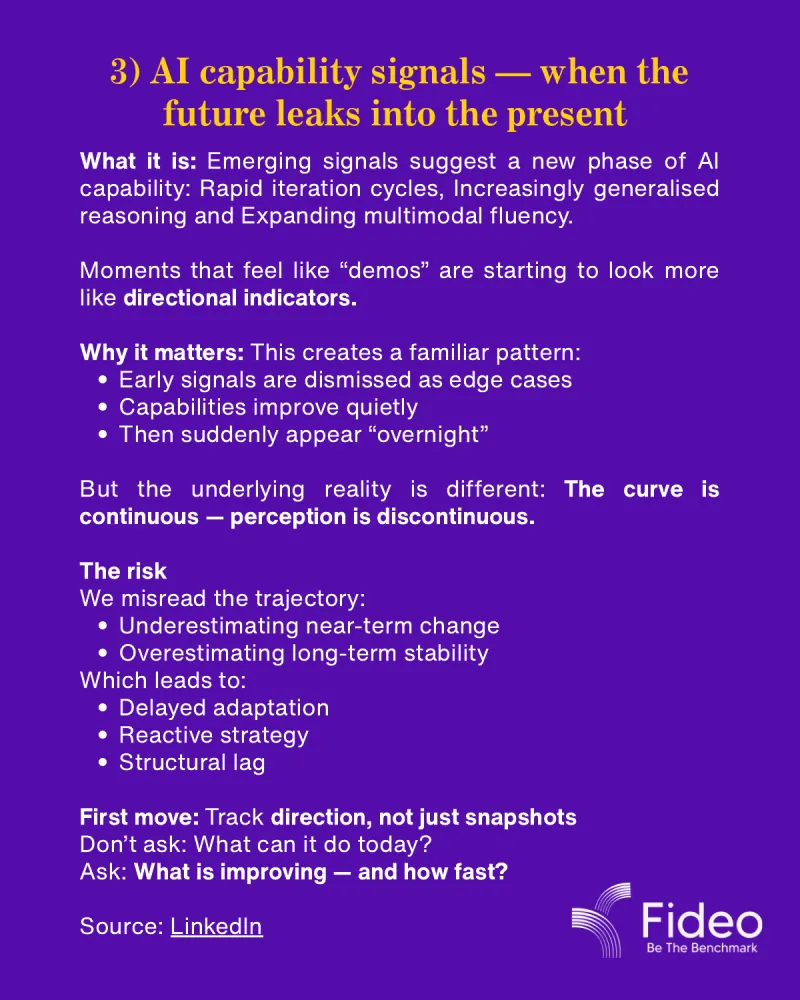
5 / 6 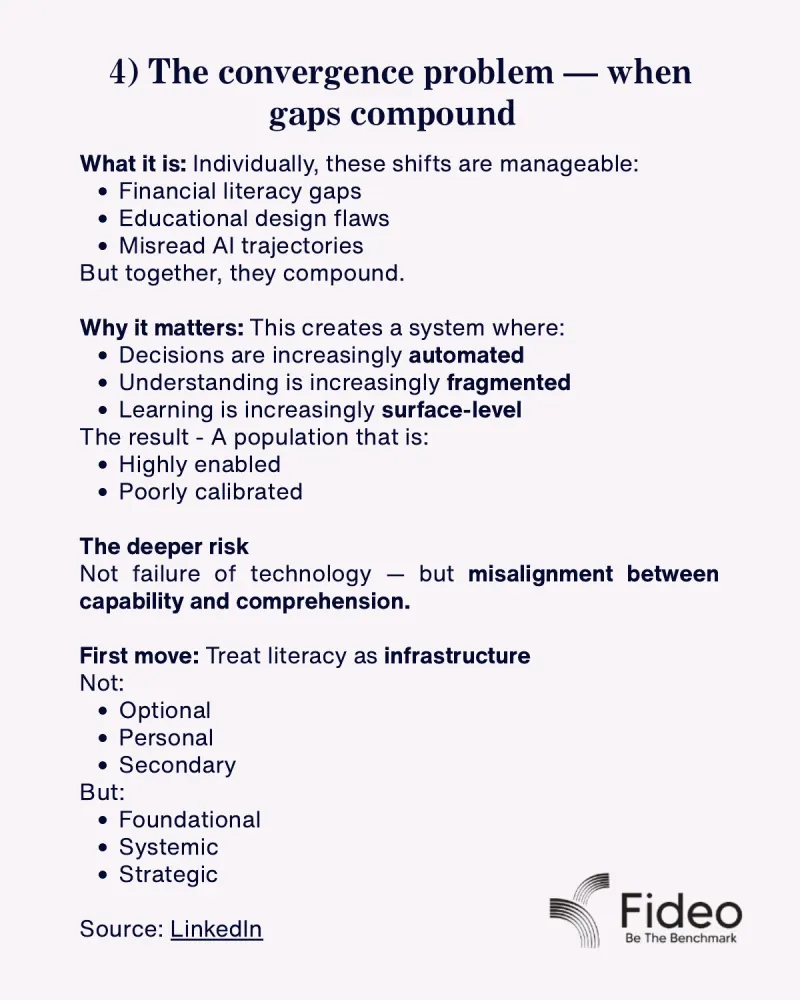
6 / 6
This week in 60 seconds
Financial literacy, learning design and AI expectations are converging unevenly. The constraint is no longer access but preparedness.
- As financial systems grow more digitised and algorithmic, the risk is outsourced judgement without informed oversight. Shift the focus from financial access to financial comprehension.
- AI can generate answers but cannot guarantee understanding, so learning should move from information delivery to cognitive structuring through narrative and progression.
- AI capability improves on a continuous curve while perception jumps, so track direction rather than snapshots by asking what is improving and how fast.
- Financial literacy gaps, educational design flaws and misread AI trajectories compound, so treat literacy as foundational, systemic and strategic infrastructure.
Try this with your team
Review a course or training module your team runs and replace the question 'What should be taught?' with 'How will this be understood, remembered, and applied?', then redesign it around progression rather than content alone.
Read this edition as text (3 min)
Big Picture
What happened: The narrative shifts again — from understanding AI… to understanding ourselves in an AI- shaped world. If Week 24 explored the gap between using AI and understanding it, Week 25 moves one layer deeper: What happens when AI doesn’t just expose a literacy gap —but amplifies existing ones?
This week is not about models, benchmarks, or governance. It is about something more structural: A world where financial literacy, educational design, and AI capability are converging — unevenly.
The question is no longer: Do people understand AI? It is: Do people have the foundational literacies needed to operate in a system where AI is embedded everywhere?
The Through-line
AI is not just introducing new capabilities —it is stress-testing old assumptions. And those assumptions are breaking across three domains: Financial literacy (how people understand value, risk, and decisions) Educational design (how people learn, retain, and apply knowledge) Technological expectation (what people believe AI systems can and will do)
The constraint is no longer access. It is preparedness.
1) The financial literacy gap — when complexity becomes invisible What it is: Financial systems are becoming: More digitised, more abstracted and more mediated by algorithms. At the same time, AI tools are beginning to: Advise, Optimise and Automate decisions.
But most individuals still operate with: Fragmented financial understanding Short-term mental models Limited awareness of systemic risk
Why it matters: This creates a dangerous asymmetry: Systems are increasingly complex User understanding remains relatively static
Which leads to: Over-reliance on automated recommendations Misinterpretation of financial signals Vulnerability to poor decision-making
The risk is not just bad choices. It is outsourced judgement without informed oversight.
First move: Shift from financial access → financial comprehension . Don’t ask: What tool should I use?
Ask: Do I understand the system this tool is operating within?
Source: LinkedIn
2) Narrative-driven learning — when structure shapes understanding
What it is: Education is increasingly experimenting with: Story-based learning Narrative-driven course design Contextualised knowledge delivery
Rather than: Linear content Abstract instruction Isolated concepts
Why it matters: Humans do not naturally learn in fragments. They learn through: Context, Sequence and Meaning Narratives provide: Coherence, Retention and Transferability
In an AI-rich environment, this becomes critical: Because AI can generate answers —but it cannot guarantee understanding .
The shift From: Information delivery To: Cognitive structuring Without narrative: Knowledge remains shallow Insights remain disconnected Learning does not compound
First move: Design learning around progression, not just content. Don’t ask: What should be taught? Ask: How will this be understood, remembered, and applied?
Source: LinkedIn
3) AI capability signals — when the future leaks into the present What it is: Emerging signals suggest a new phase of AI capability: Rapid iteration cycles, Increasingly generalised reasoning and Expanding multimodal fluency.
Moments that feel like “demos” are starting to look more like directional indicators.
Why it matters: This creates a familiar pattern: Early signals are dismissed as edge cases Capabilities improve quietly Then suddenly appear “overnight”
But the underlying reality is different: The curve is continuous — perception is discontinuous.
The risk We misread the trajectory: Underestimating near-term change Overestimating long-term stability Which leads to: Delayed adaptation Reactive strategy Structural lag
First move: Track direction, not just snapshots Don’t ask: What can it do today? Ask: What is improving — and how fast?
Source: LinkedIn
4) The convergence problem — when gaps compound What it is: Individually, these shifts are manageable: Financial literacy gaps Educational design flaws Misread AI trajectories But together, they compound.
Why it matters: This creates a system where: Decisions are increasingly automated Understanding is increasingly fragmented Learning is increasingly surface-level The result - A population that is: Highly enabled Poorly calibrated
The deeper risk Not failure of technology — but misalignment between capability and comprehension.
First move: Treat literacy as infrastructure Not: Optional Personal Secondary But: Foundational Systemic Strategic
Source: LinkedIn
Sources
- LinkedInlinkedin.com/posts/celebrating-national-financial-literacy-share-7450579496501657601-xmCK/
- LinkedInlinkedin.com/posts/money-financial-education-ugcPost-7445025670717444096-Jyx2/
- LinkedInlinkedin.com/posts/charlottevonessen_designing-courses-around-narratives-ugcPost-744913581
- LinkedInlinkedin.com/posts/emollick_sign-of-the-future-gpt-55-share-7453174194680524801-Bx45/
More questions about this edition
What risks follow from misreading AI's trajectory?
The edition says underestimating near-term change and overestimating long-term stability leads to delayed adaptation, reactive strategy and structural lag.
How does this edition relate to the previous week's theme?
Week 24 explored the gap between using AI and understanding it. Week 25 goes a layer deeper, asking what happens when AI amplifies existing literacy gaps rather than simply exposing them.
What is the deeper risk the edition identifies?
Not failure of technology, but misalignment between capability and comprehension, producing a system where decisions are automated, understanding is fragmented and learning is surface-level.
Get the Zeitgeist every Friday
One email a week with the new edition. Unsubscribe in one click.
Check your inbox to confirm your subscription.
Please enter a valid email address and try again.