Week of 3 to 7 Nov 2025
Ghana's virtual assets policy, stablecoin deposit risk and securing enterprise AI
1 / 7 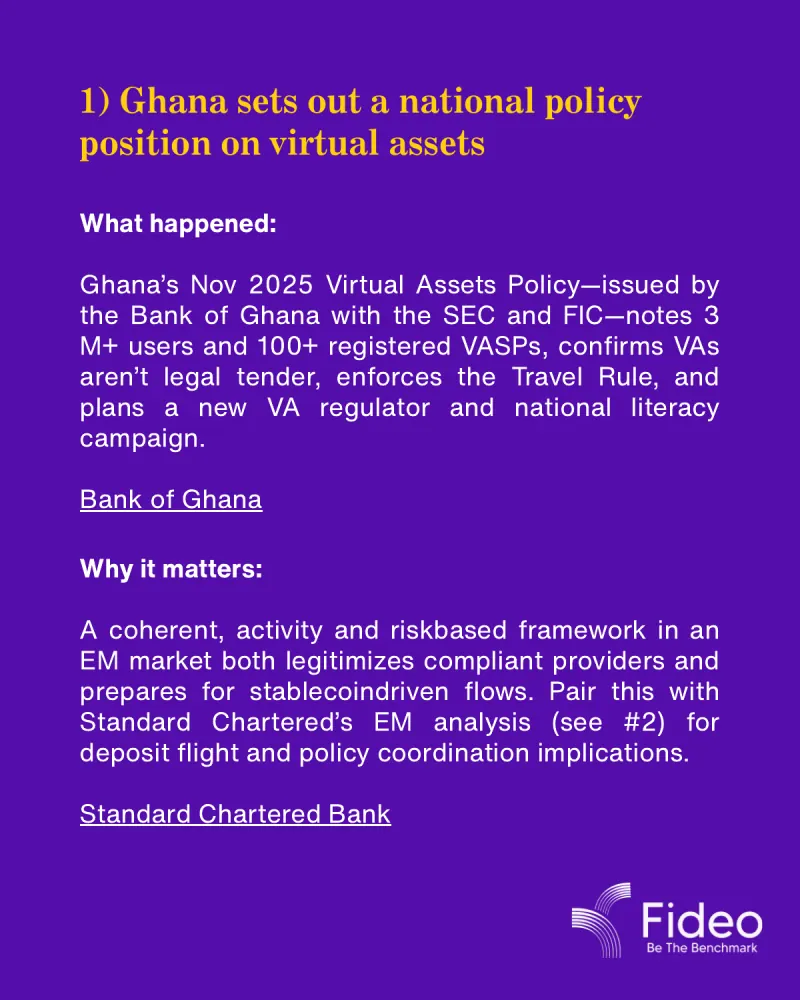
2 / 7 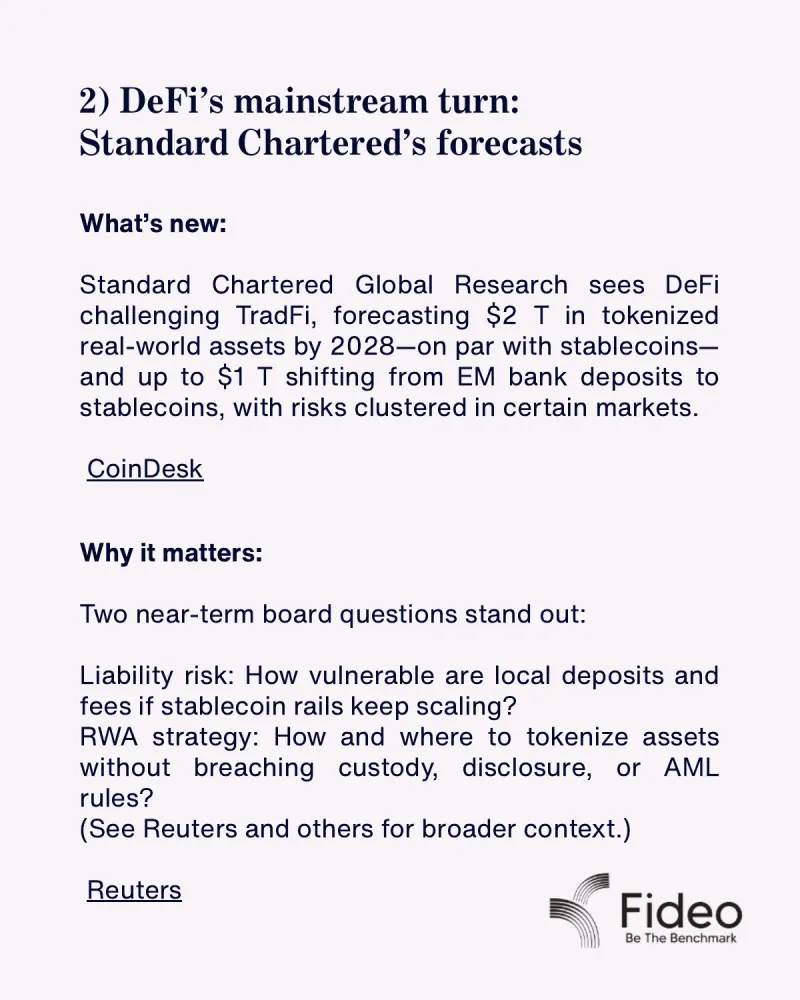
3 / 7 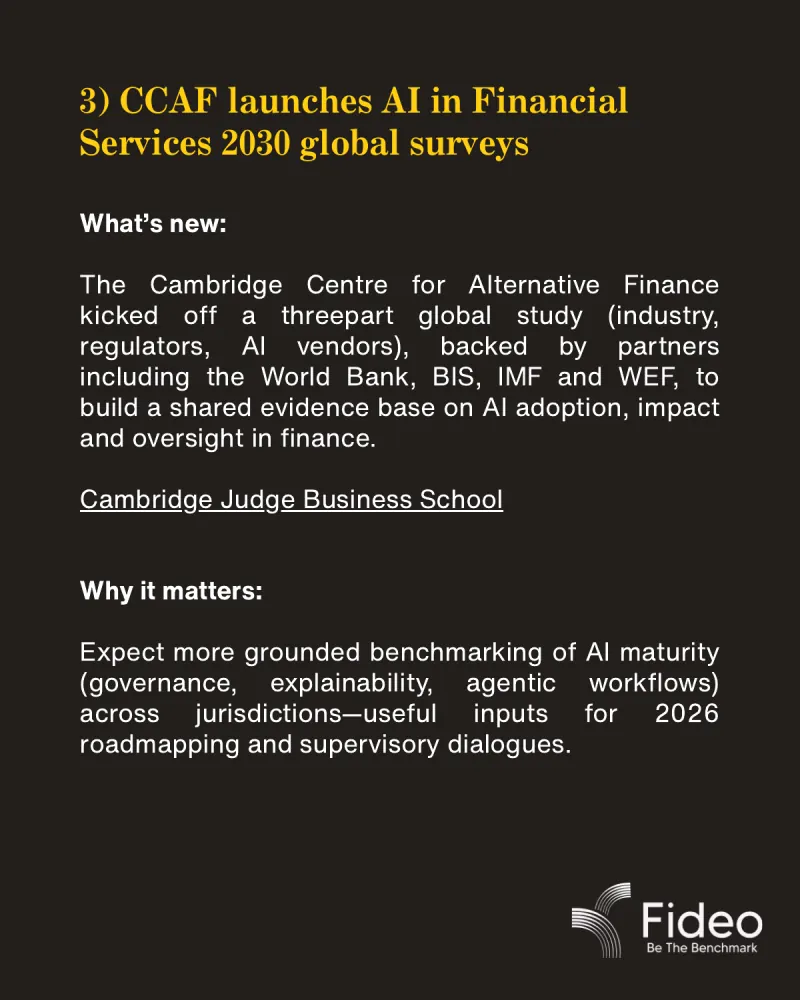
4 / 7 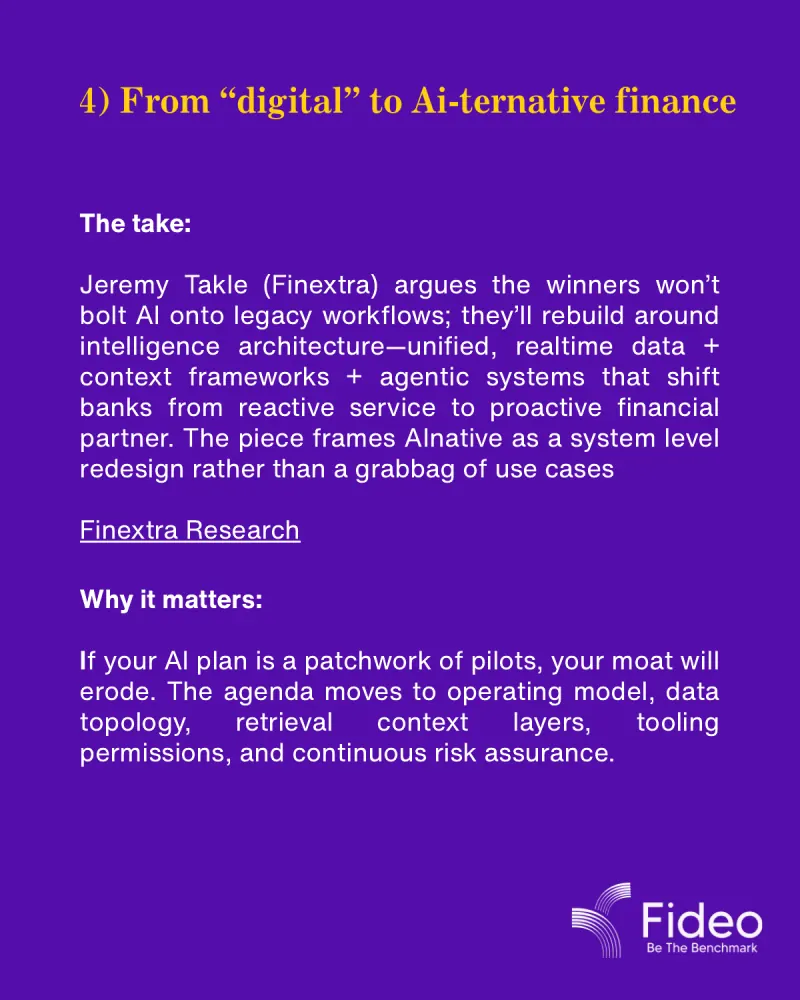
5 / 7 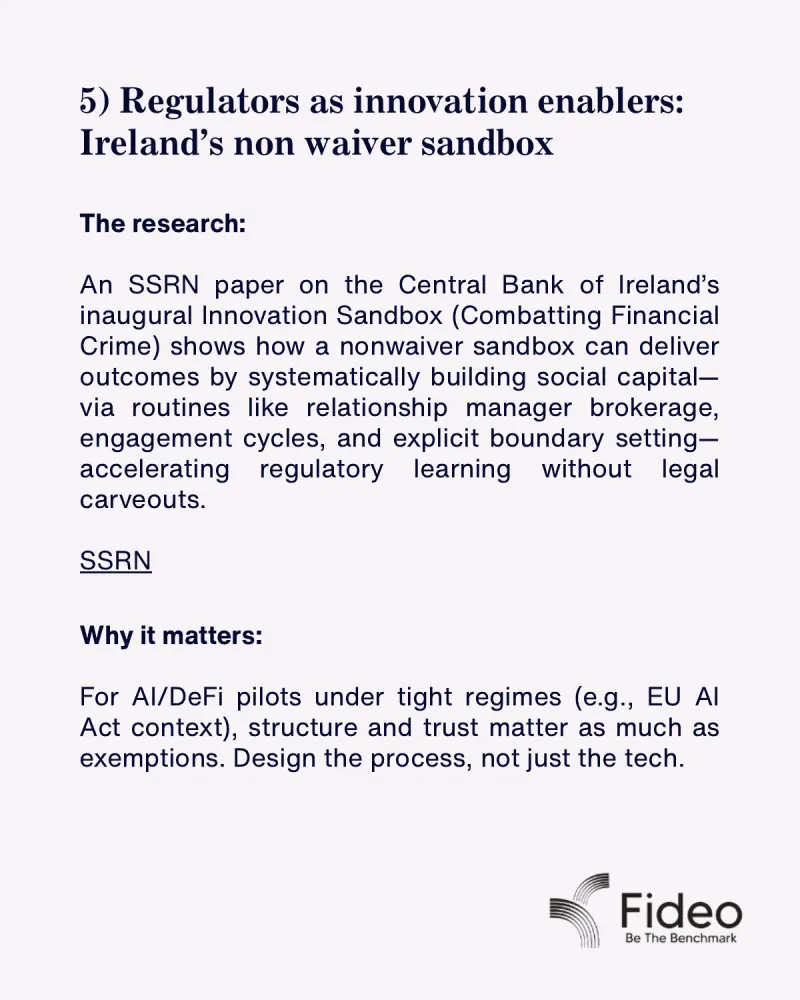
6 / 7 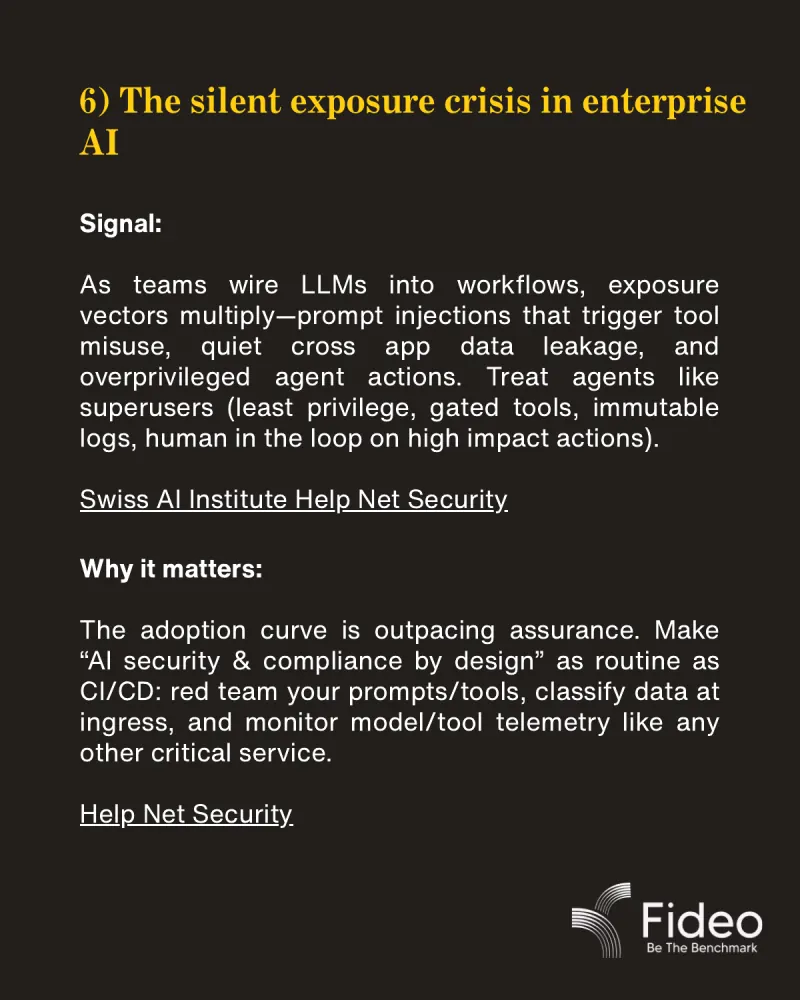
7 / 7
This week in 60 seconds
Six reads from the week of 3 to 7 November 2025 on digital assets, AI in finance and regulatory sandboxes
- Ghana's Nov 2025 Virtual Assets Policy notes 3M+ users and 100+ registered VASPs, confirms virtual assets are not legal tender, enforces the Travel Rule and plans a new regulator.
- Standard Chartered forecasts $2T in tokenised real-world assets by 2028 and up to $1T shifting from EM bank deposits to stablecoins, with risks clustered in certain markets.
- The Cambridge Centre for Alternative Finance has launched a three-part global study of industry, regulators and AI vendors on AI adoption, impact and oversight in finance.
- Finextra's Jeremy Takle argues AI-native banking is a system-level redesign built on unified real-time data, context frameworks and agentic systems, not a patchwork of pilots.
- Research on the Central Bank of Ireland's Innovation Sandbox shows a non-waiver sandbox can speed regulatory learning by building trust and structure rather than legal carve-outs.
Try this with your team
Treat your AI agents like superusers: review each one for least privilege, gated tools, immutable logs and human sign-off on high-impact actions. Then red team your prompts and tools, classify data at ingress, and monitor model and tool telemetry like any other critical service.
Read this edition as text (3 min)
1) Ghana sets out a national policy position on virtual assets
What happened:
Ghana’s Nov 2025 Virtual Assets Policy—issued by the Bank of Ghana with the SEC and FIC—notes 3 M+ users and 100+ registered VASPs, confirms VAs aren’t legal tender, enforces the Travel Rule, and plans a new VA regulator and national literacy campaign.
Bank of Ghana
Why it matters:
A coherent, activity and riskbased framework in an EM market both legitimizes compliant providers and prepares for stablecoindriven flows. Pair this with Standard Chartered’s EM analysis (see #2) for deposit flight and policy coordination implications.
Standard Chartered Bank
2) DeFi’s mainstream turn: Standard Chartered’s forecasts
What’s new:
Standard Chartered Global Research sees DeFi challenging TradFi, forecasting $2 T in tokenized real-world assets by 2028—on par with stablecoins— and up to $1 T shifting from EM bank deposits to stablecoins, with risks clustered in certain markets.
CoinDesk
Why it matters:
Two near-term board questions stand out:
Liability risk: How vulnerable are local deposits and fees if stablecoin rails keep scaling? RWA strategy: How and where to tokenize assets without breaching custody, disclosure, or AML rules? (See Reuters and others for broader context.)
Reuters
3) CCAF launches AI in Financial Services 2030 global surveys
What’s new:
The Cambridge Centre for Alternative Finance kicked off a threepart global study (industry, regulators, AI vendors), backed by partners including the World Bank, BIS, IMF and WEF, to build a shared evidence base on AI adoption, impact and oversight in finance.
Cambridge Judge Business School
Why it matters:
Expect more grounded benchmarking of AI maturity (governance, explainability, agentic workflows) across jurisdictions—useful inputs for 2026 roadmapping and supervisory dialogues.
4) From “digital” to Ai-ternative finance
The take:
Jeremy Takle (Finextra) argues the winners won’t bolt AI onto legacy workflows; they’ll rebuild around intelligence architecture—unified, realtime data + context frameworks + agentic systems that shift banks from reactive service to proactive financial partner. The piece frames AInative as a system level redesign rather than a grabbag of use cases
Finextra Research
Why it matters:
I f your AI plan is a patchwork of pilots, your moat will erode. The agenda moves to operating model, data topology, retrieval context layers, tooling permissions, and continuous risk assurance.
5) Regulators as innovation enablers: Ireland’s non waiver sandbox
The research:
An SSRN paper on the Central Bank of Ireland’s inaugural Innovation Sandbox (Combatting Financial Crime) shows how a nonwaiver sandbox can deliver outcomes by systematically building social capital— via routines like relationship manager brokerage, engagement cycles, and explicit boundary setting— accelerating regulatory learning without legal carveouts.
SSRN
Why it matters:
For AI/DeFi pilots under tight regimes (e.g., EU AI Act context), structure and trust matter as much as exemptions. Design the process, not just the tech.
6) The silent exposure crisis in enterprise AI
Signal:
As teams wire LLMs into workflows, exposure vectors multiply—prompt injections that trigger tool misuse, quiet cross app data leakage, and overprivileged agent actions. Treat agents like superusers (least privilege, gated tools, immutable logs, human in the loop on high impact actions).
Swiss AI Institute Help Net Security
Why it matters:
The adoption curve is outpacing assurance. Make “AI security & compliance by design” as routine as CI/CD: red team your prompts/tools, classify data at ingress, and monitor model/tool telemetry like any other critical service.
Help Net Security
Sources
- bog.gov.ghbog.gov.gh/wp-content/uploads/2025/11/Ghanas-Policy-Position-on-Virtual-Assets-and-Service
- sc.comsc.com/en/uploads/sites/66/content/docs/SC-CIB-Stablecoins-and-EM.pdf
- coindesk.comcoindesk.com/markets/2025/10/30/defi-set-to-challenge-tradfi-with-usd2t-in-tokenized-asset
- reuters.comreuters.com/business/finance/stablecoins-could-suck-1-trillion-em-banks-next-three-years-s
- jbs.cam.ac.ukjbs.cam.ac.uk/2025/global-survey-explores-ais-future-in-financial-services/
- finextra.comfinextra.com/blogposting/29744/ai-native-finance-will-your-bank-be-left-behind
- papers.ssrn.compapers.ssrn.com/sol3/papers.cfm?abstract_id=5673351
- siai.orgsiai.org/memo/2025/09/202509278998
- helpnetsecurity.comhelpnetsecurity.com/2025/04/14/quiet-data-breach-ai-workflows/
More questions about this edition
Which bodies issued Ghana's Virtual Assets Policy?
It was issued by the Bank of Ghana together with the SEC and the FIC, and it also plans a national literacy campaign alongside a new virtual assets regulator.
What board questions does the Standard Chartered forecast raise?
The edition highlights two: how vulnerable local deposits and fees are if stablecoin rails keep scaling, and how and where to tokenise assets without breaching custody, disclosure or AML rules.
What security risks come from wiring LLMs into workflows?
The edition points to prompt injections that trigger tool misuse, quiet cross-app data leakage and overprivileged agent actions, noting that adoption is outpacing assurance.
Get the Zeitgeist every Friday
One email a week with the new edition. Unsubscribe in one click.
Check your inbox to confirm your subscription.
Please enter a valid email address and try again.