Week of 2 to 6 Feb 2026
Financial crime and financial infrastructure are converging

1 / 8 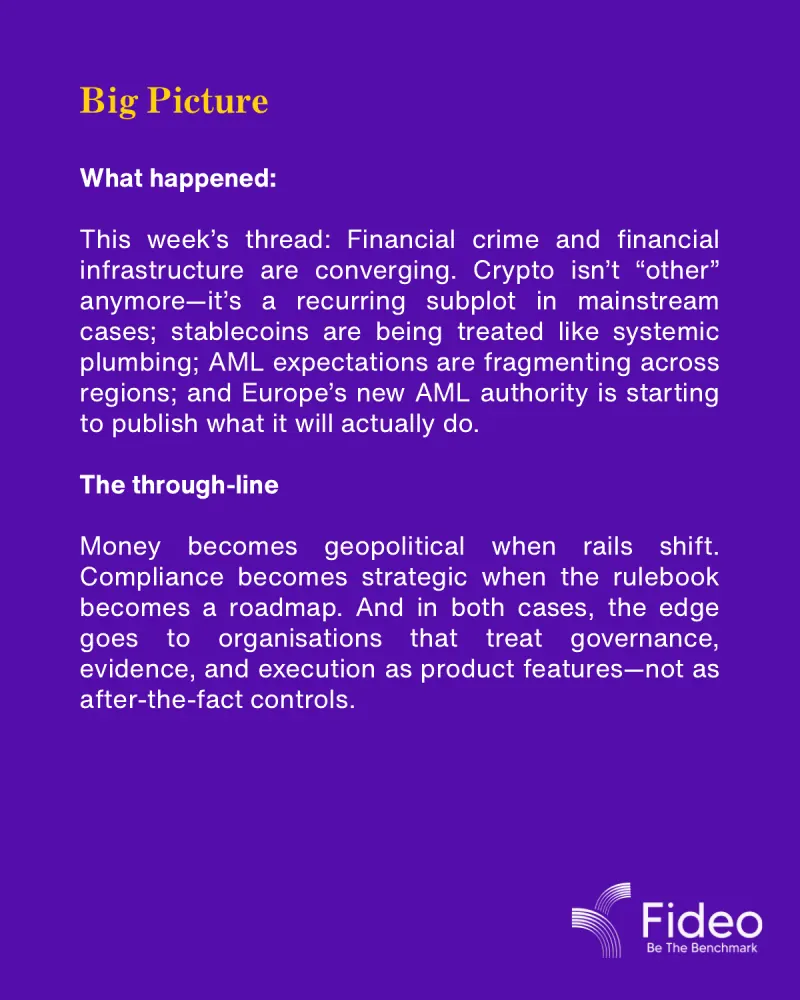
2 / 8 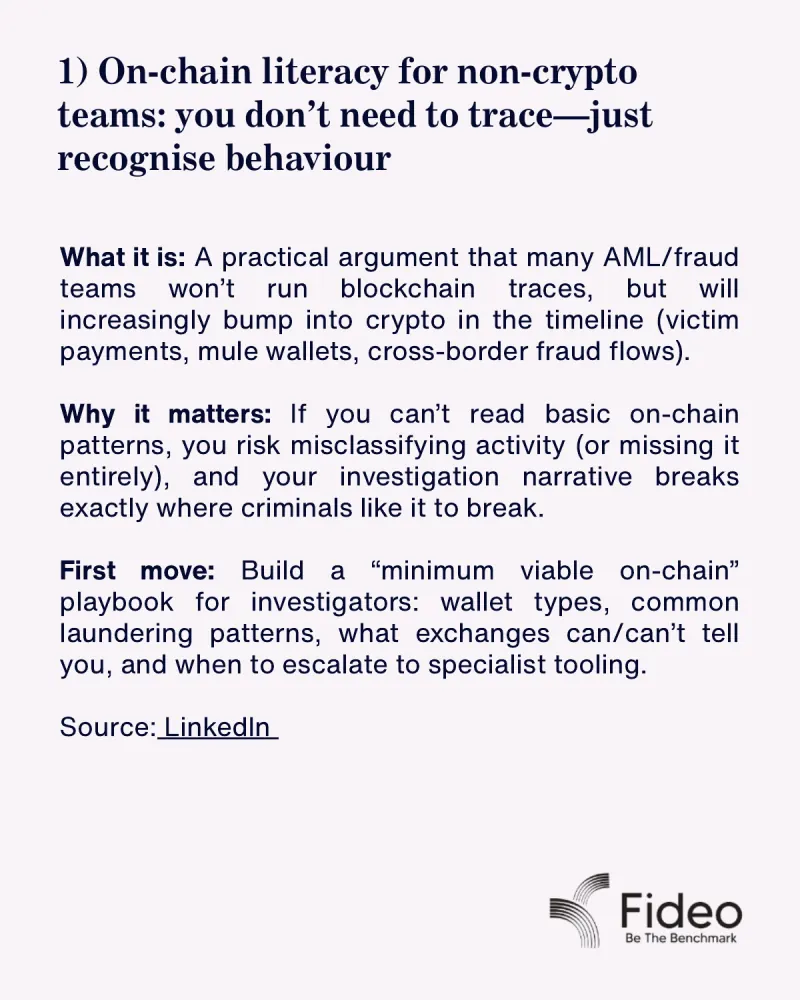
3 / 8 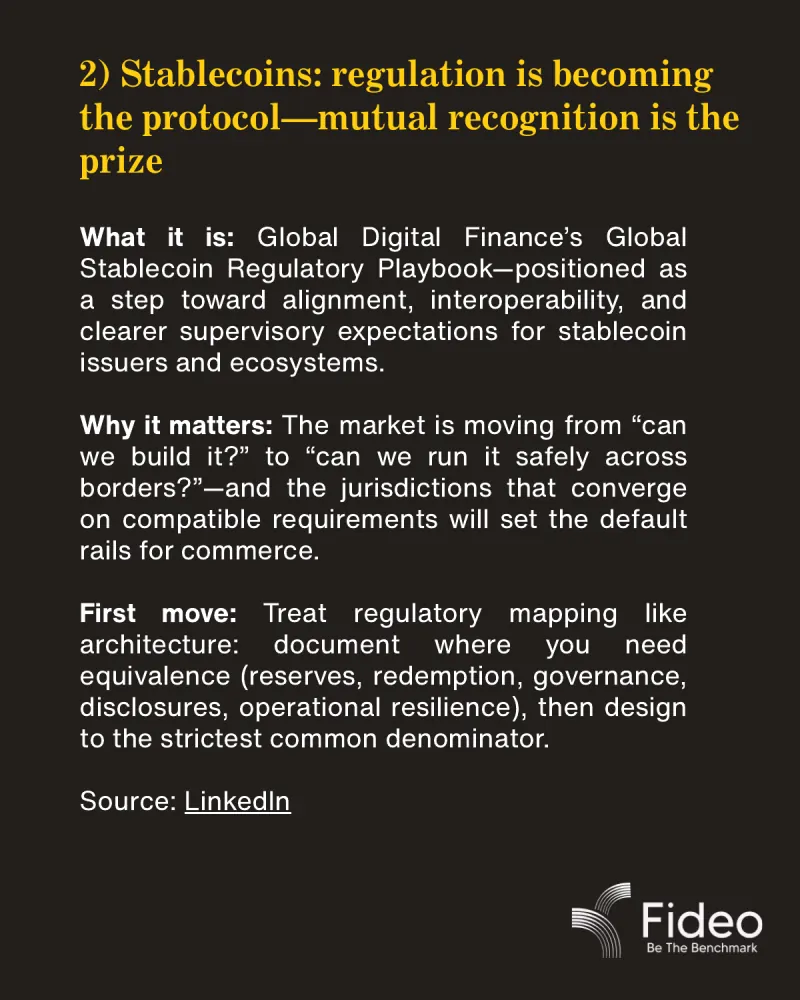
4 / 8 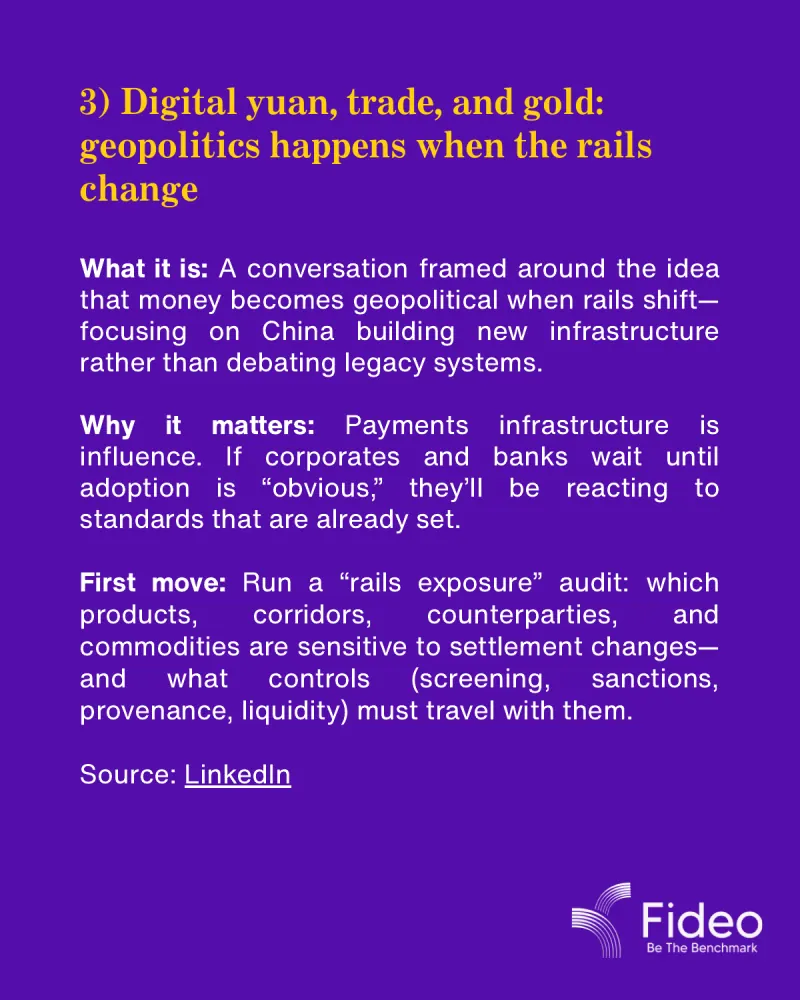
5 / 8 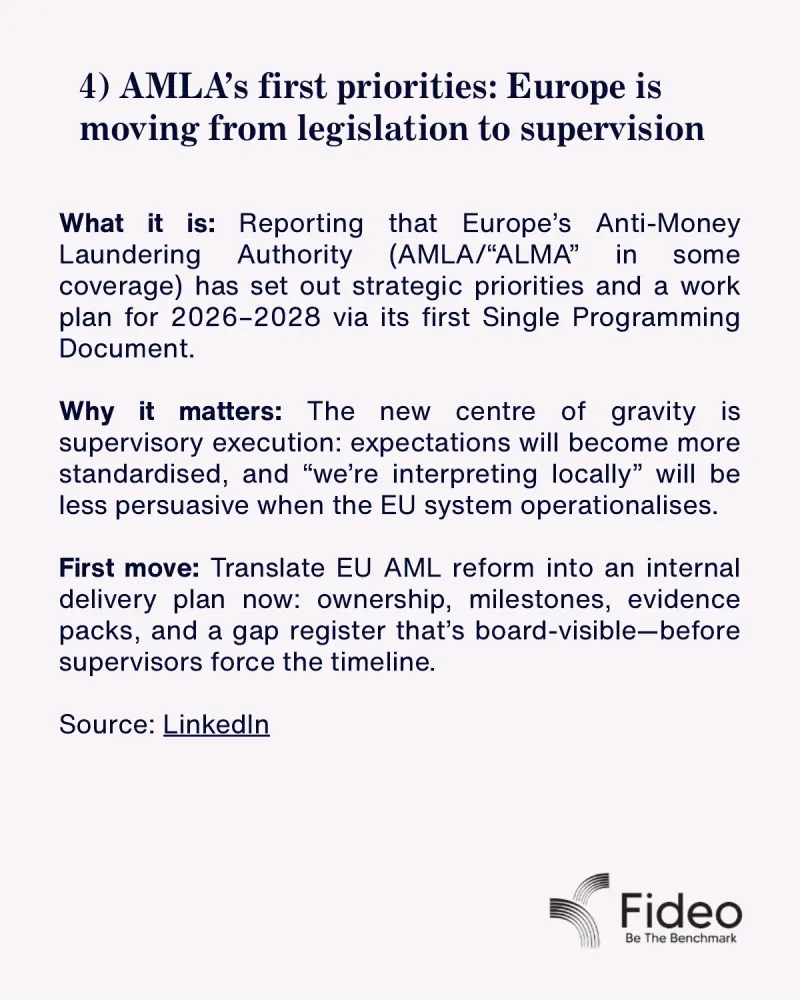
6 / 8 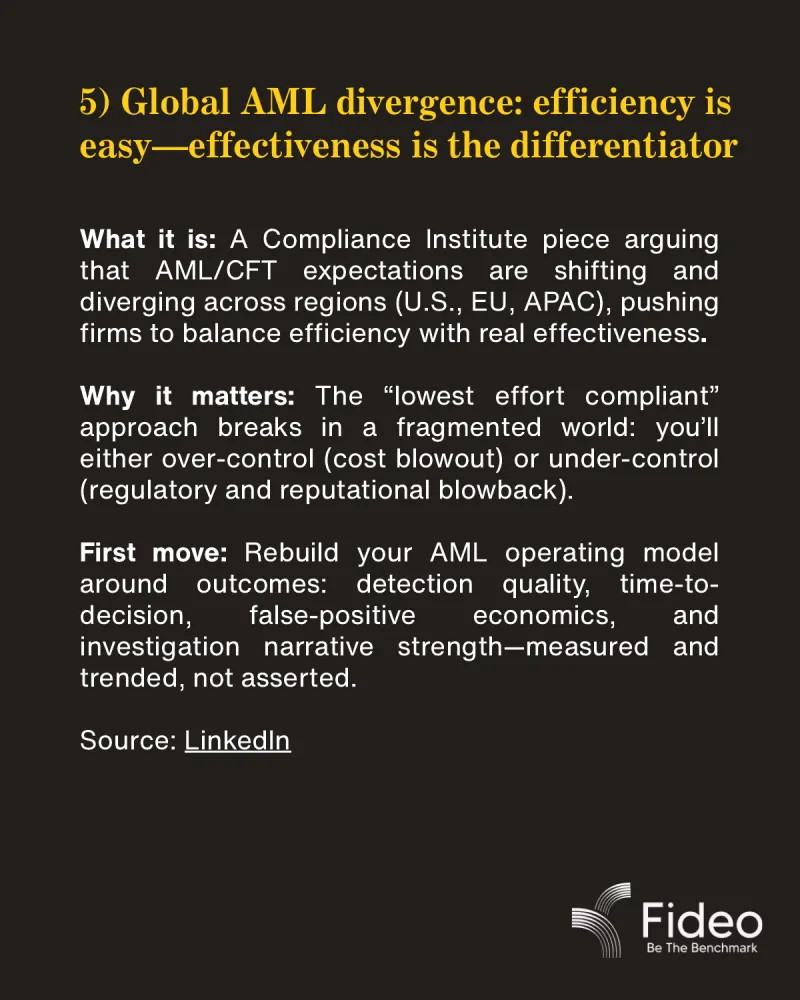
7 / 8 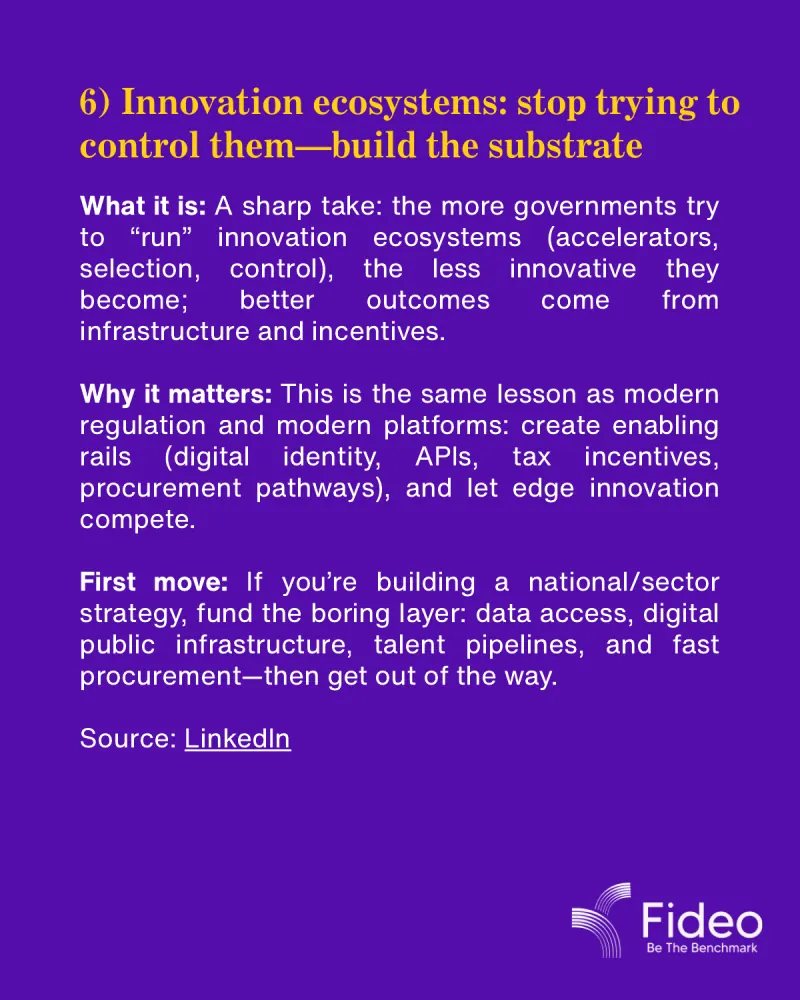
8 / 8
This week in 60 seconds
On-chain literacy, stablecoin playbooks, digital yuan rails, AMLA's first priorities and global AML divergence.
- AML and fraud teams need not run blockchain traces, but must recognise basic on-chain patterns or risk misclassifying or missing activity.
- Global Digital Finance's Global Stablecoin Regulatory Playbook signals a shift from building stablecoins to running them safely across borders.
- Payments infrastructure is influence: firms that wait for digital yuan adoption to look obvious will react to standards already set.
- Europe's AMLA has set out priorities and a 2026 to 2028 work plan in its first Single Programming Document, moving the focus to supervision.
- With AML expectations diverging across the US, EU and APAC, a lowest-effort compliance approach leads to either cost blowouts or regulatory blowback.
Try this with your team
Build a minimum viable on-chain playbook for investigators covering wallet types, common laundering patterns, what exchanges can and cannot tell you, and when to escalate to specialist tooling.
Read this edition as text (4 min)
Big Picture
What happened:
This week’s thread: Financial crime and financial infrastructure are converging. Crypto isn’t “other” anymore—it’s a recurring subplot in mainstream cases; stablecoins are being treated like systemic plumbing; AML expectations are fragmenting across regions; and Europe’s new AML authority is starting to publish what it will actually do.
The through-line
Money becomes geopolitical when rails shift. Compliance becomes strategic when the rulebook becomes a roadmap. And in both cases, the edge goes to organisations that treat governance, evidence, and execution as product features—not as after-the-fact controls.
1) On-chain literacy for non-crypto teams: you don’t need to trace—just recognise behaviour
What it is: A practical argument that many AML/fraud teams won’t run blockchain traces, but will increasingly bump into crypto in the timeline (victim payments, mule wallets, cross-border fraud flows).
Why it matters: If you can’t read basic on-chain patterns, you risk misclassifying activity (or missing it entirely), and your investigation narrative breaks exactly where criminals like it to break.
First move: Build a “minimum viable on-chain” playbook for investigators: wallet types, common laundering patterns, what exchanges can/can’t tell you, and when to escalate to specialist tooling.
Source: LinkedIn
2) Stablecoins: regulation is becoming the protocol—mutual recognition is the prize
What it is: Global Digital Finance’s Global Stablecoin Regulatory Playbook—positioned as a step toward alignment, interoperability, and clearer supervisory expectations for stablecoin issuers and ecosystems.
Why it matters: The market is moving from “can we build it?” to “can we run it safely across borders?”—and the jurisdictions that converge on compatible requirements will set the default rails for commerce.
First move: Treat regulatory mapping like architecture: document where you need equivalence (reserves, redemption, governance, disclosures, operational resilience), then design to the strictest common denominator.
Source: LinkedIn
3) Digital yuan, trade, and gold: geopolitics happens when the rails change
What it is: A conversation framed around the idea that money becomes geopolitical when rails shift— focusing on China building new infrastructure rather than debating legacy systems.
Why it matters: Payments infrastructure is influence. If corporates and banks wait until adoption is “obvious,” they’ll be reacting to standards that are already set.
First move: Run a “rails exposure” audit: which products, corridors, counterparties, and commodities are sensitive to settlement changes— and what controls (screening, sanctions, provenance, liquidity) must travel with them.
Source: LinkedIn
4) AMLA’s first priorities: Europe is moving from legislation to supervision
What it is: Reporting that Europe’s Anti-Money Laundering Authority (AMLA/“ALMA” in some coverage) has set out strategic priorities and a work plan for 2026–2028 via its first Single Programming Document.
Why it matters: The new centre of gravity is supervisory execution: expectations will become more standardised, and “we’re interpreting locally” will be less persuasive when the EU system operationalises.
First move: Translate EU AML reform into an internal delivery plan now: ownership, milestones, evidence packs, and a gap register that’s board-visible—before supervisors force the timeline.
Source: LinkedIn
5) Global AML divergence: efficiency is easy—effectiveness is the differentiator
What it is: A Compliance Institute piece arguing that AML/CFT expectations are shifting and diverging across regions (U.S., EU, APAC), pushing firms to balance efficiency with real effectiveness .
Why it matters: The “lowest effort compliant” approach breaks in a fragmented world: you’ll either over-control (cost blowout) or under-control (regulatory and reputational blowback).
First move: Rebuild your AML operating model around outcomes: detection quality, time-to- decision, false-positive economics, and investigation narrative strength—measured and trended, not asserted.
Source: LinkedIn
6) Innovation ecosystems: stop trying to control them—build the substrate
What it is: A sharp take: the more governments try to “run” innovation ecosystems (accelerators, selection, control), the less innovative they become; better outcomes come from infrastructure and incentives.
Why it matters: This is the same lesson as modern regulation and modern platforms: create enabling rails (digital identity, APIs, tax incentives, procurement pathways), and let edge innovation compete.
First move: If you’re building a national/sector strategy, fund the boring layer: data access, digital public infrastructure, talent pipelines, and fast procurement—then get out of the way.
Source: LinkedIn
Sources
- LinkedInlinkedin.com/posts/marco-b-8121922_why-understanding-basic-on-chain-behaviour-activity-742
- LinkedInlinkedin.com/posts/silvanandermatt_gdf-global-stablecoin-regulatory-playbook-activity-7424
- LinkedInlinkedin.com/posts/pete-townsend-1b18301a_money-doesnt-become-geopolitical-overnight-activ
- LinkedInlinkedin.com/posts/amlintelligence_alma-fius-eafcs2026-activity-7424762314366820352-j9in/
- LinkedInlinkedin.com/posts/compliance-institute_navigating-the-shifting-global-aml-landscape-activ
- LinkedInlinkedin.com/posts/dcirl_startupecosystems-economicdevelopment-innovation-activity-7424933
More questions about this edition
How should firms approach stablecoin rules in several jurisdictions?
Treat regulatory mapping like architecture: document where equivalence is needed across reserves, redemption, governance, disclosures and operational resilience, then design to the strictest common denominator.
What should an AML operating model be measured on?
Outcomes such as detection quality, time to decision, false-positive economics and investigation narrative strength, measured and trended rather than asserted.
What does the edition suggest for national or sector innovation strategies?
Fund the enabling layer, including data access, digital public infrastructure, talent pipelines and fast procurement, then let edge innovation compete rather than trying to run the ecosystem.
Get the Zeitgeist every Friday
One email a week with the new edition. Unsubscribe in one click.
Check your inbox to confirm your subscription.
Please enter a valid email address and try again.