Week of 23 to 27 Mar 2026
From capability to consequence: AI friction shows up in real systems

1 / 8 
2 / 8 
3 / 8 
4 / 8 
5 / 8 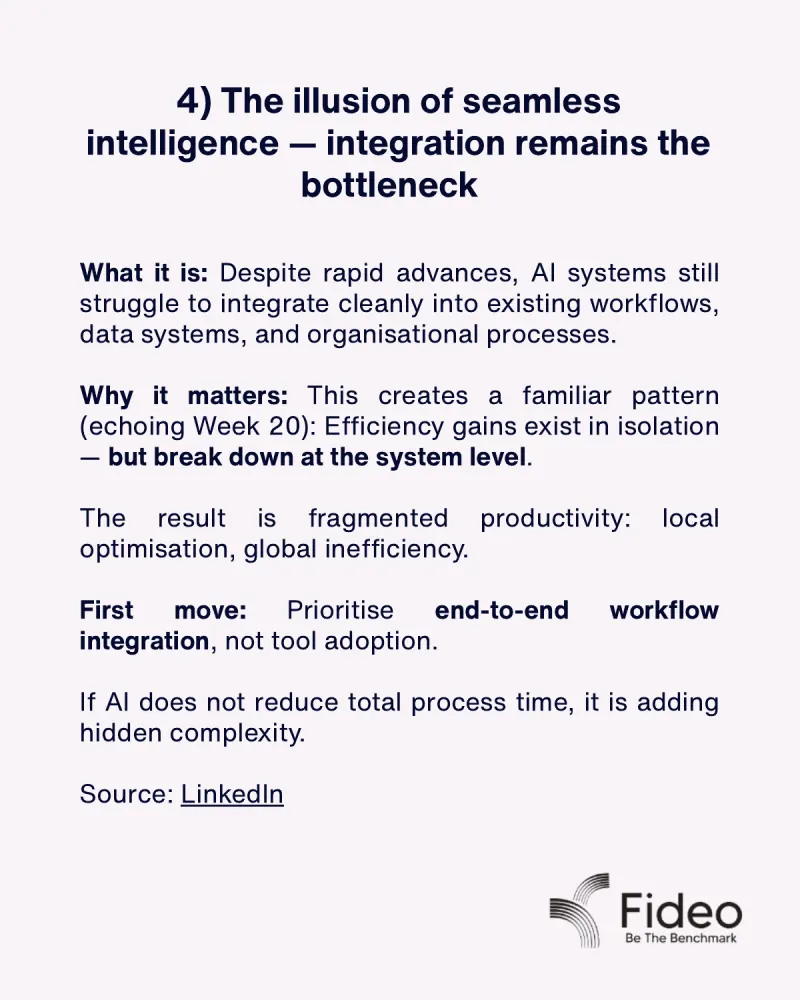
6 / 8 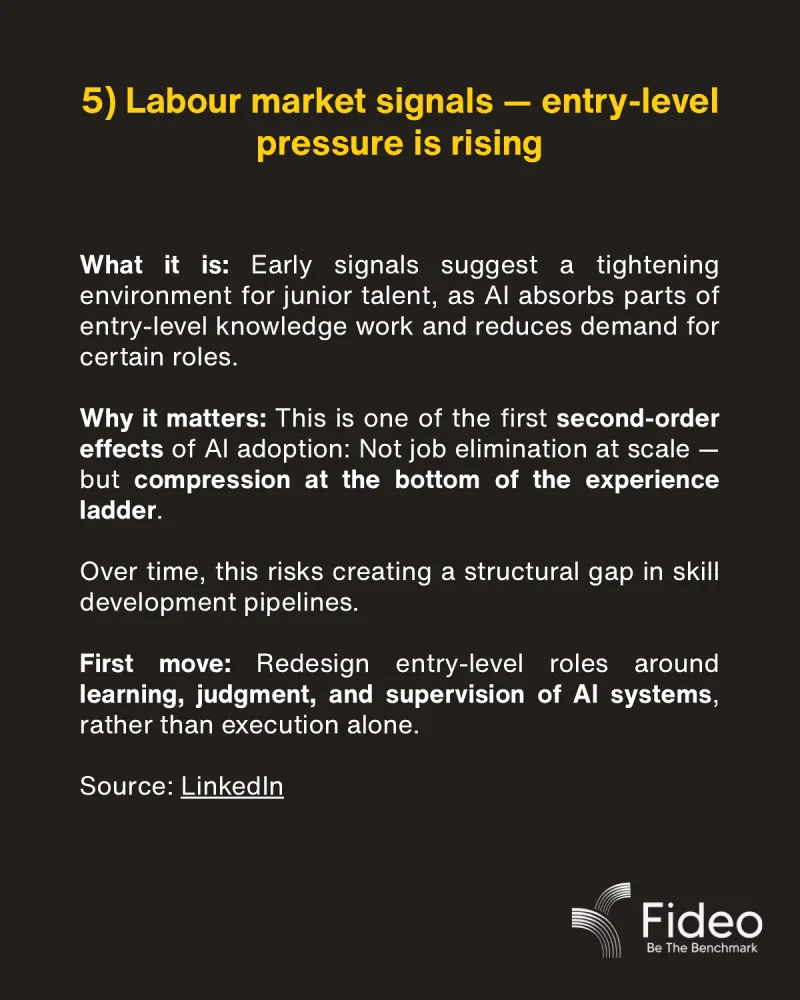
7 / 8 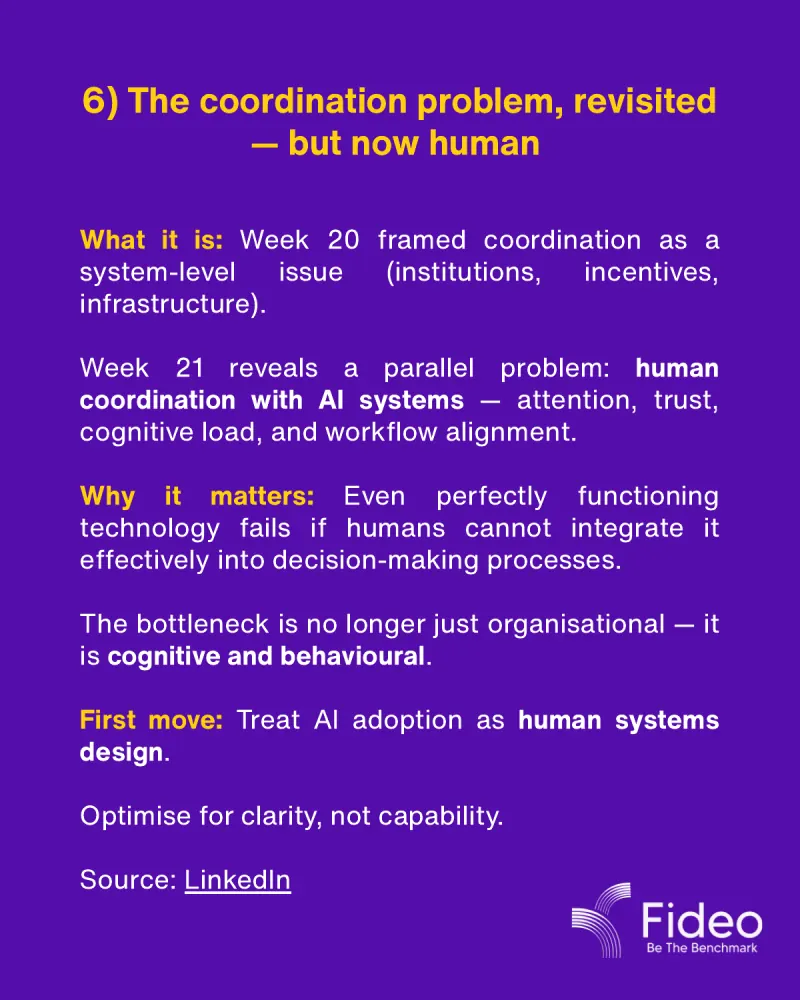
8 / 8
This week in 60 seconds
Week 21: productivity gains are real but uneven, and the constraint is now human rather than technical
- AI is boosting productivity in measurable ways, but as incremental gain rather than step-change, creating a mismatch between investment, expectation and realised value.
- Automation hits organisational limits: core services still rely on human judgment, trust and accountability, so institutional design is the constraint.
- Growing signals of AI fatigue suggest constant prompting, validating and interpreting outputs can raise cognitive burden rather than lower it.
- Integration remains the bottleneck: efficiency gains in isolation break down at system level, giving local optimisation and global inefficiency.
- Entry-level pressure is rising as AI absorbs junior knowledge work, risking a structural gap in skill development pipelines.
Try this with your team
Pick one workflow and decompose the roles in it into decision layers. Automate the execution steps, keep human ownership where accountability cannot be outsourced, then check whether total process time actually fell. If it did not, the AI is adding hidden complexity.
Read this edition as text (4 min)
Big Picture
What happened: The narrative is shifting again — from capability to consequence.
If Week 20 was about plumbing (infrastructure, incentives, coordination), Week 21 is about friction showing up in real systems : organisational fatigue, uneven productivity gains, and the gap between theoretical efficiency and lived experience. AI and digital transformation are no longer judged by what they can do — but by how they actually perform under pressure.
The Through-line
Across AI and financial systems, the constraint is becoming behavioural, not technical. Tools are improving. Outputs are accelerating. But organisations are discovering that human systems — attention, cognition, incentives — do not scale at the same rate.
The result: productivity gains are real, but inconsistent — and often offset by new forms of friction.
1) AI productivity — gains are visible, but not transformative
What it is: Emerging evidence suggests AI is boosting productivity in measurable ways — faster outputs, improved workflows, reduced manual effort — but not at the level needed to drive meaningful economic transformation.
Why it matters: The expectation was step-change improvement. The reality is incremental gain.
This creates a mismatch between investment, expectation, and realised value — particularly in knowledge work, where output quality, judgment, and context still limit full automation.
First move: Shift from “AI as a multiplier” to AI as a margin optimiser . Focus on compounding small efficiency gains across workflows rather than expecting step-change productivity leaps.
Source: LinkedIn
2) Automation hits organisational limits — not technical ones
What it is: Large firms are signalling that automation has boundaries — not because the tools are insufficient, but because core services still rely on human judgment, trust, and accountability .
Why it matters: This reinforces a recurring pattern: Technology can replace tasks, but not entire roles — especially where responsibility, interpretation, or client interaction is involved.
The constraint is institutional design , not model capability.
First move: Decompose roles into decision layers. Automate execution, but retain human ownership where accountability cannot be outsourced.
Source: LinkedIn
3) Cognitive overload — the hidden cost of AI adoption
What it is: There are growing signals of “AI fatigue” — particularly in knowledge-heavy environments — where constant interaction with AI tools leads to mental overload, reduced clarity, and diminished critical thinking.
Why it matters: AI doesn’t just save time — it changes how work is processed cognitively .
If every task involves prompting, validating, and interpreting AI outputs, the cognitive burden can increase rather than decrease.
First move: Design workflows that minimise interaction overhead.
The goal is not more AI usage — it is less friction per decision .
Source: LinkedIn
4) The illusion of seamless intelligence — integration remains the bottleneck
What it is: Despite rapid advances, AI systems still struggle to integrate cleanly into existing workflows, data systems, and organisational processes.
Why it matters: This creates a familiar pattern (echoing Week 20): Efficiency gains exist in isolation — but break down at the system level .
The result is fragmented productivity: local optimisation, global inefficiency.
First move: Prioritise end-to-end integration , not tool adoption.
workflow
If AI does not reduce total process time, it is adding hidden complexity.
Source: LinkedIn
5) Labour market signals — entry-level pressure is rising
What it is: Early signals suggest a tightening environment for junior talent, as AI absorbs parts of entry-level knowledge work and reduces demand for certain roles.
Why it matters: This is one of the first second-order effects of AI adoption: Not job elimination at scale — but compression at the bottom of the experience ladder .
Over time, this risks creating a structural gap in skill development pipelines.
First move: Redesign entry-level roles around learning, judgment, and supervision of AI systems , rather than execution alone.
Source: LinkedIn
6) The coordination problem, revisited — but now human
What it is: Week 20 framed coordination as a system-level issue (institutions, incentives, infrastructure).
Week 21 reveals a parallel problem: human coordination with AI systems — attention, trust, cognitive load, and workflow alignment.
Why it matters: Even perfectly functioning technology fails if humans cannot integrate it effectively into decision-making processes.
The bottleneck is no longer just organisational — it is cognitive and behavioural .
First move: Treat AI adoption as human systems design .
Optimise for clarity, not capability.
Source: LinkedIn
Sources
- bmmagazine.co.ukbmmagazine.co.uk/in-business/pwc-ai-strategy-partners-no-place-automation-services/
- LinkedInlinkedin.com/posts/gen-ai-boosts-productivity-but-cant-turn-share-7440037310114553858-YvZu
- LinkedInlinkedin.com/posts/adrian-whelan-he-him-43091511_is-ai-causing-brain-fry-among-fund-staff-
- LinkedInlinkedin.com/posts/stuart-pedley-smith-454b22_pinocchio-metaphor-assessment-share-74428611
- LinkedInlinkedin.com/posts/the-new-york-times_this-is-the-worst-spring-for-college-graduates-activ
More questions about this edition
How does this week differ from Week 20?
Week 20 was about plumbing: infrastructure, incentives and coordination at system level. Week 21 is about friction in real systems and a parallel problem of human coordination with AI, covering attention, trust, cognitive load and workflow alignment.
What should organisations aim for instead of more AI usage?
The edition says the goal is less friction per decision. It recommends treating AI adoption as human systems design and optimising for clarity, not capability.
How should entry-level roles change?
They should be redesigned around learning, judgment and supervision of AI systems, rather than execution alone.
Get the Zeitgeist every Friday
One email a week with the new edition. Unsubscribe in one click.
Check your inbox to confirm your subscription.
Please enter a valid email address and try again.