Week of 16 to 20 Mar 2026
From promise to plumbing: tokenisation and AI meet the coordination problem

1 / 7 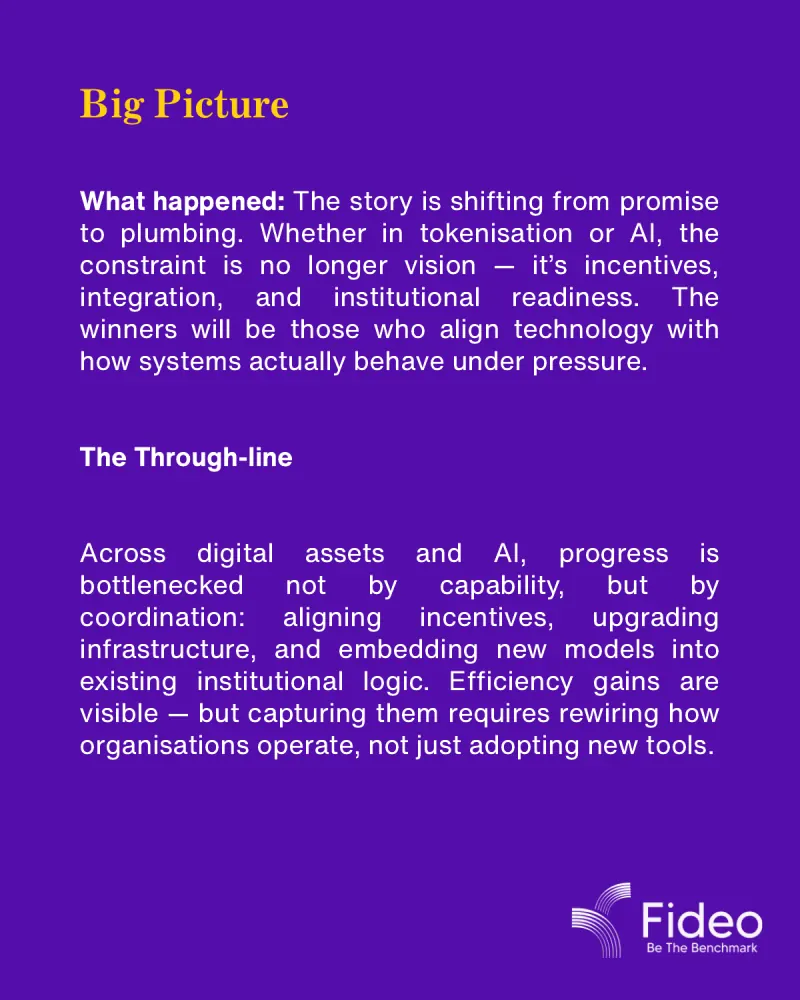
2 / 7 
3 / 7 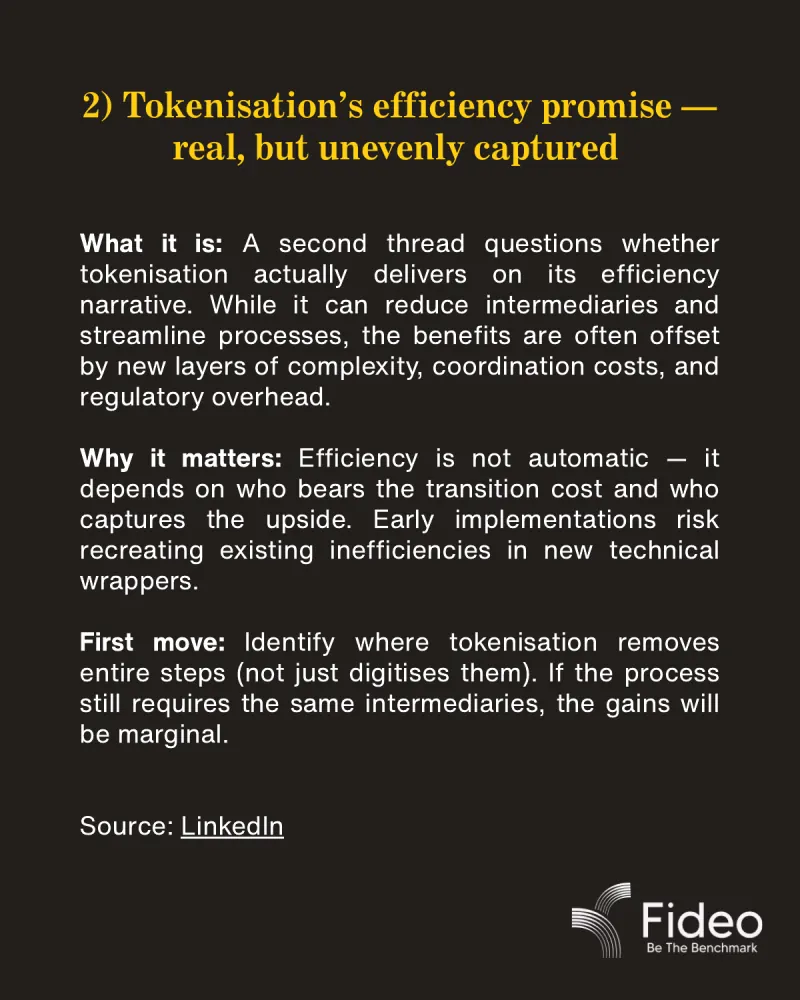
4 / 7 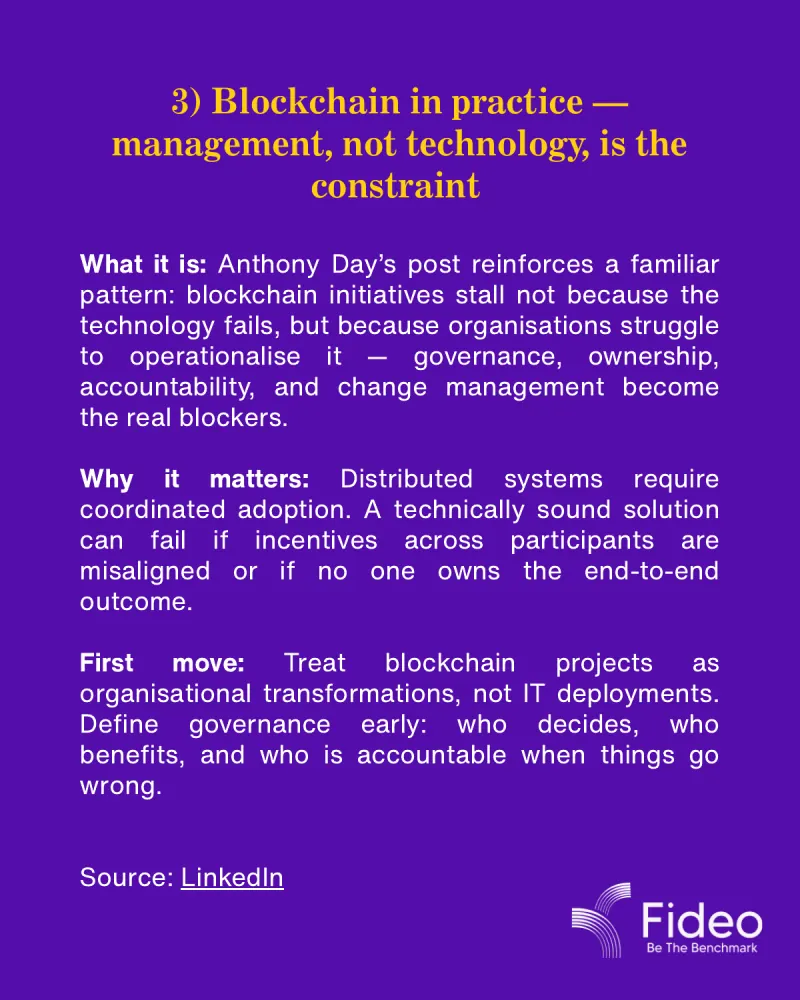
5 / 7 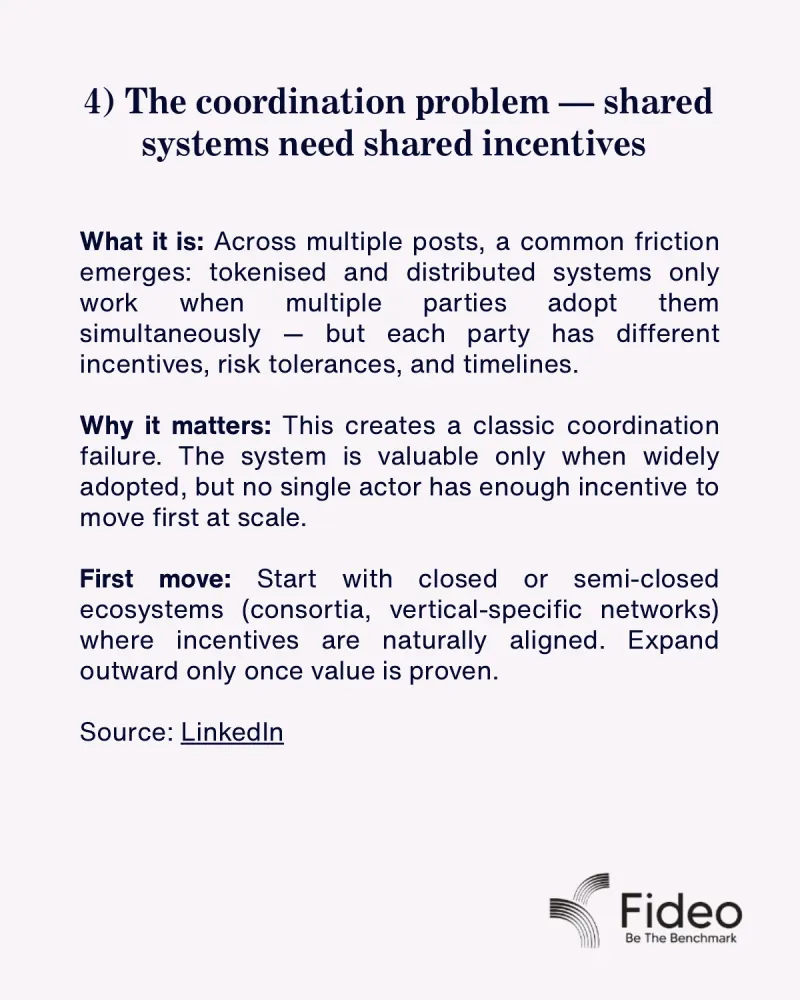
6 / 7 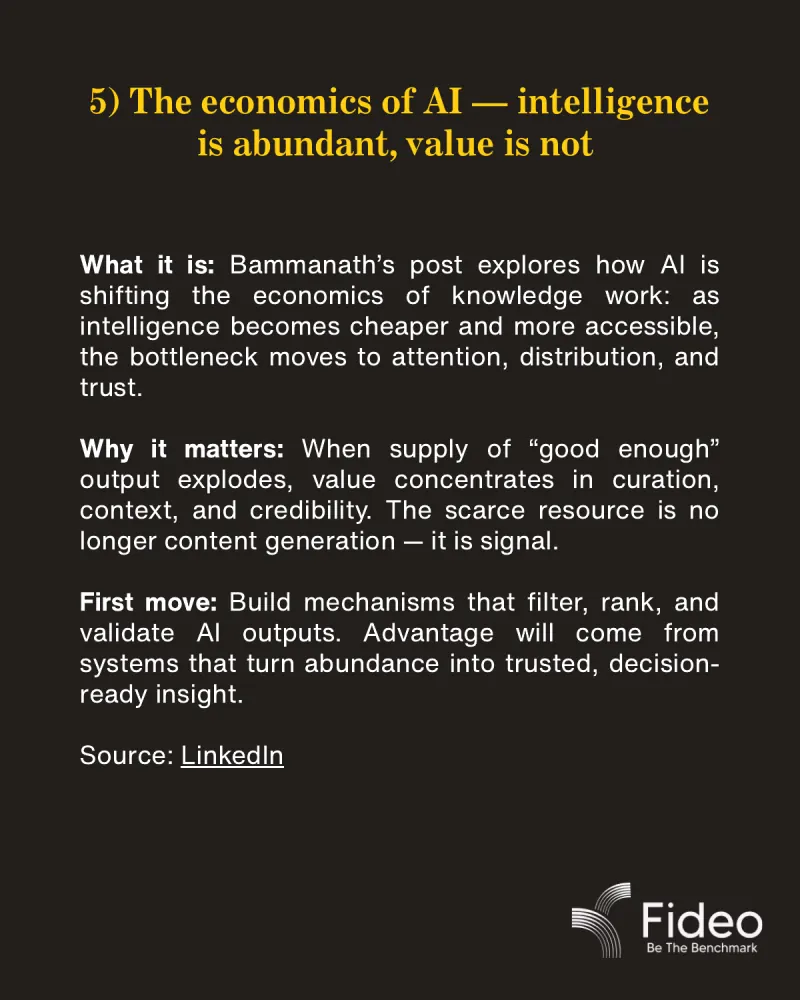
7 / 7
This week in 60 seconds
This week's top reads show progress is limited by incentives, integration and institutional readiness, not technology.
- Across tokenisation and AI, the constraint has shifted from vision and capability to incentives, integration and institutional readiness.
- Tokenisation and stablecoins promise faster settlement and less friction only when they work with existing custody, regulation, compliance and market structure.
- Tokenisation's efficiency gains are uneven. If a process still needs the same intermediaries, digitising steps delivers only marginal gains.
- Blockchain projects stall on governance, ownership and accountability, so treat them as organisational transformations rather than IT deployments.
- As AI makes intelligence cheap, value moves to curation, context and credibility. Advantage comes from systems that filter, rank and validate AI outputs.
Try this with your team
Before scaling any tokenisation pilot, map how the tokenised asset connects to custody, reporting and liquidity flows. Focus on these integration points rather than on issuance alone.
Read this edition as text (3 min)
Big Picture
What happened: The story is shifting from promise to plumbing. Whether in tokenisation or AI, the constraint is no longer vision — it’s incentives, integration, and institutional readiness. The winners will be those who align technology with how systems actually behave under pressure.
The Through-line
Across digital assets and AI, progress is bottlenecked not by capability, but by coordination: aligning incentives, upgrading infrastructure, and embedding new models into existing institutional logic. Efficiency gains are visible — but capturing them requires rewiring how organisations operate, not just adopting new tools.
1) Tokenisation meets institutional reality — infrastructure is necessary, not sufficient
What it is: Olaf Ammermann highlights how tokenisation and stablecoins are gaining traction with institutional players, promising faster settlement, reduced friction, and new liquidity models — but only when integrated into existing financial architecture.
Why it matters: Tokenisation is often framed as a clean break from legacy systems. In practice, adoption depends on interoperability with those systems — custody, regulation, compliance, and market structure. Without that, efficiency gains remain theoretical.
First move: Focus on integration points, not just issuance. Map how tokenised assets connect to custody, reporting, and liquidity flows before scaling pilots.
Source: LinkedIn
2) Tokenisation’s efficiency promise — real, but unevenly captured
What it is: A second thread questions whether tokenisation actually delivers on its efficiency narrative. While it can reduce intermediaries and streamline processes, the benefits are often offset by new layers of complexity, coordination costs, and regulatory overhead.
Why it matters: Efficiency is not automatic — it depends on who bears the transition cost and who captures the upside. Early implementations risk recreating existing inefficiencies in new technical wrappers.
First move: Identify where tokenisation removes entire steps (not just digitises them). If the process still requires the same intermediaries, the gains will be marginal.
Source: LinkedIn
3) Blockchain in practice — management, not technology, is the constraint
What it is: Anthony Day’s post reinforces a familiar pattern: blockchain initiatives stall not because the technology fails, but because organisations struggle to operationalise it — governance, ownership, accountability, and change management become the real blockers.
Why it matters: Distributed systems require coordinated adoption. A technically sound solution can fail if incentives across participants are misaligned or if no one owns the end-to-end outcome.
First move: Treat blockchain projects as organisational transformations, not IT deployments. Define governance early: who decides, who benefits, and who is accountable when things go wrong.
Source: LinkedIn
4) The coordination problem — shared systems need shared incentives
What it is: Across multiple posts, a common friction emerges: tokenised and distributed systems only work when multiple parties adopt them simultaneously — but each party has different incentives, risk tolerances, and timelines.
Why it matters: This creates a classic coordination failure. The system is valuable only when widely adopted, but no single actor has enough incentive to move first at scale.
First move: Start with closed or semi-closed ecosystems (consortia, vertical-specific networks) where incentives are naturally aligned. Expand outward only once value is proven.
Source: LinkedIn
5) The economics of AI — intelligence is abundant, value is not
What it is: Bammanath’s post explores how AI is shifting the economics of knowledge work: as intelligence becomes cheaper and more accessible, the bottleneck moves to attention, distribution, and trust.
Why it matters: When supply of “good enough” output explodes, value concentrates in curation, context, and credibility. The scarce resource is no longer content generation — it is signal.
First move: Build mechanisms that filter, rank, and validate AI outputs. Advantage will come from systems that turn abundance into trusted, decision- ready insight.
Source: LinkedIn
Sources
- LinkedInlinkedin.com/posts/olafammermann_tokenisation-stablecoins-and-institutional-ugcPost-743750
- LinkedInlinkedin.com/posts/%F0%9D%97%A6%F0%9D%97%BC%F0%9D%98%83%F0%9D%97%B2%F0%9D%97%BF%F0%9D%97%B
- LinkedInlinkedin.com/posts/anthonyjjday_blockchain-technology-management-share-7438987762722082816
- LinkedInlinkedin.com/posts/tokenization-promises-efficiency-but-the-ugcPost-7439251350414282752-Sp
- LinkedInlinkedin.com/posts/bammanath_economics-of-ai-ugcPost-7436829406763024385-wQ5v/
More questions about this edition
How can firms get past the coordination problem in shared tokenised systems?
Start with closed or semi-closed ecosystems, such as consortia or vertical-specific networks, where incentives are naturally aligned. Expand outward only once value is proven.
What is the main risk with early tokenisation implementations?
They risk recreating existing inefficiencies in new technical wrappers. Efficiency is not automatic and depends on who bears the transition cost and who captures the upside.
What governance questions should a blockchain project settle early?
Who decides, who benefits, and who is accountable when things go wrong. A technically sound solution can fail if incentives are misaligned or no one owns the end-to-end outcome.
Get the Zeitgeist every Friday
One email a week with the new edition. Unsubscribe in one click.
Check your inbox to confirm your subscription.
Please enter a valid email address and try again.