Week of 6 to 10 Apr 2026
AI in EdTech: duty of care when capability outpaces safeguarding

1 / 7 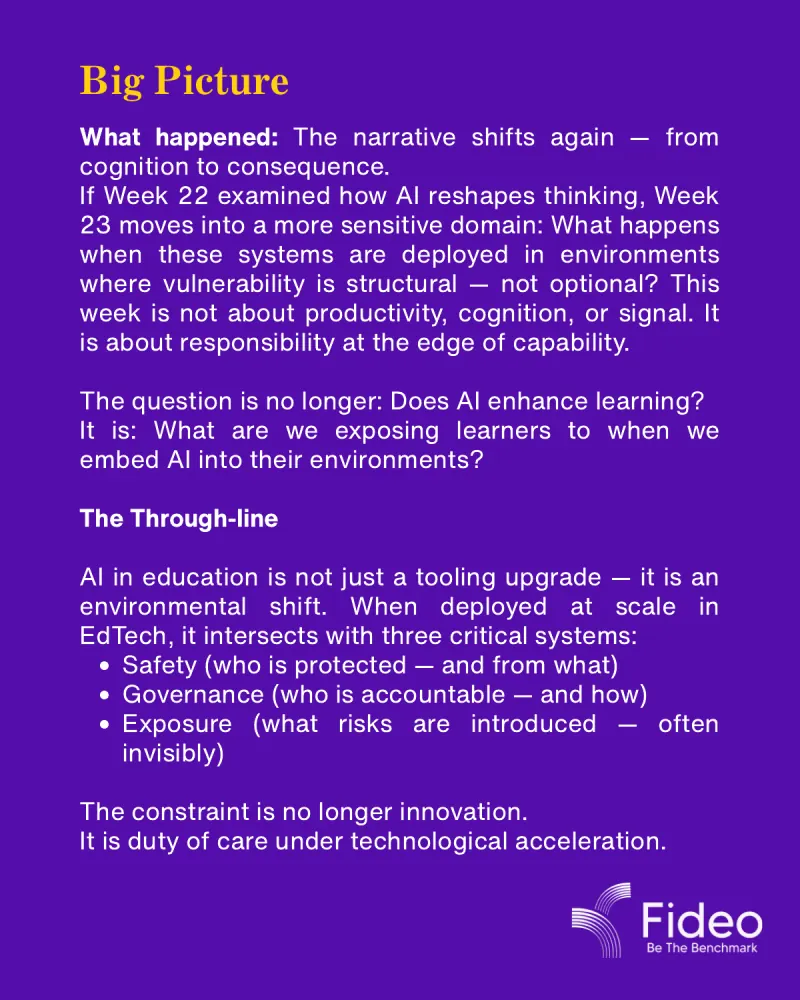
2 / 7 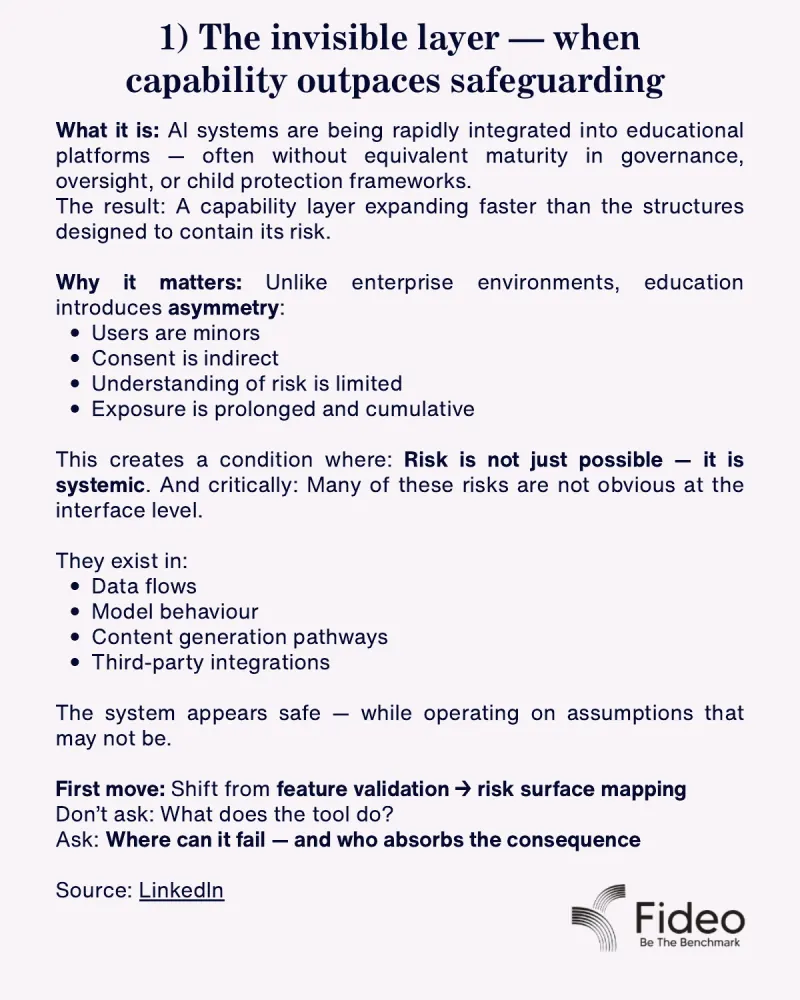
3 / 7 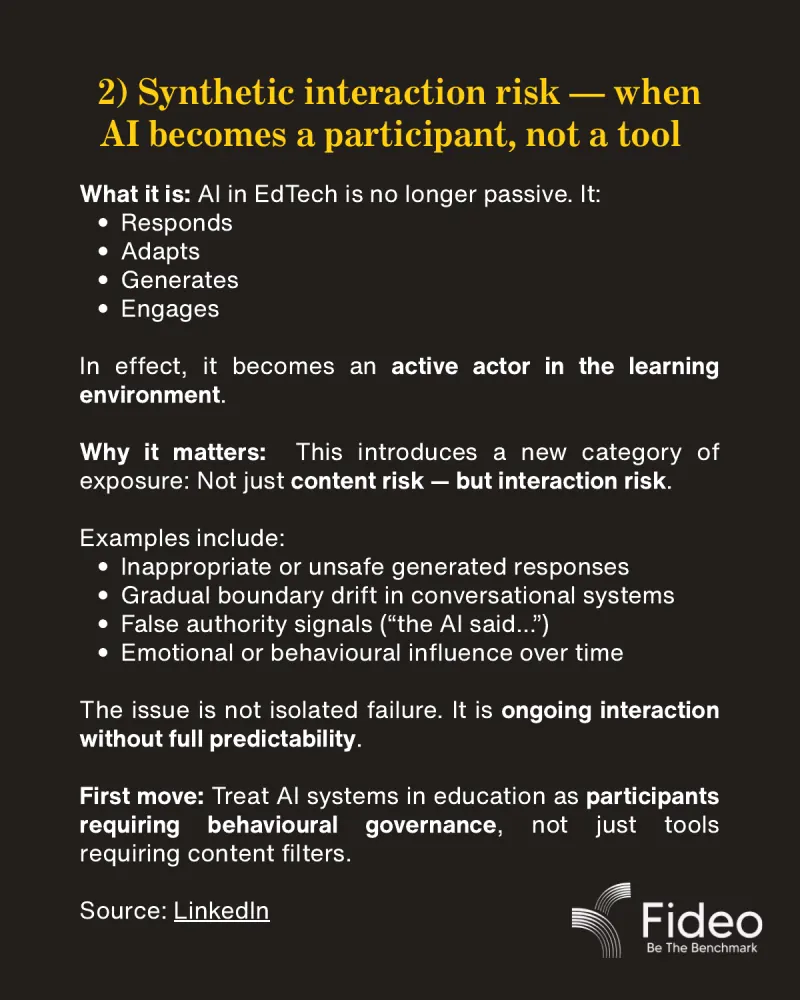
4 / 7 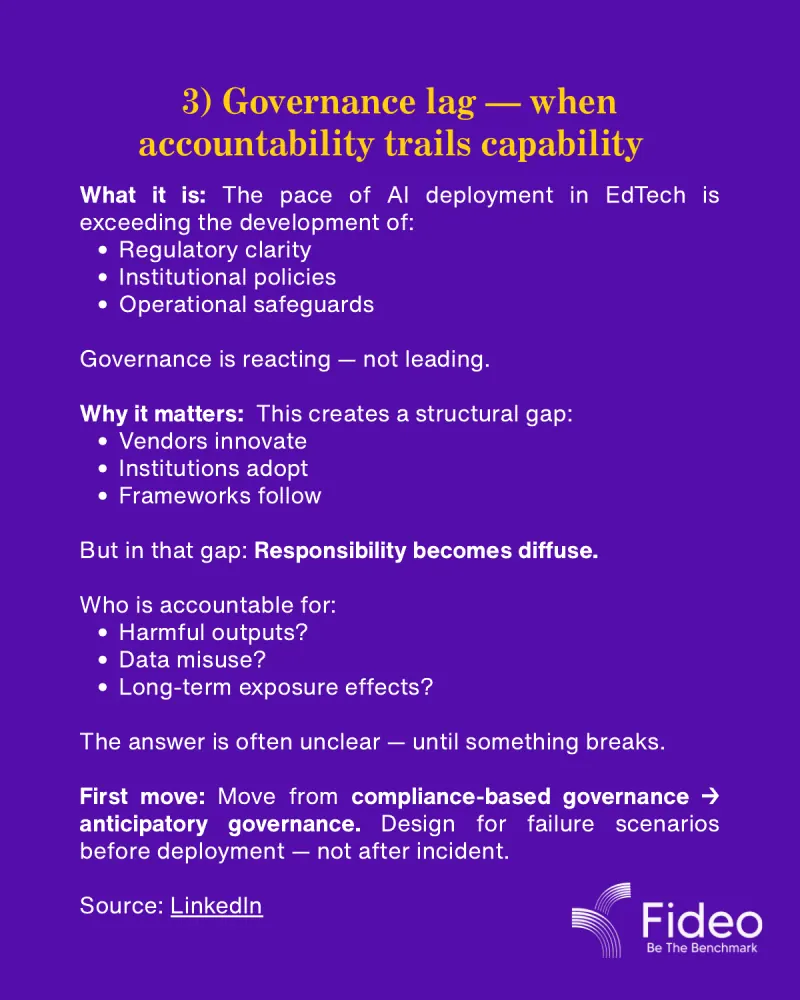
5 / 7 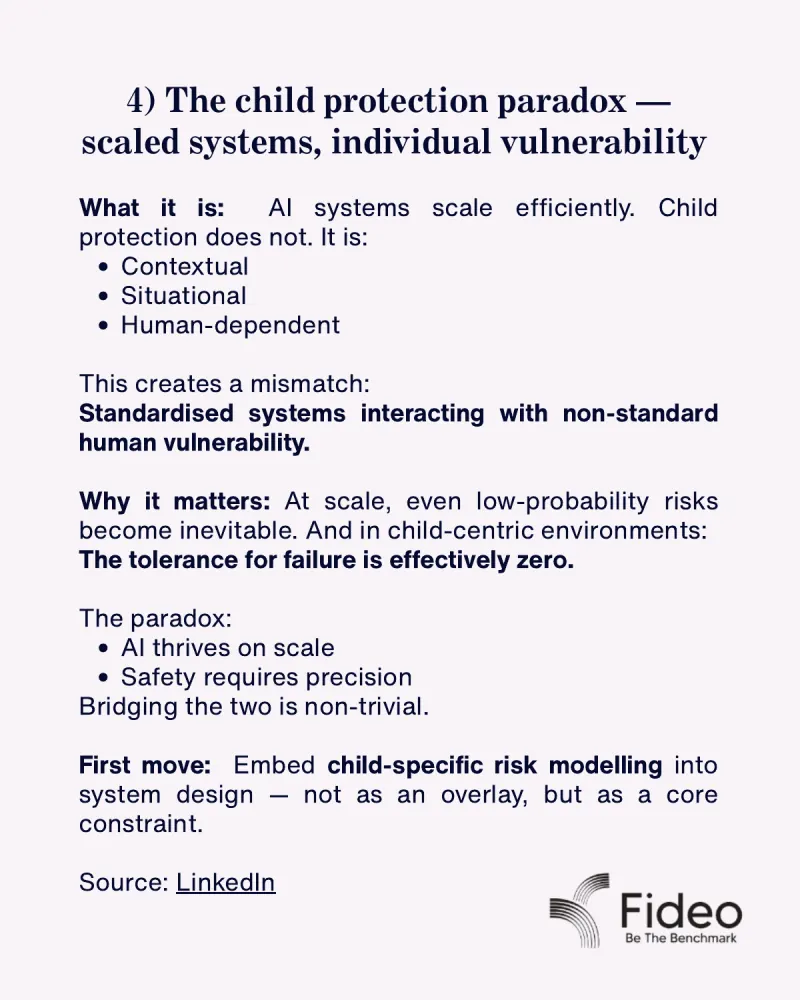
6 / 7 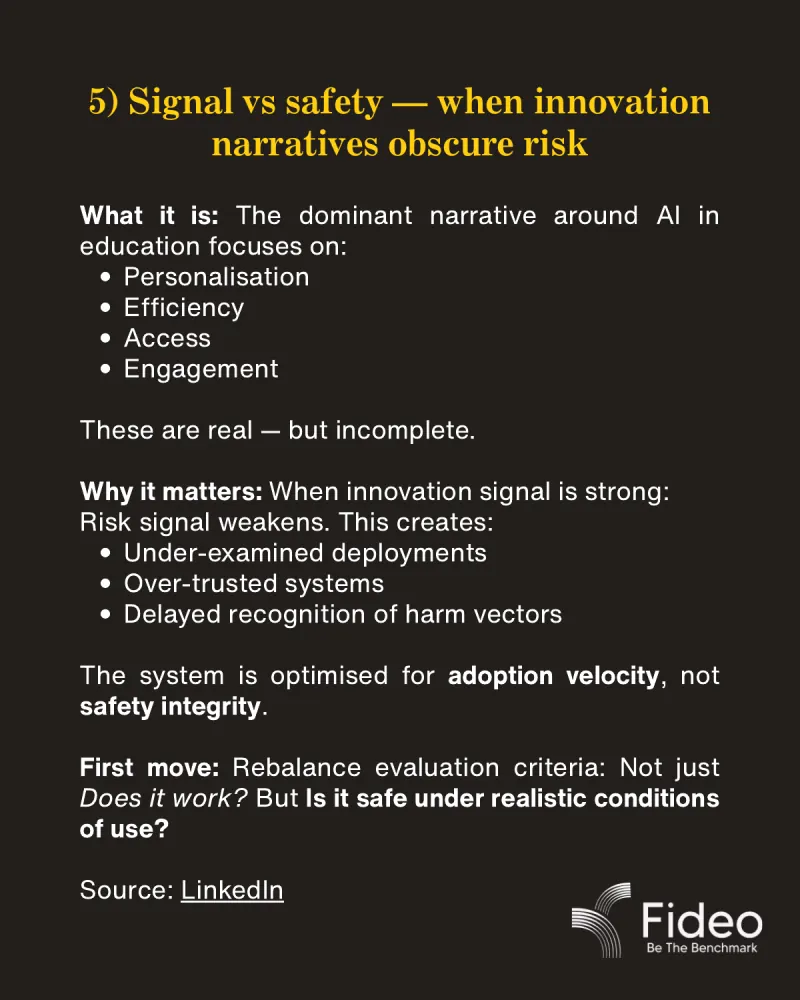
7 / 7
This week in 60 seconds
Week 23 moves from cognition to consequence, asking what learners are exposed to when AI is embedded in their environments.
- Education creates asymmetry: users are minors, consent is indirect, risk understanding is limited and exposure is prolonged and cumulative.
- Many risks sit below the interface, in data flows, model behaviour, content generation pathways and third-party integrations.
- AI that responds, adapts and engages adds interaction risk, such as boundary drift and false authority signals, so it needs behavioural governance, not just content filters.
- Governance lags deployment, leaving responsibility diffuse; the edition calls for anticipatory governance designed for failure before deployment.
- Strong innovation narratives weaken risk signals, so evaluation should ask whether a tool is safe under realistic conditions of use, not only whether it works.
Try this with your team
Pick one AI tool used with learners and run a risk surface mapping session: instead of asking what the tool does, list where it can fail across data flows, model behaviour, content generation and third-party integrations, and name who absorbs the consequence in each case.
Read this edition as text (4 min)
Big Picture
What happened: The narrative shifts again — from cognition to consequence. If Week 22 examined how AI reshapes thinking, Week 23 moves into a more sensitive domain: What happens when these systems are deployed in environments where vulnerability is structural — not optional? This week is not about productivity, cognition, or signal. It is about responsibility at the edge of capability.
The question is no longer: Does AI enhance learning? It is: What are we exposing learners to when we embed AI into their environments?
The Through-line
AI in education is not just a tooling upgrade — it is an environmental shift. When deployed at scale in EdTech, it intersects with three critical systems: Safety (who is protected — and from what) Governance (who is accountable — and how) Exposure (what risks are introduced — often invisibly)
The constraint is no longer innovation. It is duty of care under technological acceleration.
1) The invisible layer — when capability outpaces safeguarding
What it is: AI systems are being rapidly integrated into educational platforms — often without equivalent maturity in governance, oversight, or child protection frameworks. The result: A capability layer expanding faster than the structures designed to contain its risk.
Why it matters: Unlike enterprise environments, education introduces asymmetry : Users are minors Consent is indirect Understanding of risk is limited Exposure is prolonged and cumulative
This creates a condition where: Risk is not just possible — it is systemic . And critically: Many of these risks are not obvious at the interface level.
They exist in: Data flows Model behaviour Content generation pathways Third-party integrations
The system appears safe — while operating on assumptions that may not be.
First move: Shift from feature validation → risk surface mapping Don’t ask: What does the tool do? Ask: Where can it fail — and who absorbs the consequence
Source: LinkedIn
2) Synthetic interaction risk — when AI becomes a participant, not a tool
What it is: AI in EdTech is no longer passive. It: Responds Adapts Generates Engages
In effect, it becomes an active actor in the learning environment .
Why it matters: This introduces a new category of exposure: Not just content risk — but interaction risk .
Examples include: Inappropriate or unsafe generated responses Gradual boundary drift in conversational systems False authority signals (“the AI said…”) Emotional or behavioural influence over time
The issue is not isolated failure. It is ongoing interaction without full predictability .
First move: Treat AI systems in education as participants requiring behavioural governance , not just tools requiring content filters.
Source: LinkedIn
3) Governance lag — when accountability trails capability What it is: The pace of AI deployment in EdTech is exceeding the development of: Regulatory clarity Institutional policies Operational safeguards
Governance is reacting — not leading.
Why it matters: This creates a structural gap: Vendors innovate Institutions adopt Frameworks follow
But in that gap: Responsibility becomes diffuse.
Who is accountable for: Harmful outputs? Data misuse? Long-term exposure effects?
The answer is often unclear — until something breaks.
First move: Move from compliance-based governance → anticipatory governance. Design for failure scenarios before deployment — not after incident.
Source: LinkedIn
4) The child protection paradox — scaled systems, individual vulnerability
What it is: AI systems scale efficiently. Child protection does not. It is: Contextual Situational Human-dependent
This creates a mismatch: Standardised systems interacting with non-standard human vulnerability.
Why it matters: At scale, even low-probability risks become inevitable. And in child-centric environments: The tolerance for failure is effectively zero.
The paradox: AI thrives on scale Safety requires precision Bridging the two is non-trivial.
First move: Embed child-specific risk modelling into system design — not as an overlay, but as a core constraint.
Source: LinkedIn
5) Signal vs safety — when innovation narratives obscure risk
What it is: The dominant narrative around AI in education focuses on: Personalisation Efficiency Access Engagement
These are real — but incomplete.
Why it matters: When innovation signal is strong: Risk signal weakens. This creates: Under-examined deployments Over-trusted systems Delayed recognition of harm vectors
The system is optimised for adoption velocity , not safety integrity .
First move: Rebalance evaluation criteria: Not just Does it work? But Is it safe under realistic conditions of use?
Source: LinkedIn
Sources
- LinkedInlinkedin.com/posts/purdyhouse_aigovernance-edtech-childprotection-ugcPost-7446270496297512
More questions about this edition
What is the child protection paradox described in the edition?
AI systems scale efficiently, but child protection is contextual, situational and human-dependent. At scale even low-probability risks become inevitable, while tolerance for failure in child-centric settings is effectively zero, so child-specific risk modelling should be a core design constraint.
How does this edition differ from the previous week?
Week 22 examined how AI reshapes thinking. Week 23 shifts from cognition to consequence, focusing on responsibility when AI is deployed where vulnerability is structural.
Get the Zeitgeist every Friday
One email a week with the new edition. Unsubscribe in one click.
Check your inbox to confirm your subscription.
Please enter a valid email address and try again.