Week of 24 to 28 Nov 2025
Where the perimeter sits: AI, SupTech, on-chain AML and the halo effect
1 / 9 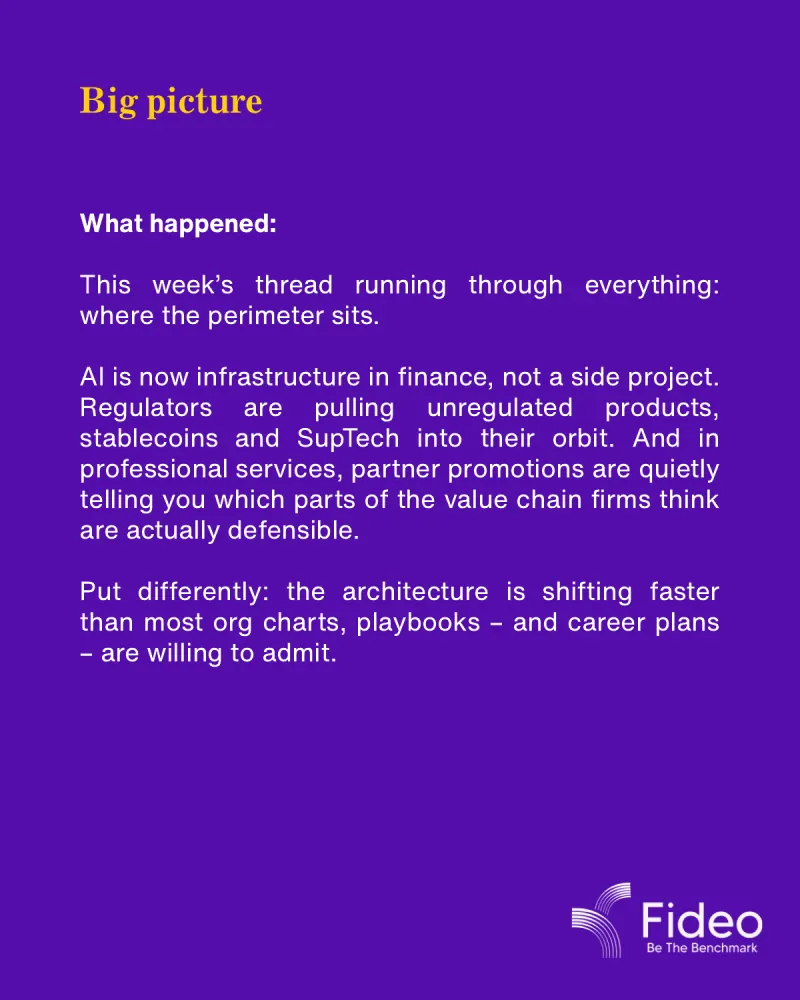
2 / 9 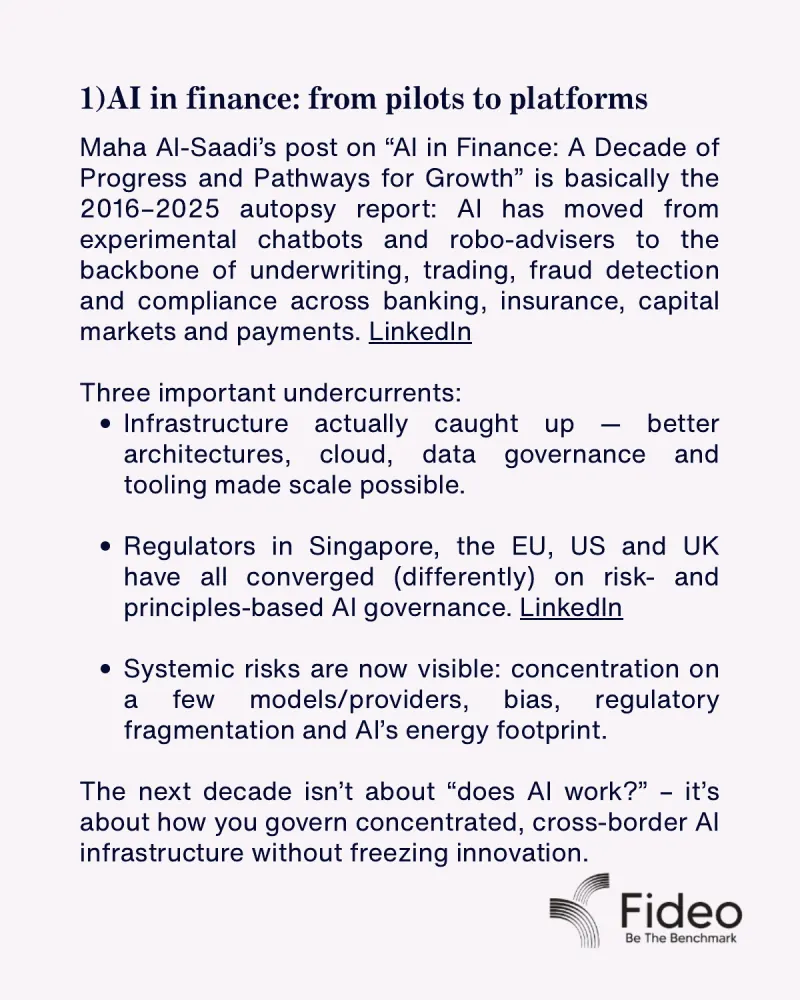
3 / 9 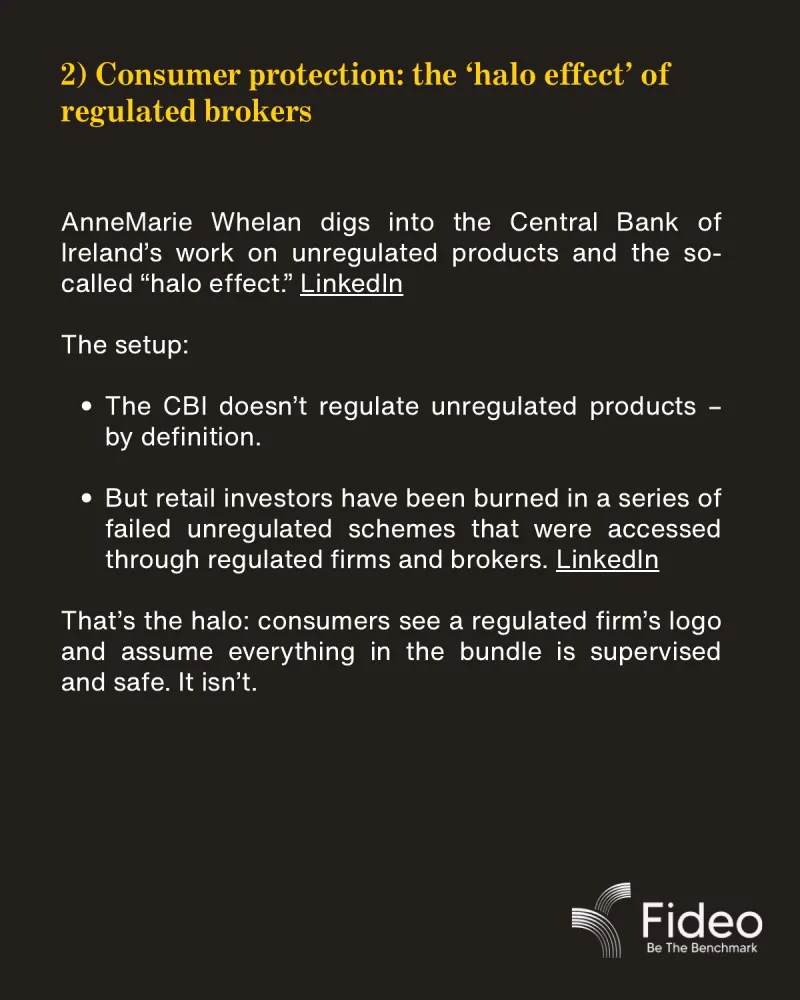
4 / 9 
5 / 9 
6 / 9 
7 / 9 
8 / 9 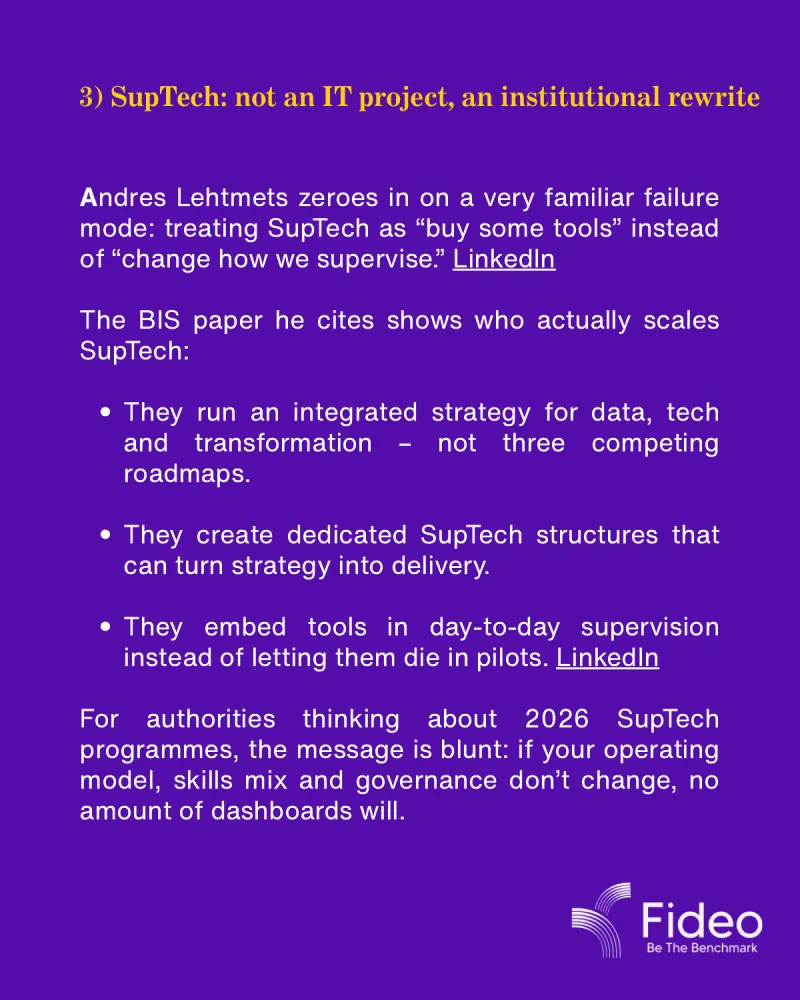
9 / 9
This week in 60 seconds
AI is now infrastructure in finance, and regulators are pulling more activity into their orbit than most org charts admit.
- AI has moved from experimental chatbots to the backbone of underwriting, trading, fraud detection and compliance. The next question is governing concentrated, cross-border AI infrastructure.
- The Central Bank of Ireland's halo effect work shows consumers assume anything sold through a regulated firm is supervised. CPC 2025 will push brokers to tighten disclosure, governance and oversight.
- A BIS paper finds SupTech scales only with an integrated data and tech strategy, dedicated structures and tools embedded in daily supervision, not by buying dashboards.
- On-chain AML needs behavioural intelligence on wallets, contract interactions and cross-chain patterns, as laundering via bridges and smart contracts fragments the trail.
- FinCrime Frontier 2025-26 findings point to weak data foundations and patchy AI governance, with only a minority of firms having robust validation and drift monitoring.
Try this with your team
If you sell both regulated and unregulated products, review them against the three areas CPC 2025 will tighten: is the regulatory perimeter explicit in your disclosures, who signs off on mixed-product advice, and how does your board monitor off-perimeter selling?
Read this edition as text (4 min)
Big picture
What happened:
This week’s thread running through everything: where the perimeter sits.
AI is now infrastructure in finance, not a side project. Regulators are pulling unregulated products, stablecoins and SupTech into their orbit. And in professional services, partner promotions are quietly telling you which parts of the value chain firms think are actually defensible.
Put differently: the architecture is shifting faster than most org charts, playbooks – and career plans – are willing to admit.
1)AI in finance: from pilots to platforms
Maha Al-Saadi’s post on “AI in Finance: A Decade of Progress and Pathways for Growth” is basically the 2016–2025 autopsy report: AI has moved from experimental chatbots and robo-advisers to the backbone of underwriting, trading, fraud detection and compliance across banking, insurance, capital markets and payments. LinkedIn
Three important undercurrents: Infrastructure actually caught up — better architectures, cloud, data governance and tooling made scale possible.
Regulators in Singapore, the EU, US and UK have all converged (differently) on risk- and principles-based AI governance. LinkedIn
Systemic risks are now visible: concentration on a few models/providers, bias, regulatory fragmentation and AI’s energy footprint.
The next decade isn’t about “does AI work?” – it’s about how you govern concentrated, cross-border AI infrastructure without freezing innovation.
2) Consumer protection: the ‘halo effect’ of regulated brokers
AnneMarie Whelan digs into the Central Bank of Ireland’s work on unregulated products and the so- called “halo effect. ” LinkedIn
The setup:
The CBI doesn’t regulate unregulated products – by definition.
But retail investors have been burned in a series of failed unregulated schemes that were accessed through regulated firms and brokers. LinkedIn
That’s the halo: consumers see a regulated firm’s logo and assume everything in the bundle is supervised and safe. It isn’t.
2) Consumer protection: the ‘halo effect’ of regulated brokers continued
With CPC 2025 landing from March 2026, brokers who straddle regulated and unregulated products will be forced to tighten:
Disclosure – making the regulatory perimeter brutally explicit.
Governance – who signs off on mixed-product advice?
Oversight – how boards monitor “off-perimeter” selling practices.
This is a warning shot: the regulator will increasingly target conduct even when the underlying product sits outside the classic perimeter. LinkedIn
3) SupTech: not an IT project, an institutional rewrite
A ndres Lehtmets zeroes in on a very familiar failure mode: treating SupTech as “buy some tools” instead of “change how we supervise. ” LinkedIn
The BIS paper he cites shows who actually scales SupTech:
They run an integrated strategy for data, tech and transformation – not three competing roadmaps.
They create dedicated SupTech structures that can turn strategy into delivery.
They embed tools in day-to-day supervision instead of letting them die in pilots. LinkedIn
For authorities thinking about 2026 SupTech programmes, the message is blunt: if your operating model, skills mix and governance don’t change, no amount of dashboards will.
4) On-chain AML: behaviour over transactions
Adeel Mirza’s “compliance wake-up call” is aimed at financial crime teams still running models optimised for banks and fiat transfers while criminals migrate to DeFi, cross-chain bridges and swap-based layering. LinkedIn
His core argument:
Traditional transaction-centric models miss how modern laundering uses protocol hops, bridges and smart contracts to fragment the trail.
The response isn’t “more data” in the old sense; it’s behavioural intelligence – decoding wallets, contract interactions and cross-chain patterns as behavioural signatures of illicit actors. LinkedIn
He points to five pillars for effective on-chain monitoring and a new investigative methodology tailored for the blockchain era. The implicit challenge for banks: your existing TM stack likely can’t see half of this.
Zooming out: AI, data and the new perimeter
If you lay these signals alongside the FinCrime Frontier 2025–26 findings – weak data foundations, patchy AI governance and low confidence in detection quality – a pattern emerges.
AI is already systemic in finance, but only a minority of firms have fully-defined AI governance and robust validation/drift monitoring in place.
Data quality and integration remain the biggest drag on effectiveness, even as regulators move closer to direct supervision of high-risk entities.
Pair that with SupTech’s institutional lag and on-chain financial crime moving faster than traditional models, and the perimeter question sharpens:
Who owns the architecture – and who is still just buying tools or selling hours into it?
That’s the real Zeitgeist for Week 8.
3) SupTech: not an IT project, an institutional rewrite
A ndres Lehtmets zeroes in on a very familiar failure mode: treating SupTech as “buy some tools” instead of “change how we supervise. ” LinkedIn
The BIS paper he cites shows who actually scales SupTech:
They run an integrated strategy for data, tech and transformation – not three competing roadmaps.
They create dedicated SupTech structures that can turn strategy into delivery.
They embed tools in day-to-day supervision instead of letting them die in pilots. LinkedIn
For authorities thinking about 2026 SupTech programmes, the message is blunt: if your operating model, skills mix and governance don’t change, no amount of dashboards will.
Sources
- LinkedInlinkedin.com/posts/mahaalsaadi_ai-in-finance-ugcPost-7393599931418034176-kvPF/
- LinkedInlinkedin.com/pulse/halo-effect-financial-brokers-unregulated-products-annemarie-whelan-90i
- LinkedInlinkedin.com/posts/andreslehtmets_making-suptech-work-ugcPost-7399416478300626944-o07o/
- LinkedInlinkedin.com/posts/mirzaadeel_fc-ugcPost-7395375890182053888-YVPq/
More questions about this edition
When does CPC 2025 start to apply?
The edition says CPC 2025 lands from March 2026, affecting brokers who straddle regulated and unregulated products.
What systemic risks from AI in finance does the edition highlight?
Concentration on a few models or providers, bias, regulatory fragmentation and AI's energy footprint.
Which regulators have converged on AI governance?
Regulators in Singapore, the EU, the US and the UK have converged, in different ways, on risk- and principles-based AI governance.
Get the Zeitgeist every Friday
One email a week with the new edition. Unsubscribe in one click.
Check your inbox to confirm your subscription.
Please enter a valid email address and try again.