Week of 16 to 20 Feb 2026
Governance is becoming the security boundary
1 / 8 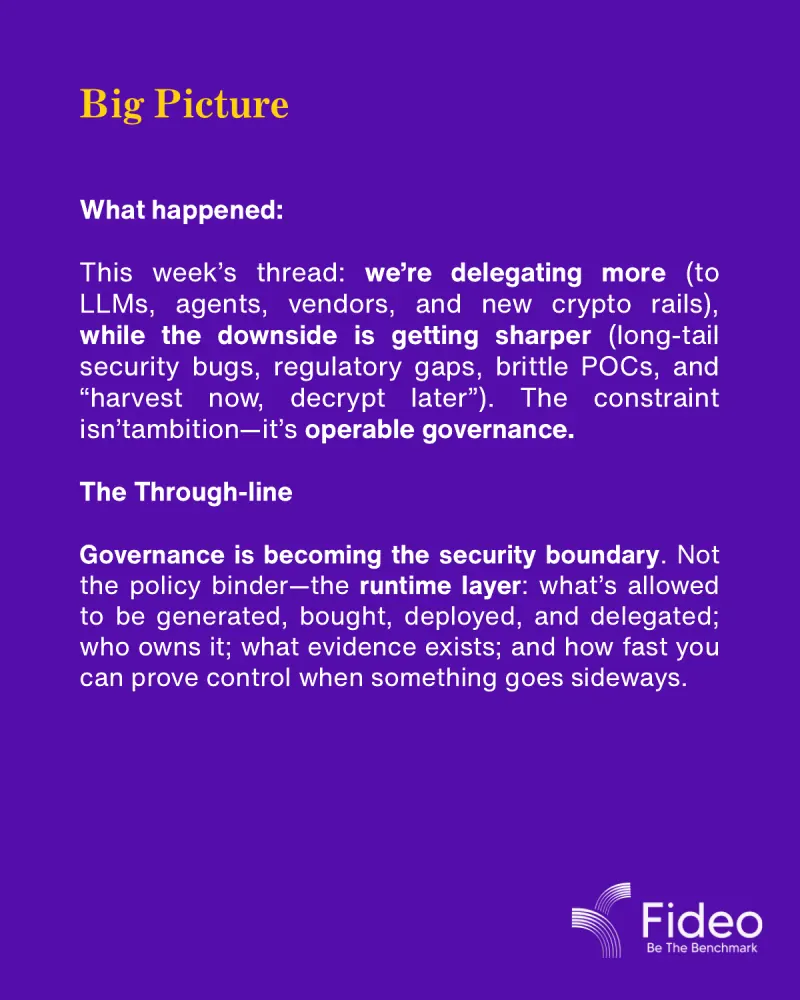
2 / 8 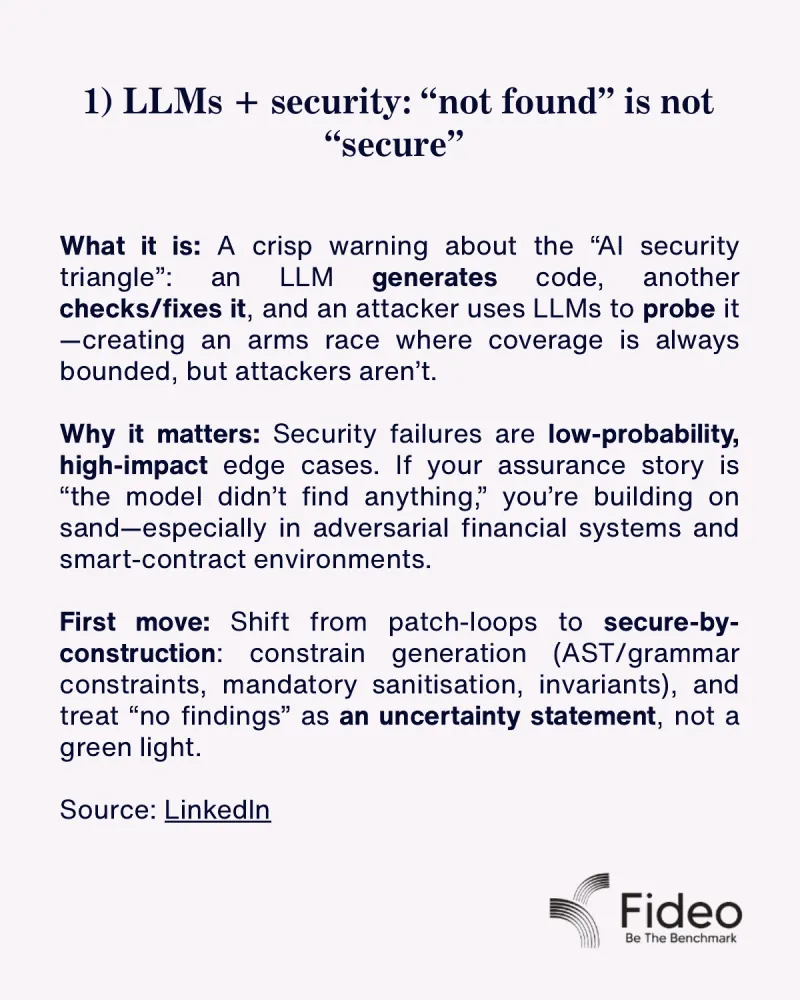
3 / 8 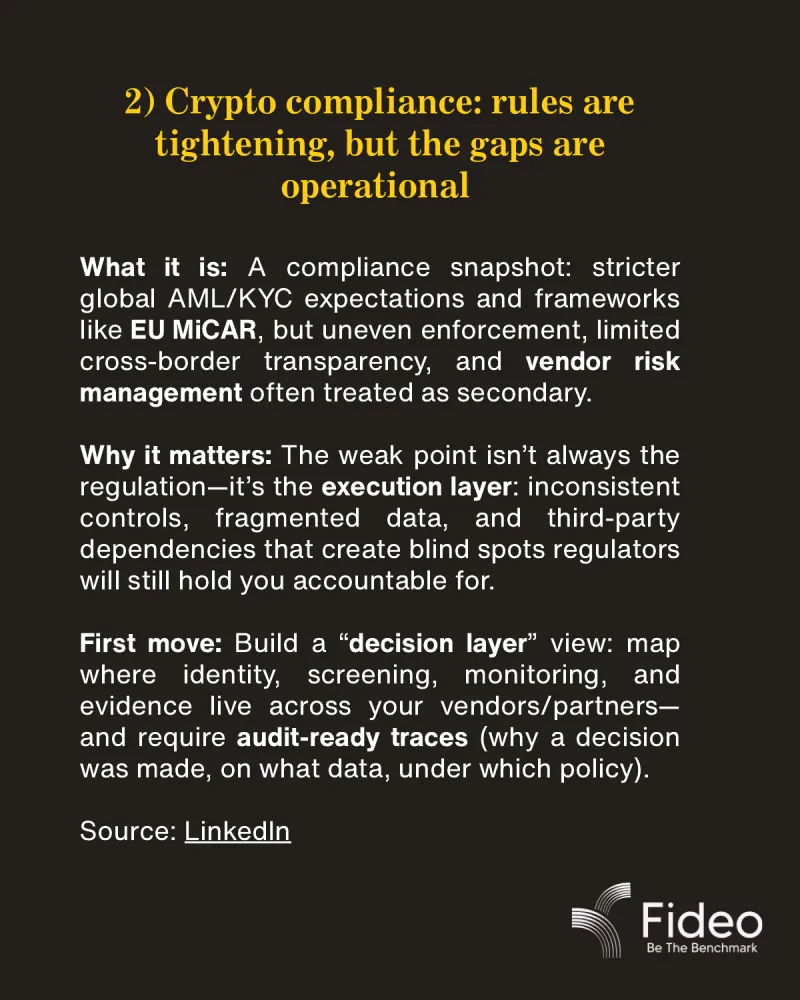
4 / 8 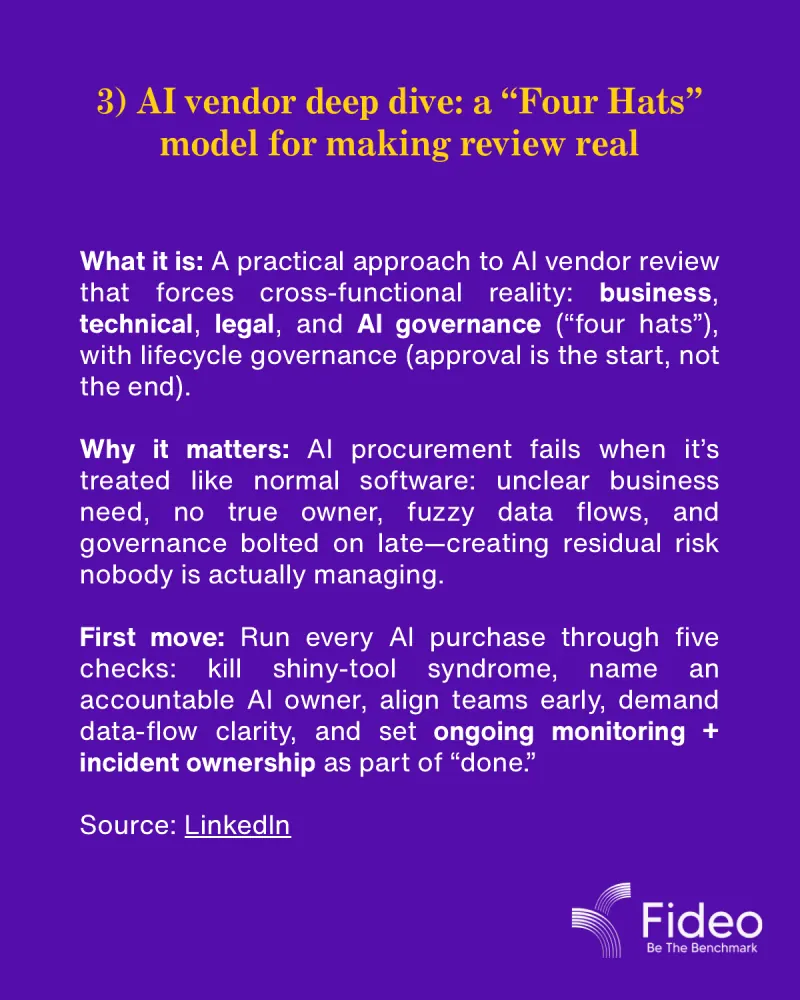
5 / 8 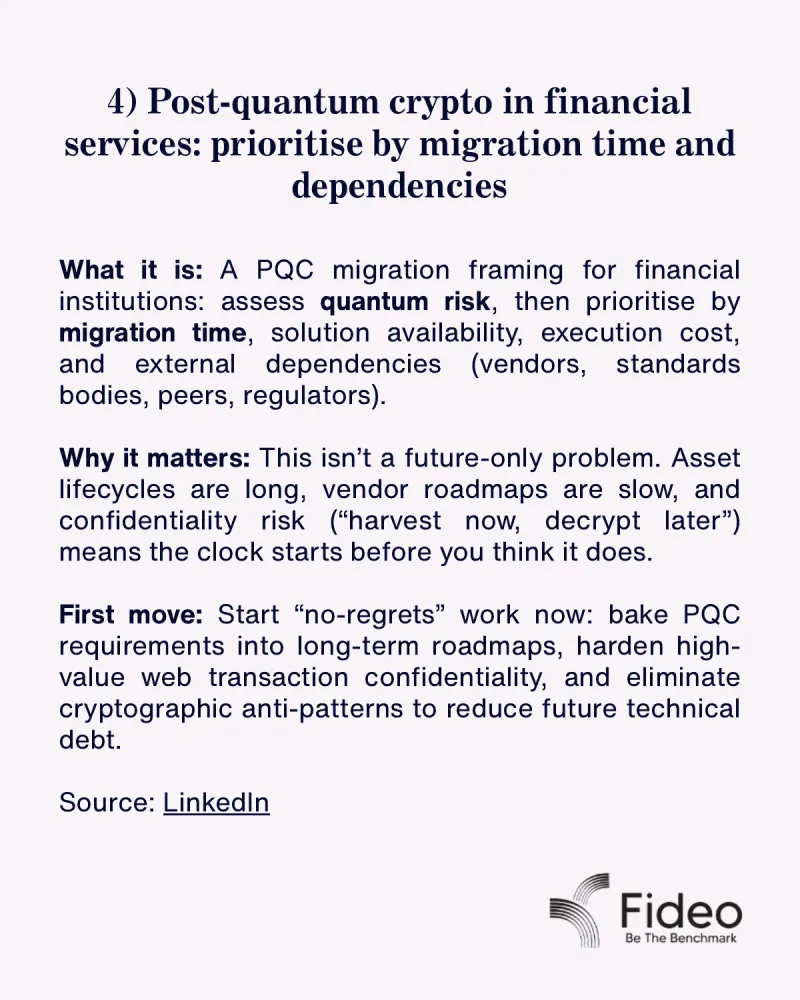
6 / 8 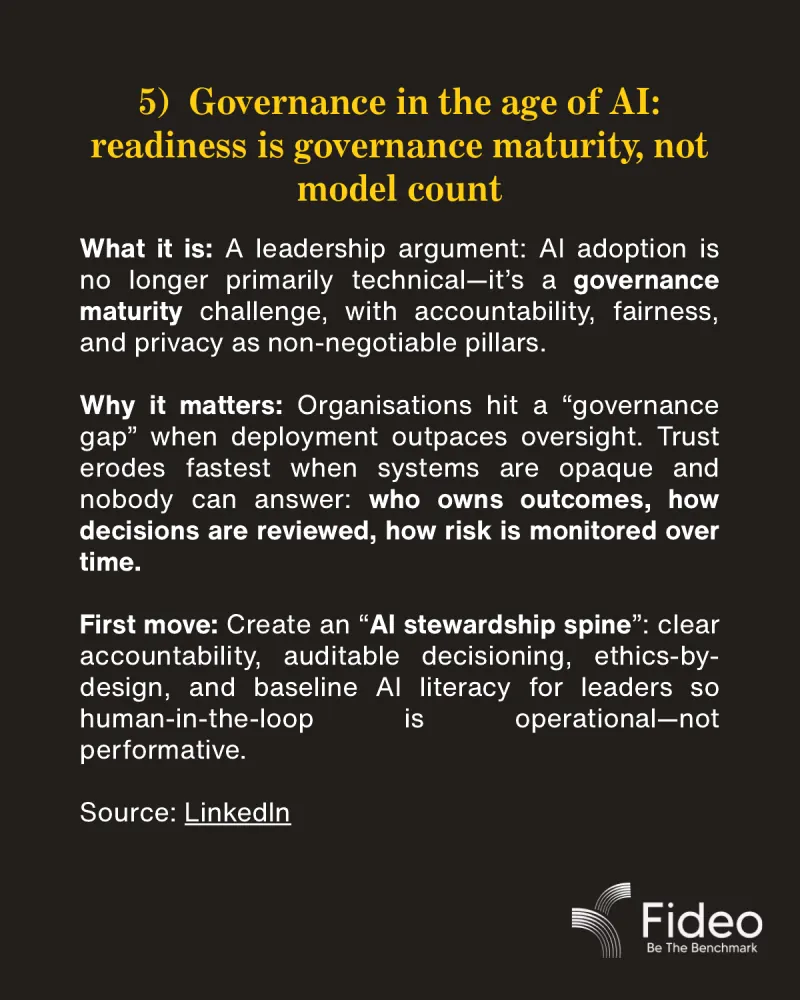
7 / 8 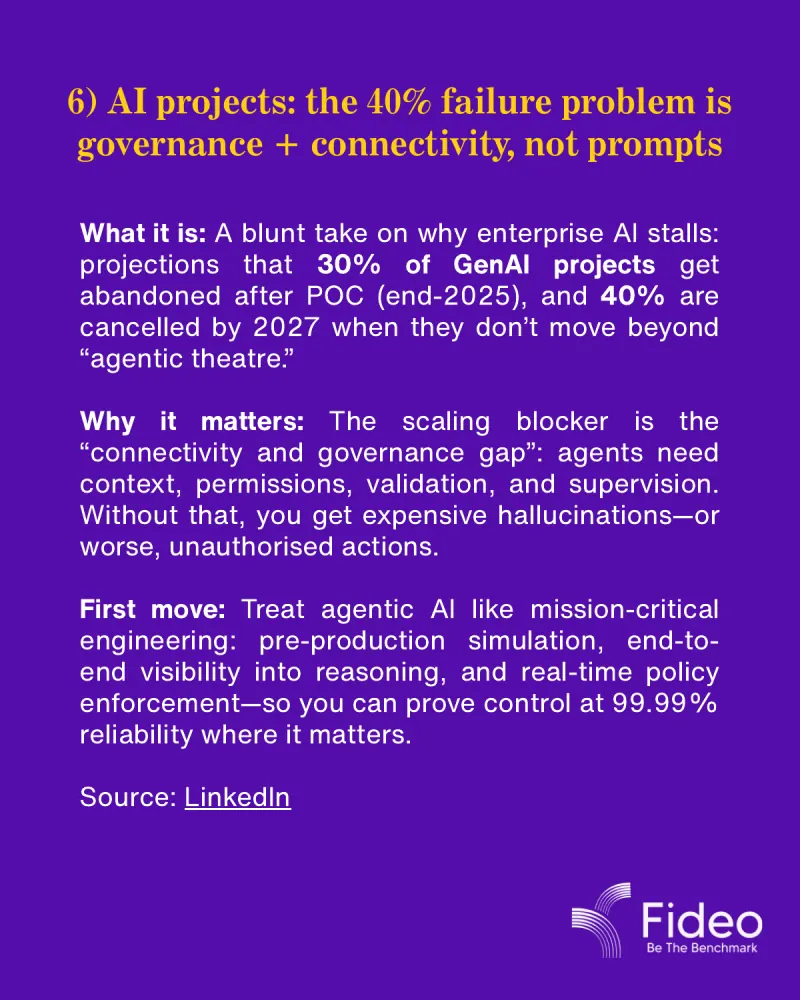
8 / 8
This week in 60 seconds
We are delegating more to LLMs, agents, vendors and crypto rails while the downside gets sharper.
- A model reporting no security findings is an uncertainty statement, not a green light; shift from patch loops to secure-by-construction code generation.
- Crypto compliance gaps sit in the execution layer: inconsistent controls, fragmented data and third-party dependencies regulators still hold you accountable for.
- AI vendor review needs four hats (business, technical, legal and AI governance), and approval is the start of lifecycle governance, not the end.
- Post-quantum migration should be prioritised by migration time and dependencies, because 'harvest now, decrypt later' means the clock has already started.
- Projections suggest 40% of agentic AI projects are cancelled by 2027; the blocker is the connectivity and governance gap, not prompts.
Try this with your team
Run your next AI purchase through five checks: kill shiny-tool syndrome, name an accountable AI owner, align teams early, demand data-flow clarity, and make ongoing monitoring and incident ownership part of the definition of done.
Read this edition as text (4 min)
Big Picture
What happened:
This week’s thread: we’re delegating more (to LLMs, agents, vendors, and new crypto rails), while the downside is getting sharper (long-tail security bugs, regulatory gaps, brittle POCs, and “harvest now, decrypt later”). The constraint isn’tambition—it’s operable governance.
The Through-line
Governance is becoming the security boundary . Not the policy binder—the runtime layer : what’s allowed to be generated, bought, deployed, and delegated; who owns it; what evidence exists; and how fast you can prove control when something goes sideways.
1) LLMs + security: “not found” is not “secure”
What it is: A crisp warning about the “AI security triangle”: an LLM generates code, another checks/fixes it , and an attacker uses LLMs to probe it —creating an arms race where coverage is always bounded, but attackers aren’t.
Why it matters: Security failures are low-probability, high-impact edge cases. If your assurance story is “the model didn’t find anything,” you’re building on sand—especially in adversarial financial systems and smart-contract environments.
First move: Shift from patch-loops to secure-by- construction : constrain generation (AST/grammar constraints, mandatory sanitisation, invariants), and treat “no findings” as an uncertainty statement , not a green light.
Source: LinkedIn
2) Crypto compliance: rules are tightening, but the gaps are operational
What it is: A compliance snapshot: stricter global AML/KYC expectations and frameworks like EU MiCAR , but uneven enforcement, limited cross-border transparency, and vendor risk management often treated as secondary.
Why it matters: The weak point isn’t always the regulation—it’s the execution layer : inconsistent controls, fragmented data, and third-party dependencies that create blind spots regulators will still hold you accountable for.
First move: Build a “ decision layer ” view: map where identity, screening, monitoring, and evidence live across your vendors/partners— and require audit-ready traces (why a decision was made, on what data, under which policy).
Source: LinkedIn
3) AI vendor deep dive: a “Four Hats” model for making review real
What it is: A practical approach to AI vendor review that forces cross-functional reality: business , technical , legal , and AI governance (“four hats”), with lifecycle governance (approval is the start, not the end).
Why it matters: AI procurement fails when it’s treated like normal software: unclear business need, no true owner, fuzzy data flows, and governance bolted on late—creating residual risk nobody is actually managing.
First move: Run every AI purchase through five checks: kill shiny-tool syndrome, name an accountable AI owner, align teams early, demand data-flow clarity, and set ongoing monitoring + incident ownership as part of “done. ”
Source: LinkedIn
4) Post-quantum crypto in financial services: prioritise by migration time and dependencies
What it is: A PQC migration framing for financial institutions: assess quantum risk , then prioritise by migration time , solution availability, execution cost, and external dependencies (vendors, standards bodies, peers, regulators).
Why it matters: This isn’t a future-only problem. Asset lifecycles are long, vendor roadmaps are slow, and confidentiality risk (“harvest now, decrypt later”) means the clock starts before you think it does.
First move: Start “no-regrets” work now: bake PQC requirements into long-term roadmaps, harden high- value web transaction confidentiality, and eliminate cryptographic anti-patterns to reduce future technical debt.
Source: LinkedIn
5) Governance in the age of AI: readiness is governance maturity, not model count
What it is: A leadership argument: AI adoption is no longer primarily technical—it’s a governance maturity challenge, with accountability, fairness, and privacy as non-negotiable pillars.
Why it matters: Organisations hit a “governance gap” when deployment outpaces oversight. Trust erodes fastest when systems are opaque and nobody can answer: who owns outcomes, how decisions are reviewed, how risk is monitored over time.
First move: Create an “ AI stewardship spine ”: clear accountability, auditable decisioning, ethics-by- design, and baseline AI literacy for leaders so human-in-the-loop is operational—not performative.
Source: LinkedIn
6) AI projects: the 40% failure problem is governance + connectivity, not prompts
What it is: A blunt take on why enterprise AI stalls: projections that 30% of GenAI projects get abandoned after POC (end-2025), and 40% are cancelled by 2027 when they don’t move beyond “agentic theatre. ”
Why it matters: The scaling blocker is the “connectivity and governance gap”: agents need context, permissions, validation, and supervision. Without that, you get expensive hallucinations—or worse, unauthorised actions.
First move: Treat agentic AI like mission-critical engineering: pre-production simulation, end-to- end visibility into reasoning, and real-time policy enforcement—so you can prove control at 99.99% reliability where it matters.
Source: LinkedIn
Sources
- LinkedInlinkedin.com/posts/krzysztofgogol_llms-security-trouble-activity-7429450444525023232-8rbI/
- LinkedInlinkedin.com/posts/lukaszlukaszewski_compliance-aml-cryptocompliance-activity-742917886297
- LinkedInlinkedin.com/posts/ciara-o-buachalla-lawyer-mba-ai-governance-advisor_the-ai-vendor-deep-d
- LinkedInlinkedin.com/posts/mahaalsaadi_post-quantum-cryptography-migration-in-financial-activity-7
- LinkedInlinkedin.com/posts/kadir-tas-a1106a22_governance-in-the-age-of-ai-ugcPost-7429495689270837
- disseqt.aidisseqt.ai/articles/ai-projects-40-failure-rate-by-2027-and-how-to-be-in-the-60
More questions about this edition
What is the 'AI security triangle'?
One LLM generates code, another checks or fixes it, and an attacker uses LLMs to probe it. This creates an arms race where defensive coverage is always bounded but attackers are not.
What 'no-regrets' post-quantum work can financial institutions start now?
Bake PQC requirements into long-term roadmaps, harden the confidentiality of high-value web transactions, and eliminate cryptographic anti-patterns to reduce future technical debt.
What is an 'AI stewardship spine'?
A foundation of clear accountability, auditable decisioning, ethics-by-design and baseline AI literacy for leaders, so that human-in-the-loop oversight is operational rather than performative.
Get the Zeitgeist every Friday
One email a week with the new edition. Unsubscribe in one click.
Check your inbox to confirm your subscription.
Please enter a valid email address and try again.