Week of 1 to 5 Dec 2025
Trust, yield and literacy: the new design variables of finance

1 / 10 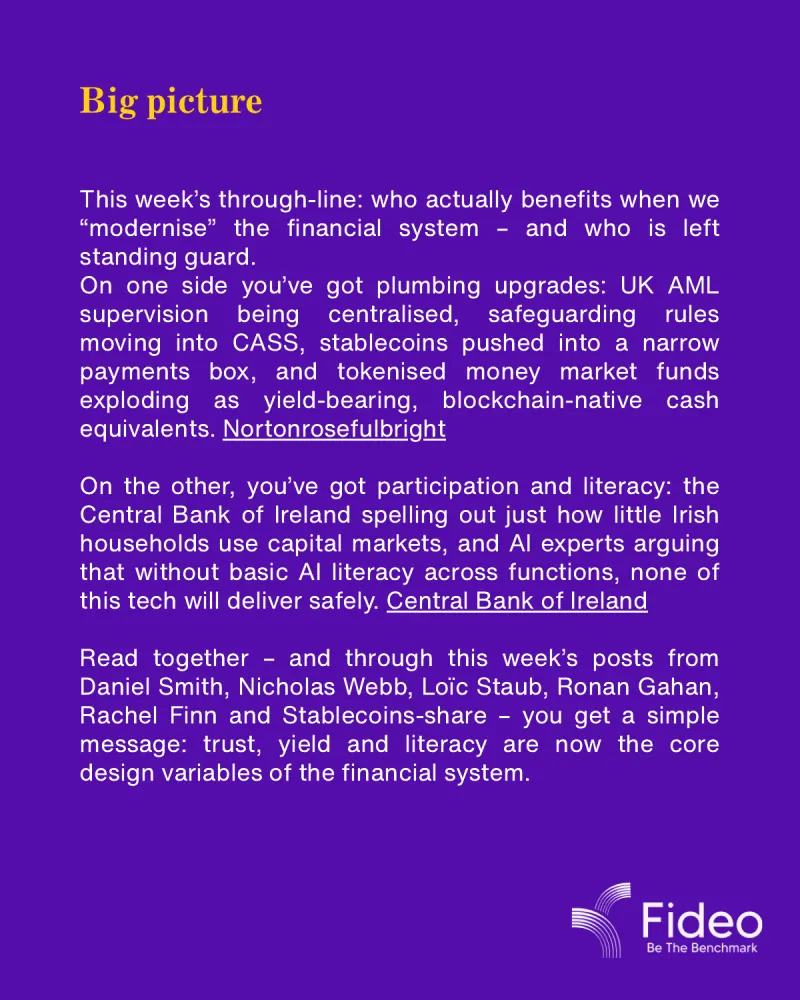
2 / 10 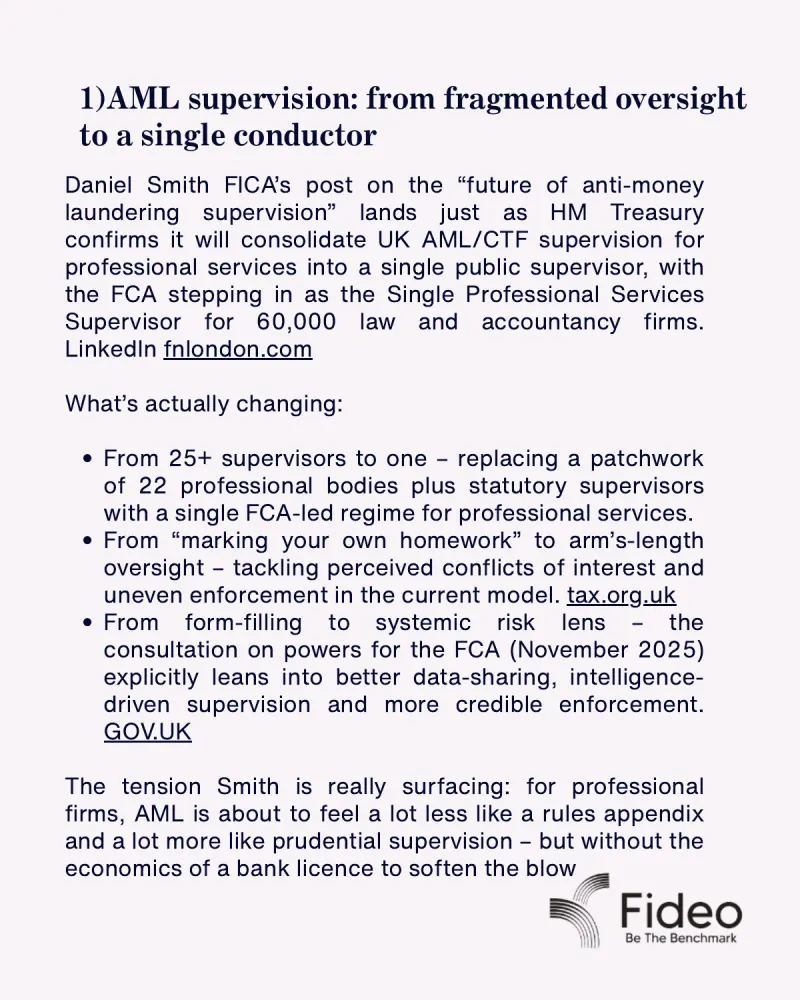
3 / 10 
4 / 10 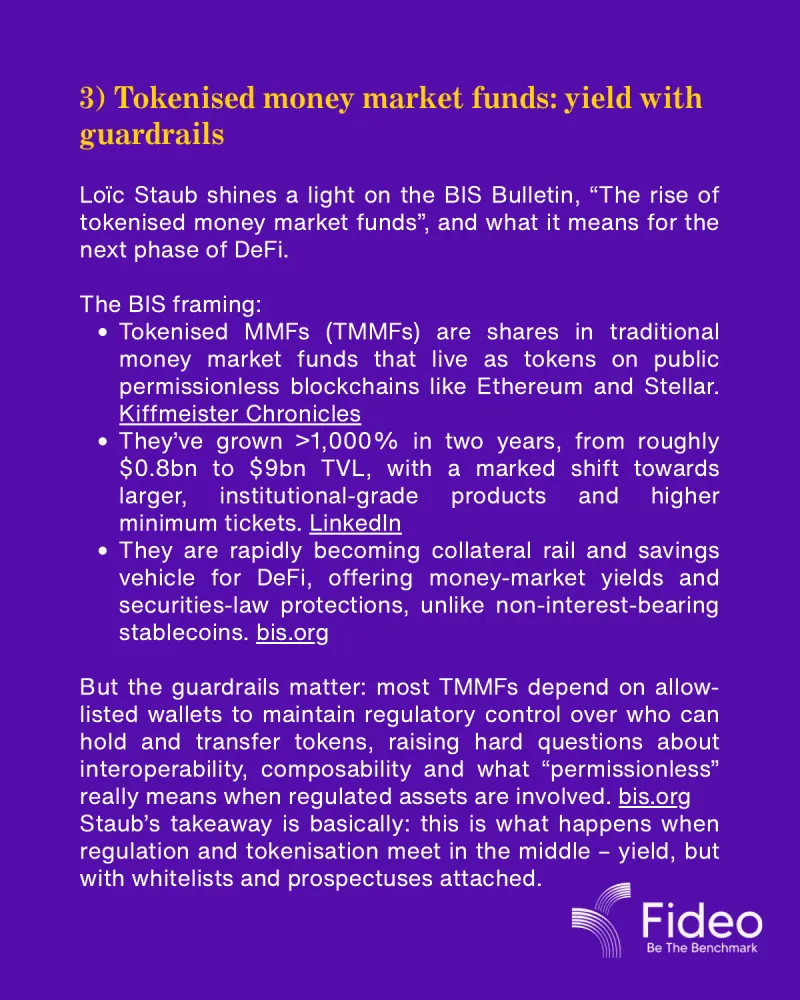
5 / 10 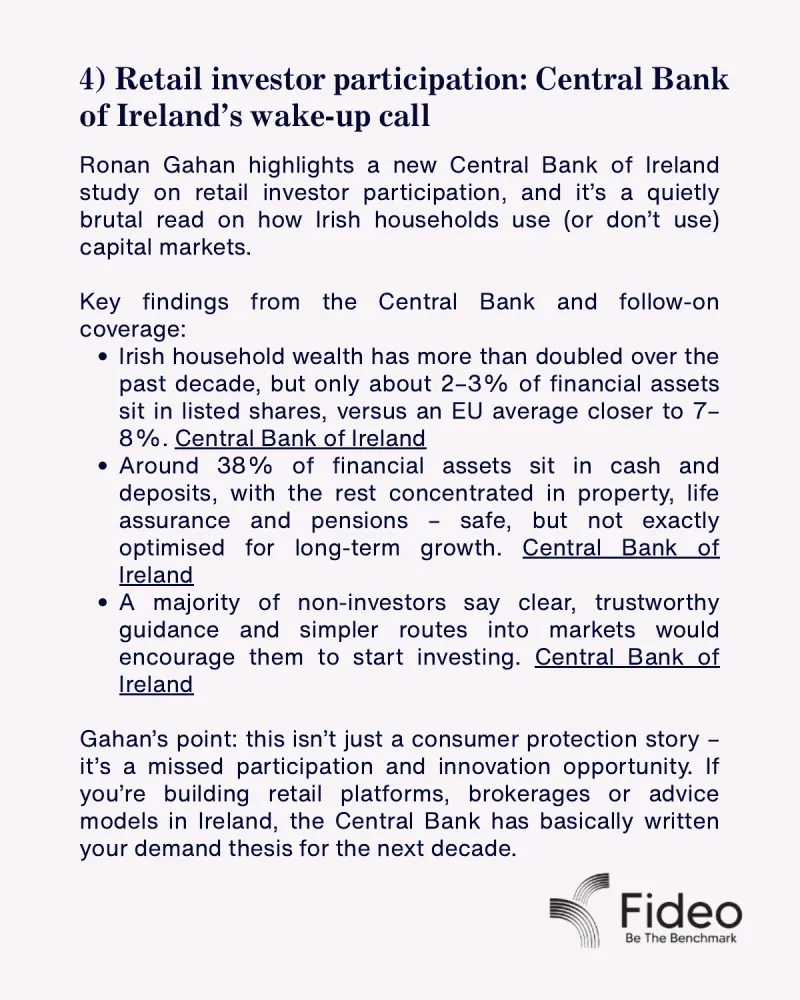
6 / 10 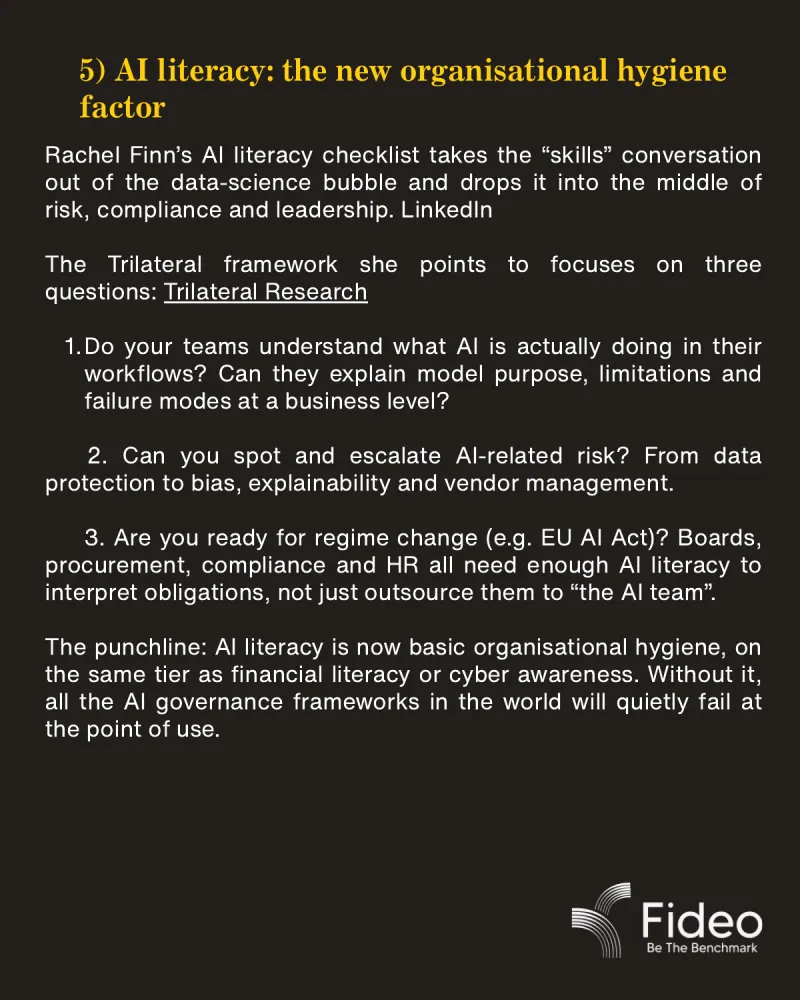
7 / 10 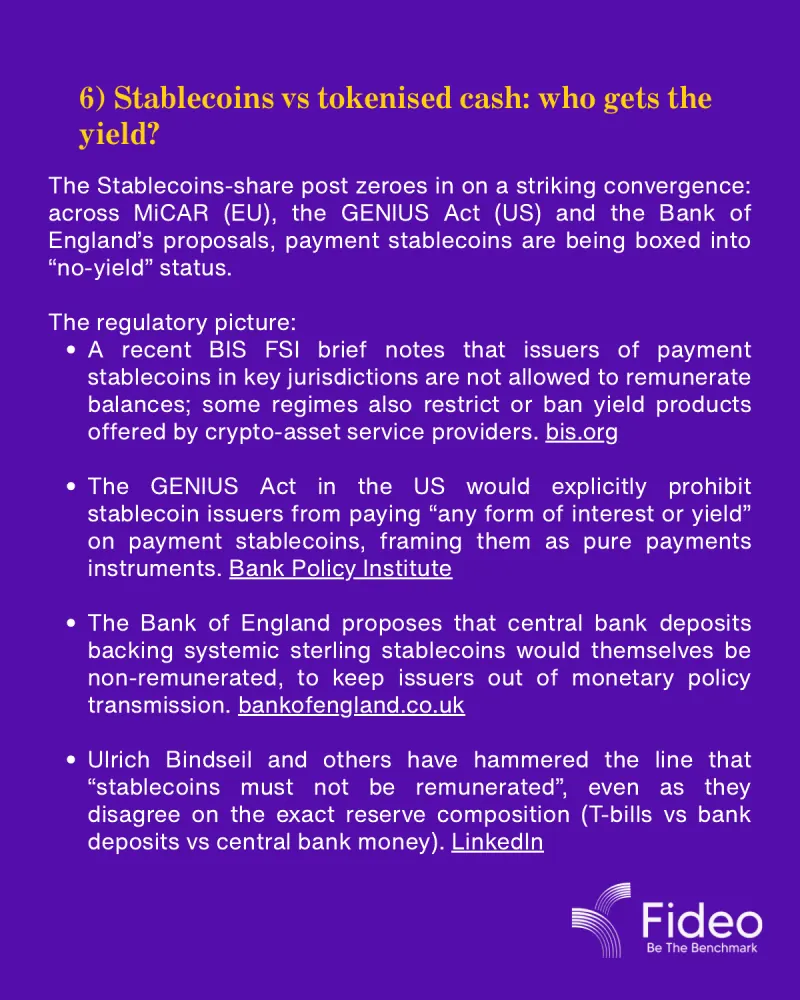
8 / 10 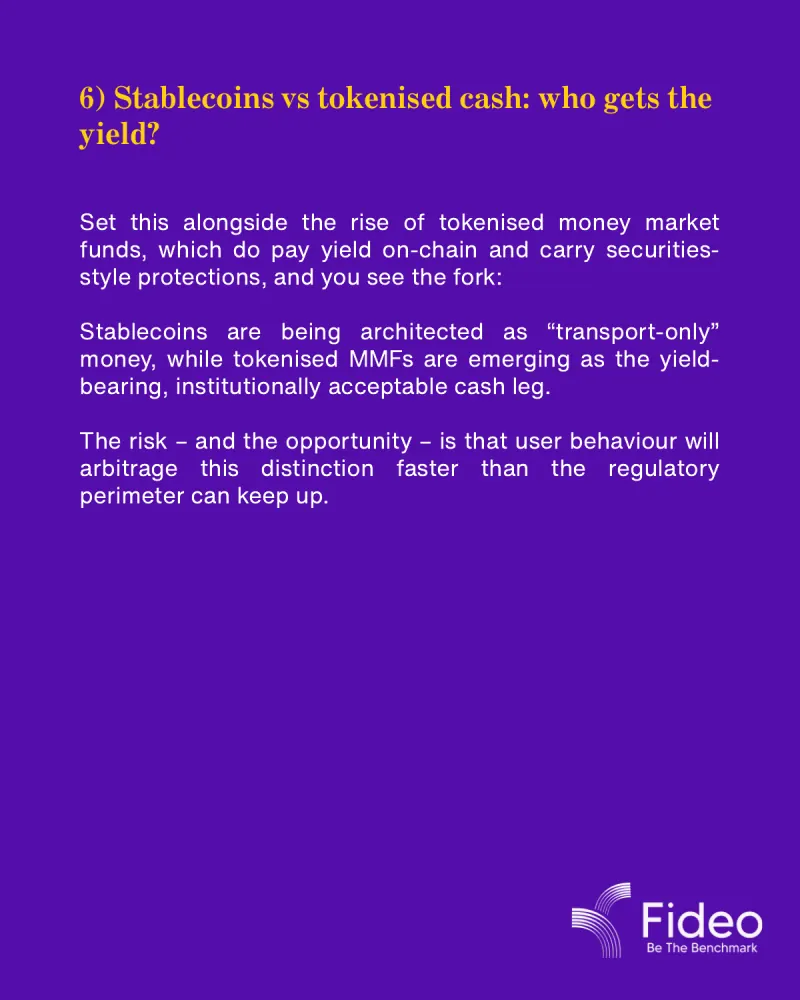
9 / 10 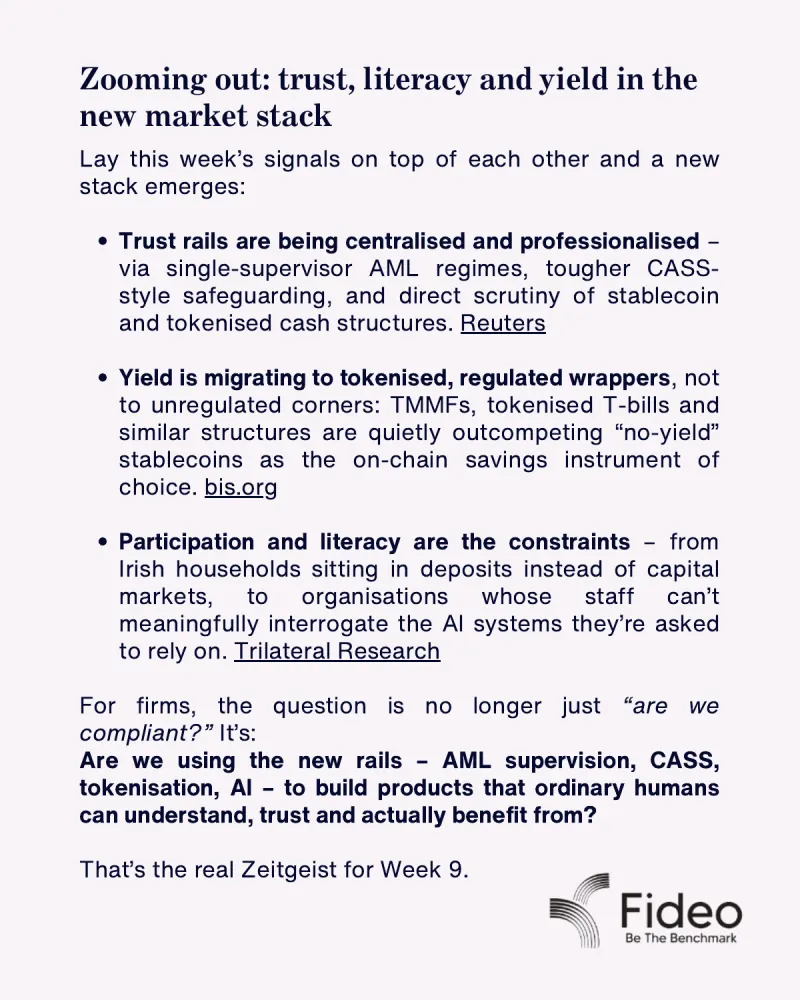
10 / 10
This week in 60 seconds
AML supervision consolidates, safeguarding moves towards CASS, stablecoins lose yield and tokenised funds gain it
- HM Treasury will replace 25+ AML supervisors with the FCA as single supervisor for about 60,000 law and accountancy firms, shifting towards intelligence-driven oversight.
- The FCA's safeguarding overhaul for payments and e-money firms is the biggest since 2017 and pushes them towards CASS-style standards owned by senior management.
- Tokenised money market funds grew over 1,000% in two years, from about $0.8bn to $9bn, offering on-chain yield but mostly relying on allow-listed wallets.
- MiCAR, the GENIUS Act and Bank of England proposals all push payment stablecoins into no-yield status, leaving tokenised funds as the yield-bearing cash leg.
- Only about 2 to 3% of Irish household financial assets sit in listed shares, against an EU average closer to 7 to 8%, with around 38% in cash and deposits.
Try this with your team
Run the three-question AI literacy check from the Trilateral framework: can your teams explain what AI does in their workflows, including purpose, limitations and failure modes; can they spot and escalate AI-related risk; and do boards, procurement, compliance and HR understand obligations such as the EU AI Act rather than leaving them to the AI team?
Read this edition as text (7 min)
Big picture
This week’s through-line: who actually benefits when we “modernise” the financial system – and who is left standing guard. On one side you’ve got plumbing upgrades: UK AML supervision being centralised, safeguarding rules moving into CASS, stablecoins pushed into a narrow payments box, and tokenised money market funds exploding as yield-bearing, blockchain-native cash equivalents. Nortonrosefulbright
On the other, you’ve got participation and literacy: the Central Bank of Ireland spelling out just how little Irish households use capital markets, and AI experts arguing that without basic AI literacy across functions, none of this tech will deliver safely. Central Bank of Ireland
Read together – and through this week’s posts from Daniel Smith, Nicholas Webb, Loïc Staub, Ronan Gahan, Rachel Finn and Stablecoins-share – you get a simple message: trust, yield and literacy are now the core design variables of the financial system.
1)AML supervision: from fragmented oversight to a single conductor
Daniel Smith FICA’s post on the “future of anti-money laundering supervision” lands just as HM Treasury confirms it will consolidate UK AML/CTF supervision for professional services into a single public supervisor, with the FCA stepping in as the Single Professional Services Supervisor for 60,000 law and accountancy firms. LinkedIn fnlondon.com
What’s actually changing:
From 25+ supervisors to one – replacing a patchwork of 22 professional bodies plus statutory supervisors with a single FCA-led regime for professional services. From “marking your own homework” to arm’s-length oversight – tackling perceived conflicts of interest and uneven enforcement in the current model. tax.org.uk From form-filling to systemic risk lens – the consultation on powers for the FCA (November 2025) explicitly leans into better data-sharing, intelligence- driven supervision and more credible enforcement. GOV.UK
The tension Smith is really surfacing: for professional firms, AML is about to feel a lot less like a rules appendix and a lot more like prudential supervision – but without the economics of a bank licence to soften the blow
2) CASS and safeguarding: leadership, not just line items
Nicholas Webb picks up the other half of the trust story: client asset protection and safeguarding for payments and e-money firms. LinkedIn
His core message dovetails with the FCA’s own direction of travel:
The FCA’s overhaul of the safeguarding framework for payments and e-money is the biggest change since the 2017 Payment Services Regulations, and pushes expectations closer to CASS-style standards.
Moving elements of safeguarding into CASS is not just a technical re-labelling; it’s a statement that payments firms are being judged by the same asset-protection bar as investment firms.
In recent supervisory work, the FCA keeps coming back to leadership, MI and culture – are boards treating safeguarding breaches like capital events, or operational noise? Simmons & Simmons
Webb’s implicit challenge is simple: if your CASS and safeguarding frameworks aren’t visibly owned by senior management, you’re already behind the curve going into 2026
3) Tokenised money market funds: yield with guardrails
Loïc Staub shines a light on the BIS Bulletin, “The rise of tokenised money market funds”, and what it means for the next phase of DeFi.
The BIS framing: Tokenised MMFs (TMMFs) are shares in traditional money market funds that live as tokens on public permissionless blockchains like Ethereum and Stellar. Kiffmeister Chronicles They’ve grown >1,000% in two years, from roughly $0.8bn to $9bn TVL, with a marked shift towards larger, institutional-grade products and higher minimum tickets. LinkedIn They are rapidly becoming collateral rail and savings vehicle for DeFi, offering money-market yields and securities-law protections, unlike non-interest-bearing stablecoins. bis.org
But the guardrails matter: most TMMFs depend on allow- listed wallets to maintain regulatory control over who can hold and transfer tokens, raising hard questions about interoperability, composability and what “permissionless” really means when regulated assets are involved. bis.org Staub’s takeaway is basically: this is what happens when regulation and tokenisation meet in the middle – yield, but with whitelists and prospectuses attached.
4) Retail investor participation: Central Bank of Ireland’s wake-up call
Ronan Gahan highlights a new Central Bank of Ireland study on retail investor participation, and it’s a quietly brutal read on how Irish households use (or don’t use) capital markets.
Key findings from the Central Bank and follow-on coverage: Irish household wealth has more than doubled over the past decade, but only about 2–3% of financial assets sit in listed shares, versus an EU average closer to 7– 8%. Central Bank of Ireland Around 38% of financial assets sit in cash and deposits, with the rest concentrated in property, life assurance and pensions – safe, but not exactly optimised for long-term growth. Central Bank of Ireland A majority of non-investors say clear, trustworthy guidance and simpler routes into markets would encourage them to start investing. Central Bank of Ireland
Gahan’s point: this isn’t just a consumer protection story – it’s a missed participation and innovation opportunity. If you’re building retail platforms, brokerages or advice models in Ireland, the Central Bank has basically written your demand thesis for the next decade.
5) AI literacy: the new organisational hygiene factor
Rachel Finn’s AI literacy checklist takes the “skills” conversation out of the data-science bubble and drops it into the middle of risk, compliance and leadership. LinkedIn
The Trilateral framework she points to focuses on three questions: Trilateral Research
1.Do your teams understand what AI is actually doing in their workflows? Can they explain model purpose, limitations and failure modes at a business level?
2. Can you spot and escalate AI-related risk? From data protection to bias, explainability and vendor management.
3. Are you ready for regime change (e.g. EU AI Act)? Boards, procurement, compliance and HR all need enough AI literacy to interpret obligations, not just outsource them to “the AI team”.
The punchline: AI literacy is now basic organisational hygiene, on the same tier as financial literacy or cyber awareness. Without it, all the AI governance frameworks in the world will quietly fail at the point of use.
6) Stablecoins vs tokenised cash: who gets the yield?
The Stablecoins-share post zeroes in on a striking convergence: across MiCAR (EU), the GENIUS Act (US) and the Bank of England’s proposals, payment stablecoins are being boxed into “no-yield” status.
The regulatory picture: A recent BIS FSI brief notes that issuers of payment stablecoins in key jurisdictions are not allowed to remunerate balances; some regimes also restrict or ban yield products offered by crypto-asset service providers. bis.org
The GENIUS Act in the US would explicitly prohibit stablecoin issuers from paying “any form of interest or yield” on payment stablecoins, framing them as pure payments instruments. Bank Policy Institute
The Bank of England proposes that central bank deposits backing systemic sterling stablecoins would themselves be non-remunerated, to keep issuers out of monetary policy transmission. bankofengland.co.uk
Ulrich Bindseil and others have hammered the line that “stablecoins must not be remunerated”, even as they disagree on the exact reserve composition (T-bills vs bank deposits vs central bank money). LinkedIn
6) Stablecoins vs tokenised cash: who gets the yield?
Set this alongside the rise of tokenised money market funds, which do pay yield on-chain and carry securities- style protections, and you see the fork:
Stablecoins are being architected as “transport-only” money, while tokenised MMFs are emerging as the yield- bearing, institutionally acceptable cash leg.
The risk – and the opportunity – is that user behaviour will arbitrage this distinction faster than the regulatory perimeter can keep up.
Zooming out: trust, literacy and yield in the new market stack
Lay this week’s signals on top of each other and a new stack emerges:
Trust rails are being centralised and professionalised – via single-supervisor AML regimes, tougher CASS- style safeguarding, and direct scrutiny of stablecoin and tokenised cash structures. Reuters
Yield is migrating to tokenised, regulated wrappers , not to unregulated corners: TMMFs, tokenised T-bills and similar structures are quietly outcompeting “no-yield” stablecoins as the on-chain savings instrument of choice. bis.org
Participation and literacy are the constraints – from Irish households sitting in deposits instead of capital markets, to organisations whose staff can’t meaningfully interrogate the AI systems they’re asked to rely on. Trilateral Research
For firms, the question is no longer just “are we compliant?” It’s: Are we using the new rails – AML supervision, CASS, tokenisation, AI – to build products that ordinary humans can understand, trust and actually benefit from?
That’s the real Zeitgeist for Week 9.
Sources
- nortonrosefulbright.comnortonrosefulbright.com/en/knowledge/publications/b0ecd12a/08-hm-treasury-consultation-out
- centralbank.iecentralbank.ie/news/article/press-release-irish-households-are-not-realising-the-full-bene
- gov.ukgov.uk/government/consultations/reforming-anti-money-laundering-and-counter-terrorism-fina
- tax.org.uktax.org.uk/reform-of-the-aml-and-ctf-supervisory-regime
- assets.publishing.service.gov.ukassets.publishing.service.gov.uk/media/690cb012d4c5f31272d3e6b3/AML-Supervision_Reform_Pow
- LinkedInlinkedin.com/posts/nicholas-webb-9002a630_safeguarding-cass-compliance-activity-7391758414
- simmons-simmons.comsimmons-simmons.com/en/publications/cmeljlphr007uvaqkrxysd9rr/fca-publishes-insights-from-
- bis.orgbis.org/publ/bisbull115.pdf
- LinkedInlinkedin.com/posts/carstenhermann_bis-the-rise-of-tokenized-money-market-funds-activity-73
- centralbank.iecentralbank.ie/publication/retail-investor-participation-in-ireland---consumer-research-an
- trilateralresearch.comtrilateralresearch.com/responsible-ai/assess-your-organisations-ai-literacy-skills-a-check
- bis.orgbis.org/fsi/fsibriefs27.pdf
- bpi.combpi.com/wp-content/uploads/2025/11/BPI-TCH-ABA-CBA-FSF-Comment-Letter-to-UST-ANPR-on-GENIU
- bankofengland.co.ukbankofengland.co.uk/paper/2025/cp/proposed-regulatory-regime-for-sterling-denominated-syst
- LinkedInlinkedin.com/posts/ulrich-bindseil-764b4015_regulatory-responses-to-the-financial-stabilit
- icaew.comicaew.com/regulation/regulatory-news/regulatory-news-oct-2025/hm-treasury-to-consolidate-a
More questions about this edition
Why are regulators stopping stablecoins from paying yield?
The edition says regimes frame payment stablecoins as pure payments instruments. The Bank of England, for example, proposes non-remunerated central bank deposits behind systemic sterling stablecoins to keep issuers out of monetary policy transmission.
What would encourage Irish non-investors to start investing?
According to the Central Bank of Ireland study, a majority of non-investors say clear, trustworthy guidance and simpler routes into markets would encourage them to start.
What is the main risk in splitting stablecoins from tokenised funds?
The edition warns that user behaviour may arbitrage the distinction between transport-only stablecoins and yield-bearing tokenised funds faster than the regulatory perimeter can keep up.
Get the Zeitgeist every Friday
One email a week with the new edition. Unsubscribe in one click.
Check your inbox to confirm your subscription.
Please enter a valid email address and try again.