Week of 12 to 16 Oct 2026
English football's fragile finances: what the IFR State of the Game draft means for boards
1 / 9 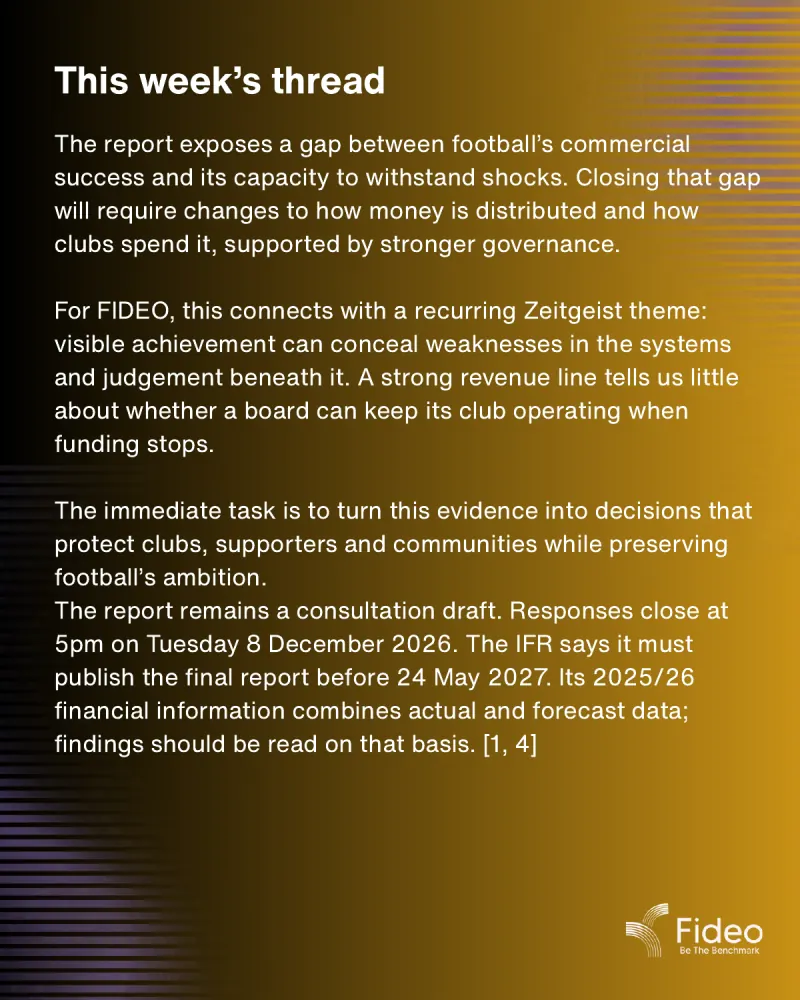
2 / 9 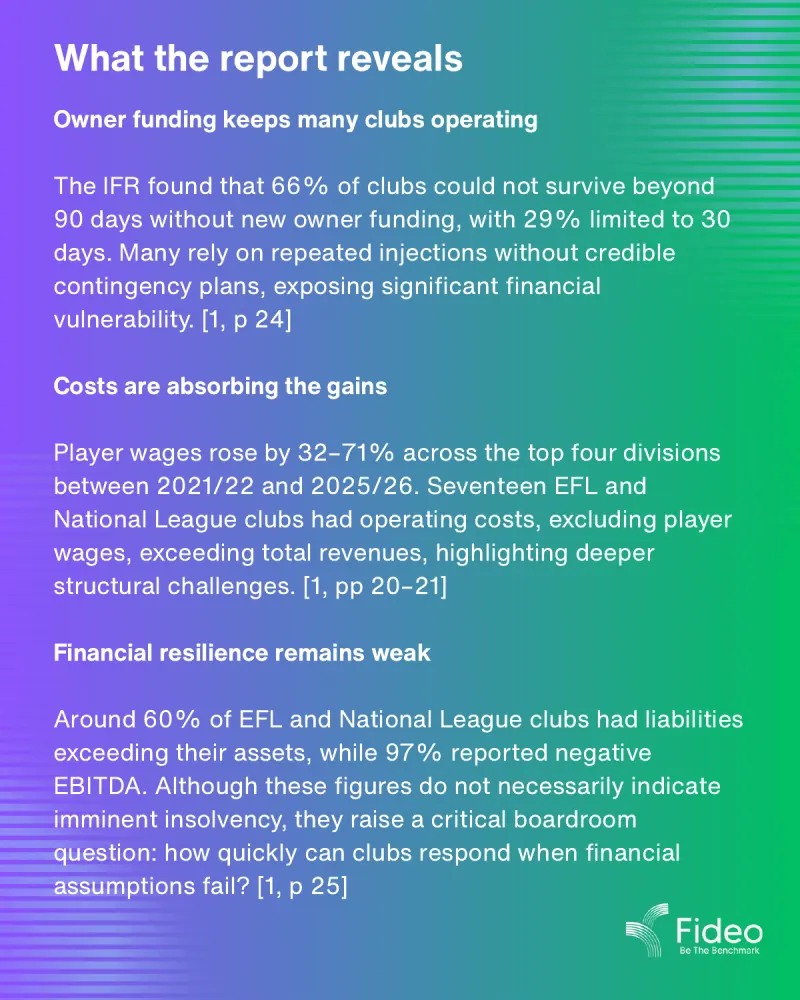
3 / 9 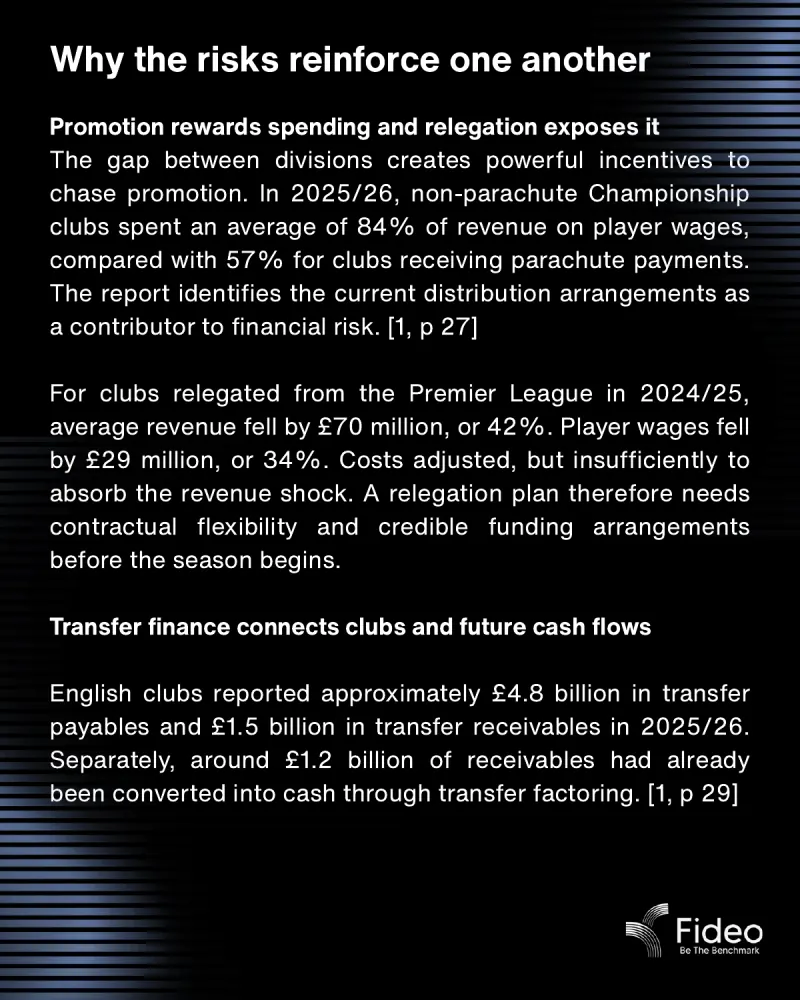
4 / 9 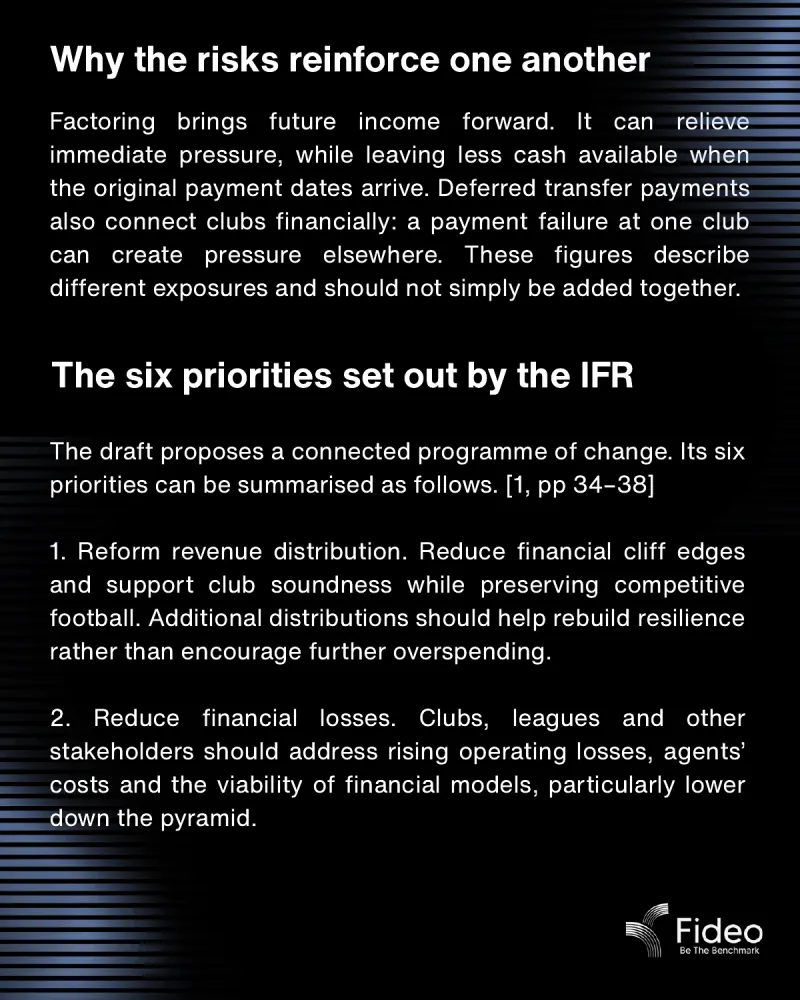
5 / 9 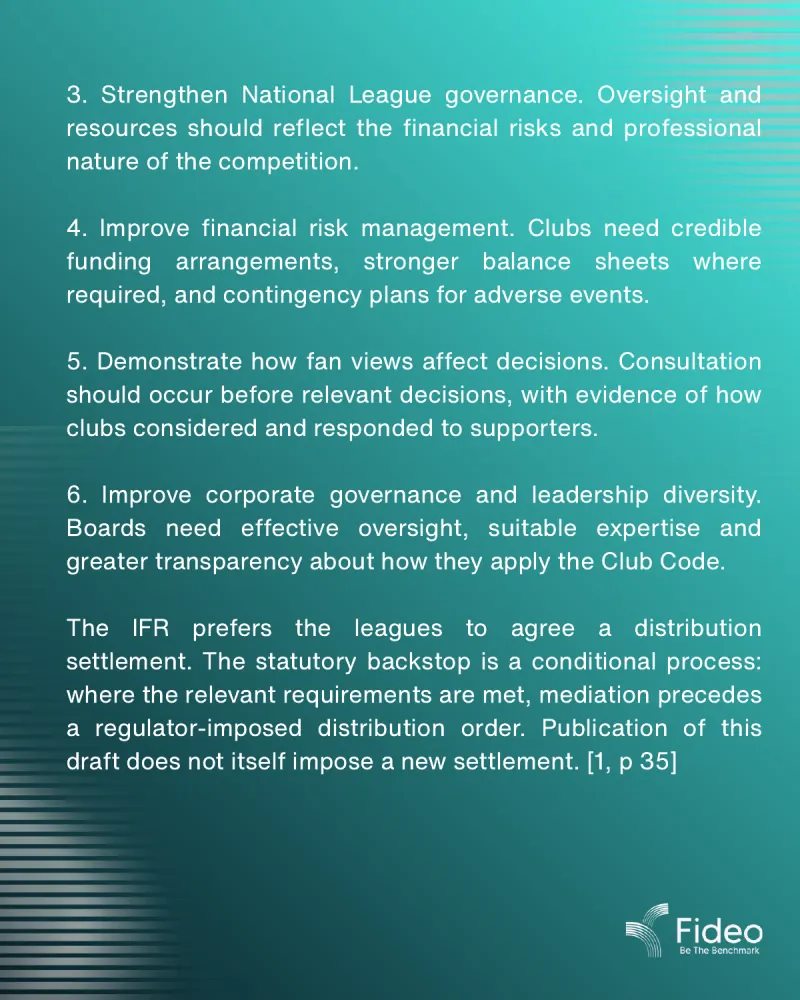
6 / 9 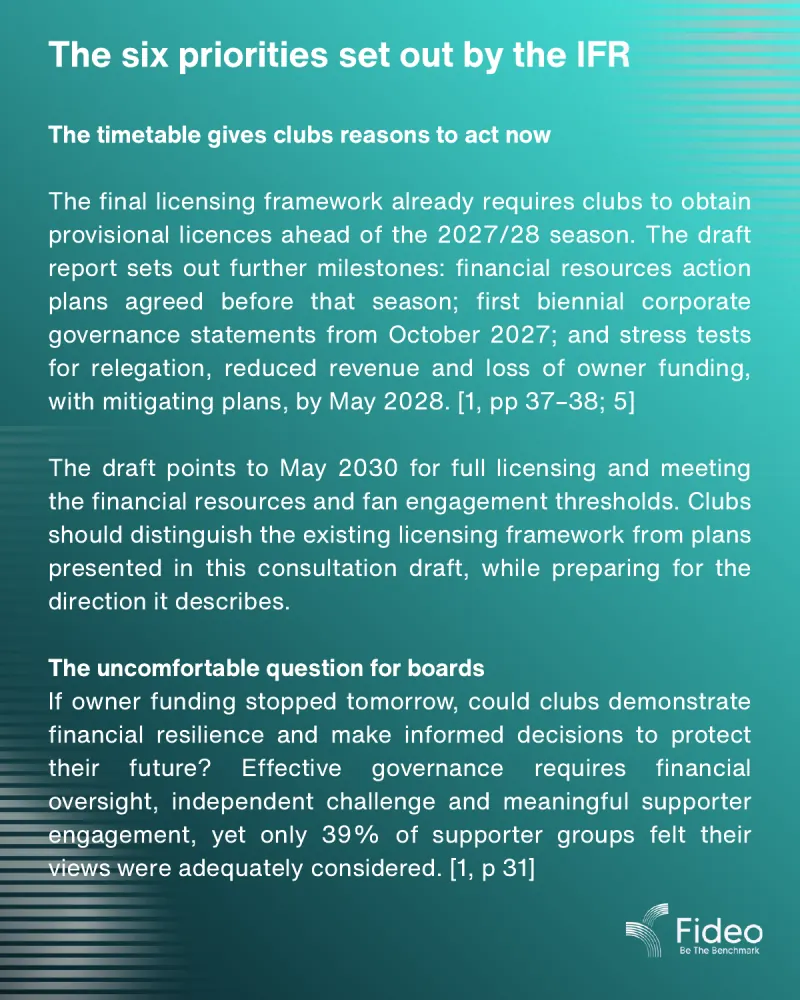
7 / 9 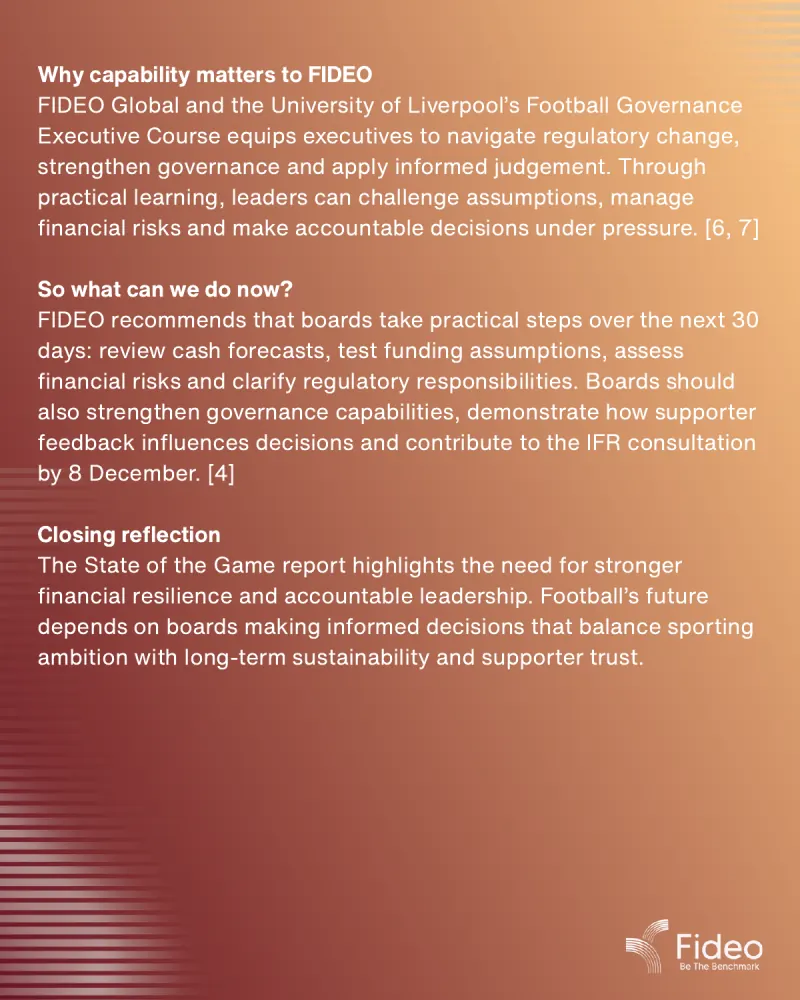
8 / 9 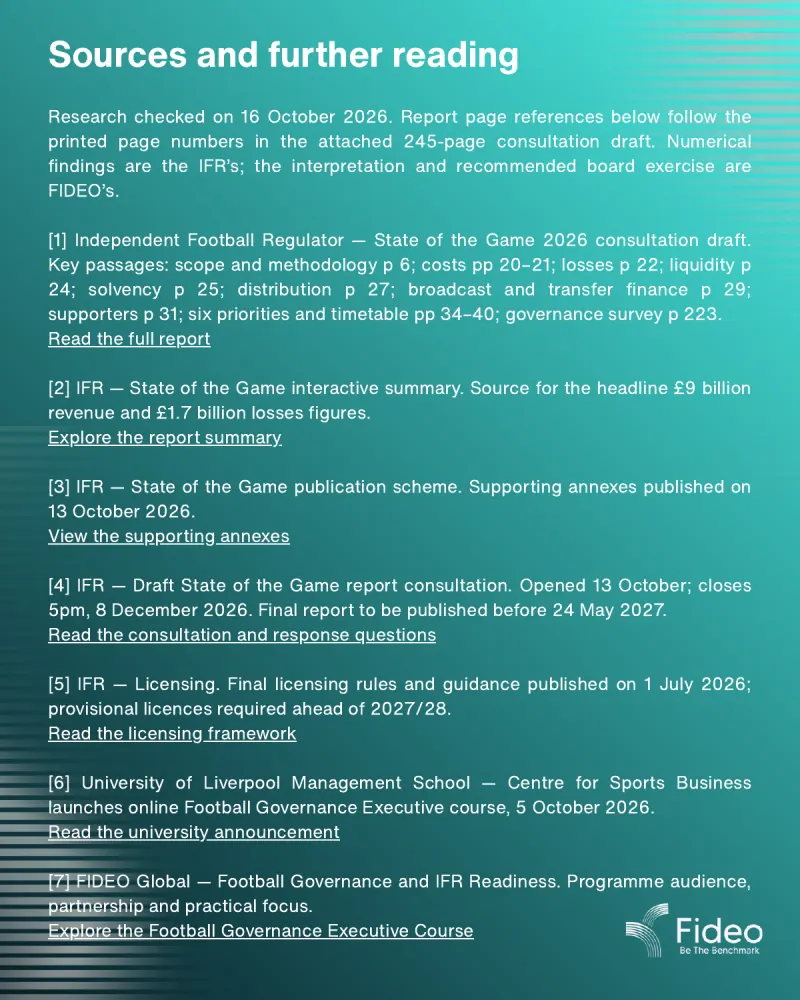
9 / 9
This week in 60 seconds
Commercial success masks clubs that depend on owner funding, rising wages and transfer finance
- The IFR found 66% of clubs could not survive beyond 90 days without new owner funding, and 29% were limited to 30 days.
- Player wages rose by 32 to 71% across the top four divisions between 2021/22 and 2025/26, and 97% of EFL and National League clubs reported negative EBITDA.
- Non-parachute Championship clubs spent an average of 84% of revenue on wages in 2025/26, against 57% for clubs receiving parachute payments.
- The draft sets six priorities, from reforming revenue distribution to improving corporate governance, with stress tests due by May 2028 and full licensing by May 2030.
- Consultation responses close at 5pm on Tuesday 8 December 2026, and the final report must be published before 24 May 2027.
Try this with your team
Over the next 30 days, have your board review cash forecasts, test funding assumptions, assess financial risks and clarify regulatory responsibilities, then ask: if owner funding stopped tomorrow, could the club show resilience? Use the answers to inform a response to the IFR consultation by 8 December.
Read this edition as text (6 min)
This week’s thread
The report exposes a gap between football’s commercial success and its capacity to withstand shocks. Closing that gap will require changes to how money is distributed and how clubs spend it, supported by stronger governance.
For FIDEO, this connects with a recurring Zeitgeist theme: visible achievement can conceal weaknesses in the systems and judgement beneath it. A strong revenue line tells us little about whether a board can keep its club operating when funding stops.
The immediate task is to turn this evidence into decisions that protect clubs, supporters and communities while preserving football’s ambition. The report remains a consultation draft. Responses close at 5pm on Tuesday 8 December 2026. The IFR says it must publish the final report before 24 May 2027. Its 2025/26 financial information combines actual and forecast data; findings should be read on that basis. [1, 4]
What the report reveals
Owner funding keeps many clubs operating
The IFR found that 66% of clubs could not survive beyond 90 days without new owner funding, with 29% limited to 30 days. Many rely on repeated injections without credible contingency plans, exposing significant financial vulnerability. [1, p 24]
Costs are absorbing the gains
Player wages rose by 32–71% across the top four divisions between 2021/22 and 2025/26. Seventeen EFL and National League clubs had operating costs, excluding player wages, exceeding total revenues, highlighting deeper structural challenges. [1, pp 20–21]
Financial resilience remains weak
Around 60% of EFL and National League clubs had liabilities exceeding their assets, while 97% reported negative EBITDA. Although these figures do not necessarily indicate imminent insolvency, they raise a critical boardroom question: how quickly can clubs respond when financial assumptions fail? [1, p 25]
Why the risks reinforce one another
Promotion rewards spending and relegation exposes it The gap between divisions creates powerful incentives to chase promotion. In 2025/26, non-parachute Championship clubs spent an average of 84% of revenue on player wages, compared with 57% for clubs receiving parachute payments. The report identifies the current distribution arrangements as a contributor to financial risk. [1, p 27]
For clubs relegated from the Premier League in 2024/25, average revenue fell by £70 million, or 42%. Player wages fell by £29 million, or 34%. Costs adjusted, but insufficiently to absorb the revenue shock. A relegation plan therefore needs contractual flexibility and credible funding arrangements before the season begins.
Transfer finance connects clubs and future cash flows
English clubs reported approximately £4.8 billion in transfer payables and £1.5 billion in transfer receivables in 2025/26. Separately, around £1.2 billion of receivables had already been converted into cash through transfer factoring. [1, p 29]
Why the risks reinforce one another
Factoring brings future income forward. It can relieve immediate pressure, while leaving less cash available when the original payment dates arrive. Deferred transfer payments also connect clubs financially: a payment failure at one club can create pressure elsewhere. These figures describe different exposures and should not simply be added together.
The six priorities set out by the IFR
The draft proposes a connected programme of change. Its six priorities can be summarised as follows. [1, pp 34–38]
1. Reform revenue distribution. Reduce financial cliff edges and support club soundness while preserving competitive football. Additional distributions should help rebuild resilience rather than encourage further overspending.
2. Reduce financial losses. Clubs, leagues and other stakeholders should address rising operating losses, agents’ costs and the viability of financial models, particularly lower down the pyramid.
3. Strengthen National League governance. Oversight and resources should reflect the financial risks and professional nature of the competition.
4. Improve financial risk management. Clubs need credible funding arrangements, stronger balance sheets where required, and contingency plans for adverse events.
5. Demonstrate how fan views affect decisions. Consultation should occur before relevant decisions, with evidence of how clubs considered and responded to supporters.
6. Improve corporate governance and leadership diversity. Boards need effective oversight, suitable expertise and greater transparency about how they apply the Club Code.
The IFR prefers the leagues to agree a distribution settlement. The statutory backstop is a conditional process: where the relevant requirements are met, mediation precedes a regulator-imposed distribution order. Publication of this draft does not itself impose a new settlement. [1, p 35]
The six priorities set out by the IFR
The timetable gives clubs reasons to act now
The final licensing framework already requires clubs to obtain provisional licences ahead of the 2027/28 season. The draft report sets out further milestones: financial resources action plans agreed before that season; first biennial corporate governance statements from October 2027; and stress tests for relegation, reduced revenue and loss of owner funding, with mitigating plans, by May 2028. [1, pp 37–38; 5]
The draft points to May 2030 for full licensing and meeting the financial resources and fan engagement thresholds. Clubs should distinguish the existing licensing framework from plans presented in this consultation draft, while preparing for the direction it describes.
The uncomfortable question for boards If owner funding stopped tomorrow, could clubs demonstrate financial resilience and make informed decisions to protect their future? Effective governance requires financial oversight, independent challenge and meaningful supporter engagement, yet only 39% of supporter groups felt their views were adequately considered. [1, p 31]
Why capability matters to FIDEO FIDEO Global and the University of Liverpool’s Football Governance Executive Course equips executives to navigate regulatory change, strengthen governance and apply informed judgement. Through practical learning, leaders can challenge assumptions, manage financial risks and make accountable decisions under pressure. [6, 7]
So what can we do now? FIDEO recommends that boards take practical steps over the next 30 days: review cash forecasts, test funding assumptions, assess financial risks and clarify regulatory responsibilities. Boards should also strengthen governance capabilities, demonstrate how supporter feedback influences decisions and contribute to the IFR consultation by 8 December. [4]
Closing reflection The State of the Game report highlights the need for stronger financial resilience and accountable leadership. Football’s future depends on boards making informed decisions that balance sporting ambition with long-term sustainability and supporter trust.
Sources and further reading
Research checked on 16 October 2026. Report page references below follow the printed page numbers in the attached 245-page consultation draft. Numerical findings are the IFR’s; the interpretation and recommended board exercise are FIDEO’s.
[1] Independent Football Regulator — State of the Game 2026 consultation draft. Key passages: scope and methodology p 6; costs pp 20–21; losses p 22; liquidity p 24; solvency p 25; distribution p 27; broadcast and transfer finance p 29; supporters p 31; six priorities and timetable pp 34–40; governance survey p 223. Read the full report
[2] IFR — State of the Game interactive summary. Source for the headline £9 billion revenue and £1.7 billion losses figures. Explore the report summary
[3] IFR — State of the Game publication scheme. Supporting annexes published on 13 October 2026. View the supporting annexes
[4] IFR — Draft State of the Game report consultation. Opened 13 October; closes 5pm, 8 December 2026. Final report to be published before 24 May 2027. Read the consultation and response questions
[5] IFR — Licensing. Final licensing rules and guidance published on 1 July 2026; provisional licences required ahead of 2027/28. Read the licensing framework
[6] University of Liverpool Management School — Centre for Sports Business launches online Football Governance Executive course, 5 October 2026. Read the university announcement
[7] FIDEO Global — Football Governance and IFR Readiness. Programme audience, partnership and practical focus. Explore the Football Governance Executive Course
Sources
- sotg.footballregulator.org.uksotg.footballregulator.org.uk/api/media/file/IFR%20State%20of%20the%20Game%20Report.pdf
- sotg.footballregulator.org.uksotg.footballregulator.org.uk/
- footballregulator.org.ukfootballregulator.org.uk/publication-scheme/state-of-the-game
- engage.footballregulator.org.ukengage.footballregulator.org.uk/state-of-the-game-consultation
- footballregulator.org.ukfootballregulator.org.uk/licensing
- liverpool.ac.ukliverpool.ac.uk/management/news/stories/title,1570623,en.php
- fideo-global.comfideo-global.com/football
More questions about this edition
Does the draft report impose a new revenue distribution settlement?
No. The IFR prefers the leagues to agree a settlement. Its statutory backstop is conditional: where requirements are met, mediation comes before any regulator-imposed distribution order.
Why is transfer factoring a concern?
Factoring brings future income forward, which can ease immediate pressure but leaves less cash when original payment dates arrive. About £1.2 billion of receivables had already been factored, and deferred payments link clubs so one failure can spread.
How reliable are the 2025/26 figures?
The IFR's 2025/26 financial information combines actual and forecast data, so findings should be read on that basis. The report also remains a consultation draft.
Get the Zeitgeist every Friday
One email a week with the new edition. Unsubscribe in one click.
Check your inbox to confirm your subscription.
Please enter a valid email address and try again.