Week of 17 to 21 Nov 2025
Carbon, code and crypto crime: EU climate targets, MiCA, DORA and Coin Laundry
1 / 13 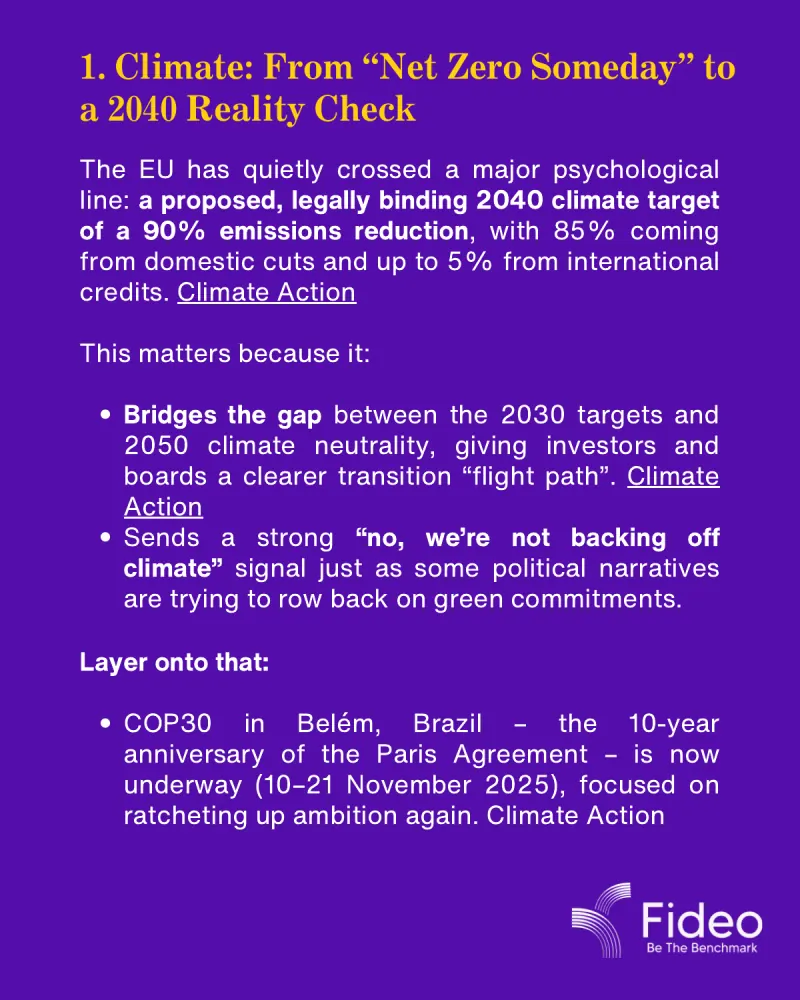
2 / 13 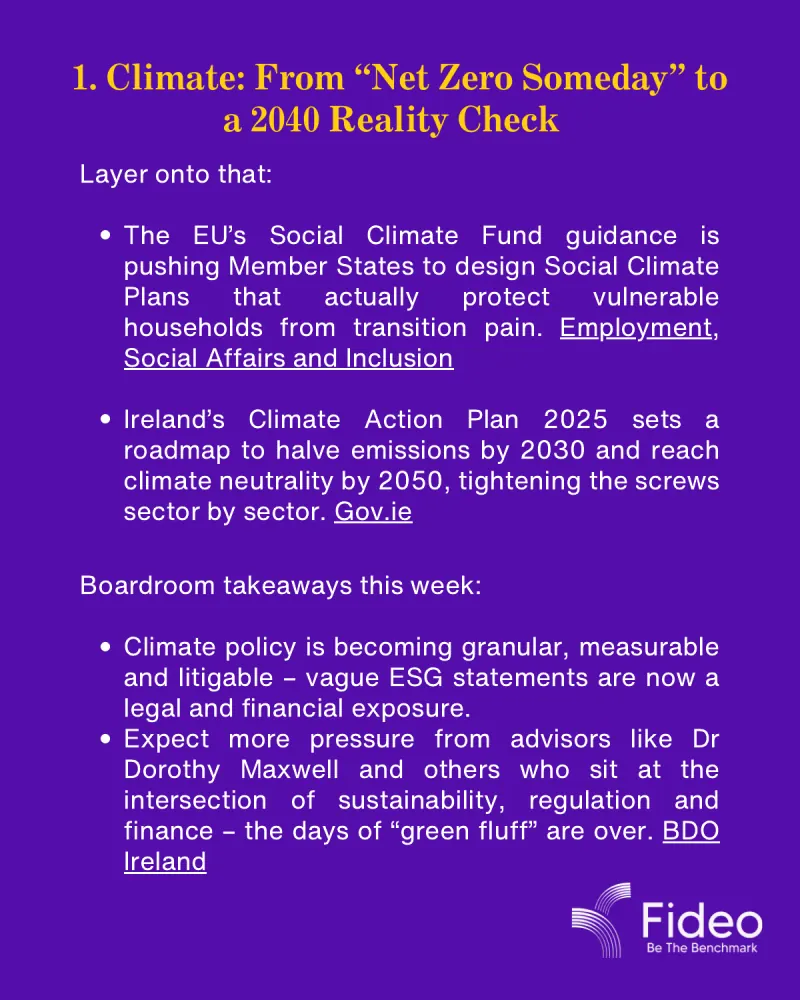
3 / 13 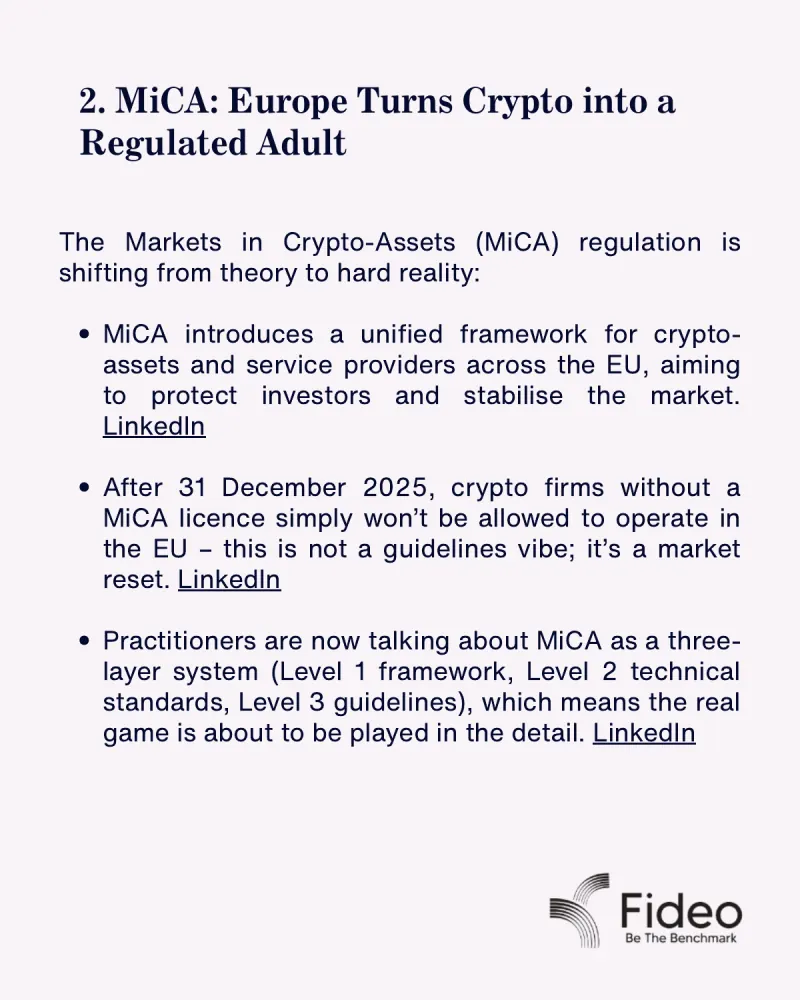
4 / 13 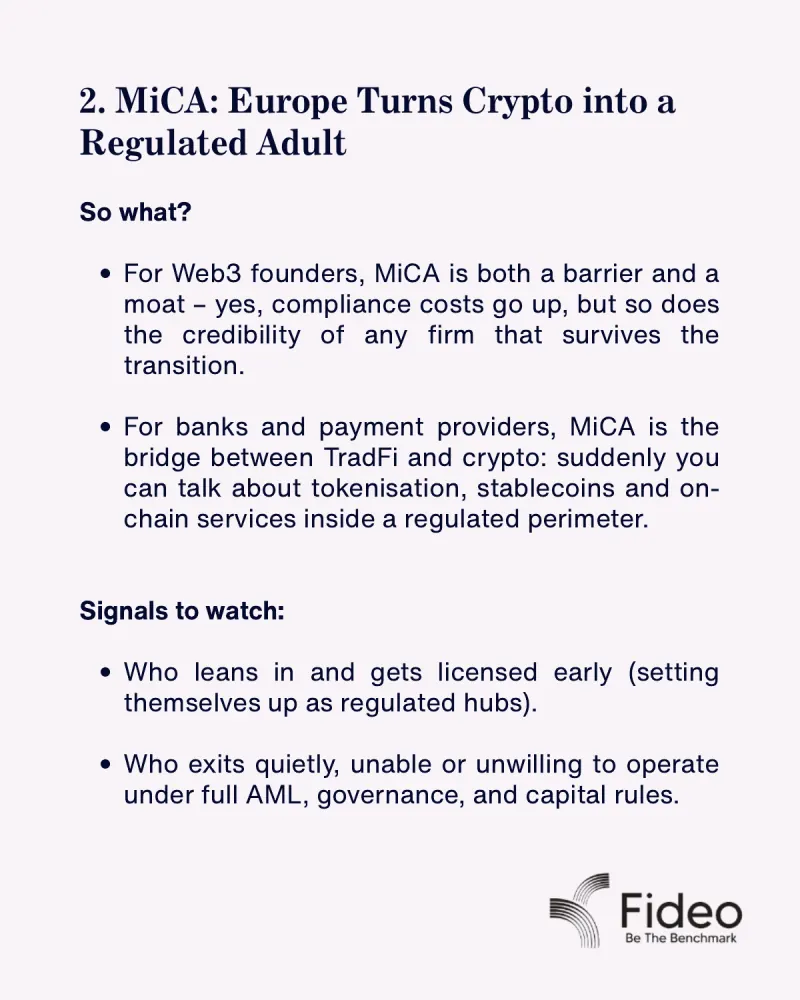
5 / 13 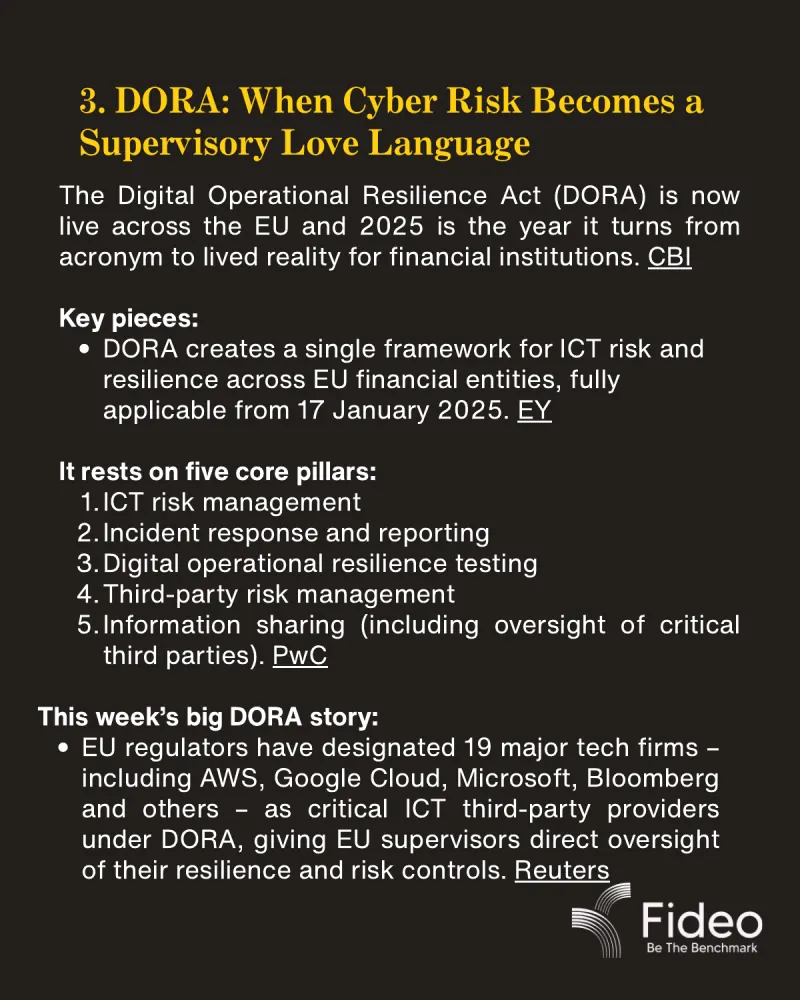
6 / 13 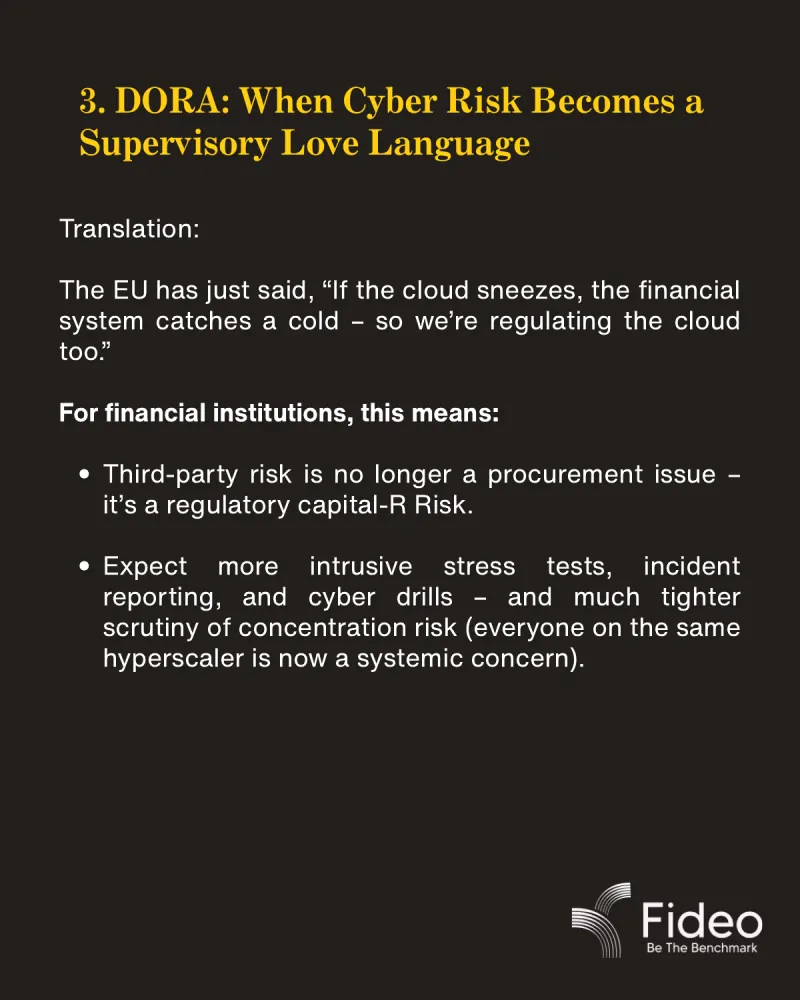
7 / 13 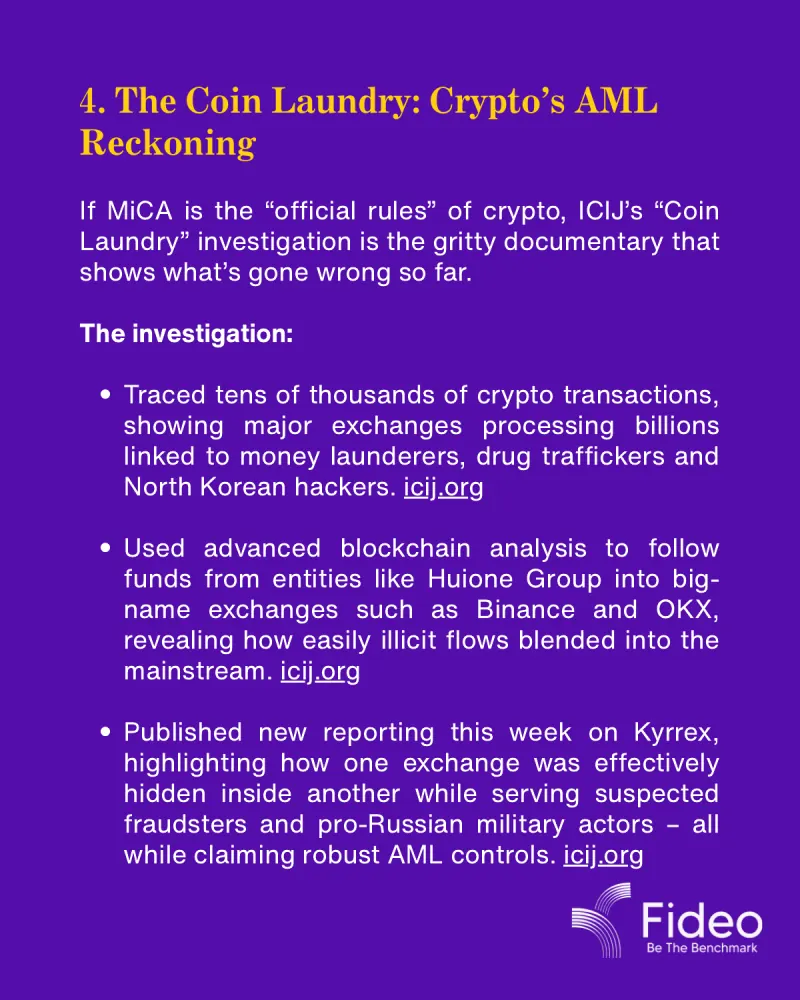
8 / 13 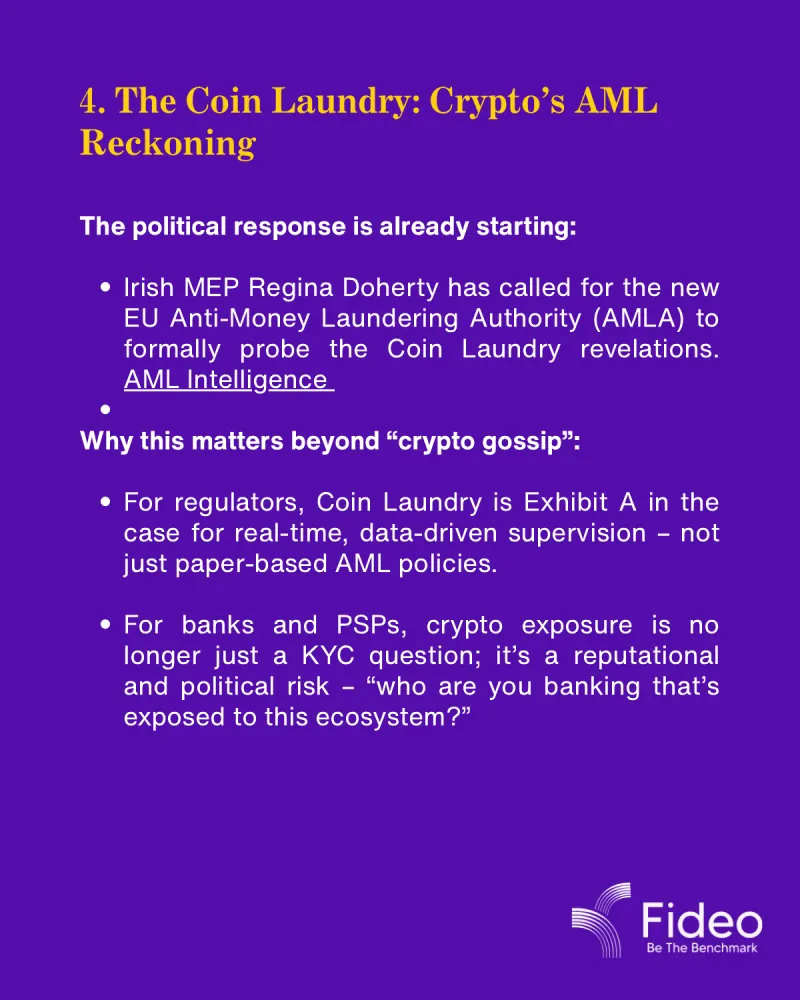
9 / 13 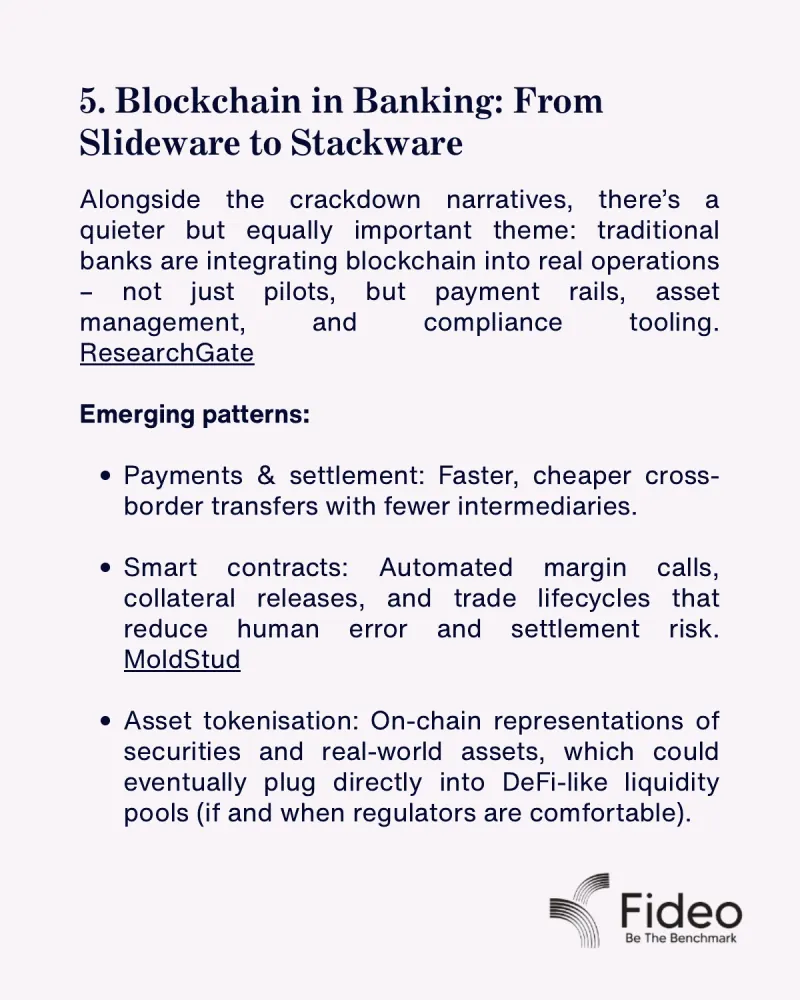
10 / 13 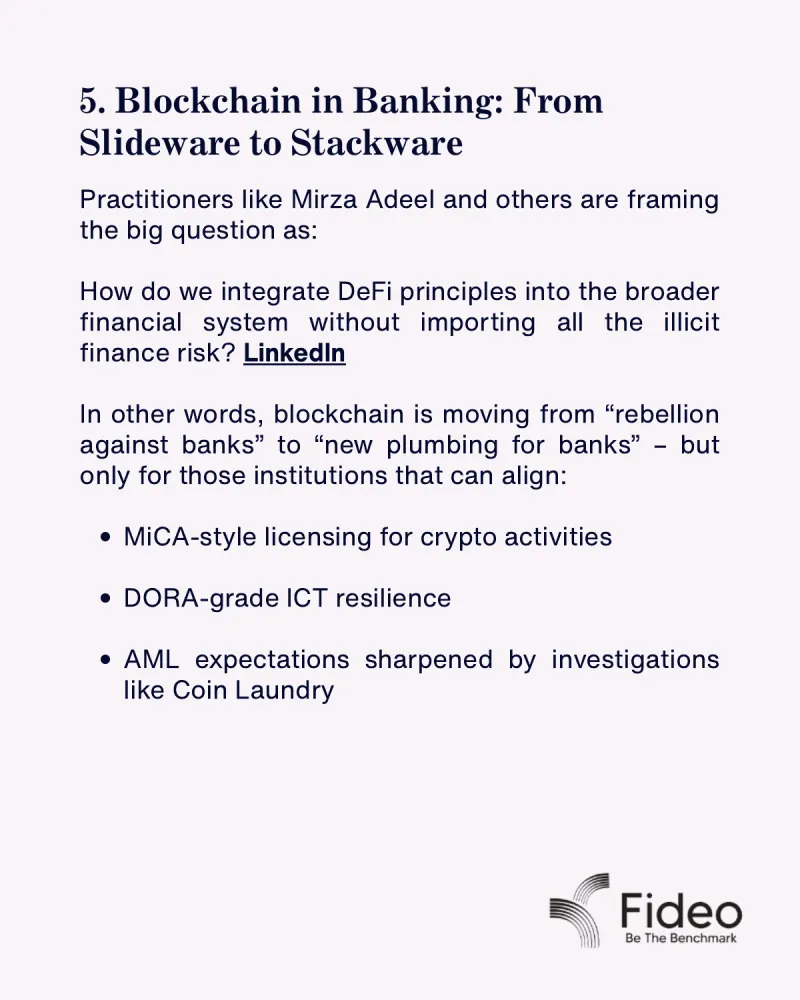
11 / 13 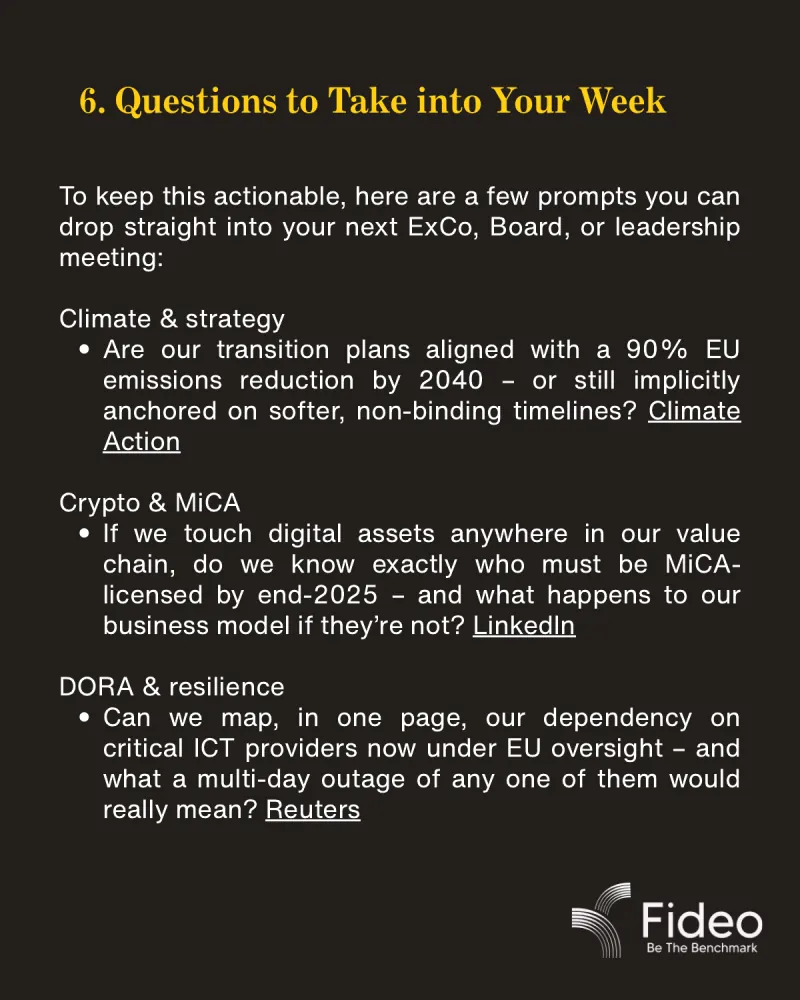
12 / 13 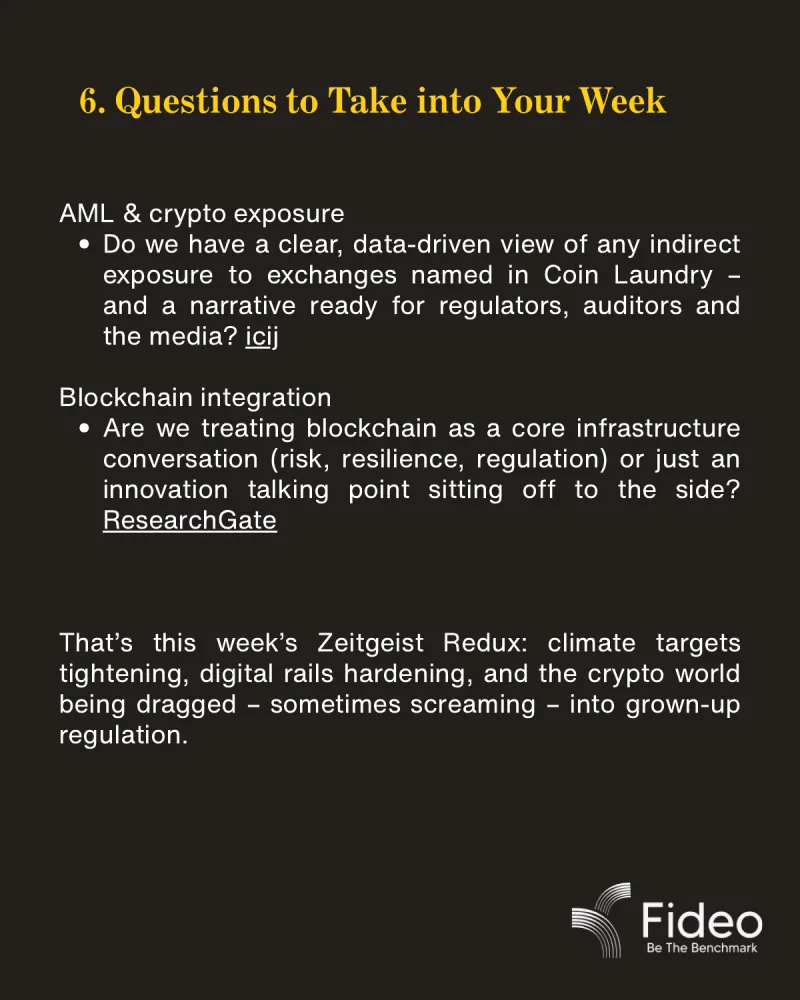
13 / 13
This week in 60 seconds
Climate targets tighten, digital rails harden and crypto is pushed into grown-up regulation
- The EU has proposed a legally binding 2040 target of a 90% emissions cut, so vague ESG statements are becoming a legal and financial exposure.
- After 31 December 2025, crypto firms without a MiCA licence will not be allowed to operate in the EU, which acts as both a barrier and a moat.
- EU regulators have designated 19 tech firms, including AWS, Google Cloud, Microsoft and Bloomberg, as critical ICT third-party providers under DORA.
- ICIJ's Coin Laundry investigation traced billions in illicit flows through major exchanges, making crypto exposure a reputational and political risk for banks and PSPs.
- Banks are moving blockchain from pilots into payment rails, smart contracts and asset tokenisation, but only firms meeting MiCA, DORA and AML standards will benefit.
Try this with your team
Bring this question to your next ExCo or board meeting: can we map, on one page, our dependency on the critical ICT providers now under EU oversight, and say what a multi-day outage of any one of them would really mean?
Read this edition as text (6 min)
1. Climate: From “Net Zero Someday” to a 2040 Reality Check
The EU has quietly crossed a major psychological line: a proposed, legally binding 2040 climate target of a 90% emissions reduction , with 85% coming from domestic cuts and up to 5% from international credits. Climate Action
This matters because it:
Bridges the gap between the 2030 targets and 2050 climate neutrality, giving investors and boards a clearer transition “flight path”. Climate Action Sends a strong “no, we’re not backing off climate” signal just as some political narratives are trying to row back on green commitments.
Layer onto that:
COP30 in Belém, Brazil – the 10-year anniversary of the Paris Agreement – is now underway (10–21 November 2025), focused on ratcheting up ambition again. Climate Action
1. Climate: From “Net Zero Someday” to a 2040 Reality Check
Layer onto that:
The EU’s Social Climate Fund guidance is pushing Member States to design Social Climate Plans that actually protect vulnerable households from transition pain. Employment, Social Affairs and Inclusion
Ireland’s Climate Action Plan 2025 sets a roadmap to halve emissions by 2030 and reach climate neutrality by 2050, tightening the screws sector by sector. Gov.ie
Boardroom takeaways this week:
Climate policy is becoming granular, measurable and litigable – vague ESG statements are now a legal and financial exposure. Expect more pressure from advisors like Dr Dorothy Maxwell and others who sit at the intersection of sustainability, regulation and finance – the days of “green fluff” are over. BDO Ireland
2. MiCA: Europe Turns Crypto into a Regulated Adult
The Markets in Crypto-Assets (MiCA) regulation is shifting from theory to hard reality:
MiCA introduces a unified framework for crypto- assets and service providers across the EU, aiming to protect investors and stabilise the market. LinkedIn
After 31 December 2025, crypto firms without a MiCA licence simply won’t be allowed to operate in the EU – this is not a guidelines vibe; it’s a market reset. LinkedIn
Practitioners are now talking about MiCA as a three- layer system (Level 1 framework, Level 2 technical standards, Level 3 guidelines), which means the real game is about to be played in the detail. LinkedIn
2. MiCA: Europe Turns Crypto into a Regulated Adult
So what?
For Web3 founders, MiCA is both a barrier and a moat – yes, compliance costs go up, but so does the credibility of any firm that survives the transition.
For banks and payment providers, MiCA is the bridge between TradFi and crypto: suddenly you can talk about tokenisation, stablecoins and on- chain services inside a regulated perimeter.
Signals to watch:
Who leans in and gets licensed early (setting themselves up as regulated hubs).
Who exits quietly, unable or unwilling to operate under full AML, governance, and capital rules.
3. DORA: When Cyber Risk Becomes a Supervisory Love Language
The Digital Operational Resilience Act (DORA) is now live across the EU and 2025 is the year it turns from acronym to lived reality for financial institutions. CBI
Key pieces: DORA creates a single framework for ICT risk and resilience across EU financial entities, fully applicable from 17 January 2025. EY
It rests on five core pillars: 1.ICT risk management 2.Incident response and reporting 3.Digital operational resilience testing 4.Third-party risk management 5.Information sharing (including oversight of critical third parties). PwC
This week’s big DORA story: EU regulators have designated 19 major tech firms – including AWS, Google Cloud, Microsoft, Bloomberg and others – as critical ICT third-party providers under DORA, giving EU supervisors direct oversight of their resilience and risk controls. Reuters
3. DORA: When Cyber Risk Becomes a Supervisory Love Language
Translation:
The EU has just said, “If the cloud sneezes, the financial system catches a cold – so we’re regulating the cloud too. ”
For financial institutions, this means:
Third-party risk is no longer a procurement issue – it’s a regulatory capital-R Risk.
Expect more intrusive stress tests, incident reporting, and cyber drills – and much tighter scrutiny of concentration risk (everyone on the same hyperscaler is now a systemic concern).
4. The Coin Laundry: Crypto’s AML Reckoning
If MiCA is the “official rules” of crypto, ICIJ’s “Coin Laundry” investigation is the gritty documentary that shows what’s gone wrong so far.
The investigation:
Traced tens of thousands of crypto transactions, showing major exchanges processing billions linked to money launderers, drug traffickers and North Korean hackers. icij.org
Used advanced blockchain analysis to follow funds from entities like Huione Group into big- name exchanges such as Binance and OKX, revealing how easily illicit flows blended into the mainstream. icij.org
Published new reporting this week on Kyrrex, highlighting how one exchange was effectively hidden inside another while serving suspected fraudsters and pro-Russian military actors – all while claiming robust AML controls. icij.org
4. The Coin Laundry: Crypto’s AML Reckoning
The political response is already starting:
Irish MEP Regina Doherty has called for the new EU Anti-Money Laundering Authority (AMLA) to formally probe the Coin Laundry revelations. AML Intelligence
Why this matters beyond “crypto gossip”:
For regulators, Coin Laundry is Exhibit A in the case for real-time, data-driven supervision – not just paper-based AML policies.
For banks and PSPs, crypto exposure is no longer just a KYC question; it’s a reputational and political risk – “who are you banking that’s exposed to this ecosystem?”
5. Blockchain in Banking: From Slideware to Stackware
Alongside the crackdown narratives, there’s a quieter but equally important theme: traditional banks are integrating blockchain into real operations – not just pilots, but payment rails, asset management, and compliance tooling. ResearchGate
Emerging patterns:
Payments & settlement: Faster, cheaper cross- border transfers with fewer intermediaries.
Smart contracts: Automated margin calls, collateral releases, and trade lifecycles that reduce human error and settlement risk. MoldStud
Asset tokenisation: On-chain representations of securities and real-world assets, which could eventually plug directly into DeFi-like liquidity pools (if and when regulators are comfortable).
5. Blockchain in Banking: From Slideware to Stackware
Practitioners like Mirza Adeel and others are framing the big question as:
How do we integrate DeFi principles into the broader financial system without importing all the illicit finance risk? LinkedIn
In other words, blockchain is moving from “rebellion against banks” to “new plumbing for banks” – but only for those institutions that can align:
MiCA-style licensing for crypto activities
DORA-grade ICT resilience
AML expectations sharpened by investigations like Coin Laundry
6. Questions to Take into Your Week
To keep this actionable, here are a few prompts you can drop straight into your next ExCo, Board, or leadership meeting:
Climate & strategy Are our transition plans aligned with a 90% EU emissions reduction by 2040 – or still implicitly anchored on softer, non-binding timelines? Climate Action
Crypto & MiCA If we touch digital assets anywhere in our value chain, do we know exactly who must be MiCA- licensed by end-2025 – and what happens to our business model if they’re not? LinkedIn
DORA & resilience Can we map, in one page, our dependency on critical ICT providers now under EU oversight – and what a multi-day outage of any one of them would really mean? Reuters
6. Questions to Take into Your Week
AML & crypto exposure Do we have a clear, data-driven view of any indirect exposure to exchanges named in Coin Laundry – and a narrative ready for regulators, auditors and the media? icij
Blockchain integration Are we treating blockchain as a core infrastructure conversation (risk, resilience, regulation) or just an innovation talking point sitting off to the side? ResearchGate
That’s this week’s Zeitgeist Redux: climate targets tightening, digital rails hardening, and the crypto world being dragged – sometimes screaming – into grown-up regulation.
Sources
- climate.ec.europa.euclimate.ec.europa.eu/eu-action/european-climate-law_en
- climate.ec.europa.euclimate.ec.europa.eu/document/download/e1b5a957-c6b9-4cb2-a247-bd28bf675db6_en
- climate.ec.europa.euclimate.ec.europa.eu/international-action-climate-change/cop30-2025-11-10_en
- employment-social-affairs.ec.europa.euemployment-social-affairs.ec.europa.eu/news/commission-provides-new-guidance-member-states
- gov.iegov.ie/en/department-of-climate-energy-and-the-environment/publications/climate-action-pla
- bdo.iebdo.ie/en-gb/our-people/dr-dorothy-maxwell-ficrs-dip-iod
- LinkedInlinkedin.com/pulse/mica-harmonised-eu-regulation-crypto-assets-bdo-malta-sgzqf
- LinkedInlinkedin.com/posts/cnc-signal-global_coinbase-cryptonews-aml-activity-7392212911898750977-
- LinkedInlinkedin.com/posts/mateusz-bartoszewicz90_mica-web3-blockchain-activity-739501136618254745
- centralbank.iecentralbank.ie/regulation/digital-operational-resilience-act-dora
- eyfinancialservicesthoughtgallery.ieeyfinancialservicesthoughtgallery.ie/digital-operational-resilience-act-dora/
- pwc.iepwc.ie/services/audit-and-assurance/regulation/digital-operations-resilience-act.html
- reuters.comreuters.com/sustainability/boards-policy-regulation/amazon-google-named-by-eu-among-critic
- icij.orgicij.org/investigations/coin-laundry/
- icij.orgicij.org/investigations/coin-laundry/how-icij-traced-hundreds-of-millions-from-huione-grou
- icij.orgicij.org/investigations/coin-laundry/hunt-for-missing-millions-unmasks-one-crypto-exchange
- amlintelligence.comamlintelligence.com/2025/11/latest-amla-must-probe-coin-laundry-revelations-says-regina-do
- researchgate.netresearchgate.net/publication/385256572_Blockchain_Integration_in_Banking_A_Fintech_Revolut
- moldstud.commoldstud.com/articles/p-blockchain-integration-in-finance-and-banking
- LinkedInlinkedin.com/posts/mirzaadeel_aml-cryptolaundering-blockchainanalytics-activity-7391700807
More questions about this edition
How is the proposed EU 2040 climate target split?
The proposal is a 90% emissions reduction. 85% would come from domestic cuts and up to 5% from international credits.
What are DORA's five core pillars?
They are ICT risk management, incident response and reporting, digital operational resilience testing, third-party risk management, and information sharing, including oversight of critical third parties.
How is MiCA structured?
Practitioners describe MiCA as a three-layer system: a Level 1 framework, Level 2 technical standards and Level 3 guidelines. This means much of the real impact will be decided in the detail.
Get the Zeitgeist every Friday
One email a week with the new edition. Unsubscribe in one click.
Check your inbox to confirm your subscription.
Please enter a valid email address and try again.