Week of 23 to 27 Feb 2026
From AI outputs to AI outcomes: agents, concentration risk and stablecoin rails
1 / 8 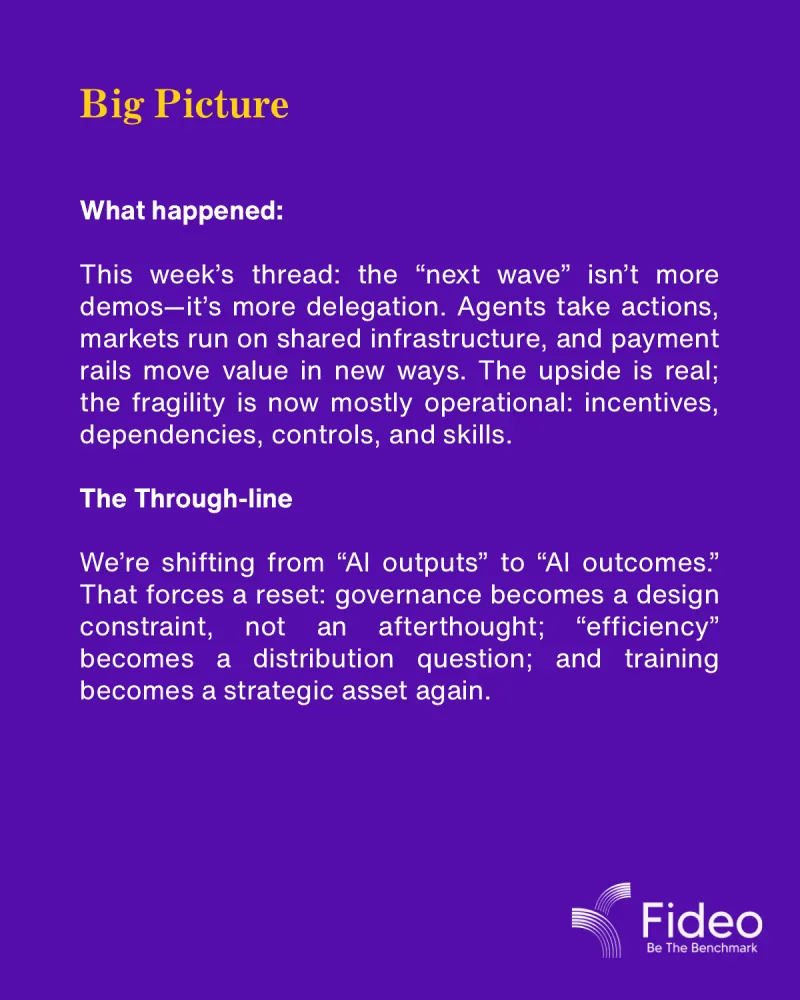
2 / 8 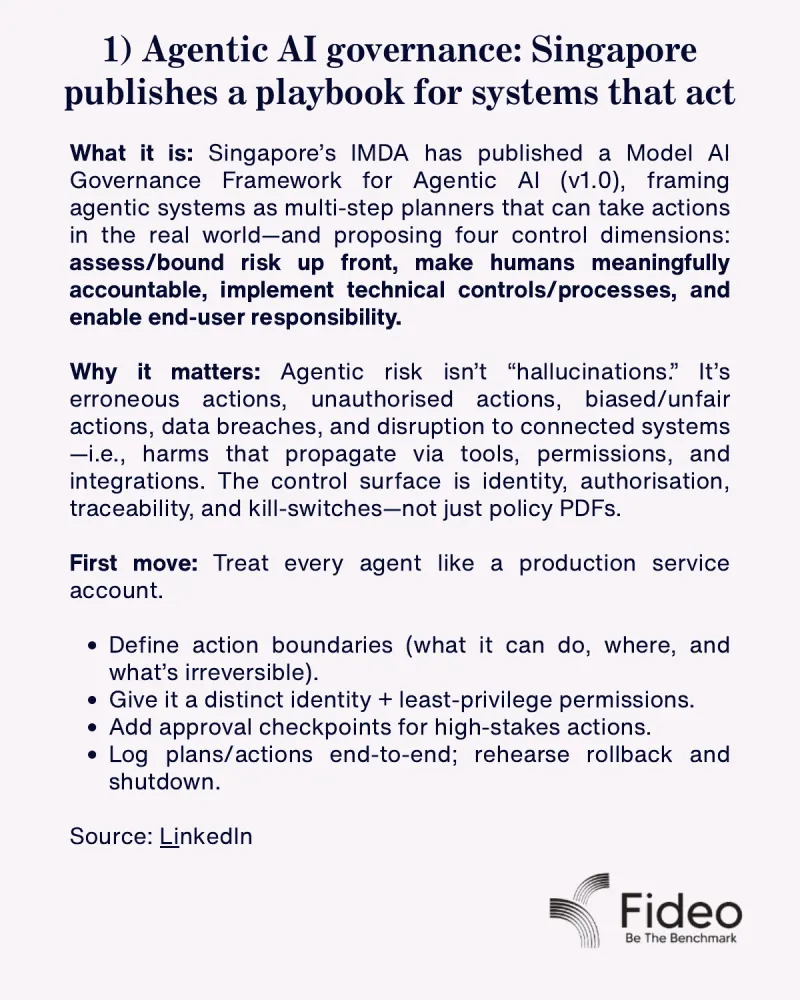
3 / 8 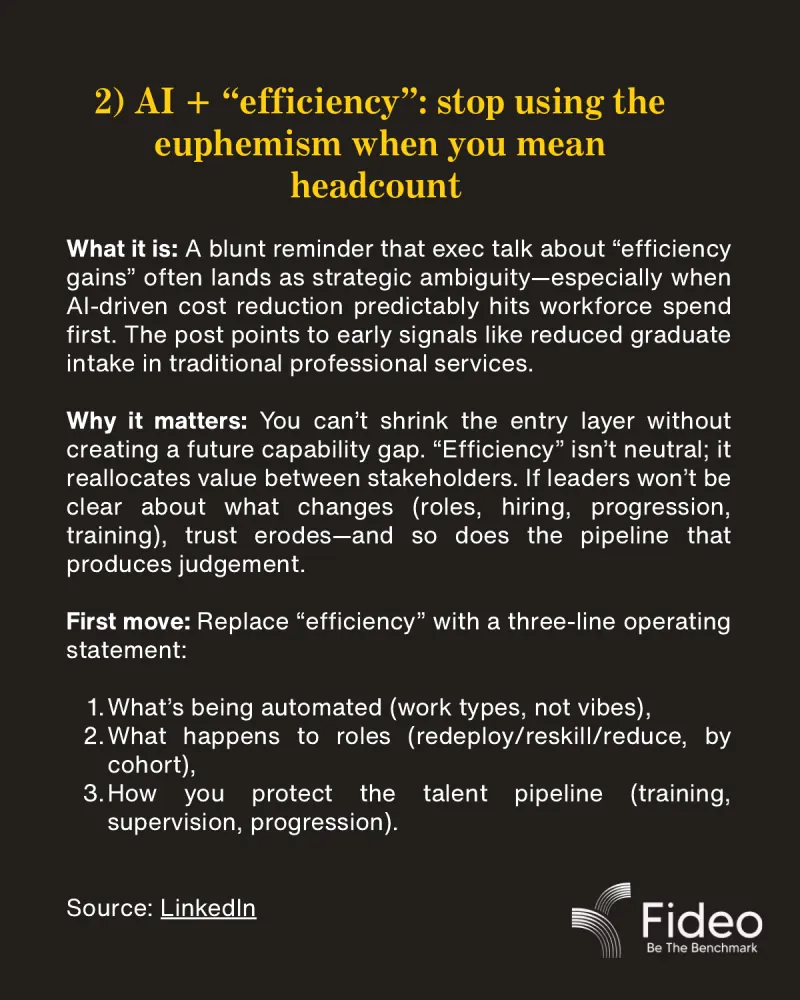
4 / 8 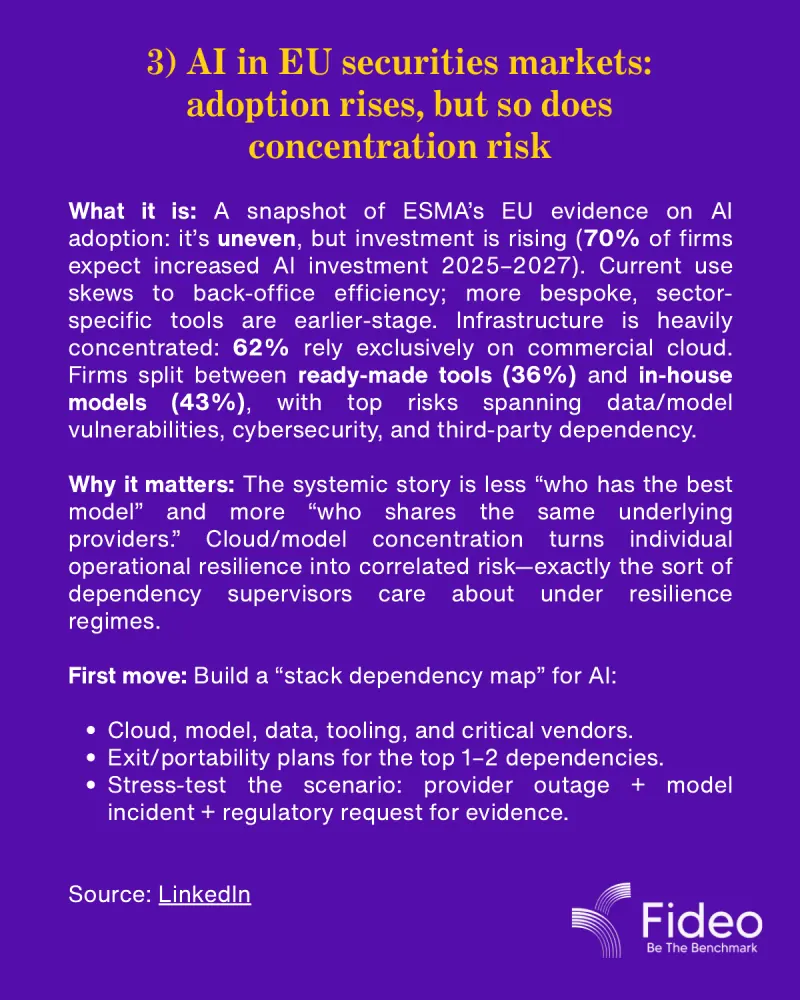
5 / 8 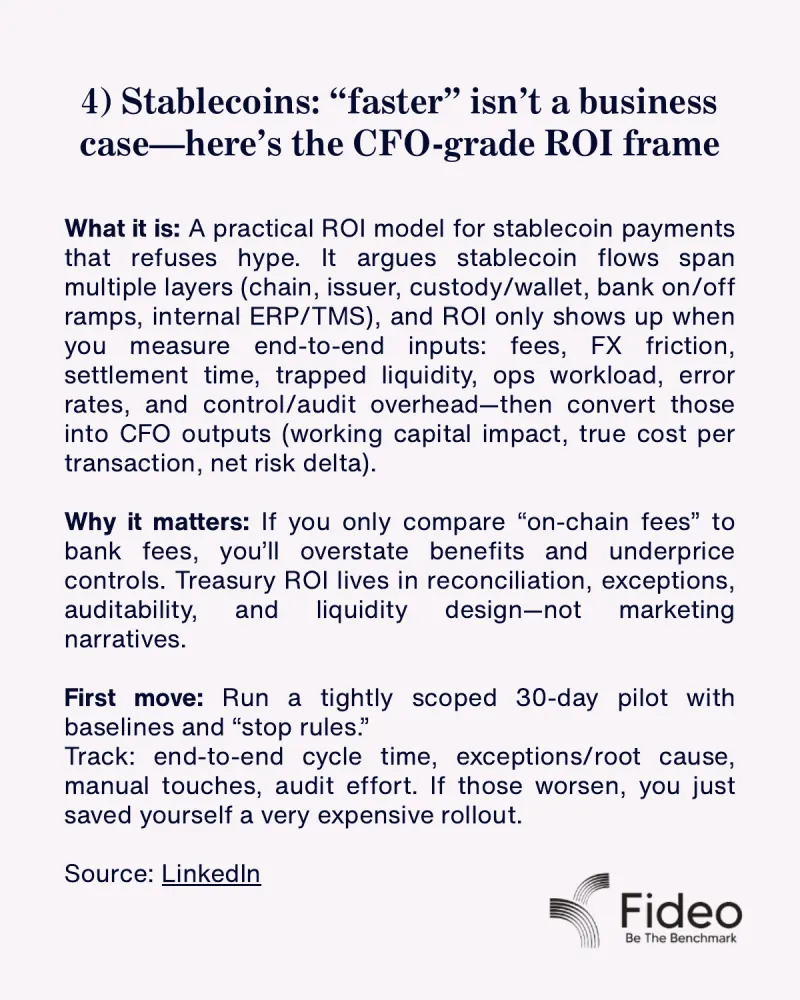
6 / 8 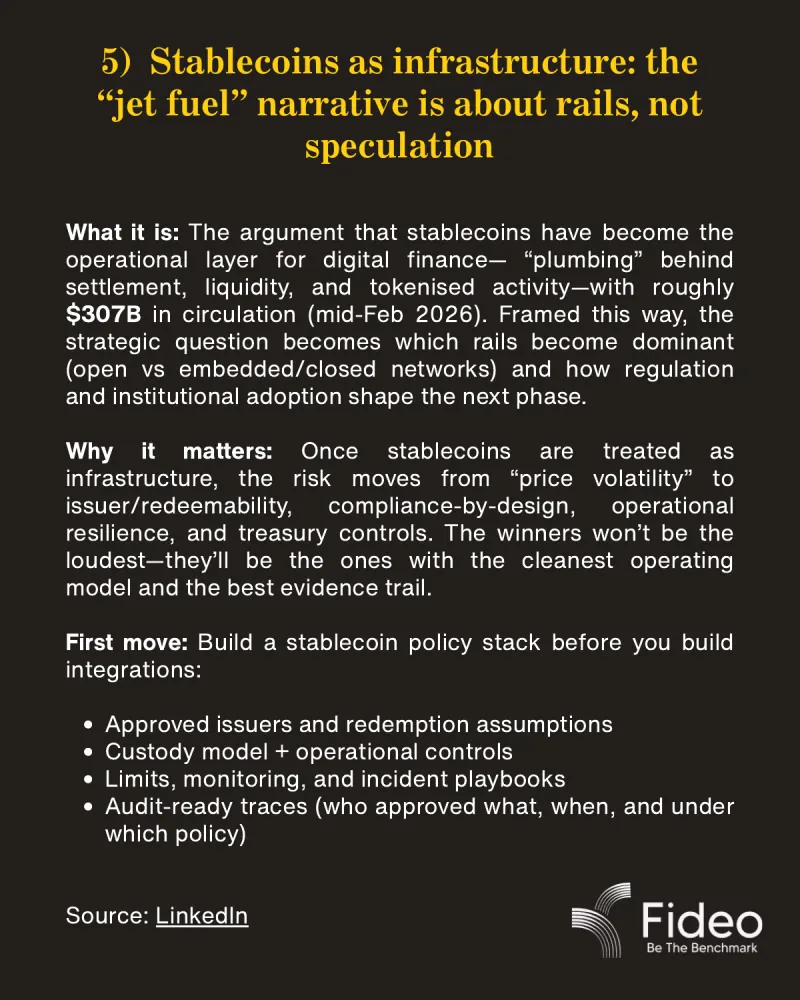
7 / 8 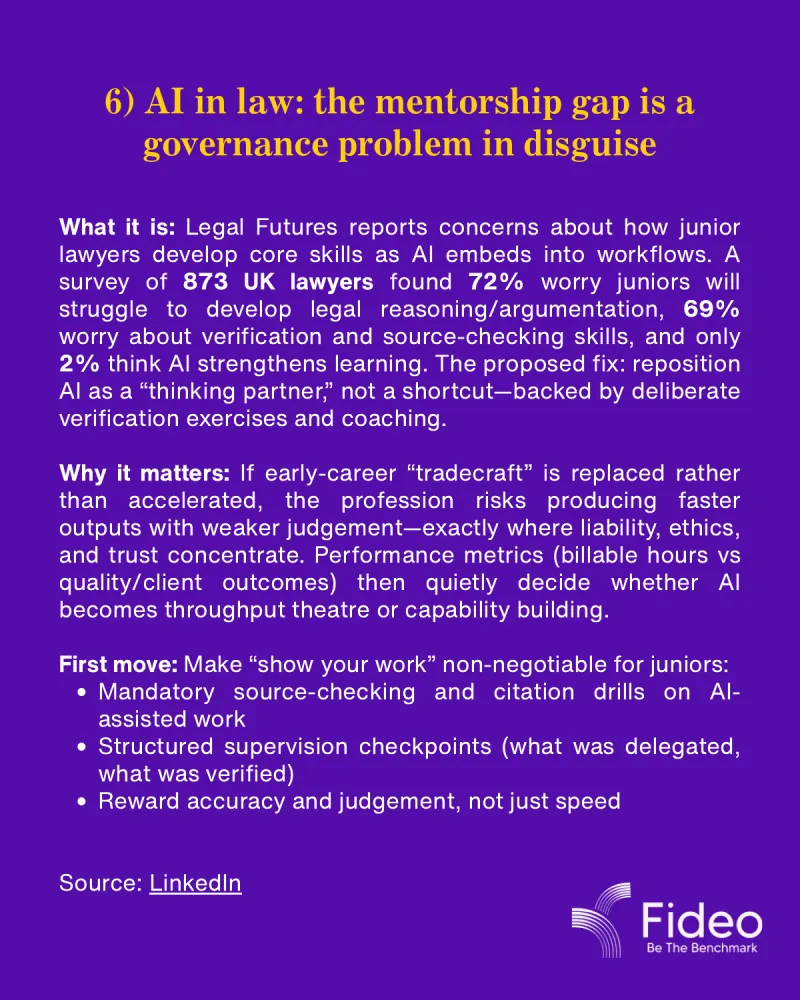
8 / 8
This week in 60 seconds
Singapore's agentic AI framework, ESMA's cloud concentration data, stablecoin ROI and the junior skills gap in law
- Singapore's IMDA published a Model AI Governance Framework for Agentic AI (v1.0) with four control dimensions, treating agentic risk as harmful actions rather than hallucinations.
- ESMA evidence shows 70% of EU securities firms expect more AI investment in 2025 to 2027, while 62% rely exclusively on commercial cloud, creating correlated risk.
- Stablecoin ROI only appears when measured end to end, including reconciliation, exceptions, audit effort and liquidity, not just on-chain fees versus bank fees.
- With roughly $307B in circulation in mid-February 2026, stablecoins are framed as infrastructure, shifting risk to redeemability, compliance-by-design and treasury controls.
- A survey of 873 UK lawyers found 72% worry juniors will struggle to build legal reasoning and only 2% think AI strengthens learning.
Try this with your team
Build a stack dependency map for your AI: list cloud, model, data, tooling and critical vendors, write exit or portability plans for the top one or two dependencies, then stress-test a combined provider outage, model incident and regulatory request for evidence.
Read this edition as text (5 min)
Big Picture
What happened:
This week’s thread: the “next wave” isn’t more demos—it’s more delegation. Agents take actions, markets run on shared infrastructure, and payment rails move value in new ways. The upside is real; the fragility is now mostly operational: incentives, dependencies, controls, and skills.
The Through-line
We’re shifting from “AI outputs” to “AI outcomes. ” That forces a reset: governance becomes a design constraint, not an afterthought; “efficiency” becomes a distribution question; and training becomes a strategic asset again.
1) Agentic AI governance: Singapore publishes a playbook for systems that act
What it is: Singapore’s IMDA has published a Model AI Governance Framework for Agentic AI (v1.0), framing agentic systems as multi-step planners that can take actions in the real world—and proposing four control dimensions: assess/bound risk up front, make humans meaningfully accountable, implement technical controls/processes, and enable end-user responsibility.
Why it matters: Agentic risk isn’t “hallucinations. ” It’s erroneous actions, unauthorised actions, biased/unfair actions, data breaches, and disruption to connected systems —i.e., harms that propagate via tools, permissions, and integrations. The control surface is identity, authorisation, traceability, and kill-switches—not just policy PDFs.
First move: Treat every agent like a production service account.
Define action boundaries (what it can do, where, and what’s irreversible). Give it a distinct identity + least-privilege permissions. Add approval checkpoints for high-stakes actions. Log plans/actions end-to-end; rehearse rollback and shutdown.
Source: LinkedIn
2) AI + “efficiency”: stop using the euphemism when you mean headcount
What it is: A blunt reminder that exec talk about “efficiency gains” often lands as strategic ambiguity—especially when AI-driven cost reduction predictably hits workforce spend first. The post points to early signals like reduced graduate intake in traditional professional services.
Why it matters: You can’t shrink the entry layer without creating a future capability gap. “Efficiency” isn’t neutral; it reallocates value between stakeholders. If leaders won’t be clear about what changes (roles, hiring, progression, training), trust erodes—and so does the pipeline that produces judgement.
First move: Replace “efficiency” with a three-line operating statement:
1.What’s being automated (work types, not vibes), 2.What happens to roles (redeploy/reskill/reduce, by cohort), 3.How you protect the talent pipeline (training, supervision, progression).
Source: LinkedIn
3) AI in EU securities markets: adoption rises, but so does concentration risk
What it is: A snapshot of ESMA’s EU evidence on AI adoption: it’s uneven , but investment is rising ( 70% of firms expect increased AI investment 2025–2027). Current use skews to back-office efficiency; more bespoke, sector- specific tools are earlier-stage. Infrastructure is heavily concentrated: 62% rely exclusively on commercial cloud. Firms split between ready-made tools (36%) and in-house models (43%) , with top risks spanning data/model vulnerabilities, cybersecurity, and third-party dependency.
Why it matters: The systemic story is less “who has the best model” and more “who shares the same underlying providers. ” Cloud/model concentration turns individual operational resilience into correlated risk—exactly the sort of dependency supervisors care about under resilience regimes.
First move: Build a “stack dependency map” for AI:
Cloud, model, data, tooling, and critical vendors. Exit/portability plans for the top 1–2 dependencies. Stress-test the scenario: provider outage + model incident + regulatory request for evidence.
Source: LinkedIn
4) Stablecoins: “faster” isn’t a business case—here’s the CFO-grade ROI frame
What it is: A practical ROI model for stablecoin payments that refuses hype. It argues stablecoin flows span multiple layers (chain, issuer, custody/wallet, bank on/off ramps, internal ERP/TMS), and ROI only shows up when you measure end-to-end inputs: fees, FX friction, settlement time, trapped liquidity, ops workload, error rates, and control/audit overhead—then convert those into CFO outputs (working capital impact, true cost per transaction, net risk delta).
Why it matters: If you only compare “on-chain fees” to bank fees, you’ll overstate benefits and underprice controls. Treasury ROI lives in reconciliation, exceptions, auditability, and liquidity design—not marketing narratives.
First move: Run a tightly scoped 30-day pilot with baselines and “stop rules. ” Track: end-to-end cycle time, exceptions/root cause, manual touches, audit effort. If those worsen, you just saved yourself a very expensive rollout.
Source: LinkedIn
5) Stablecoins as infrastructure: the “jet fuel” narrative is about rails, not speculation
What it is: The argument that stablecoins have become the operational layer for digital finance— “plumbing” behind settlement, liquidity, and tokenised activity—with roughly $307B in circulation (mid-Feb 2026). Framed this way, the strategic question becomes which rails become dominant (open vs embedded/closed networks) and how regulation and institutional adoption shape the next phase.
Why it matters: Once stablecoins are treated as infrastructure, the risk moves from “price volatility” to issuer/redeemability, compliance-by-design, operational resilience, and treasury controls. The winners won’t be the loudest—they’ll be the ones with the cleanest operating model and the best evidence trail.
First move: Build a stablecoin policy stack before you build integrations:
Approved issuers and redemption assumptions Custody model + operational controls Limits, monitoring, and incident playbooks Audit-ready traces (who approved what, when, and under which policy)
Source: LinkedIn
6) AI in law: the mentorship gap is a governance problem in disguise
What it is: Legal Futures reports concerns about how junior lawyers develop core skills as AI embeds into workflows. A survey of 873 UK lawyers found 72% worry juniors will struggle to develop legal reasoning/argumentation, 69% worry about verification and source-checking skills, and only 2% think AI strengthens learning. The proposed fix: reposition AI as a “thinking partner,” not a shortcut—backed by deliberate verification exercises and coaching.
Why it matters: If early-career “tradecraft” is replaced rather than accelerated, the profession risks producing faster outputs with weaker judgement—exactly where liability, ethics, and trust concentrate. Performance metrics (billable hours vs quality/client outcomes) then quietly decide whether AI becomes throughput theatre or capability building.
First move: Make “show your work” non-negotiable for juniors: Mandatory source-checking and citation drills on AI- assisted work Structured supervision checkpoints (what was delegated, what was verified) Reward accuracy and judgement, not just speed
Source: LinkedIn
Sources
- LinkedInlinkedin.com/posts/oliver-patel_singapore-published-the-worlds-first-agentic-activity-7430
- LinkedInlinkedin.com/posts/barry-brennan_efficiency-should-not-be-a-euphemism-activity-74298483193
- LinkedInlinkedin.com/posts/mahaalsaadi_ai-eu-securities-market-activity-7431402118500159489-Ztr_/
- LinkedInlinkedin.com/pulse/do-stablecoins-actually-streamline-payments-cfo-grade-shiven-ymree/
- forbes.comforbes.com/sites/digital-assets/2026/02/19/stablecoins-are-the-jet-fuel-powering-the-digit
- legalfutures.co.uklegalfutures.co.uk/latest-news/lawyers-worried-about-impact-of-ai-on-training-next-generat
More questions about this edition
How should leaders talk about AI efficiency gains?
The edition suggests replacing the word efficiency with a three-line operating statement: what work types are being automated, what happens to roles by cohort (redeploy, reskill or reduce), and how the talent pipeline is protected through training, supervision and progression.
How can a firm test stablecoin payments without a costly rollout?
Run a tightly scoped 30-day pilot with baselines and stop rules, tracking end-to-end cycle time, exceptions and root causes, manual touches and audit effort. If those worsen, the rollout is not worth it.
What practical controls apply to AI agents?
Treat each agent like a production service account: define action boundaries, give it a distinct identity with least-privilege permissions, add approval checkpoints for high-stakes actions, log plans and actions end to end, and rehearse rollback and shutdown.
Get the Zeitgeist every Friday
One email a week with the new edition. Unsubscribe in one click.
Check your inbox to confirm your subscription.
Please enter a valid email address and try again.